Search & find:
Media, press releases, events for your editorial coverage

Bosch’s hardware-software edge: how we’re bridging the physical and digital with ...

05.01.2026

Presentations

Business/economy

Bosch’s hardware-software edge: how we’re bridging the physical and digital with ...

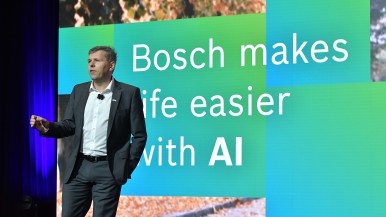
Dr. Tanja Rueckert, member of the board of management of Robert Bosch GmbH, and Paul Thomas, president of Bosch in North America, at CES ® , on January 5, 2026 Check against delivery.Tanja Rueckert: Good morning, everyone! A very warm welcome to the Bosch press conference at CES 2026. Paul Thomas: Hello and welcome from me as well. We’re thrilled to have you here – thank you for joining us, either on-site or via the livestream. Tanja Rueckert: Vehicle components. Industrial machinery. Power tools. Home appliances. Microchips. It’s no secret that Bosch is a diversified company. But our expertise is not only broad, it also bridges a gap that many others struggle to cross: the divide between the physical and the digital. Most companies are at home on one side or the other. Rarely does one have equal competence in the world of things and the world of software. Bosch, however, is one such company: you could say we’re at home everywhere. Paul Thomas: Since its earliest days, Bosch has been a byword for innovative, high-quality hardware. At the dawn of the digital age, we then did what we’ve always done in our quest to bring the most pioneering and beneficial solutions to market. We figured out what competence was required, and we built it up in-house. Tanja Rueckert: Thanks to this mindset, software has been a core competence of ours for decades now. It allowed us to establish ourselves as an early digital pioneer in our diverse hardware-based business, where we helped drive forward the Internet of Things and Industry 4.0. Now, it’s enabling us to play a key role in shaping the software-driven mobility of the future. And it’s driving growth across the board: by the beginning of the next decade, we aim to generate sales of over 6 billion euros with software and services. It’s also put us on the forefront in leveraging AI, where we’re one of the leading European companies for AI patents filed – with 2,000 and counting. In total, we’ll be investing more than 2.5 billion euros in AI by the end of 2027. And so far we’ve already trained over 100,000 associates on AI – nearly a quarter of our workforce. Above all, having both hardware and software competence enables us to deliver superior versions of both. And this, ultimately, is what sets us apart. Our hardware has an edge because we can use our home-grown software and AI expertise to level it up. At the same time, our software has an edge because we deeply understand the hardware it runs on. The result is solutions that are innovative, intelligent, and offer a host of tangible benefits to their users. In other words, true people-centric tech! But let’s talk specifics. How exactly does our mastery of the hardware-software divide give our solutions an edge? Paul Thomas: Well first and foremost, it enables us to equip our solutions with groundbreaking functions and unlock capabilities no one else has yet been able to realize. Case in point: our smartphone-based solution Origify, which you can see in action at our booth. Counterfeit products are a huge and growing problem: last year they were estimated to account for up to 3 percent of global trade, with a market value in the trillions. We urgently need more effective ways to combat this problem, and with Origify, we’ve developed a truly innovative one. In simple terms, it works on the basis of surface pattern recognition. Where other solutions rely on add-ons like tags, chips, or codes, Origify uses an object’s unique physical attributes to create a tamper-proof digital identity. Once that has been registered in our system, our new Detector app can quickly and reliably verify authenticity via a live video stream. Within seconds, you know whether a pair of sneakers, a car part, or even a painting is the real thing. This revolutionary technology could really shake up the counterfeiting industry – and it stems from our profound expertise on both sides of the physical-digital divide. Tanja Rueckert: Of course, many people’s daily concerns are more practical in nature. Laundry, housework, cooking. In the home, our appliances have long set the benchmark for quality, innovativeness, and precision engineering. Thanks to software and AI, we’re now unlocking a new level of convenience and intelligence in them. After all, we strongly believe that technology should serve people, not the other way around. It should take away stress, and help you to achieve more for less effort – no matter what your skill level. For example, in the kitchen… And we have one more surprise!Guest appearance by Marcel Vigneron, Top Chef All-Star and Food Network star Paul Thomas: Look who we have with us today, let’s give a hand to Marcel Vigneron! Tanja Rueckert: Marcel, we’re so happy to have you here. But I must admit, all this talk about cooking is making me hungry! Maybe because I missed breakfast this morning… Marcel Vigneron: Tanja, not to worry: I just happen to know a thing or two about cooking! Got you covered. I hope you don’t mind a little steak for breakfast… Tanja Rueckert: Well, I’m jetlagged, and in Germany it’s dinner time, so that sounds perfect! Paul Thomas: I’m always up for a steak! Marcel Vigneron: We happen to have a few juicy ribeyes on hand. Let’s fire these up! By the way, how do you like your steak? Tanja Rueckert: Medium-rare, of course! Paul Thomas: Sounds good to me. Marcel Vigneron: Fantastic. So, I’m going to be cooking your steak with the help of some cool new technology you saw in the video. It’s cutting-edge stuff, where generative AI meets incredible sensors from across the Bosch world. Paul Thomas: And it’s all based on something the 800 Series Induction Cooktop already has built-in: our AutoChef feature. Marcel Vigneron: Absolutely, Paul. AutoChef is the basis here. It’s a sensor-based technology that continuously regulates the temperature of your frying pan and adjusts it so you get the best possible result. And now AutoChef is being leveled up with the help of the new Bosch Cook AI. That feature is still in final testing, but I can give you a sneak peek today of how it’s going to work and how helpful it’s going to be for home cooks. Tanja Rueckert: We’re always very excited to see AI making life easier. Can you tell us more about how it works? Marcel Vigneron: Sure, Tanja, Bosch Cook AI is powered by generative AI, combined with proprietary technologies and processes in the appliances. Basically, you take a picture of your ingredients and tell it what result you want – in this case the degree of doneness for your steak. The algorithm figures out the right heat level and timing and communicates with your cooktop, while giving you precise, live instructions. There’s basically no more guess work. And this Bluetooth meat probe is tracking the temperature of the steak as well. Together, Bosch Cook AI and AutoChef work in concert to lead you to the finish line. It’s that easy! Paul Thomas: It sounds fantastic, but tell me the truth – is it really useful for a chef of your caliber? Marcel Vigneron: Well Paul, the truth is I’m a huge fan of science and technology and I find it really exciting to see how the latest innovations can take my profession to the next level. And really, that’s why I love Bosch, because I feel like I’m getting a preview of something we’re all going to be using in a few years. You’re the enablers of the future, and it’s cool to be able to play a part in that! But at the end of the day, even I just need to get dinner on the table sometimes. And it’s great to have a helping hand when my 5-year-old distracts me at the wrong moment... Tanja Rueckert: Oh, I know all about that! I wish I’d had something like that when my kids were young – it would have helped me a lot! Marcel Vigneron: I hear you! By the way, I wanted to mention to people that if they stop by the Bosch booth this week, they can see me and a few fellow alums from Top Chef: my fellow Food Network star Bryan Voltaggio, and my long-time friend and co-host of Next-Level Chef on Fox, Nyesha Arrington. We have some fun things going on with a “Battle in the Booth” theme and some exciting cooking challenges. If you’re lucky you might even snag a taste… Looks like it’s done. Let’s see how we did. Tanja Rueckert : Oh, it looks perfect! I really think this could be a game changer – it means that anyone can cook an impressive meal for their friends and family. That’s what I call people-centric tech! Paul Thomas: And ultimately that’s what we’re aiming for. We want the seamless functionality of our products with their enhanced digital features to empower and enable people. Or as we like to say, “The more you Bosch, the more you feel like a Bosch”! Marcel Vigneron: Or in this case “cook like a Bosch”! Tanja Rueckert: That’s right, thank you Marcel! Let’s give him a big hand! So, first we’re combining our software and hardware expertise to unlock groundbreaking functions and unique capabilities. Second, we’re leveraging our software competence to enable hardware to do something revolutionary: we’re helping it evolve. In the past, if you wanted something more “up to date,” you had to trade in your old product for a newer model. Today, with the right capabilities and the right software, hardware can continue to evolve and gain new functionality long after you bring it home. Thanks to comprehensive connectivity, many Bosch appliances are now able to gain completely new capabilities via over-the-air updates. For example, we recently added “air fry” and “air sous vide” functions to a range of our connected ovens that didn’t come with them. At no cost to their owners! Paul Thomas: Wow, and we’re not only helping our own hardware to evolve. In the mobility domain, our Vehicle Motion Management is enabling many cars to gain new features, functions, and options for personalization long after they leave the dealer’s lot. This pioneering hardware-agnostic software solution manages and coordinates various functions in the braking, steering, powertrain, and suspension systems. Essentially, it allows all these variables to be fine-tuned at the press of a button. By selecting from different driving modes, the car’s characteristics can be intelligently adapted to the driver’s needs or the driving situation. And Vehicle Motion Management itself is constantly evolving – for example, we’ve recently enhanced it with capabilities to control the vehicle’s movement in all six degrees of freedom. Available as part of a pre-installed package or as an over-the-air update for capable cars, the control in all six degrees of freedom can play a major role in reducing vehicle roll during cornering. This means it can help significantly reduce motion sickness – which, as studies show, not only affects up to one-third of adults, but also disproportionately affects passengers. Since a lot of us are going to be passengers in the self-driving cars of the future, this has the potential to bring increased well-being to hundreds of millions of people worldwide – and to help eliminate a real obstacle on our path to autonomous mobility. Not bad for a little algorithm! And it’s another great example of how we’re using our hardware-software edge to make a difference in people’s lives. Which brings me to number three. Thanks to our dual-domain expertise, as a matter of principle we offer much more than individual components and piecemeal solutions. Across our diverse areas of business, we specialize in all-in-one systems, intelligent platforms, and even entire ecosystems. And this, as you’ll see, translates into numerous benefits for our customers. Tanja Rueckert: Our systems expertise is especially visible – and valuable – in vehicles. I’m sure you’ve heard of how software is enabling greater intelligence, efficiency, safety, and personalization behind the wheel. It’s really a paradigm shift – by the end of this decade, more than 80 percent of new vehicles worldwide are projected to be software-defined, with a market value exceeding a trillion dollars. Bosch is playing a key role in shaping this transition. Here, the combination of our software expertise and our profound knowledge across all areas of vehicle technology enables us to offer a major advantage to automakers. Specifically, it means they get customizable, deployment-ready systems with minimal development times and without the usual compatibility headaches. When it comes to software-driven mobility, we’re facilitating development from the ground up. Our Eclipse Safe Open Vehicle Core project, S-CORE for short, is an initiative we’re spearheading with our subsidiary ETAS. It aims to create a high-performance middleware platform based on open source. Middleware is basically the central nervous system of software-defined vehicles – it’s responsible for translating between the highly complex and diverse hardware and software components within a vehicle. Together with global automakers, we’re seeking to move beyond current OEM-specific solutions to create a single standard that’s available to all. Ultimately, this will speed up development, lower costs, enhance security, and boost innovation across the entire industry – which in turn means more people will have access to all the benefits software-defined vehicles have to offer. Paul Thomas: Our systems expertise is especially apparent at the solutions level. Here, we’re a leading provider of innovative hardware such as electronic by-wire systems, as well as the software that controls their operation and interplay. Soon, we’ll see a market first – with the launch of our true brake-by-wire system which will go into production with one of the world’s largest automakers. By-wire systems are a key technology for tomorrow’s self-driving and software-defined vehicles. And Bosch is quickly establishing itself as the go-to partner: by 2032, we expect to achieve cumulative global sales of more than 7 billion euros with our steer-by-wire and brake-by-wire systems. When talking about vehicles of the future, of course we also have to talk about AI. At Bosch we’re already using AI to enhance safety and convenience behind the wheel. By 2035, we’re aiming for sales of well over 10 billion euros with AI-based solutions for assisted and automated driving. At our booth, for example, you can see a demonstration of our AI-powered cockpit. This is a truly pioneering system, since it can both hear and see! This is possible thanks to two different language models. One is a text-based large language model, which means you can talk to your vehicle as if it was a person sitting next to you. The other is a visual language model, which means the cockpit can make sense of what it sees via cameras and sensors, inside and outside the vehicle. Together, they unlock some truly next-level functions: for example, the vehicle can automatically search for a parking spot when you arrive at your destination, or generate minutes for online meetings you attend from behind the wheel. Tanja Rueckert: As you’ve seen, our ability to bridge the physical-digital divide translates into a wide range of features, capabilities, and systems. It also makes us a preferred partner – for example, in the industrial domain, where we possess many years of experience as both a user and a provider. In fact, here at CES, we’re signing a wide-ranging MoU to explore an initiative to realize the next leap in industrial productivity using agentic AI. To help me tell you more about this exciting collaboration, please welcome to the stage Dayan Rodriguez, corporate vice president of manufacturing and mobility at Microsoft.Guest appearance by Dayan Rodriguez, corporate vice president manufacturing and mobility, Microsoft Dayan Rodriguez: Hi Tanja, hi Paul! Tanja Rueckert: Hi Dayan, so glad to have you here! Why don’t you start off by telling us a little about the project? Dayan Rodriguez: Happy to! Let me start with a little context. The world is changing, and so are the requirements for doing business in this AI era. Companies are navigating new layers of complexity and rapid technological evolution. In our factories, connecting diverse value streams is challenging. We must evolve with new ways of working. But it’s easier said than done – many factories operate with legacy systems, and they need to evolve intentionally and thoughtfully. At the same time, the volume of data continues to grow, but the ability to interpret it and derive decisions is increasingly difficult. This is where we come in. Working together, Bosch and Microsoft want to harness agentic AI to help transform factories. This powerful technology can make sense of this data, and then autonomously make decisions and execute tasks to optimize production, maintenance, and supply chains. It’s like adding another layer of intelligence to factory processes. Paul Thomas: In fact, we’re calling what we’re doing here “Manufacturing Co-Intelligence.” Our deep industrial knowledge forms the basis. Bosch brings decades of manufacturing expertise to the table as well as the lifecycle data insights leveraged from more than 1 billion products and 700 million digital twins in our own AI-enabled factories. Tanja Rueckert: That’s right, and in combination with Microsoft’s IT infrastructure and software expertise, we want to create an open, scalable, and secure ecosystem that empowers our customers. Our collaboration aims to see beyond data to understand its real-world meaning. And this is going to help manufacturers evolve to meet the challenges of the future. We want to give them the tools to make smarter choices and boost efficiency, while ensuring maximum quality and flexibility. But we also want to make manufacturing more human-centric, don’t we? Dayan Rodriguez: Yes, central to our vision is a factory that empowers and unburdens its workers. Our goal is simplified solutions. At the moment, when something goes wrong on a production line, like a machine malfunctioning, for example, it’s all hands on deck. Maintenance technicians are often called out in the middle of the night, or on weekends or holidays, to fix problems and get production up and running again ASAP. It’s stressful, and fixing large machines under time pressure is not without risk either. With agentic AI monitoring all processes, even minor deviations can be identified and solutions implemented long before they cause a catastrophic failure – meaning a safer, lower-stress yet more productive workplace for everyone. Paul Thomas: And of course, that productivity translates into savings. In our own operations as well as those of our pilot customers, we’re seeing system integration costs slashed by up to 70 percent, and predictive warranty solutions enabling savings of up to a third. Tanja Rueckert: Our agentic approach also delivers much greater reliability on the semantic level. Thanks to their integrated domain knowledge, our AI agents respond to questions correctly up to three times more often than isolated AI systems. And they save time, reducing the manual effort needed for things like fact-finding, data consolidation, and documentation by up to half. Dayan Rodriguez: Yes, the impact is profound! Thanks to our powerful blend of deep industrial knowledge and cutting-edge technology, we hope to transform the manufacturing landscape and the lives of those who work there. Together, we’re contributing to the development of a new future – where human and machine work together in intelligent and cooperative ways. We proudly call this our “Manufacturing Co-Intelligence” vision! Tanja Rueckert: Yes indeed. Thank you, Dayan – I can’t wait to see where our collaboration will lead! Dayan Rodriguez: Thank you both for having me! Paul Thomas: Our work with Microsoft is a strong example of how we’re continuing to push forward growth, investment, and collaborations here in the U.S. – and it’s only one of many. The U.S. is one of Bosch’s key growth markets. In fact, we recently signed an exciting cooperation agreement with Kodiak AI. This is a dynamic company on the vanguard of AI-powered autonomous trucking technology that has already deployed Class 8 trucks with no humans on board in a commercial operation. As part of our cooperation, we’ll be supporting the development of a production-ready, redundant platform that combines the hardware, firmware, and software necessary to realize fully autonomous trucking at scale. This platform will include sensors such as cameras and radars that the trucks use to perceive their surroundings and advanced steering technologies to promote enhanced safety for this critical vehicle segment. This collaboration is a win-win for us: it offers us a great opportunity to deepen our understanding of real-world autonomous vehicle requirements while at the same time enhancing our portfolio for the broader autonomous mobility ecosystem. Where investments are concerned, we’re on track with our silicon carbide wafer fab in Roseville, California. Over the past two and a half years, we have committed a substantial portion of our planned 1.9 billion dollar investment and remain on track to begin manufacturing later this year. Producing silicon carbide chips here in the United States is a key part of our strategic plan to reinforce our semiconductor portfolio and support our local customers with access to this essential technology for the future of energy and mobility – including hybrid vehicles. And in football-related news, I hope you caught our first-ever Big Game ad last year. With the help of some phenomenal friends, we showed the U.S. how Bosch products can transform your life for the better. But even if you didn’t see it, don’t worry. We’ll be back at the Big Game on February eighth with another winning spot that demonstrates how “The more you Bosch, the more you feel like a Bosch.” We hope you’ll tune in! Tanja Rueckert: Very exciting! I can’t wait to see what’s coming next. At Bosch, our innovation has always been driven by a simple goal: to make life better through technology. This involves putting people at the center of our efforts, and focusing on meeting their evolving needs. But we can’t develop people-centric tech without people, and this is why it’s so important that we maintain a dialogue with them. For five years now, that’s exactly what we’ve done in the framework of the Bosch Tech Compass, an annual survey we conduct in seven countries worldwide. Thanks to the Tech Compass, we know for example that a lot of people are suffering from a kind of “progress fatigue.” In fact, 57 percent of respondents would like to hit the pause button on technological development until its consequences can be better understood. On the other hand, never before have we seen such positive responses regarding AI. A majority of respondents believe it will have a greater positive impact on society than any other technology. And there’s more good news. General optimism in technology is higher than it has been in years. Globally, 71 percent of people now agree that technological progress makes the world a better place. Of course, we at Bosch share this conviction wholeheartedly. Because we’re committed to creating people-centric tech. By seamlessly bridging the software-hardware divide, we deliver technology that supports and enables humans; technology that is truly “Invented for life.” Thank you and come by our booth to see for yourself! Paul Thomas: Thanks everyone, and see you at our booth in the Central Hall!

Coded #LikeABosch – how we’re creating software and AI-enabled solutions Invente ...

06.01.2025

Presentations

Business/economy

Coded #LikeABosch – how we’re creating software and AI-enabled solutions Invente ...

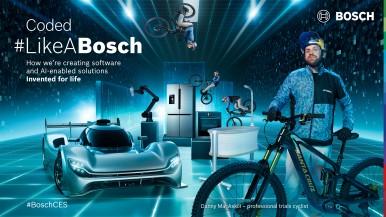
Dr. Tanja Rückert, member of the board of management of Robert Bosch GmbH, and Paul Thomas, president of Bosch in North America, at CES®, on January 6, 2025 Check against delivery.Guest appearance by Danny MacAskill, Scottish trials cyclist Danny MacAskill: Ladies and gentlemen, please welcome to the stage Tanja Rückert and Paul Thomas! Tanja Rückert: Thank you, Danny. Let’s have a hand for Danny MacAskill! Danny, you’re truly a wizard on two wheels. And you’re certainly in a great position to appreciate the opportunities digital technologies are unlocking in the world of cycling. Paul Thomas: Danny, tell us – when you look ahead ten or fifteen years, what digital solution has had the biggest positive impact on your career? Danny MacAskill: In ten or fifteen years? Well, there are a lot of technologies I’m already using today – things that help me plan my routes and collect data that let me evaluate my performance, so I can do better next time. But actually… If we’re talking about that far in the future, there’s something else that I think will have a bigger impact. Tanja Rückert: What is it? Danny MacAskill: An AI-based robot clone of myself that I can swap places with before doing a risky maneuver. That will save me a lot of recovery time and just a lot of generally unpleasant injuries. It’ll have to look just like me, though, so nobody can tell it’s a robot. You guys can do that, right? Paul Thomas: But Danny, what makes your routines so special is you! So, while AI can help with your training and data, replacing you isn’t what we think AI is about. That’s actually something we’ll be talking about today. Danny MacAskill: Well, it couldn’t hurt to ask… Tanja Rückert and Paul Thomas: Hello everyone and welcome to CES 2025! We’re so glad you could join us, either in person or virtually. Danny and his bicycle offer us the perfect lead-in for the topic we want to talk to you about today: how Bosch is breaking new ground in our digital business. And our eBike business in particular is a great place to start, since it’s the perfect example of how our entire company has evolved over the last few years. From a leading innovator and manufacturer in the world of hardware, we’ve evolved into a company that can seamlessly bridge the gap between the world of things and the world of data. Fifteen years ago, we launched the first Bosch eBike system. The business initially brought together our expertise in traditional hardware domains such as cordless power tools and electric motors. We entered the market with a single drive unit, battery, and LED display. Fast forward to today: we’re one of the leading makers of eBike drive systems globally. But what’s more, we’re a leading provider of smart, connected solutions that are transforming the way consumers approach mobility and experience cycling. The ever-increasing digital expertise of Bosch eBike Systems is on display here at CES. For example, we’re debuting a new and unique solution called Battery Lock, which enables you to digitally deactivate your battery when it’s not in use, simply using your smartphone or Kiox display. Let’s face it, batteries are one of the most valuable and easily-resold components on an eBike. But once a battery has been disabled, it's basically useless to anyone else. Which means less risk of theft and more peace of mind for you. And it’s extremely convenient – to unlock your bike again, you don’t even need to take your phone out of your pocket, since the battery recognizes you via Bluetooth. We’re also presenting a solution called Range Control. This feature of our eBike Flow app helps cyclists plan their routes with the help of AI. If you’re an e-biker, you know that a big worry is whether you’ll run out of motor support before you reach your destination. Well, with Range Control, you know in advance exactly how far your battery will take you. It even lets you decide how much charge you want left when you get where you’re going. The algorithm does this by taking things like your system weight, installed components, route elevation, and individual riding behavior into account. On this basis, it dynamically adapts motor support to maximize battery efficiency during your ride. And best of all, the more you use it, the more accurate it gets, as it continues to learn your riding style. At least when you’re on two wheels with the Bosch smart system, range anxiety will be a thing of the past! What the eBike example illustrates is how software and digital solutions have become an integral part of our business at all levels – and that our heavy investments in this area are bearing fruit. By the beginning of the next decade, we aim to generate sales of over 6 billion euros with software and services. Of course, a lot of this will feature AI: after all, we employ some 5,000 AI experts, and we’ve filed more than 1,500 AI-related patents in the last five years. This makes us the European leader for AI patents, by the way. You may not remember, but at CES 2020, we announced that by 2025, every product and solution in our portfolio would either contain AI or be developed or manufactured with its help. Not only have we achieved this goal, we did so two years earlier than planned. But our digital transformation and the success we’re seeing with software and AI is only part of the story. The other part is what we’re hinting at with our CES tagline this year, “Coded #LikeABosch.” Code, of course, is the foundation of all digital solutions, and today we want to throw back the curtain and show you how that foundation is built. Not the literal lines of code, of course, but something far more fundamental. In a nutshell, “Coded #LikeABosch” describes the approach we take in all our digital activities – an approach that is above all guided by our “Invented for life” ethos. Let’s look at its four key aspects. First and foremost, “Coded #LikeABosch” reflects our focus on identifying what people need and want – especially when it comes to things like safety, convenience, and efficiency. On that basis, we create digital solutions that bring them real benefits – not just novelty. As a longstanding tech leader, we’ve always pursued innovations that improve people’s lives. Bosch was behind the magneto ignition that helped democratize the automobile, and we developed the groundbreaking vehicle safety systems such as airbag control units, ABS, and ESP that have saved countless lives around the world. Now, we’re doing the same with our digital innovations. Our software alerts road users to the danger of wrong-way drivers. It enables intelligent cameras that “see” smoke and fire before they get out of control, or that detect a ball crossing your car’s path and warn you that a child may follow. It forms the basis of energy-saving building management platforms, cutting-edge digital healthcare solutions, and safe, efficient manufacturing operations. And in the mobility realm, of course, it’s helping pave the way toward the software-defined vehicles of the future – and in the process unlocking many new benefits for their users. At our booth this year, one of the most impressive showcases is a racecar. It’s not just any racecar, though – it’s a cutting-edge Le Mans Daytona hybrid vehicle – also known as LMDh. It’s the first hybrid-powered prototype racecar approved to compete in both NASCAR’s IMSA series as well as the ACO’s FIA World Endurance Championship. These are cars you’ll see racing at endurance classics such as Le Mans, Daytona, and Sebring. And they’re very special for two reasons: one, because the LMDh was the first entirely new car to receive global approval from both organizations, and two, because it has a Bosch hybrid system at its core. If you’re a motorsport fan, you’ll have to check it out! Among the high-tech digital features you’ll find is our new cloud-based telemetry platform RaceConnect. This module allows us to extract maximum value from the stream of data being produced by vehicles on the track by converting it into actionable insights for the series, manufacturers, teams, and fans, and all in real time. But it’s actually another component of the system we want to spend a few minutes talking about – namely, the braking system. Not for the reasons you might think, though. We have an inspiring story to share about how this brake system has enabled one particular driver to continue doing what he loves best in the face of incredible adversity. To help tell this story, we have a very special guest here today. But before we welcome him on stage, let’s take a look at the challenges he faces and the Bosch technology that’s helping him overcome them…Guest appearance by Robert Wickens, motorsport racing driver Paul Thomas: Robert, thank you so much for joining us here at CES! That’s a pretty incredible journey. You returned to racing in 2022, and this past year you debuted the Bosch hand control system for braking. Can you tell us a little more about the system and what it has enabled for you? Robert Wickens: Thanks, Paul! It’s a pleasure to be here. When I first returned to racing after my accident, I used a system that was based on physical linkages that went down to the actual brake pedal and pressed it. It worked, but it wasn’t ideal. Then Bosch approached me with a solution that took the electric brake system they supply for the LMDh class. That system is based on cutting-edge brake-by-wire technology, using software to intelligently balance the braking torque from the electric motor generator unit and the traditional hydraulic brakes. The Bosch motorsport team figured out how to integrate this hardware with parts of my existing system, and more importantly to adapt and tailor the software for use with hand controls. The result is like night and day in terms of feel and responsiveness. The added technology allows me to brake faster and with more consistency than with my previous system, and it also features advanced diagnostics for safety. In short, this system has given me the ability to control my vehicle in the same way that other drivers do. Paul Thomas: So, with Bosch technology you’re now able to drive with world-class speed and accuracy? Robert Wickens: Exactly. Tanja Rückert: And what does that mean for you and your career? Robert Wickens: Honestly, it’s a game-changer for me. I can race like I used to again. And that basically means I can continue to do what I love professionally, which is compete – and at the highest level. I also love that because of its software architecture the system is transportable; I have been driving a Hyundai Elantra N TCR, but in the future I can take it with me into any number of other cars. But more than that, I’m glad that no matter what else I achieve in my career, together with Bosch I’ll be able to leave behind a legacy for the next generation of racing drivers with disabilities. Not only by showing them that a disability is absolutely compatible with this career, but by helping to develop and refine the actual technology that will help them pursue their dreams. Paul Thomas: Can you give us any idea of what the future holds for you? Robert Wickens: Well I do have some exciting news! To start in 2025, I’m making my debut in IMSA’s WeatherTech SportsCar Championship with the No. 36 DXDT Corvette Z06 GT3.R, which is a step up in power and competition I’m looking forward to. Beyond that, my collaboration with Bosch allows for endless opportunities and continuing to push the boundaries of this system. So I know this is only the beginning of our story together. Tanja Rückert and Paul Thomas: Congratulations, Robert, and thank you so much for joining us today. You have such an incredible, inspiring story, and we’re honored to have been able to play a part in it! That’s a really great example of what we mean with technology “Invented for life” and real benefits. It also shows why we are so committed to driving forward the move to software-defined vehicles – because of the potential they offer for greater safety, efficiency, and accessibility. And not just in the racing segment! After all, Bosch has software expertise derived from our extensive knowledge of the entire mobility ecosystem. That’s what sets us apart from other companies – we’re active on all levels and in all domains of the software-defined vehicle, which makes us the go-to partners. Speaking of partners, let’s move on to the second aspect of our approach. As a matter of principle when it comes to our digital activities, we pursue a collaborative, hardware-agnostic, open-platform strategy. This is because on a fundamental level, we believe that in this sphere, more can be achieved by opening up than by narrowing down. That’s why we engage in collaborations with other companies such as VW and its subsidiary Cariad, with whom we’re working on bringing automated driving functions to cars in all price segments. It’s why we’re focusing on hardware-agnostic software such as our groundbreaking Vehicle Motion Management, which you can see demonstrated at our booth. And it’s why we’re proponents of open and cross-brand platforms in nearly all our areas of business, such as our award-winning industrial automation toolkit ctrlX AUTOMATION. This system runs on an open-source Linux operating system and functions kind of like an app store for high-tech factory applications. It already counts more than 100 global partners that are actively contributing to its further development. Or take the example of our smart-home business. Over the past few years, we’ve not only continued to develop intelligent, connected solutions that make our lives easier and more convenient, we’ve been working to make them cross-compatible with other companies’ products and platforms. After all, doesn’t it also increase ease and convenience to be able to choose freely among different brands and still have everything work together seamlessly? At our booth, we’re showcasing a range of new Bosch smart-home products that are now compatible with the Matter open standard . Matter is a freely available connectivity standard for smart home and IoT devices. Stop by our booth to check out our smart wall plug, door and window contact, radiator thermostat, air purifier, and air conditioning unit. We’re also showcasing the newly launched Bosch 100 series French Door Bottom Mount refrigerator , which will be compatible with Alexa through Matter in 2025. Bosch is excited to be working with Amazon to move the Matter-enabled home appliance space forward. And this launch reinforces our leadership position as the first company globally to have brought a Matter-enabled home appliance to market. All these flexible, modular solutions can help to make your home more comfortable, energy-efficient, and secure. And looking ahead, in addition to managing our home appliances with our long-standing Home Connect app, users may be able to control all Matter-enabled devices across a smart home through partner systems or hubs, such as those from Amazon, Google, and Apple. So more choice and more convenience – by taking a collaborative approach, we can serve customer needs even better. This brings me to aspect number three: in our digital activities, we prioritize the building of trust in new technologies. This is something we’ve been talking about for a long time, but it’s more relevant than ever today. At Bosch, we recognized at an early stage that without trust, many digital technologies are never going to achieve widespread acceptance and adoption. This is why an essential part of our digital strategy has been to put the focus on users of our technology, and to ensure that people’s concerns are addressed above all. Nowhere is this more important than in the realm of AI. This is why we’ve made it a priority to develop AI in a way that is safe, secure, robust, and explainable. Several years ago, we developed our AI code of ethics, which guides all our development activities in this domain. We’re also strong proponents of a standardized, easy to understand AI Label, which puts the core idea of the European AI Act into practice and will provide transparency to consumers. We believe these are important tools for convincing people to trust our digital technologies like they’ve long trusted our analog ones. And they will also help ensure that people remain the focal point of the development and application of AI technologies. For us, this people-centric approach means a focus on identifying applications where AI can be used to assist people and make their lives easier, safer, and simply better. One of the innovations we’re showcasing at CES encapsulates this approach perfectly. It’s our new Revol multi-modal AI infant care solution, and it was a CES Innovation Award Honoree in both the “smart home” and “artificial intelligence” categories. All you parents out there know how much time, energy, and uncertainty are involved in caring for a little one. This is where technology can help pick up the slack. The Revol is a smart crib that helps keep an eye on your baby, thanks to sensors, camera, and AI. How exactly? By monitoring your baby’s heart and respiratory rate. The software also signals in good time if a soft toy or blanket is covering the child’s airway or if crying is detected. And should your little one have trouble falling asleep, the crib can automatically engage a gentle rocking function. What this solution doesn’t do is replace the human element. Caretaking still comes from parental involvement and expertise, as you remain the decision maker. You’re just offered a helping hand to keep your baby safe and healthy, so that your time together is characterized by more enjoyment and less worry. This is exactly where AI is incredibly useful, and it’s why we’re focusing on applications like this to build trust in the technology. Dealing responsibly and transparently with user data is also part of this. With the Revol, all data transmitted is encrypted end-to-end and stored on Bosch-administered servers, while all data at rest is secured locally with individual data encryption keys. But we also give you the final say whether it’s transmitted at all – the Revol has an offline mode, which keeps all data within your four walls, if that’s what you prefer. The way the Revol harnesses digital technologies to aid and assist parents offers the perfect bridge to the fourth and final aspect of our approach . Namely, we aim to use these technologies to complement and support human intelligence and abilities, not to replace them – especially when it comes to AI. Here, I want to talk about AI – and specifically GenAI – in a little more depth, since it’s without a doubt one of the most transformative technological developments of recent decades. While the advent of artificial intelligence was already a milestone in itself, the leap to generative AI represents nothing short of a technological revolution – on par with the invention of the computer or internet. GenAI has thrown open the doors to everyone – you no longer need to be an AI expert to harness this technology’s power and potential. At Bosch we’re currently seeing how GenAI is acting as a catalyst for the rapid uptake of AI technology throughout our organization. As a result, GenAI has made topics like AI upskilling and AI governance so much more important. How are we using it? Well, in our internal processes, Bosch is using GenAI in a wide variety of applications with the aim of streamlining our work and serving our customers better. We’ve recently rolled out tools that for example support our associates in generating texts, videos, and software code. But GenAI is also helping us unlock new possibilities in our solutions for customers, too. In collaboration with the German company Aleph Alpha, we’ve launched an AI-based service which responds to vehicle breakdown calls with the help of natural language processing. With the multilingual elevator emergency call service, we’ve established another AI-based service which connects a person trapped in a stalled elevator with our service expert. An AI-based voice bot translates the interaction in real time, and GenAI enhances the support. In both cases, it means people in trouble get someone on the other end of the line instantly who can help them in multiple languages. We’ve also put GenAI into our Series 8 smart oven, which you can experience here at CES. Thanks to sensors, a camera, and a mini foundation model installed in each appliance, this oven learns to automatically identify dishes and choose the perfect time and temperature for each. All you need to do is assemble the ingredients, and the oven does the rest. Here again, the more you use it, the better it gets as it builds on its own experience and learns your preferences. That’s the beauty of AI, and why I get so excited about the possibilities it offers. But in all honesty, I also find it frustrating that there’s clearly still a lack of a balanced perspective on AI in wider society. On one hand, there is a lot of fear and misunderstanding, and this is leading to hesitancy or even outright rejection of AI. On the other hand, its strongest proponents often downplay legitimate concerns and are over-confident about what AI can do. As is so often the case, the reality is somewhere in the middle. If used wisely and responsibly, AI is a valuable tool that works together with and complements human intelligence. It can be an assistant, a companion for life and work. But it cannot – and should not – operate independently of people or be designed to replace them. This is why the development of AI skills is so crucial. This fits with our findings in the latest Bosch Tech Compass, the survey we conduct each year to gauge global attitudes to technology. In our most recent survey, we asked people about their opinions on a range of AI-related topics. Interestingly, a widespread belief in the importance of building AI-related skills was reflected in the results. For instance, 82 percent of global respondents are planning to educate themselves on matters related to AI. In line with this, 63 percent also believe AI should be taught as a standalone subject in school, which means people think such skills are increasingly fundamental and should be acquired early. In contrast, employers are at an early stage in recognizing the importance of AI skills – only about a quarter of respondents report that they have received any on-the-job AI training . At Bosch, we take the issue of AI skills very seriously. So far, we have launched a number of initiatives to upskill our workforce. Among these is a dedicated learning portal called our AI Academy, which is open to everyone at the company. It offers a broad portfolio of both virtual and in-person training opportunities for associates at all levels of expertise. So far more than 65,000 associates have completed training related to AI and GenAI. One area in which we’re actively demonstrating how we can put these new skills to use – and more generally how AI can be used to complement rather than replace human expertise – is the manufacturing sphere. Bosch is widely considered a pioneer of what’s being called Industrial AI, which involves harnessing the technology to optimize and streamline manufacturing operations, in the process helping to make it more safe, efficient, and precise. So that’s what “Coded #LikeABosch” means in a nutshell: digital solutions that are designed to assist, support, and benefit people. And they’re an increasingly fundamental part of our portfolio – and thus our growth efforts – in all our global markets. That of course includes the United States, and one digital innovation we’re pleased to be rolling out more widely is our wrong-way driver warning. The Bosch cloud-based system tracks vehicles as they approach highway entrance or exit ramps. Using anonymized data, the system can tell if a vehicle is moving in the permitted direction of travel. If it is moving the wrong way, a warning is issued to the driver. A warning can also be sent to other drivers, alerting them that an approaching vehicle is travelling the wrong direction. According to the U.S. Federal Highway Administration, there were more than 700 fatalities in 2022 from wrong-way driving – up almost 60 percent over a five-year period. Here is an example where digital services can provide real value to help reduce these incidents. That’s why we’re very excited to announce here at CES that we are working together with SiriusXM Connect to potentially bring Bosch wrong-way driver alerts into the new SiriusXM Connect mobile safety app. This would mean that millions of new consumers would have access to this technology to help alert them of wrong-way driving incidents. We’re also actively working to bring this technology to more vehicles and smartphones via collaborations; we hope to have more to announce soon. In other areas of business as well, the United States continues to be a major strategic focal point for our growth efforts, and we’re continuing our program of heavy investment here. A few months ago, we announced the biggest single transaction in our company’s history, our planned $8 billion acquisition of the residential and light commercial HVAC business from Johnson Controls and Hitachi. That’s expected to close sometime this year. We’re also contributing to the build-up of semiconductor manufacturing in the United States. We’re continuing to work toward the planned launch of silicon carbide chip production at our Roseville, California, facility in 2026. As was announced just last month, the project has received proposed support from the CHIPS and Science Act, which is helping enable us to transform the Roseville site into a world-class semiconductor manufacturing operation. And that’s not all. We’re planning multiple new product launches in our power tools and home appliances categories tailored to the U.S. market. There’s a lot of exciting stuff happening at Bosch in the U.S. right now! And beginning shortly, people here are going to be hearing a lot more from us. They’ll also be seeing us in places they’ve never seen us before. One place in particular might be quite surprising… We’re proud to announce here at CES that for the first time in our company’s history, Bosch will be advertising at the “Big Game” on February 9! Stay tuned for more information in the coming weeks and make sure to keep an eye out for Bosch during the game! As we look toward the future, we see how digital technologies are opening up a vast new landscape of possibilities. In particular, AI and GenAI have the potential to help enable greater comfort, efficiency, cost savings, and sustainability in nearly every domain – if the right approach is taken. We believe such an approach should put the focus on people. Especially when it comes to AI, we believe the four aspects we just outlined are essential to fostering a balanced and realistic view. They’re also the key to ensuring that this technology is put to work doing what it does best – namely supporting, assisting, and enhancing our own efforts. At Bosch, we long ago traded in our membership in the hardware-only club and are continuously breaking new ground in the digital sphere. But in a data-driven world, our essential motivation hasn’t changed. As ever, we remain committed to leveraging technology to make people’s lives better – in line with our “Invented for life” ethos. Stop by our booth this week and see for yourself what beneficial digital technology “Coded #LikeABosch” looks like. Thank you!

With the future programmed in: Bosch is taking its software business forward.

19.06.2024

Presentations

Business/economy

With the future programmed in: Bosch is taking its software business forward.

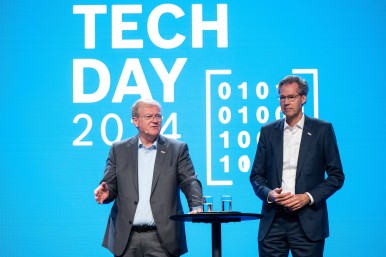
Dr. Stefan Hartung, chairman of the board of management, Robert Bosch GmbH, Dr. Markus Heyn, member of the board of management, at the Bosch Tech Day on June 18 and 19, 2024. Check against delivery.Ladies and gentlemen, The Library of Congress in Washington D.C. is one of the biggest libraries in the world. Its digital collection comprises well over 900 million files with a total size of some 21 petabytes. One petabyte is just over one million gigabytes. That number of files alone will keep you busy for quite a while. For example, by watching high-definition television non-stop for more than 13 years. Yet the traffic data we have now recorded at Bosch using our sensor technology take up somewhat more space than 21 petabytes – well over ten times more, in fact. This doesn’t only show how frequently we travel the world’s roads together with our partners. It is also a symbol of how, at Bosch, the digital and physical worlds have merged and are mutually dependent. It is only with the help of these vast volumes of data, for example, that we can develop our solutions for tomorrow’s mobility – hardware such as sensors and braking systems, and above all new and intelligent software for tomorrow’s mobility. Today, you will be able to see and experience some of these solutions for yourself on our proving ground here. I’m very glad that this has persuaded you to join us, and would like to extend a warm welcome to our Bosch Tech Day here in Renningen. Especially in mobility, the speed of software development is extremely high. One might even be tempted to dig out the old “data highway” cliché – but this time in a new, almost literal, sense: on the roads of the future, after all, software will have a greater influence on traffic than any other technology. For Bosch, the fast-moving nature of this field is an advantage: after all, across all our business sectors, software is already the decisive factor behind all our areas of future growth – whether the smart control of factories, smart home appliances, or our new growth area of medical technology. Yet while software is nothing new for Bosch, our focus so far has mainly been on programs for products, such as software for airbag control units, for e-bikes, or for efficient heat pumps. But another area is now growing alongside this – our business with “standalone software” that can be developed and marketed independently of any product. For example, we offer software for a video function that allows vehicles to detect their surroundings better. The decisive thing here is that the software is hardware-agnostic, and can run on chips made by different manufacturers. Demand for standalone software and for digital services will pick up rapidly over the next few years. By the end of the decade, we want our software to generate sales running into the billions. And that’s not even counting the software embedded in our products. To illustrate how important this embedded software is, I’d like to take a brief look at our very first software product: Bosch Motronic. This was a control unit that controlled ignition and gasoline injection at the same time. It did so digitally, with a microcontroller and memory. Forty-five years ago, Motronic debuted in a production vehicle, the BMW 732i. With this, Bosch heralded the automotive software age. What began with very modest volumes for one vehicle model has now taken on a completely different dimension. Each year, we supply our customers worldwide with more than 250 million control units that we have coded. Since the debut of Motronic, therefore, Bosch has developed from a purely hardware company to one of the biggest software providers in Europe, if not the world. In all, 48,000 people are currently working on software at Bosch – many of them in Germany, but also at our Indian subsidiary Bosch Global Software Technologies, which has grown by leaps and bounds over the past 25 years and now runs branch operations in Mexico and Vietnam. All around the world, Bosch software can be found in countless production lines, car repair shops, and medical appliances. It alerts to the danger of wrong-way drivers and surveils landmarks such as the Elbphilharmonie concert hall and Neuschwanstein Castle, where it guards valuable cultural assets against fire and vandalism. It can be found in industrial technology, where we have developed the fastest-growing factory-automation ecosystem in the shape of the ctrlX Automation control platform. And in our Building Technologies division, our Nexospace software offers a digital service solution for efficient and sustainable building management. Indeed, until very recently, algorithms developed by us were even to be found in outer space, in software that analyzed noises on board the ISS and alerted to possible anomalies. So as you can see, “Invented for life” applies to our software as well. And unlike purely software companies, we are even in a position to integrate lines of code directly into products – into people’s lives, if you like. At all times, the basis for our “Invented for life” ethos has been our strengths in the precise and reliable manufacture of complex physical objects. We want to continue to dynamically build on these strengths, as well as on our profound domain knowledge in mobility, manufacturing, and building technology. It is precisely these strengths that are now making us increasingly attractive for partners who have traditionally played a leading role in the world of software. As it is, barely any company will be able to exploit the huge potential of software and AI on its own. Instead, what is needed is alliances between equal partners. In this context, open source software offers an especially useful way of pooling expertise across company boundaries, of saving costs, and of creating standardized solutions. In AI for its part, which is becoming increasingly important for software development, we now need planning certainty. The AI Act passed by the EU must now be rapidly translated into standards, so that expensive and complex case-by-case assessments can be avoided. Regulation is necessary. But it must not unnecessarily throttle the pace of technology or even prevent innovation. Especially in the area of mobility, this pace is increasingly picking up. The triumphant march of software will revolutionize the automotive industry more fundamentally than any new type of powertrain. Justifiably, more and more customers expect their vehicle to synchronize smoothly with their digital world. This also includes its updatability. In the future, it will not just be the case that the software in cars, trucks, motorbikes, and e-bikes will be state of the art when they are made. Instead, it will keep pace with developments. With software under the hood, cars will become out of date more slowly. It will then be possible to integrate improved convenience features and new safety functions over the air, without any fuss – just like in a smartphone. Bosch technology will make software updates possible for e-bikes, motorbikes, cars, and trucks. Since the debut of our smart system for e-bikes at the end of 2021 alone, we have used software updates to roll out roughly 70 new features and modifications via the eBike Flow app – from an alarm and tracking function to new riding modes. However, the growing demands made of software-defined mobility are pushing conventional vehicle architectures to their limits. This is why Bosch is now developing a centralized, cross-domain IT and electronics architecture featuring a high-performance software stack and powerful vehicle computers and sensors. Our advantage here is that we know our way around hardware AND software – and are thus one of the few companies that are fully proficient in the interplay of automotive electronics and the cloud. McKinsey estimates that the global market for automotive software and electronics may reach 462 billion dollars by 2030. That is the equivalent of 5.5 percent average annual growth from 2019 – and thus significantly more than the growth of automotive production. We want to be the number-one choice for automakers worldwide in this area as well. On top of that, there is hardware. Without it, the new software world will not be practicable. This is an area where we are already successful. With our modern vehicle computers alone, we have generated sales of just under 4 billion euros over the past three years. Ladies and gentlemen, software is not just an add-on for Bosch, but one of the mainstays of our success. Software determines our processes, our manufacturing operations, and the way we think. For a long time now, software has been just as much a part of our everyday work as the five red letters at our factory gates. Together with AI, it is the foundation for future innovation. And in all our business sectors, it will become increasingly important for value creation. But it is especially in mobility that we have a very clear goal: Just as there is barely any car today that does not feature a Bosch part, in the future there won’t be any cars on the road that do not feature Bosch software. To explain to you how we are shaping the future of mobility in the process, I’d now like to hand over to my colleague Markus Heyn. Thank you!A new chapter in automaking history: Markus Heyn on the age of the software-defined vehicleLadies and gentlemen, A warm welcome to Renningen from me as well. On your way here, it’s likely that some of you already spent a few minutes in one of the traffic jams around Stuttgart this morning. Ten meters forward – brake – stop – jolt. Then another ten meters, and again: brake, stop, jolt. This could soon be a thing of the past. Not the traffic jams, unfortunately. But the constant jolts every time you brake. This is because Bosch has developed software – which we’ll be demonstrating to you later – that lets vehicles brake very softly, without any jolts. Now you might say that soft braking like this is nothing more than a fun gimmick in the car of the future. But have you ever actually tried to bring your vehicle to a halt completely smoothly, without any jolts, like a real chauffeur? It really isn’t that easy, even if you concentrate hard! And apart from that, you might like to ask your passengers, and your children on the rear seat, what they think. Anyone who is reading something on their cellphone, or who is prone to travel sickness, will be very grateful for ultra-smooth braking. We can ensure jolt-free stop-and-go driving with software that brakes as smoothly as a professional chauffeur. Not only does this solution make for an especially smooth ride, it is also part of a new chapter in the history of automaking. We are standing at the dawn of the age of the software-defined vehicle. As Stefan has already made clear, Bosch is just as much a software company as a hardware one. This is especially true of our mobility sector, where 42,000 people worldwide are working to develop software for current and future vehicles. That’s more than in any other company in the automotive industry. And with that, we are already part of the change in our industry. Increasingly, the starting point for designing and developing new vehicle models is software. That said, the software-defined vehicle, or SDV, won’t appear overnight, and there are very few fully software-defined vehicles on our roads right now. The ones that are come almost exclusively from completely new players in the market. As fully software-defined vehicles gradually become more common, the share of software in vehicles will triple. In some cases, one single car may currently feature more than one hundred control units, made by different manufacturers. Even now, orchestrating this cacophony is a very demanding task. And updating it while preserving the necessary safety and reliability is a headache. But for an SDV to be updatable, its electrical and electronic architecture must not be too complex. So what we need is a high-performance software stack and ever fewer, but more powerful, vehicle computers. In an SDV, therefore, we have to merge many of the functions that have so far been domain-specific: together with Qualcomm, we have already debuted a system-on-chip that can simultaneously process infotainment and driver assistance functions – and were the first supplier to do so. In the future, other domains could be integrated on one chip. In this way, the number of control units could be reduced to less than ten by 2030. The result would be installation that takes up less space, fewer cables, and less weight. In short, costs would be lower and flexibility higher. Merging driver assistance and infotainment control units alone can reduce costs by as much as 30 percent. Depending on the vehicle class, this can mean a saving of more than 100 euros in some cases – and this in just one component. This will also make automated driving functions more affordable, and thus attractive for price-conscious vehicle segments. So as you can see, the software defined vehicle will also mean more changes in hardware requirements than the name may suggest. For its part, the required software will be developed in close collaboration between OEMs and suppliers. One challenge here is connecting the many software packages in the vehicle, which have to communicate with each other across brand boundaries. The Bosch subsidiary ETAS provides the middleware for this. If you like, this is the translation software between the vehicle’s physical components and its application software, even if they are made by different suppliers. But above all, what is new here is that individual software functions can now be marketed as licensed products, independently of hardware. One good example of this is our Vehicle Motion Management. And that brings us back to jolts when braking. Vehicle Motion Management, or VMM for short, is a comprehensive systems solution that makes the driving experience safer, smoother, more efficient, and also a bit more unusual. Both the suspension and the powertrain, braking, and steering systems are managed optimally and in concert by the software. This allows handling characteristics, such as acceleration and braking behavior, to be individually determined – all the way to a jolt-free halt. I warmly recommend you to see for yourself later on how this improves smoothness, safety, and vehicle dynamics. Vehicle Motion Management is also evidence of the success of the Mobility business sector and its new organization. I’m sure you have already heard that we have completely reorganized this sector, especially with respect to three future cross-domain areas of mobility: software, semiconductors, and vehicle computers. Our top priority here is the best possible market and customer focus. Our response to geopolitical developments is to significantly step up our international collaboration. To achieve this, we have been working even more intensively across divisional, regional, and functional boundaries since the beginning of the year. Without this new structure, it is unlikely that Vehicle Motion Management could have debuted so quickly. And our customers also appreciate this new speed: for VMM alone, we expect sales running into the hundreds of millions by 2030. Standalone software will account for a significantly greater share of the future sales revenue than classic embedded software. With our mobility solutions as a whole, we want our newly restructured business to achieve global sales of more than 80 billion euros by 2029. And of course, we also want automated driving solutions to play a part in this. In this context, the SDV is essential for future developments. For privately owned vehicles, Bosch is focusing on gradually taking driver assistance forward. Right now, we are the only established Tier 1 supplier developing driver assistance software for Levels 2+ and beyond. For the various levels, Bosch can supply the crucial products: sensors, cameras, and radar, as well as the vehicle computers, software, and services to go with them. Especially in automated driving, advances in AI are opening up completely new possibilities. This is because generative AI will be capable of describing the visual world more precisely and translating it into code. In this way, vehicles will be able to deal much better with complex situations. So if, say, a ball suddenly rolls onto the road ahead, cars will soon no longer register the mere object, but also anticipate the child that may come running after it. Widening context in this way allows the system to react significantly faster and more appropriately in comparable situations. Such a scenario is made possible by combining what are known as foundation models with our profound knowledge of vehicle systems. With our huge volumes of traffic data, we can train the AI. And because you can never have enough material for this purpose, we are working to collect even more traffic data with various automakers the world over – also with the VW software subsidiary Cariad. In the future as well, therefore, our store of data will likely be bigger than the Library of Congress’s – a kind of digital library for the mobility of the future. And now we’re looking forward to your questions. Following them, you will be able to try out in practice a lot of the things we have only talked about here. And that includes soft braking. I wish you all a fascinating – and jolt-free – afternoon. Thank you!

Energized #LikeABosch – energy-focused innovations to power a sustainable tomorrow

08.01.2024

Presentations

Business/economy

Energized #LikeABosch – energy-focused innovations to power a sustainable tomorrow

Dr. Tanja Rückert, member of the board of management of Robert Bosch GmbH, and Mike Mansuetti, president of Bosch in North America, at CES®, on January 8, 2024 Check against deliveryHello everyone, and welcome to the Bosch press conference at CES 2024! We’re delighted to have you here – thank you so much for joining us, either in person or via our livestream. Today we’d like to talk to you about a topic that affects us all: energy. Did you know that over the past 50 years global energy use has doubled? Those of us who were around in the 1970s know that it was hardly the dark ages. Most of the modern comforts and conveniences we know today already existed: cars, dishwashers, air conditioning, airplane travel. But as more and more people around the globe have gained access to modern technologies and our collective use of them has intensified, our energy consumption has skyrocketed. And it hasn’t peaked yet: in fact, our needs are still growing at a rate of 1 to 2 percent each year. The problem, of course, is that we continue to meet most of these needs with fossil fuels. Fossil fuels still account for more than 80 percent of energy consumed globally, yet we must reduce our dependence on them for the sake of our climate. Clearly, returning to pre-industrial levels of consumption is not an option. Somehow, we have to find a way forward that balances our ever-growing need for energy with the health and stability of our planet. We need an approach that is sustainable from social, economic, and environmental perspectives. This is especially true where energy is concerned. Today, you’re going to hear about the wide range of technologies we’re developing to help us meet our energy needs in a more sustainable way – with solutions that make our lives “Energized #LikeABosch.” When it comes to energy-focused innovation, we’re pursuing a two-pronged approach: First, we’re focusing on optimizing the use of traditional energy sources. Specifically, this involves continuously improving efficiency, thus saving energy and costs, as well as driving forward electrification. Electrification in particular holds tremendous potential as a pathway to achieving net-zero goals in multiple domains, including personal and commercial transport as well as the home. Second, we’re looking beyond traditional energy sources for more sustainable alternatives. We’re focusing in particular on hydrogen, which we believe will be central to meeting our future climate-neutral energy needs. Here, we’re active at multiple points along the H 2 value chain, from building up a production and supply infrastructure to developing innovative new hydrogen-based technologies. So, let’s start by looking in more detail at how we’re enhancing the use of traditional energies. As I mentioned, a major focus of our activities here is electrification. At first glance, electrification seems to simply be a means to reducing energy consumption, since electric technologies are often far more efficient than their fossil fuel-based counterparts. But electrification offers much more: electric solutions come with the potential for climate-neutral operation “baked-in” – all they need for this is a supply of electricity generated from renewables. Mobility in particular is already well on its way to becoming more electric, and Bosch is a leading supplier along the electromobility value chain. In fact, our diversity here is unrivaled across the globe – with technology ranging from chips to e-axles, from e-bikes to trucks, from batteries to fuel cells, and from hardware to software and services. Over the last few years, we’ve seen the viability of electric cars as an everyday mode of transport increase dramatically. But a big stumbling block continues to be the charging process: drivers used to investing only a few minutes in finding a gas station and filling their tanks are suddenly confronted with the question of where to charge an electric vehicle, and above all when. Well, we’ve been thinking about this too, and we have a solution: what if your car could go charge itself? The year before last, our automated valet parking solution became the first driverless parking system officially approved for commercial use. At CES 2024, we’re debuting an exciting new addition to this system, which conveniently has to do with energy – and it’s a CES Innovation Award Honoree. Automated valet charging is essentially an automated way to charge your electric car when you’re out and about. You don’t have to worry about finding an empty charging spot or returning to the parking garage halfway through your shopping trip to unplug – all you have to do is press a button on your phone, and the system takes care of the rest, guiding the vehicle to the charging station and back to a parking space when it’s full. This isn’t something in the pipeline – it’s already available to our customers now. And by no means does it require newly built, state-of-the-art parking garages. We’ve designed the charging setup to work in two ways: the AVC robot can either be deployed in garages that already have automated valet parking, or in garages that are installing the required infrastructure for the first time. This combination of automated valet parking and automated valet charging is unique in the market and is already generating considerable interest among our automotive customers. It sounds like a fun gimmick, right? Well, it’s actually more than that. Every step we make toward increasing the convenience of electromobility will also increase its attractiveness – which in turn will drive uptake. As a matter of fact, we’re working on improving the feasibility and attractiveness of electromobility on many levels. This is why we’re also investing in silicon carbide technology. In electric vehicles, silicon carbide chips enable greater range and more efficient recharging, as they use up to 50 percent less energy than standard chips. Installed in vehicles’ power electronics, they enable cars to drive a significantly longer distance on one battery charge – on average, range is 6 percent greater. We’re currently ramping up our production capacities for silicon carbide chips globally, including a major investment here in the U.S. As we announced a few months ago, we recently acquired a California-based wafer fab, and over the next few years plan to invest more than 1.5 billion dollars in the Roseville facility, with the aim of starting production there by 2026. At our booth, we’ll have a demo explaining the benefits of silicon carbide as we prepare to ramp up production of this important technology here in the United States. In addition to the mobility sphere, we’re focusing on the home as a major candidate for energy optimization. We see huge potential for optimizing energy use in the home. For example, in the U.S., residential and commercial buildings are responsible for nearly a third of total energy use as well as total greenhouse gas emissions. This is unsurprising, considering that more than half of American homes still rely on gas or other fossil fuels as their primary heating or cooking fuel. Around the world, we’re developing technologies to make buildings and their contents more energy-efficient and to facilitate electrification. A major focal point for us is heat-pump technology. Here in North America, we’re debuting a very exciting innovation at CES which is hitting the market this year – our new air-to-air IDS Ultra Heat Pump. Unlike most air-to-air heat pumps, it was developed for areas with harsh winters. Traditionally, air-source heat pumps have the advantage of being relatively affordable and easy to install, and like all heat pumps they can cool as well as heat. They have the disadvantage, however, of not working very well in extremely cold temperatures. We recently conducted a survey here in the U.S. and Canada that confirmed our suspicions: while awareness of heat pumps is near universal, and more than a fifth of all respondents even currently own one, this is very geographically uneven. The highest percentage of heat pump ownership is concentrated in the Southeast, no doubt due to its mild winters. In colder places like New England and the Upper Midwest, we see ownership rates 6 to 7 times lower. And in those places, the few homeowners who do invest in a heat pump usually have to keep a backup system running that takes over when temperatures drop below freezing. Our new cold-climate heat pump nearly eliminates this need. It provides 100 percent heating capacity down to outdoor temperatures of 5 degrees Fahrenheit, and it’s operational down to minus 13. For people in northern regions, this means they can reduce their reliance on fossil fuel-based heating systems and make the switch to electric in a more affordable way, thanks to the growing number of state rebates and federal tax credits here in the U.S. And apart from electricity’s superior sustainability credentials and net-zero readiness, switching to heat pumps also comes with energy and cost saving advantages. This is definitely good news for the nearly two-thirds of respondents to our survey who cited cost and efficiency as their main concerns when it comes to heating and cooling their homes! In an announcement today, the Department of Energy confirmed that Bosch’s cold climate heat pump meets the requirements to progress from lab to field testing as part of the Residential Cold Climate Heat Pump Technology Challenge. The goal of the challenge is to advance heat pump technology, allowing consumers options for electrified heating and cooling of their homes. Heat-pump technology is so promising, in fact, that we’re also putting it to use in other areas of the home. One of these is the new hybrid electric water heater we’re showcasing here at CES. Launching in North America later this year, this is the most energy-efficient water heater in our lineup: by combining heat-pump technology with electric elements, this ENERGY STAR-certified device achieves 3 to 4 times the efficiency of our traditional electric storage water heaters. With solutions like this, we’re helping pave the way to an increasingly electrified home. Of course, we’re also focusing on appliances as a lever for energy savings. Bosch home appliances has been a frontrunner in this area for a long time – evidenced by the fact that it was named as an ENERGY STAR Partner of the Year by the U.S. Environmental Protection Agency and the Department of Energy for the third year in a row. Most of us know that it’s possible to run our appliances on a schedule that optimizes electricity costs or green energy usage; in practice, however, it’s not always easy. First, we have to know what time of day to run them; then we have to remember to actually switch them on at the right time. Well, our new MySchedule feature can help on both counts. Included on our new generation of dishwashers, this function is operated via our Home Connect platform. In a nutshell, MySchedule allows you to automatically delay operation to hours when electricity is cheapest or when green energy is available. This means that your ability to optimize your energy use no longer depends on your ability to remember to hit the “on” button at the right moment. Another approach to optimizing energy comes from our Power Tools business. If you work with cordless power tools, you know how much of a headache it is to keep track of your different batteries and make sure they’re charged. We’re looking to simplify workers’ lives by reducing the number of battery solutions they need to keep track of. AMPShare is a shared battery platform which lets workers use the same batteries across Bosch power tools, as well as the AMPShare-compatible products of our partners. Workers have been excited about the opportunity to simplify their battery assortment. Since AMPShare launched, we’ve welcomed more than 30 global partners, including 15 here in North America, 3 of which are new partners we’re introducing here at CES. Beyond welcoming new partners, we’re collaborating with our partners on new product launches. In the near future we expect there will be a number of new AMPShare-compatible products hitting the market, such as the Perfect Pro radio, which is on display in the Bosch booth. In addition to making it easier for workers to manage their batteries, AMPShare’s goal is to allow workers to use more tools with fewer batteries, leading to less material usage and waste production. Beyond the home, we’re also focusing on optimizing energy efficiency in the commercial sector, and here our portfolio goes beyond products to consulting and system solutions. Globally – as well as here in North America – we’re investing heavily in our system integration business. As we announced a few months ago, we recently acquired Canada-based Paladin Technologies, which will enable us to significantly expand our activities in North America. We’ve already built up a very strong business in the United States through our subsidiary Climatec, which continues to grow and support a variety of customers with energy-focused building optimizations. For the past 7 years, for instance, Climatec has been working with the Rowland Unified School District in Rowland Heights, California. Thanks to Climatec’s improvements including HVAC modernizations, building automation systems, LED lighting, and solar installations, the school district expects to see efficiency gains that will save them more than 38 million dollars in energy costs over the next few years. The expansion of our residential and consumer goods portfolios as well as our integrator business demonstrates our focus on profitable growth in North America. Our mobility business will also be a major part of that growth, and this in particular relates to the second prong of our energy strategy, which I’ll tell you about now. As mentioned earlier, another way we’re tackling the energy challenge is by tapping into new sources of renewable energy – specifically hydrogen. The thing is that renewable power can be generated most efficiently in the world’s sunniest and windiest regions, which is not always where it’s needed. We need a storage medium to transfer that energy between regions, and chemical carriers such as hydrogen, which is produced with electricity, offer us an excellent way to do that. At Bosch, we’re convinced that hydrogen is one of the keys to decarbonizing our energy supply. As such, we’re investing heavily in hydrogen technologies and developing solutions along the H 2 value chain. A major thrust of our efforts is the hydrogen fuel-cell powertrain , which we believe is the path to electrification for heavier vehicles. Last summer we started volume production of our fuel-cell power module in Stuttgart. We plan to supply the hydrogen powertrain system as well as important components, and we already have orders from truck makers in the U.S., Europe, and China. This week Nikola is offering rides in a truck powered by a Bosch fuel cell to experience this exciting new technology! In addition, we’re working on components for a hydrogen engine that uses the fuel directly, as opposed to first converting it into electricity. This technology can offer the performance of a diesel engine. On top of that, the climate benefit of the hydrogen engine increases even more when green hydrogen is used. It will be suitable for commercial vehicles in the on- and off-road segments, such as heavy-duty long-haul trucks and construction machinery. As a systems provider for hydrogen engines, we’re currently developing solutions for both port and direct injection. A first H 2 engine with our components is due to debut this year. Around the globe, investment in hydrogen technologies is slowly starting to pick up speed. In this regard, the U.S. is setting a great example. On the public side, the federal government is driving forward the buildup of an H 2 infrastructure and has made 7 billion dollars available for establishing so-called hydrogen hubs across the country. Including sources of private investment, the amount of funding available has surpassed 50 billion dollars, which is kickstarting a lot of activity. At Bosch, we’re committed to helping drive forward the clean-energy economy in North America, which is why we’re currently engaged with multiple hubs to identify projects where we can contribute our technological expertise in both the production and provisioning of hydrogen. And as our business in the area of hydrogen production develops, we’re actively exploring local manufacturing to support it. So, on one hand we’re enhancing energy efficiency and driving forward electrification. On the other we’re pursuing hydrogen as a more sustainable power source. A common theme across all our areas of business is our comprehensive use of software and digitalization to optimize existing solutions as well as create new ones. Our expertise in this area no longer represents a niche in our portfolio, but by now underpins nearly every solution in it. Bosch is one of the few high-tech innovators that is equally at home in the worlds of things and data; our global software engineering workforce currently numbers more than 44,000. Here as well, we are driven by our “Invented for life” ethos, which in practice means that we’re leveraging the power of data and algorithms to enhance comfort and convenience as well as efficiency and sustainability. In the mobility domain, software is a key enabler of achieving the goals of future mobility that is more sustainable. We’re so committed to this vision of mobility that we’re realigning our entire mobility business to facilitate it – by positioning ourselves more than ever before as a software company for mobility, and by strengthening our cross-divisional collaboration. In our role as the world’s largest automotive supplier, we’re leading the way toward the software-defined vehicle – a vehicle that is electrified, automated, and connected, and can tap into a wide range of digital mobility services that enhance efficiency, performance, and convenience. Especially when it comes to developing useful and beneficial services for the software-defined vehicle, we’re firm believers in bringing as much expertise on board as possible. This is why we’re working with partners across the automotive landscape to realize new and innovative solutions for our customers. A great example of this is our collaboration with Amazon Web Services to develop some useful cross-domain in-vehicle functions and services that repurpose driver assistance technology in new ways. I’d like to welcome Wendy Bauer, vice president and general manager of automotive and manufacturing at AWS, to join me in telling you more about what we’re working on together. Guest appearance by Wendy Bauer, vice president and general manager of automotive & manufacturing at AWS: We are indeed working on some very exciting new functions and services and look forward to sharing the benefits of the cloud with the industry and everyday users around the world. The innovation areas are broad, ranging from vehicle technology, to logistics with the L.OS platform, and smart home devices. Tanja Rückert: For instance, take the connected, fully automatic, bean-to-cup espresso machine Bosch is debuting here at CES. It’s pretty cool on its own – it was a CES Innovation Honoree in the Smart Home category – but together, we’re working to connect it to driver drowsiness detection. Wendy Bauer: We’ve all been there – you’re on your way home from running errands and you’re exhausted. What if your car could recognize you might be tired and automatically takes action? Now, with the functions enabled by the cloud and software-defined vehicles, your car can pre-empt your needs. Before you can even think about stopping to grab some coffee, an in-vehicle voice assistance like Amazon Alexa asks if you need a caffeinated pick-me-up. Why yes, you respond, after CES… a triple-shot cappuccino would be nice. And what do you know: 10 minutes later, as you open your front door, your coffee machine is putting on the final flourish of foam. Tanja Rückert: And for the times when you can’t make it home for refreshment, we’re developing what we’re calling our point-of-interest assistant. Here, our Bosch vehicle interior monitoring camera monitors your gaze while you’re driving and automatically identifies things you look at – for example, a particular restaurant or coffee shop. Wendy Bauer: Thanks to the real-time power of the cloud, with technologies such as AI, generative AI, and access to a host of the leading foundational models, you can ask your voice assistant, if the place is open and how busy it is, without even needing to specify the name of the establishment you’re looking at. In real time, it will let you know if it’s worth a stop or if you’re better off going somewhere else along your route, thus saving you time as well as unnecessary driving. Tanja Rückert: Now that would be useful, wouldn’t it? Thanks to our collaboration, these are just a couple of the features we could see in our vehicles soon. It’s clear that no one company can realize the future of mobility on its own. This is why it’s so important that we collaborate across the industry. Wendy Bauer: At AWS we see collaboration as a key to the industry’s advancement and success. By working together, we’ll be able to achieve the future of mobility faster than ever before. Tanja Rückert: Still on the subject of vehicles and digitalization, here at CES we’re also debuting two new mobility services that harness the cloud to cut costs and enhance sustainability. One is a new addition to our battery-in-the-cloud service portfolio: Usage Certificate To Go is a retrofit solution which draws on our extensive expertise in battery modeling. By analyzing battery data uploaded to the cloud from an OBD2 dongle, the service can determine a battery’s precise state of health and help users to prolong their battery life by up to 20 percent. Our new cloud-based Vehicle Health Service s are aimed at fleet operators: they offer tools such as predictive diagnostics to facilitate more efficient vehicle condition monitoring and preventive maintenance to avoid vehicle breakdowns and increase fleet utilization. Both these new service offerings can ultimately help prolong vehicle life and optimize resource use. And when it comes to harnessing digitalization to optimize mobility generally, I can’t leave out a mention of our eBike business. Across the board, we’re using cloud-based connectivity to enhance the electric biking experience. For instance, over-the-air updates via our eBike Flow app enable users to keep their ebike system up to date and improve it continuously with new features and upgrades. Connectivity also underpins a whole suite of digital services, such as our eBike Lock and our eBike Alarm solution, which alerts you to any suspicious movement and also enables location tracking in case of theft. We’re continuously growing our eBike portfolio, as you can see at our booth, above all because we’re committed to making eBikes a viable and attractive piece of the urban mobility puzzle. While greater sustainability might be an add-on benefit for many of our digital service solutions, for others it’s the main objective. We already told you how we’re lowering energy usage in commercial buildings via our system integration solutions. We’re also harnessing digitalization to achieve efficiency gains in this domain. Our Building Technologies division, for example, recently added a new energy-focused service for the European market to its suite for digital commercial building management. Modular, customizable, and compatible with old and new buildings alike, the Nexospace Energy Manager uses cloud-based data analytics to evaluate the efficiency of energy supply, distribution, and use. On this basis, it suggests concrete measures that can be taken to reduce consumption. One of our current clients is the German-owned international supermarket chain REWE. Based on our software’s suggestions, they’re seeing their energy usage slashed by up to 20 percent across more than 2,000 of their stores. We’re also leveraging digital technologies in combination with our expertise in low-emissions manufacturing to help others in the industrial sector reduce their carbon footprint. At the heart of Decarbonize Industries, a digital decarbonization planning service we offer together with a partner, is powerful AI-supported data analytics. At Bosch, we know from experience that traditional roadmaps to decarbonization take months or even years to draw up – our data-based approach, however, can generate a concrete plan in minutes. Available on a subscription basis, this service is already on track to help our customers in Germany significantly reduce both CO 2 emissions and costs thanks to efficiency gains, and we’re currently laying the groundwork for rolling out the platform in other regions. Our energy challenges are not going to be solved overnight, but one thing is clear: we can’t afford not to act. For the sake of our planet, we must end our reliance on fossil fuels, and we must do it quickly. At the same time, unrealistic targets will get us nowhere – we must focus on solutions that are feasible as well as affordable. If history has taught us anything, it’s that we have a seemingly unlimited appetite for energy. What is not inevitable, however, is that our carbon footprint must keep growing too. By driving forward electrification, switching to cleaner and renewable sources of power, and maximizing energy efficiency, we can meet our ever-increasing needs in a way that is sustainable for society and the planet. Doing so, however, will require effort, investment, and the right policy framework. Another crucial piece of the puzzle is technology. Here, we’re already hard at work on innovative new solutions that are helping us reduce the footprints of our vehicles, homes, and industries while we lay the foundations for a climate-neutral energy supply. At Bosch, we’re committed to using technology as a tool for shaping a brighter tomorrow. Come visit our booth this week and see how our “Invented for life” solutions are helping to bring us a step closer to our vision of sustainable, unlimited energy for everyone. Thank you! Presskit #BoschCES 2024 Event #BoschCES 2024

Hardware and software, alone and in combination: Bosch has everything it takes f ...

04.09.2023

Presentations

Business/economy

Hardware and software, alone and in combination: Bosch has everything it takes f ...

Dr. Stefan Hartung, chairman of the board of management, Robert Bosch GmbH, and Dr. Markus Heyn, chairman of the Mobility business sector, at the IAA press conference on September 4, 2023 Check against delivery.Ladies and gentlemen, As the video just showed, the way we drive in the future will be different. Together with our customers and associates, but also with policymakers and the general public, we want to shape the future of mobility. This is summed up in the motto: “Let’s shape the new era of mobility, together.” Yet we are fully aware that the focus of interest at this year’s IAA is not just cars, but also protests against driving. We have no problem with criticism of the automotive industry. But that criticism should be fair. Electromobility is becoming a core business for us. We want sustainable mobility, and above all we want to make it affordable – this is the only way it will succeed in the market. The transformation of our business is no simple task, but we are devoting all our energy to tackling it, with the interests of our customers in mind. What this also means is that we are positioning ourselves more than ever before as a software company for mobility – in addition to our strengths in hardware. You could say that the vehicles of the future will be as much at home in the cloud as on the roads. In this context, not only hardware will be vital, but also the smooth interaction of software from various sources. And this is precisely why, in our reorganized Mobility business sector, we are strengthening cross-divisional collaboration. We are also assigning horizontal responsibility for software, vehicle computers, and semiconductors. All this is making good progress. The ultimate objective is an ambitious one: we want to use Bosch technology to bring about the software-defined vehicle. Even now, we offer solutions across all the domains of automotive software engineering, from control units to the cloud. We will hear more about this later from my colleague Markus Heyn. But before that, I would like to outline the current market situation. What we can see here is that Bosch is growing rapidly, but also investing heavily in the future of mobility. Business situation: Rapid growth coupled with substantial upfront investments However, we are witnessing volatile market developments in 2023 as well. While automotive production grew slightly in the first half of the year, these gains are now fading. The consequences of the war will accompany us for some time yet, especially the uncertainty as concerns energy and raw materials. In addition, inflation is placing a burden on purchasing power, especially in Europe and the United States. Our Mobility business sector is not immune to these developments, even if it is growing faster than the industry. Adjusted for exchange-rate effects, we expect it to grow by roughly 10 percent in 2023. And while this also includes price effects, we are above all posting strong increases in volume as a result of rollouts, such as the new generation of our ESP anti-skid system. This year and beyond, we are making heavy upfront investments in the transformation of mobility – in areas such as software, electric driving, and automated driving. On the whole, the transformation of our industry presents us – just like other companies – with a dual task: On the one hand, we have to find viable prospects for our workforce and give them the skills they need. On this subject, the works agreement we recently concluded for our German locations is a good start. On the other hand, we have to remain at the cutting edge of technology. This applies above all to our efforts to create the software-defined vehicle. En route to tomorrow’s mobility: thinking through the implications of the software-defined vehicle However, Bosch software is not only changing the way we drive, but also how we manufacture vehicles. We are more than an automotive supplier. With our industrial technology, we can support the automotive industry along the entire value chain. So before we turn to the car itself, let’s look at three examples. First, we secure automotive supply chains. Our track and trace solution allows us to pinpoint the position and condition of transport crates in real time. We are now equipping 260,000 transport carriers at BMW with this solution, so that important powertrain components can be reliably and securely tracked. Second, we are digitally connecting automotive production. For example, battery-cell factories still have a scrappage rate of between 10 and 15 percent. Our Nexeed Industry 4.0 software helps significantly reduce this wastage. In the future, it will be deployed in VW cell factories. Third, we are applying artificial intelligence to automotive production, where it can detect anomalies and defects at an early stage. At Bosch, our MAS manufacturing analytics solution is already in use in 50 plants. At our location in Bursa, Turkey, for example, AI has helped lower manufacturing costs significantly. But now for the software-defined vehicle itself. This requires a new, centralized IT and electronic architecture. Bosch is one of the few companies that is developing such an architecture – from the cloud, to core onboard computers, to chips. We are the foremost company in the automotive industry that makes semiconductors itself. Moreover, we produce a large share of these chips in collaboration with partners. Together with TSMC, Infineon, and NXP, we only very recently announced that we will be investing in a joint venture in Dresden. Our common objective is a new factory to meet the growing demand for chips in the car of the future. We are posting rapid growth in our business with onboard computers. As early as 2026, we expect computers for driver assistance and infotainment to generate sales of more than 3 billion euros. And we know how to control the interaction between automotive electronics and the internet of things. Connectivity will be a standard feature of the next vehicle generation, which will debut in the market in the second half of this decade. In this context, we foresee not only a tripling of software applications, but also a tenfold increase in the number of applications accessing the cloud. In this future form of mobility, Bosch no longer sees itself solely as a supplier of systems and components. More than ever, we will also be automakers’ software partner. For this purpose, our Mobility business sector alone employs 38,000 software engineers – the biggest team of its kind in the industry. In our approach to the software-defined vehicle, we go further than others. This sets us apart from many tech players, who hardwire computer cores from consumer electronics with automotive software functions. This creates technological dependencies that, if at all possible, we want to avoid in the interest of the industry. This is why, for the most part, Bosch software is hardware-agnostic, and runs on chips made by different manufacturers. One way we make this possible is through our new middleware solution for driver assistance and automated driving systems, which helps disengage software applications from their underlying hardware. In addition, it is more important than ever to integrate software from diverse sources. Here as well, Bosch can contribute specialist expertise. Take infotainment systems, where the share of third-party software is in the region of 90 percent. Here, Bosch makes it possible for software packages to interact flexibly, regardless of their origin. And it does so on time for customers such as a globally operating automaker that has to manage 200 new rollouts each year. We are currently growing 25 percent annually with infotainment systems – twice as fast as the market. We also want to use our experience to accelerate software development along the automotive industry value chain. For this purpose, we are now setting up a collaborative platform that developers from various companies can use to continuously test and integrate function changes. This is already a standard feature in the IT industry – our solution is the first time it has been used in the automotive industry. We are already using the platform to work with other suppliers, and are also offering automakers the opportunity to do so. Fundamentally speaking, the software-defined vehicle will mean that new functions, such as those for driver assistance, appear on our roads faster. They will arrive via software updates, independently of hardware development. As a result, vehicles will be just like new, even after many years. Yet even software is “Invented for life,” as we say at Bosch. After all, in very concrete terms, it makes mobility safer and more sustainable. And that is my cue to hand over to my colleague Markus Heyn... Electromobility: Bosch offers solutions for every stage of value creation … Many thanks, Stefan. I’d like to start with a very concrete manifestation of sustainable mobility – electromobility. We are doing everything in our power to ramp it up, also with new software solutions. Generally speaking, our electromobility business is doing well – I could also say: it’s charged up. We’re well on track to achieving our target of 6 billion euros sales revenue by 2026. Even last year, we were able to increase our output of components for electric driving by some 50 percent. This year, production of electric motors alone will double. As early as the fall, we will be starting volume production of a new 800-volt powertrain and inverter – a system in which the battery can be recharged twice as fast as before. Whether in technology or business, Bosch wants to be a frontrunner in electromobility as well. In this context, software is the key to further enhancing convenience and sustainability. In the electric car itself, it aids connected energy and thermal management that predictively gets the battery up to the right temperature when it needs charging. Through this measure alone, the time taken to recharge is cut by as much as 20 percent. One new feature is the efficient distribution of electrical and thermal energy between the battery, the powertrain, and the air conditioning system during driving. For drivers, it not just convenience that is important, but also security when recharging. Together with the startup Fetch AI, Bosch is developing a digital passport for the electric car – independent of central data platforms. This software package means data privacy when accessing the charging network. It also makes new services possible, such as an AI-assisted traffic forecast to make the search for a charge point even simpler. Above all, what will really make electromobility sustainable is when raw materials such as lithium and cobalt can be recovered. Here as well, Bosch software can play a part. In automated recycling systems, it can identify not only the origin and condition of the batteries, but also control the process steps. In this way, the battery packs can be dismantled quickly and safely. The demand for such circular-economy solutions is growing. By 2030, the annual recycling capacity for battery materials will have risen from 50 to 420 kilotons. This is just another example of how Bosch is active along the entire electromobility value chain. In fact, our diversity here is unmatched by any other automotive supplier – with technology ranging from chips to e-axles, from e-bikes to trucks, for batteries and fuel cells. And Bosch’s role in all this is a dual one, as a supplier of both hardware and software. The one begets the other. Automated driving: Bosch is launching video software that runs on any chip Our accident protection systems offer an even better example of how hardware and software engineering are becoming separated, yet are also mutually beneficial. Our new ESP generation is a particularly striking case in point. It is more than a modified piece of hardware. The real innovation is to be found in the software, in the shape of Vehicle Dynamics Control 2.0. This is a new control concept that can intervene not only in the braking system, but also in the electrical powertrain and the electric steering. This will give drivers even more safety, with less countersteering and shorter braking distances. What is significant for automakers is that it can be used flexibly in the electronic architectures of the future: the new control system can be integrated in both a central vehicle computer and the ESP control unit, and will in the future be available as a discrete software package. It will be part of vehicle motion management, a software that coordinates all aspects of vehicle motion by centrally controlling the brakes, steering, powertrain, and chassis. Not least, this takes us one step closer to automated driving. Bosch was quick to recognize the technological and business opportunities offered along the journey to this goal. With driver assistance systems, we will again post double-digit growth this year. And over the past five years, we have more than doubled our engineering capacity for assisted and automated driving. The innovations we are presenting at this year’s IAA are evidence of the flexible customization of hardware and software. For example, our new generation of radar sensors works with artificial intelligence. This allows the sensors to detect and classify obstacles even more precisely and distinctly, including smaller objects such as motorbikes, whose reflection is only weak. One of the video sensors we offer is new camera heads whose intelligence can be reassigned to central vehicle computers. And with video perception, we are premiering a purely software solution. It allows a vehicle’s surround sensing to be designed flexibly – whether to the front of the vehicle or with a 360-degree belt. In this way, regardless of the hardware they use, automakers will be able to implement new safety and convenience functions faster. Finally, in the shape of the ADAS integration platform, we are launching a vehicle computer that acts as the “brain” of automated driving and parking functions. The platform can be regarded as a modular kit that is compatible with proprietary and third-party hardware and software. Above all, because it can integrate systems on chips from various manufacturers, it is flexible. Once again, the decisive factor here is that Bosch software runs on any chip. Bosch services for mobility service providers: making the operation of vehicle fleets even more efficient The examples I have given show how rapidly automotive engineering is changing – and Bosch is one of the drivers of this development, always with the interests of its customers firmly in its sights. But when we speak about software-defined mobility, we see more than just individual vehicles. Our new RideCare Connected Rent cloud solution allows mobility service providers to operate their fleets even more efficiently. Once they have rented out their vehicles, they automatically receive information about things such as battery status and also damage, for which the fault can then be unequivocally apportioned. This offers two main advantages: more efficiency for service providers, and more transparency for users. The new solution is already being trialed by rental companies. Initial experience suggests that it saves up to 150 euros per month and vehicle. By the end of the decade, Bosch wants to equip more than 2 million vehicles with it. Here as well, it becomes clear that, in the mobility of the future, Bosch will be a byword for both hardware and software solutions. And whenever we speak of software, we always also mean services that help people get from A to B more easily. As we embark on a journey into a new era of mobility, we can contribute our wide-ranging expertise. To quote our introductory video: “Let’s move like a Bosch!” Press kit IAA 2023 Eventpage IAA 2023

Growing with hydrogen

13.07.2023

Presentations

Business/economy

Growing with hydrogen

Dr. Stefan Hartung, chairman of the board of management, Robert Bosch GmbH, and Dr. Markus Heyn, chairman of the Mobility business sector, at the Bosch Tech Day on July 13, 2023, in Stuttgart-Feuerbach Check against delivery.Ladies and gentlemen, Geographically, Auto Shanghai and Hannover Messe may be a long way apart, but they’ve never been as interrelated as they were this year. At the Bosch booths in China and in Germany, there was one subject that dominated discussion: hydrogen. We are among the few companies that people expect to come up with solutions – solutions for the generation and application of H 2 that can quickly go into volume production. This is precisely what we are working on – worldwide, and in the heart of Europe. Here in Stuttgart-Feuerbach as well, in our oldest manufacturing plant, the hydrogen future is about to happen. Today, it will see the symbolic start of volume production of our fuel-cell power-train system. This is why we have called today’s media event, to which I would like to offer you a warm welcome. We want to show that Bosch knows its way around hydrogen, and Bosch is growing with hydrogen. With our H 2 technologies, we want to generate sales of some 5 billion euros by 2030. We are developing our solutions along the entire H 2 value chain. Before we go any further, we want to give you a quick explanation of the technology. But don’t worry, this won’t be a science lesson. To put it briefly: in a fuel cell, we generate electricity from hydrogen – in the mobile version with proton exchange membranes, and in the stationary version using solid-oxide technology. The mobile versions are used above all in trucks, while the stationary versions can supply power to computing centers or even urban districts. What’s so special about this? Both processes can be reversed, and in their reversed roles they are suitable for electrolysis: in other words, they can produce hydrogen using electricity. And Bosch is involved in this as well. There is obviously a lot of synergy between the respective fuel-cell and electrolysis technologies. We want to exploit this synergy. Bosch is helping to shape the hydrogen economy, but policymakers need to be faster in four respects Whether with fuel cells or electrolysis, Bosch is helping to shape the hydrogen economy. That will help us develop new business worldwide, and also to secure jobs in our plants – we always have both things in mind. For example, the production of mobile fuel-cell systems is getting underway both in Chongqing and here in Feuerbach. Bosch is the first company to produce these systems in both China and Germany. And the components it needs come from Bamberg, Homburg, and Wuxi. When it comes to hydrogen as well, we are opting for a global manufacturing network right from the start. We are planning to include our Anderson plant in South Carolina as well in the future. Especially in the initial phases, the prowess of our German locations will be vital in this network. But what is the long-term outlook? How good a chance do we have of not just kick-starting hydrogen in Germany und Europe, but also of creating enduring growth with hydrogen? The answer to this de-pends on whether the political conditions are right. I want to elaborate on this in more detail, since it is these conditions that enable the suc-cess of hydrogen technologies in Germany and in global competition in the first place. In principle, all of us want to be climate neutral – but this won’t be pos-sible without hydrogen. True, the main thrust of the energy transition is in the electrification of vehicles and heating systems, and Bosch is playing a role here as well. But renewable power can be generated especially efficiently in the world’s sunniest and windiest regions, not where its industrial centers are to be found. So how can we get green energy from where it is generated to where it is used? Not by means of transmission, but by using chemical carriers, and in particular hydrogen and its derivatives. Worldwide, the move from the carbon to the hydrogen economy will be decisive in the fight against climate change. This fight is a historic task. Yet we have to shift up a gear, here and now, also in Germany. We are glad to have very recently received notification of funding for our stationary fuel-cell technology. But when it comes to hydrogen, we still haven’t got up to the new “German speed” in every area. The United States is getting on with things faster. There, the Inflation Reduction Act is heavily subsidizing the resources for ramping up the hydrogen economy. Leaving China aside, interest in H 2 technologies is growing by leaps and bounds outside Europe. Europe itself has great ambitions, but we can observe worrying contradictions between ideals and reality. Four points are important for us. First, we have to step up the pace of hydrogen production in Europe. This is being hampered at present – above all by strict criteria for electricity procurement. Neither China nor the U.S. have such criteria. One example is the principle of additionality that allows green electricity for electrolyzers to be procured solely from additional wind and solar power plants. Clearly, the priority for the EU is for electricity from renewables to be used directly in applications such as cars or heating systems. But here we have to ask why electrolyzers even have to furnish proof of origin of the green electricity they use, while it is of no concern at all where the electricity for electric cars and heat pumps comes from. Such treatment is anything but equal. Above all, a regulation like this won’t stimulate hydrogen production. The EU is not doing itself any favors here. To go some way toward offsetting this competitive advantage, investment and operating costs need to be heavily subsidized, at least in the ramp-up phase. Second, international hydrogen supply chains need to be set up. Here as well, there are still obstacles to be overcome. Worldwide, hydrogen can best be transported using derivatives such as methanol, which is created by synthesizing hydrogen and carbon. But when importing these derivatives, the EU calls for effective carbon pricing in the countries of origin – without having defined the criteria more closely. This is an important point, as only very few countries have so far introduced such a pricing system. Under conditions such as these, there is one thing potential investors will be reluctant to do – and that is invest. This is worrying, since Europe wants to cover half its hydrogen requirements through partnerships with other world regions by 2030. The International Energy Agency estimates that African countries can produce 5,000 megatons of H 2 annually – as much as the world’s current total energy supply. The EU has to do all it can to establish hydrogen partnerships with other continents. That is astute energy policy – and astute development policy as well. My third point is an appeal to use hydrogen in all sectors of the economy. While it is true that H 2 is indispensable for climate-neutral chemical and steel plants, purely electrical solutions also come up against their limits in the transportation and building sectors. The older the building, the less economic sense a heat pump makes. The longer the route to be driven, the less sense a battery-only powertrain makes. It is not just ships and airplanes, but also trucks that need H 2 -based fuels. In transportation and buildings, therefore, our maxim when it comes to electrification and hydrogen solutions is not either/or, but both/and. Last not least, infrastructure for distributing hydrogen has to be created in Europe. There are many ways to transport green molecules: by pipeline, by truck, by ship. In the EU as well, we need to interconnect our centers of energy supply and energy consumption better. This is necessary for things such as the H 2 operation of stationary fuel cells in micropower plants. And not least, we need a network of hydrogen filling stations, oriented to the needs of trucks. This will not come about without a supportive framework. Whether in Europe or the U.S., it is up to the government to take us toward the hydrogen economy by resolving the “chicken-and-egg problem” of infrastructure and market development. Without H 2 trucks there can be no H 2 pumps, and without H 2 pumps, no H 2 trucks – it is blindingly obvious that governments have to take the initiative here. All in all, Europe has to do much more in order to become not just “H 2 ready,” but also “H 2 competitive.” That said, there are some positive signs, such as the promotion of research – the support granted for our stationary fuel-cell technology as part of the IPCEI program aims to do precisely this. And in its regulations for hydrogen production, the EU Commission has made some concessions to industry by relaxing a few rules. However, the planned review clause is crucial. As quickly as possible, we need a review of how electricity-procurement criteria affect H 2 production costs, and thus Europe’s competitiveness. Worldwide, the level playing field for the hydrogen economy is being staked out, and here as well, Europe has to create a counterweight to the dynamic developments in the United States. It’s high time we started to sprint. But in all this, what is Bosch doing? For the answer to that question, I’ll hand over to my colleague Markus Heyn... Bosch is commercializing hydrogen technologies, the fuel-cell power module is now going into production …many thanks Stefan! My message is clear: Bosch is entering the hydrogen economy in earnest. The clearest sign of this is our upfront investments. Between 2021 and 2026, we will have invested a total of nearly 2.5 billion euros in the development and manufacturing of our H 2 technologies. Of this amount, nearly two thirds will have gone into the fuel-cell powertrain. By as early as 2030, it is expected that one in five new trucks weighing six tons or more will feature such a powertrain. In addition, we are working on a hydrogen engine that will be suitable above all for agricultural and construction machinery, but also for heavy long-haul trucks. As Stefan Hartung has already underlined, we are occupying many fields along the entire H 2 value chain. This also means that we will supply stacks for hydrogen production, and in doing so enter the electrolysis market, which is expected to have a global volume of 26 billion euros by 2030. And we also want to use stationary fuel-cell technology for distributed energy systems, where the global market volume is expected to be 20 billion euros by 2030. So our business opportunities are enormous, and the effects of this entry into the hydrogen economy on jobs are no less important. Even now, we have more than 3,000 people at Bosch working on hydrogen technologies, more than half of them in Europe. And whether this figure rises depends in its turn on the political conditions Stefan Hartung just outlined. The important thing here is that our commitment to electrolysis and fuel cells is helping us transform our core business. We can fill most of the vacancies arising in the emerging hydrogen business from within the company, and especially with people who have so far worked in our powertrain business. More than that, we can transfer expertise from the one area to the other. Whether diesel or hydrogen technology, Bosch can rely in both instances on two essential core competencies. On the one hand, there is our systems know-how – our ability to control many components with sensor technology and complex electronics. On the other hand, there is commercialization – the ability to scale up a new development quickly into volume production. Fundamentally speaking, Bosch can apply unrivalled automotive experience to the hydrogen economy. This is why we are also in demand in H 2 production, where we are new to the market. Plenty of companies can build electrolysis stacks in the laboratory. But only very few are capable of mass producing such stacks. Specifically, we can use and modify processes from the manufacture of diesel and gasoline systems for the production of fuel cells. For example, laser welding is something we are familiar with from injector production. And whether in coating technology or leak testing, a technology transfer is possible. But none of this is any use unless complex processes can be controlled. This is the reason why we manufacture so much in-house. Over the long term as well, we want more than half of the fuel cell powertrain by value to be created internally. Not least, this also involves our traditional strength in making special-purpose machinery. This means we can cover more than 50 percent of the manufacturing equipment we need. Our capabilities are also in evidence in the finer details. Let me give you two outstanding examples. This first is high-speed laser welding. We use it to make 1,200 meters of welds in each stack of our mobile fuel-cell systems hydrogen-tight. This is a process that only exists at Bosch. Then there is laser drilling. We use it to make more than 200 million holes – 6,000 a second – in each stack of a stationary fuel-cell system. In the transition to the hydrogen economy as well, we can see that the concrete solutions developed to mitigate global warming depend on thorough technological knowledge. And it is this knowledge that Bosch can contribute. On a final note, I would like to give you a rundown of where we stand at present. First, as concerns hydrogen production. At the start of the year, Bosch started constructing prototypes for electrolysis using proton exchange membranes – in other words, the reverse of the energy conversion method used in mobile fuel cells. In a first step, we have produced 150 kilowatt stacks, and from the fall we will supply 1.25 megawatt prototypes for pilot applications. This means we are on course to start production in 2025. We are entering the market as a supplier of stacks, but will also supply sensors, controls, and the necessary services. Our lead plant is Bamberg, yet especially in electrolysis, global supply chains are crucial. What customers want is clear: they want to see the economies of scale that come from high-volume production – and this is what Bosch stands for. Moreover, hydrogen production is an important area of study for our R&D teams. In 2024, together with our partners Ceres Power and Linde, we will also trial solid-oxide electrolysis in a demonstrator project. And that brings me to the subject of stationary fuel cells, which are also based on solid-oxide technology. They can be used in distributed energy supplies – not just in the form of electricity, but also as heat. For example, in a pilot project at the hospital in Erkelenz, near Cologne in Germany, we will achieve overall efficiency of 90 percent. A micropower plant like this starts off with natural gas, but can be converted to green hydrogen. This will take us gradually toward climate neutrality. We want to start volume production of this technology in the middle of this decade. Not least, we can use our expertise in functional ceramics when manufacturing these stationary fuel-cell stacks. We developed this expertise when manufacturing lambda sensors for vehicles. On the subject of mobile applications, we can not only convert hydrogen into electricity using the fuel-cell powertrain, but also use hydrogen directly as a fuel. Such a hydrogen engine can do everything a diesel engine does, but on top of that, it is practically carbon neutral. This is a quick and cost-efficient way into the mobile use of hydrogen, since we can use more than 90 percent of our existing engineering and manufacturing technologies. Hydrogen engines are particularly suitable for heavy vehicles on long hauls with especially heavy payloads. Bosch is developing two systems for these engines: port and direct injection of hydrogen. The biggest technological challenge is the injector for direct injection. Unlike in a diesel engine, it has to work without any lubrication from the fuel, and yet, just like in a diesel engine, still be capable of opening and closing billions of times over. Our engineers are in the process of solving this problem without any additional oil being emitted. Nobody else in the world has managed this so far. The H 2 engine is expected to be launched starting in 2024. Even now, Bosch has four orders for production projects from all the major economic regions. By the end of the decade, production may run into the hundreds of thousands. Finally, ladies and gentlemen, there is the fuel-cell powertrain. Here, we are starting volume production. We can deliver the power-train system as well as important components, whether the stack, the hydrogen metering valve, or the electric air compressor. We have four production orders for the complete system, and further orders for our components. In our exhibition, you can take a look at the truck of our customer Nikola Iveco. All in all, we are supplying truck makers in China, the U.S., and Europe. Our system has already clocked 2 million kilometers in pilot operation at our customers’. In addition, we have established an international manufacturing network. Back in 2022, for example, stacks went into production in Bamberg and Wuxi. In both plants, we will have manufactured stacks with a total output of one gigawatt by the middle of the decade. Moreover, the production of complete powertrain systems is now getting underway, both here in Feuerbach and in Chongqing. In the initial stages, we will manufacture several thousand systems in total each year. We believe that the market will initially show the strongest development in China. But regardless of this, we are officially beginning volume production of our fuel-cell powertrain system here today. Together with Stefan Hartung and Thomas Pauer, the president of our powertrain division, I would now like to symbolically get production started. Please join me here on stage. It’s only a flick of a switch, but for us it’s the start of a new and exciting area of business. Bosch will now be synonymous with hydrogen!

High tech #LikeABosch – how we’re delivering better quality of life with connect ...

04.01.2022

Presentations

Business/economy

High tech #LikeABosch – how we’re delivering better quality of life with connect ...

Dr. Tanja Rückert, chief digital officer of Robert Bosch GmbH, and Mike Mansuetti, president of Bosch in North America, at the Consumer Electronics Show on January 4, 2022 Check against delivery. Good morning everyone, and welcome to the Bosch press conference! We’re delighted to have you with us digitally today. Although we regret that the pandemic has once again prevented us from meeting face to face, of course everyone’s health has top priority. The good news is that we can safely come together in a virtual manner, all thanks to technology. And that fits in perfectly with what we want to talk to you about today. Specifically, we want to talk about the benefits and opportunities offered by technology, and the positive impact it can have. Technology for a better world – today and tomorrow You’ve just seen the premiere of the latest installment of our #LikeABosch” campaign: “high tech #LikeABosch.” “High tech” may be a familiar term here at CES, but we at Bosch have a slightly different take on things. Today, we want to tell you about how our approach to high tech is not just about pushing the envelope on what’s possible. Instead, it’s about using cutting-edge technology as a means to improve people’s lives wherever they are: at home, at work, on the road, in a hospital, or even in orbit! As a company committed to delivering life-enhancing innovations, we center our development around people. But especially at a time of such profound technological change, it’s not enough for companies to assume we have all the answers. To truly give people what they need and want, we have to understand what these are – and what hesitations and concerns are attached to them. And so we did exactly this: we conducted a comprehensive international survey to gauge opinions on a wide range of technology-related topics. We asked a representative sample of people in five countries – China, Germany, India, the U.K., and the U.S. – to tell us how technological progress looks from their point of view, what they want most from technology, and where they see both the most promise and the most risk. The inaugural Bosch Tech Compass is having its global debut right here at CES. Over the course of our press conference we’ll be sharing with you some of our most interesting and relevant findings. To start with, let’s look at what for us is perhaps the most significant finding of all. As the survey showed, confidence in technology and enthusiasm about its impact are high across the globe. A full 72 percent of respondents worldwide believe that technology is making the world a better place. Above all, they believe technology is bringing them increased comfort and safety, and that it’s making work easier. And they’re optimistic about its potential, too: most significantly, 76 percent of people globally are convinced that technology holds the key to combating climate change. At Bosch, we agree wholeheartedly. After all, we’re also firmly convinced that technology has the potential to make all our lives better – that’s why “Invented for life” is not just our claim, it’s our strategic imperative. We only need to look at our portfolio for proof: think of beneficial and even lifesaving innovations such as our vehicle electronic stability program ESP, airbag control units, our digital guardian angel Help Connect, or the rapid coronavirus PCR test we developed for our Vivalytic device last year. When it comes to climate change, we at Bosch take the fight against it very seriously: we were the first global industrial enterprise to achieve carbon neutrality at all our international locations. We’re working now on reducing emissions generated along our supply chains and during the lifecycle of our products by 15 percent by 2030. In terms of volume, this is 67 million metric tons, a figure roughly twenty times greater than what our locations emitted in our baseline year of 2018. We’re also sharing our experiences and supporting other companies’ carbon neutrality efforts via our consulting company Bosch Climate Solutions. We’re driving sustainability with our products as well, enabling those who use them to reduce their carbon footprint. For example, our U.S.-based building technology subsidiary Climatec won a 35 million-dollar contract from the City of Ontario in California to boost its energy efficiency, safety, and connectivity. Within the framework of the “Smart Ontario” project, we’ll be retrofitting the city’s infrastructure with smart, connected solutions such as building automation and LED streetlights that should reduce local greenhouse gas emissions by over 10,000 tons annually. And to pursue our longstanding vision of climate-friendly mobility, we supply a full range of components and systems solutions for electromobility – in fact, no other company offers as wide a range as Bosch: from battery-electric powertrains to regenerative braking systems to fuel cells, powering everything from e-bikes to commercial vehicles. Speaking of e-bikes, they’re at the intersection of two major drivers for our business: electrification and connectivity. It wasn’t too long ago that an e-bike was a niche product. Now it has become one of the most popular forms of personal transport worldwide. But what does connectivity have to do with an e-bike? It’s the basis for a personalized e-bike experience like never before. This is exactly what our new system generation – called the eBike Smart System – offers its users. This innovation, which is a 2022 CES ® Innovation Award Honoree, was first introduced late last year and will be available for a mass audience to see and demo for the first time in the U.S. here at CES. With this entirely new system consisting of our eBike Flow app, control unit, display, battery, and drive unit, we’re merging the physical experience of riding an e-bike with digital conveniences like connectivity, personalization, and services. For example, in the future, your e-bike will be able to adapt to your riding style, suggest routes you enjoy, and guide you safely to your destination while learning your preferences and interests. Thanks to connectivity, the bike is not a static product, but one that can continually evolve after purchase. The experience can be constantly enriched with new digital experiences thanks to over-the-air updates. This is just one example of how connectivity is at the heart of all our products. In fact, we’re delighted to announce that we reached an important goal set several years ago: 100 percent of all our electronic product classes are now web-enabled. This means that for nearly everything we produce, we can now realize functions such as wireless updates and web-based services. Just think of the beneficial services we’ve already realized by putting cars online: our emergency notification service eCall, for instance, or our wrong-way driver warning. Bosch is an IoT and software company This milestone is a key proof point for how Bosch has evolved into a software and IoT company. We currently employ approximately 35,000 software developers. Overall, our annual investments in building up software competence amount to more than four and a half billion dollars. This means that we understand both sides of the coin better than most other companies – particularly when it comes to connecting things to the internet. Just let me give you an idea of what we’ve achieved recently in two of our key domains: home and mobility. When it comes to technology for the home, Bosch sold 4 million web-enabled power tools, home appliances, and heating systems in 2020; in 2021 this number increased to over 6 million – which is 50 percent growth! In the mobility sector as well, software is paramount – cars are becoming internet nodes. This has been a Bosch vision for quite a while, and we’re ideally positioned to play a major role in creating the software-defined car. In our Mobility Solutions business sector, we’re investing nearly three and a half billion dollars annually in building up our software competence in this domain. At the beginning of last year, our new Cross-Domain Computing Solutions division started operations, bringing together hardware and software development for new automotive electronics architectures. This year we’re taking the additional step of pooling our work on application-independent vehicle software for cars and the cloud at our subsidiary ETAS GmbH. This means that we’ll be able to provide solutions to manufacturers and other suppliers more quickly, securely, and efficiently in the future. In addition to optimizing our organization and building up our expertise, we’re engaging in partnerships to propel our technology leadership in the mobility sector forward. For example, together with Microsoft we’re strengthening our position in software development for all domains – from the car to the cloud. It’s also enabling us to speed up feature development to bring new software functions to vehicles faster. In this collaboration we’re making great progress toward developing an open technology platform that will enable the acceleration of automotive development cycles. Last but not least, increasing demand for software comes along with an increasing need for software integration. Here, given our domain knowledge, Bosch is at home and can provide the necessary integration know-how. Take automated driving, for example. An automated vehicle must be able to do everything a human driver can do: perceive its surrounding, make decisions, and accelerate, brake, and steer. Bosch has all the different building blocks for automated driving in our portfolio and, step by step, we’re laying the technical groundwork. With our driver assistance systems, we’re already paving the way for all levels of automation. And this is paying off: to give you an example, over the past five years, Bosch made more than 10 billion dollars in sales with driver assistance systems. From components to systems, and from software to services – when it comes to tomorrow’s mobility, all roads lead to Bosch. To give you a sense of the range of technologies we offer, and how they’ll be seamlessly integrated in future vehicles, we are showing a glimpse in our booth of how software, personalization, automation, connectivity, and electrification will unlock infinite possibilities to shape the way we get from points A to B in the future. Bosch on its way to becoming a leading data-driven AI company Speaking of the future, when asked what they think the most influential technology will be in ten years, Bosch Tech Compass respondents across the globe agreed that it will be AI and 5G. At Bosch, we’ve made AI a major strategic focus. We want to use connectivity and data collected over the IoT combined with artificial intelligence – AIoT for short – to continuously improve our products and services. A milestone on our path to become a leading data-driven AI company was the establishment of the Bosch Center for Artificial Intelligence in 2017. The BCAI currently operates at 7 locations in the U.S., Germany, India, Israel, and China. So far it has worked on more than 200 projects in the mobility, manufacturing, agriculture, and smart-home domains, and has already contributed nearly 350 million dollars to our global result. In systematically building up our expertise in AI, we’re also working toward a concrete goal: by 2025, every Bosch product will either be equipped with AI or manufactured with its help. One new product featuring AI that we’re showcasing here is our latest Home Connect fridge, which can identify its contents and suggest recipes based on what’s inside – which might not only get you out of a dinnertime rut, but can also help you use up what might otherwise go to waste. Another very special example which demonstrates how we continue to develop solutions for maximum benefit is our SoundSee technology. This acoustic technology had its debut aboard the International Space Station, where it uses AI to help monitor the health of critical systems on the ISS, such as the space station’s environmental control and life-support systems. And today we’re announcing for the first time a new use case for audio AI based on the same technology currently aboard the ISS. Together with Highmark Health in Pittsburgh, Pennsylvania, we’re exploring the use of audio AI as a diagnostic tool in pediatric medicine. Specifically, we’re working on adapting these experimental sensors to detect pulmonary conditions such as asthma at an early age, just by listening to children’s breathing patterns. Our hypothesis is that each child has a sort of audio fingerprint, and that the use of audio AI can be used to learn a child’s normal pulmonary sounds. Should something change, then the idea is that the AI will pick this up, which will potentially lead to early therapy and better outcomes. Ideally this technology will enable us to monitor kids in a non-invasive manner and alert the parents at a far earlier stage when there is a variation from the child’s baseline. Ultimately, we see the combination of AI and the IoT as holding the key to leveraging the most user benefit from both of these technologies. Think of it as a continuous improvement loop. Connected products transmit data, which is then processed with the help of AI algorithms. Optimizations are identified, then fed back to the products in the form of software updates, and the cycle starts again. In effect, this allows customers to be an integral part of the development process, and for solutions to be tailored precisely to their needs. The result is better solutions for our customers – as well as new revenue streams for us, since it will enable us to turn the sale of every digital product into services-based revenue as well. Trust and responsibility are decisive for success Like the Bosch Tech Compass respondents, we also believe that the impact of artificial intelligence and next-generation connectivity will be huge. In order to realize the full potential of these new technologies, however, they must gain widespread acceptance. For this, we must not only make the benefits comprehensible for people, we need to build trust in the technology and in the companies that create it. In fact, the same is true of all new digital technologies: trust must be established, not taken for granted. Going back to the results of the survey, this was one of the strongest points of agreement among all the respondents. Four out of five people across the globe believe that a company’s success will ultimately depend on its ability to build digital trust with its customers. To gain trust, of course, companies must act responsibly: in dealing with sensitive data, in balancing economic and ecological considerations, and in leveraging innovation for the common good. Respondents to our survey agree on this as well: a whopping 83 percent of respondents think that technological progress should be more focused on confronting society’s challenges rather than on serving individual needs. Above all, what emerges from the Bosch Tech Compass is that people are more aware than ever of both the potential and the pitfalls offered by technology, and that they want those who create it as well as those who legislate its use – in other words, companies and policymakers – to take responsibility for steering its development in the right direction. At Bosch, we’ve always prioritized trust and responsibility in our pursuit of technological advancement. This was true for the analog world, and it’s even more true for the digital world, where trust is in short supply. Above all, we want to lead by example when it comes to using innovation as a force for good, not just for profit. That’s why we’ve published an AI code of ethics for our own developers, and why we’re explicitly and exclusively committed to AI that is safe, robust, and explainable. It’s also why we are the driving force behind the Digital Trust Forum, a global consortium of representatives from different stakeholder groups whose aim is to foster a high level of trust in AI and IoT-based solutions. In particular, we’re working with our partners to develop trust policy frameworks and eventual certification and conformity labels. The plan is that products that meet certain criteria will bear a Digital Trust seal – along the lines of the energy-efficiency labels you see on home appliances, for instance. Of course, trust and acceptance also depend on people seeing the concrete benefits a new technology can deliver. Here I’d like to highlight a Bosch innovation that again demonstrates the incredible potential of AI. It’s a gas sensor – the first one on the market equipped with artificial intelligence – and it’s being used in a truly revolutionary new product. Dryad’s Silvanet Wildfire Sensor is a pioneering new solution for ultra-early wildfire detection, and our gas sensor is its digital nose. Apart from the unfathomable devastation wildfires cause, did you know that they account for up to 20 percent of annual global carbon emissions? That’s as much as the entire transportation sector combined – in other words all the cars, ships, and planes on the planet. Dryad’s sensors are mounted on trees, where they continuously monitor the local microclimate in order to detect flames early – and wirelessly notify local authorities long before camera or satellite-based systems can. These sensors are going to help save lives, homes, and tons of CO 2 from entering the atmosphere – all thanks to AI and connectivity. Solutions for a better world At Bosch, our aim is and always has been to improve people’s daily lives with our products and solutions. The Bosch Tech Compass respondents are optimistic about the beneficial potential of technology, and so are we: that’s why we continue to work on cutting-edge innovations that are designed to make life better for everyone across the globe. This is light years beyond high tech, it’s “high tech #LikeABosch”! Thank you.

Bosch is shaping the CO₂-free future: climate-friendly and attractive solutions  ...

06.09.2021

Presentations

Business/economy

Bosch is shaping the CO₂-free future: climate-friendly and attractive solutions ...

Dr. Volkmar Denner, chairman of the board of management, Robert Bosch GmbH, and Dr. Stefan Hartung, chairman of the Mobility Solutions business sector, at the IAA Mobility press conference in Munich, September 6, 2021 Check against delivery. Ladies and gentlemen, This year’s IAA comes at a time when the automotive industry is facing a challenge on three fronts. To put it briefly, these are the Covid crisis, chip scarcity, and the path to CO₂-free mobility. In this challenging environment, we are holding our own and seizing our opportunities. Together with our customers and suppliers, we are doing all we can to overcome the chip shortages, not least by ramping up our new wafer fab in Dresden. The sales revenue of our Mobility Solutions business sector will grow nearly 10 percent this year. We are a technology leader, and this means business success. This is the foundation that will get us through the next steps in the transformation of mobility successfully. We are not just following this change, but shaping it side by side with our customers. And this is why we are growing – above all in the areas that will shape our future. In 2021, we will grow more than 40 percent with systems and sensors for driver assistance. Our electromobility sales will expand twice as fast as the market. This year, they will already exceed 1 billion euros, and by 2025 they will come to some 5 billion euros. Electromobility will become a core business for Bosch, and CO₂-free mobility a growth area. We are turning challenges into opportunities – that’s how we do things at Bosch. In this context, we see ourselves as a proactive company that shapes the future. We are innovation leaders, especially when it comes to the mammoth task of reducing greenhouse gases from road traffic. The success of our e-bike business shows how much we are capable of – and this in a market that is currently expanding rapidly. In Europe alone, growth is 35 percent. Our innovations have helped e-bikes achieve a breakthrough. Our first e-bike drive debuted in 2011, and was followed in 2014 by the first cycle computer to feature integrated GPS, and in 2018 by the first e-bike ABS. Innovative strength can create new markets. Our aim is to shape the mass mobility of the future. In the future as well, therefore, there will not be any car without a bit of Bosch in it. A 55 percent reduction in the CO₂ emissions from new vehicles by 2030, and 100 percent by 2035 – we will go along with these ambitious targets set by the EU Commission. The mobility of the future must be climate-friendly, but it also has to be affordable and attractive. Only in this way will people and freight stay mobile in the future as well. The approach we take here is a technology-neutral one. What this means is that we have the right solution for every application, tailored to fit the respective policy requirements. No other company in our industry can match our broad diversification – from bicycle drives to construction machinery. We can therefore draw on all the technology we need to benefit from segment shifts in the market such as the current boost being given to electromobility in Europe. That said, there are still some unresolved questions as concerns the electrification of driving – such as the expansion of charging infrastructure and CO₂-free electricity. In this case, statements of intent are not enough. We also need concrete steps. This is a task for industry and politics in equal measure. Our common goal must be to maintain a balance between economic, ecological, and social concerns. For passenger cars, the EU Commission has set a clear course toward electromobility, and now the transformation of the automotive industry has to work. The tight deadlines that have been set will not make this easy. The decisive factor will be acceptance of these ecological goals by as many people as possible, including our own workforce. For this purpose, we are investing in training and re-skilling programs. This is part of our entrepreneurial responsibility. But policymakers that set such strict technological standards also have a duty to preserve jobs in our industry and make mobility affordable. But how will we benefit from the booming new business in electromobility? My colleague Stefan Hartung will go into this in more detail... Electromobility: our next success story … Many thanks, Volkmar! As you just said, diversification is our strength. In electromobility as well, no other company offers as many options as Bosch, from e-bikes to 40-ton trucks. We pave the way for electromobility, whatever the application. And we are confident that electric driving will be the next chapter in the Bosch success story. But to repeat once more: the pace of business developments is one side of the story. The other is the transfer of our associates to this new field of business. Both have been happening at our locations for some time now, but change takes time, and time is especially tight when it comes to the climate emergency. This makes it all the more important to win people over to sustainability. Climate action isn’t just a question of ecology. We have to think about the social climate as well. For electromobility, we have already made upfront investments of 5 billion euros. This year alone, we will spend another 700 million euros. In the end, by making these investments, we anticipated the accelerated ramp-up in the European Union. And we are preparing for increasing demand across the globe. By 2035, it is expected that 60 percent of all newly registered vehicles worldwide will be electric cars. But Bosch sees electromobility in terms of technological alternatives. More precisely, we are investing in battery-electric powertrains, but also in fuel-cell powertrains. We believe that the type of application makes a difference. Especially in heavy trucks and long-haul transport, fuel cells are the first choice. In this area, we are involved in customer projects in China, the United States, and Europe. The first trucks featuring our technology are already on the road in China. When it comes to battery-electric mobility, no other company is working in as many different areas as Bosch. We are helping it to a breakthrough with all kinds of solutions. We supply silicon carbide chips that can improve the efficiency of the battery powertrain by as much as 6 percent. And on the subject of efficiency, our integrated e-axles cannot be beaten. Last not least, we offer drivers access to a network of 200,000 charge spots in Europe. Finding the way to the nearest vacant charge spot and paying without hassle is child’s play – thanks to our internet-based charging service. We believe it is essential to make everyday electric driving easier. On this subject, the cable we are premiering at this year’s IAA is the first to allow cars to be recharged from a regular power socket without the need for a heavy control box. Sustainable mobility should also be uncomplicated – this is the only way it will gain acceptance. With our products and services, we will help electromobility achieve a breakthrough. With our profound knowledge, we are among the frontrunners for all automotive systems, as our show car here at our booth demonstrates. Not least, this is the basis from which we will help bring about automated driving. For an outline of this promising future business field, I will now hand back to Volkmar Denner... Automated driving: we are upping the pace …This is also an area in which we are making progress, ladies and gentlemen. More specifically, it is through driver assistance that we are paving the way for automated driving. Here as well, Bosch is the company for pioneering achievements, from electronic skid control to automatic emergency braking. We are continuing to pursue our “vision zero” – a vision of no more road deaths. Driver assistance makes driving both safer and smoother. This success story is now being continued with new assistance functions for passenger cars. Thanks to Bosch technology, for example, drivers will be able to take their hands off the wheel. We are the market leader in driver assistance, and will grow faster than the market in 2021 as well. Bosch is proficient in all the disciplines needed for automated driving. We pursue a strategy of supplying all the essential elements from a single source: domain control units, sensors, and connectivity. More than 5,000 engineers are working on these areas at Bosch, with more to come. In terms of patents, we are among the frontrunners worldwide – in 2020 alone, we added roughly another one thousand patent applications. When it comes to automated driving, therefore, all roads lead to Bosch. And we are not letting up. One future focus will be on applications in logistics. Driverless trucks moving around distribution hubs – this too will be possible with Bosch on board. However, it will be with driverless parking that everyday automated driving will start. Here again, Bosch is among the frontrunners, and has set standards with pilot projects in Germany and the United States. Above all, the automated valet parking being demonstrated at this year’s IAA is made by Bosch. The key feature here is our idea of a link between vehicles and fixed video cameras in the parking garage. We used our security systems expertise to develop the cameras. Over the next few years, driverless parking will become established in parking garages. Bosch is already working with Mercedes-Benz and other partners on deploying this function in a production vehicle – a world first. In the parking garage at Stuttgart airport, a smartphone command will send cars to their park bay. The new Mercedes-Benz S-Class is the world’s first production vehicle to feature the technology needed for this. Other models will follow, from diverse automakers. By 2025, we expect that several million vehicles and some 1,000 parking garages worldwide will be capable of automated valet parking. Vehicles as internet nodes: our software expertise With functions such as these, ladies and gentlemen, a prediction we made ten years ago is coming true: the vehicle is becoming an internet node. From the car to the cloud – only Bosch is active in all domains of software development. In this connection, we are also collaborating with Microsoft. The software-dominated cars of the future will need companies like Bosch – companies that are equally at home in the world of automotive electronics and of the internet of things, with which cars are connected. These vehicles will have to be equipped with a new electronics and software architecture – and we can supply it. Even the bicycle is becoming part of the internet. Here at the IAA, we are showcasing our new eBike Flow app, which allows the software in our components to be updated, for example. Nearly half the R&D associates in Mobility Solutions are now software engineers. Not least, this is our response to the reshuffling of roles in our industry. More than ever, automakers are developing their own software and employing specialist software and chip suppliers. This means all the more demand for software integration, to ensure that the modules from various sources are compatible in all models. Bosch also has this integrative expertise. Take infotainment computers: they are the most software-intensive systems in a vehicle, and their computing power and software complexity will have doubled once more by 2025. The share of integrated third-party software is especially high here, and can be as much as 90 percent. And here as well, we will post well above-average annual growth of 25 percent between now and 2025. With all our solutions, ladies and gentlemen, we will help shape a new era of mobility, true to the motto displayed at our IAA booth.

Achieving stability by embracing change: Bosch believes AIoT, electrification, a ...

22.04.2021

Presentations

Business/economy

Achieving stability by embracing change: Bosch believes AIoT, electrification, a ...

Dr. Volkmar Denner, chairman of the board of management, Robert Bosch GmbH, and Prof. Stefan Asenkerschbaumer, deputy chairman of the board of management, at the annual press conference on April 22, 2021 Check against delivery.Ladies and gentlemen, In today’s turbulent times, everyone is talking about change: business, politics, and society. For us, this change informs all our business activities, and we are pursuing it with great elan. This is one of the most exciting periods in our company’s history. As I speak, yaw-rate and acceleration sensors made by Bosch are on the surface of the Red Planet as part of the latest NASA mission. They’re helping to stabilize the Mars helicopter, which is currently sending back some spectacular images. Down here on earth, I am delighted to welcome you to our annual press conference today. For us, pursuing change is not just about readjusting our core business, but also about turning new challenges into new business. Metaphorically speaking, charting a new course and sticking to it allows us to turn a headwind into a tailwind. Let me give you few examples of what I mean. Our response to climate change? Make our company carbon neutral. To the need for climate-neutral mobility? Electrical powertrains. To the pandemic? Molecular diagnostics as a growth area. To the great strides China and the U.S. are making in the development of IT and AI? Industrial AIoT by Bosch. Bosch has the right responses to the burning questions about our future – responses that will put the company at the forefront of business and technological change. Our company’s embrace of change is what gives it its stability. That’s something we demonstrated in a year of crisis. We responded to the challenges the pandemic threw at us with courage and determination. And at the same time, we continued to press ahead with our transition from existing business to new business, always aware that the former must be able to finance the latter. This makes it all the more important that we closed the past financial year with a clearly positive result despite the pandemic, and that we expect the same for this year. Stefan Asenkerschbaumer will now report on the business situation. Following that, I will turn to the subject of Bosch strategy.The business situation of the Bosch Group: confidence for 2021 Ladies and gentlemen, on this occasion a year ago, I spoke about the huge challenges facing us in the 2020 business year. Today, I can say without fear of contradiction that we handled these challenges well. And this success gives us confidence for the current business year. After all, 2021 will also demand a lot from us. The pandemic continues to pose significant risks. Especially in our automotive operations, moreover, we are noticing the supply shortages of semiconductors, which are very much in demand. In this fraught situation, we are doing all we can to help our customers. For some weeks now, we’ve been working on this problem in task forces involving customers and suppliers. Unfortunately, this situation cannot be expected to improve any time soon. Indeed, it seems likely that the entire industry will be confronted with this unsatisfactory situation for many months to come. Both for us and our customers, this will be a drag on business developments in a phase of economic recovery. In the long run, the automotive industry’s supply chains have to become less prone to disruption, especially when it comes to semiconductors. It is not only Covid-19 that has disrupted them, but natural disasters and fires as well. But even if so many worst-case scenarios coincide, we have to make a concerted effort to keep supply chains open to the greatest possible extent. This is also the subject of talks with our business partners. We are systematically adjusting our Mobility Solutions business sector to areas of future importance such as electromobility, automated driving, and future electronics architectures. This calls for huge upfront investments. We are tackling the challenges of the year ahead with optimism. Indeed, the figures for the first three months give us every reason to be optimistic, with Bosch Group sales growing 17.0 percent. We have to factor the significant impact of the coronavirus pandemic into this result, of course, yet even compared with the same period in 2019, sales increased 8.5 percent. Looking at the business sectors, we can see 13.6 percent growth in Mobility Solutions sales. In Industrial Technology, the 11.6 percent rise is attributable to the recovery of the mechanical engineering market. The Consumer Goods business sector continues to benefit from the sustained high demand for household appliances and power tools, growing by 29.4 percent. Energy and Building Technology is also performing well, with a pleasing 10.0 percent growth in sales. Sales performance varies considerably by region, influenced by three factors: first, the slump caused by the coronavirus pandemic last year, which affected different countries at different times; second, considerable exchange-rate effects; and third, the varying pace of economic recovery in the world’s major regions. Sales in Asia Pacific (including Africa) rose a nominal 37.5 percent, and 54.4 percent in China alone. In other words, sales in China were up by 26.7 percent compared with the same period in 2019. In North America, we see a decline of 3.2 percent. After adjusting for exchange-rate effects, however, sales grew 6.6 percent. In South America, the increase is 16.2 percent. In Europe, we were able to increase sales by 13.8 percent compared to 2020. In the 2021 business year, as things stand, we’re expecting the global economy to grow by just under 4 percent, following a contraction of around 3.8 percent last year. The strongest recovery will be in Asia, followed by North America. Both regions have demonstrated appreciable progress in containing the pandemic. This progress is now also making itself felt in the service sector, and is buoying growth. In the United States, there is the additional effect of the extensive stimulus plan. In Europe, by contrast, where many countries continue to be severely affected by restrictions as a result of the rising number of coronavirus infections, the recovery will remain on hold. The result will be that economic output grows far more slowly, at barely more than 3 percent. While last year’s drop in GDP should be offset globally in 2021, we are unlikely to see a recovery from the pandemic-related losses in Europe until next year. In automotive production, we see a risk that the semiconductor shortages will stifle the recovery that was forecast for 2021. As it is, automotive production will remain considerably below the pre-crisis level of 92 million vehicles in 2019 and the historic high of 98 million vehicles in 2017. The resulting overcapacity is a drag on the industry. Against this backdrop, and assuming that there are no pandemic-related restrictions on a similarly severe scale to those seen in the second quarter of 2020, we currently expect the Bosch Group to grow its sales by roughly 6 percent in 2021. We also expect our Mobility Solutions business sector to grow. Our forecast at present is that growth will be between 5 and 7 percent, even if the semiconductor shortages are making this forecast difficult. For Industrial Technology, we forecast growth of some 6 percent. For Consumer Goods, the continuing positive development means that we currently expect to see sales growth of roughly 5 percent over the record level of the previous year. For Energy and Building Technology, we anticipate growth in the region of 4.5 percent. As I mentioned earlier, 2021 will be another very challenging year as we work to ready the Bosch Group for the requirements that lie ahead. Our comprehensive program to improve our cost structures and competitiveness has put us on a solid footing in this regard, and we are continuing to rigorously apply a raft of measures. However, such measures mean that we will once again have to shoulder considerable burdens as a result of restructuring costs. That said, we’re confident that, year on year, we’ll be able to improve our margin from operations slightly to around 3 percent; excluding restructuring expenses, the margin will be roughly 4 percent. However, the difficulty of foreseeing the effects of the semiconductor bottlenecks and the pandemic means that this forecast is also uncertain. Nonetheless, 2021 will be an important milestone on our path to regaining our target margin of around 7 percent in the next 2 to 3 years. Our positive result in 2020 creates the foundation for this – a result we achieved despite the heavy burdens of the pandemic. In 2020, sales fell 6.4 percent to 71.5 billion euros. The basis for this comparison is the adjusted figure for 2019. In other words, it excludes the activities of our packaging machinery business, which were included in the original figure for 2019. Despite the drop in sales, we achieved an EBIT margin from operations of 2.8 percent. Adjusted for restructuring expenses, which placed a considerable burden on result in 2020, the figure is 4.7 percent. In addition to the upturn in sales in the second half of 2020, extensive cost adjustments helped the company stay in the black – a pleasing result in light of the pandemic. What’s more, with the exception of Mobility Solutions, all our business sectors reported a positive result from operations. And if the costs of the extensive restructuring measures are excluded, Mobility Solutions also posted a positive result. We saw a real highlight in Consumer Goods: benefiting from the sustained high demand for household appliances and power tools, the business sector reported a record high margin from operations of 11.5 percent. Our robust financial structure should also be highlighted. At 44 percent, we retained an excellent equity ratio. And with free cash flow reaching a record level of 5.1 billion euros, liquidity was also gratifying. This gives us a solid foundation from which to turn visions of the future into concrete success. On that note, I’ll now hand back to Volkmar Denner. You can find further details of our 2020 business figures in your press kits.Endurance and speed in times of change – Bosch has both Thank you, Stefan. I’ll now turn to the profound changes in our environment and in the company. But I can’t do that without first mentioning timescales. In this respect, Bosch has to be capable of two things – driving long-term structural change and acting flexibly at short notice. Seizing the opportunities presented by megatrends such as connectivity and climate change requires investment clout and staying power. One striking example of this is the five billion euros we have already invested upfront in electromobility. Long-term thinking is a classic Bosch trait, but it doesn’t mean we can’t be agile in the short term. After all, how else could we be successful in the consumer goods business? Recently, we have seen especially strong growth here in our online business. And we are constantly bringing new products to market in rapid succession. One example is Cookit, a food processor with an integrated cooking function that also opens the door to many digital services. In addition, we demonstrated determination when we entered the market for e-bike drives ten years ago. We soon became the European market leader, and now we’re the world’s leading manufacturer. The most recent example of our agility is the rapid PCR test for coronavirus, which we successfully developed for our Vivalytic platform at the start of the pandemic. This work took us under six weeks. The test can also detect all known mutations of the virus. On a longer timescale, we are opening up further applications for our platform. One area we’re looking at is the fight against multi-resistant germs, which is important for hospitals and care homes. This is a potential area of growth for Bosch. So as we can see, Bosch has endurance and stamina in times of change, but is also capable of speed when needed.Customers becoming integral to development – the logic of AIoT This ability is in evidence in our endeavors – guided by connectivity and artificial intelligence – to develop data-driven business. Until now, such business has been the domain of IT companies outside Europe. Or at least, the heaviest investments in these areas of future importance are being made in China and the United States. On closer inspection, however, we can see that Bosch brings something unique to the table. We can combine broad domain knowledge with expertise in IoT and AI – that is, in the internet of things and artificial intelligence. And the result is AIoT. Connectivity provides knowledge about how things are used. And if we use methods of artificial intelligence to evaluate this knowledge, we can develop new functions and services, which in turn increases the benefits that things offer. This enables us to close the gap in the value-creation cycle between our engineers’ laboratories and our customers’ daily life. One way to look at it is that this daily life becomes a productive part of our development work. For example, in the future we will be able to use cloud algorithms to dynamically estimate an e-biker’s arrival time based on empirical values, rather than just on a static map. Using field data to develop additional customer benefits will become a Bosch core competence. And it is our declared aim to derive service revenue from all product revenue. We are making Bosch into a leading AIoT company. Video security is a good example of what this means from a technological and commercial perspective. AI will be a key driver of its growth in the future – video analysis based on neural networks. For that reason, we are integrating detectors both into new cameras and into an AI box that can be connected to installed devices. We are developing such detectors for video security and for video sensor technology in driver assistance systems – only Bosch is capable of leveraging such synergy effects. The first application in video security is a traffic detector that will be able to detect and locate vehicles precisely in busy traffic situations, even under difficult lighting conditions. This is important when it comes to measuring traffic flows with a high degree of accuracy, for example. As more data flows into the application, the more AI will be capable of – not least detecting accidents accurately. Software updates will make such improvements possible – adding new functions to the product and keeping it up to date. In this way, AIoT has come full circle, with the product business being complemented by software business. We are making great strides here. In 2020, for example, we sold some four million connected devices for the home – household appliances, power tools, heating systems, and smart home devices. In 2021, we will sell twice as many. And over the next few years, our sales of AI-enabled products will reach the one-billion-euro mark. We’re making good progress, having already brought more than 50 product solutions to market. Not least, the catalyst for this development is the Bosch Center for Artificial Intelligence, or BCAI for short. Just three years after its establishment, the center has already achieved a return on investment with its projects, contributing some 300 million euros to our positive EBIT. With AIoT, we are putting our own stamp on the megatrend of digitalization. And in just the same way, we are taking a Bosch approach to climate action. This megatrend challenges the ethos of our research and development like no other: Invented for life. Here, too, Bosch really can provide lasting technological answers to ecological questions, as I’ll show you now.Momentum from within and beyond the company – climate action creates business We are pleased to see that climate action efforts are gaining momentum around the world. Above all, it is encouraging that the U.S. has returned to the Paris Agreement. One especially ambitious program is the European Commission’s Green Deal. For our industries, it has two major consequences: increased electrification and more hydrogen technologies. To achieve the targets it sets, the share of electric cars among new registrations in Europe will have to rise much more sharply than previously forecast – to at least 60 percent in 2030. At the same time, the annual rate of renovation to improve energy efficiency in residential buildings will have to double to about two percent – so there will be a lot to do in the housing sector as well. Most notably, however, there are signs that green hydrogen will be given a boost. The market for green hydrogen in the EU will be worth almost 40 billion euros by 2030 – with annual growth rates of 65 percent. For Bosch, all this means that structural change in our existing businesses will accelerate, and the opportunities for new business will increase. This breach with the past is being driven not only from the outside, but also from within the company – we are not stopping our drive toward carbon neutrality. With our more than 400 locations worldwide, we’ve been carbon neutral since the first quarter of 2020. This has now been officially certified. But although this is a big step, it’s only a first milestone. The reason for this is that we are now turning our attention to what is known as Scope 3, the CO 2 emissions along our entire value chain, from suppliers to customers. To cut these emissions, we have agreed a binding target with the Science-Based Targets initiative – a 15 percent drop from their 2018 level by 2030. That’s a reduction of 67 million metric tons of carbon dioxide emissions, and this alone will reduce our carbon footprint more than 20 times as much as the switch to carbon neutrality in our own facilities. And we’re firming up the target for suppliers and logistics operations, as well as for our own products. This means, for example, that a supplier’s or logistics provider’s carbon footprint will in the future be one of the criteria for awarding new procurement contracts. And, most significantly, it means that we’ll be pushing our product portfolio in the direction of energy efficiency or even technology change.Electric driving, electric heating – Bosch is enjoying market success with electrification Even if climate-friendly mobility is the principal focus, this development is taking place in more than just one of our business sectors. Electrification not only requires solutions for electric driving in cars, but also for electric heating in buildings. Both cases involve a transition – from the combustion technology used at present to electricity-based systems in the future. Bosch is pressing ahead and making progress with both, but both will require hydrogen technologies to be used alongside electric ones. Rather than thinking about this as an “either/or” situation, it’s worth keeping an open mind and regarding these as supplementary, coexisting development routes, rather than as competing ones. But first, let’s look at electrification itself. Electromobility is establishing itself as the core business in Mobility Solutions, our biggest business sector. We’re making heavy upfront investments in this area – a further 700 million euros this year alone. More than 40 percent of our powertrain division’s R&D spending goes into this technology, compared with just over 30 percent two years ago. And this investment is paying off, both technically and commercially. At 96 percent, the efficiency of our e-axle is the best in the market, for instance. And while the market for electrical powertrain components is currently growing by a good 20 percent a year, Bosch is growing by almost 40 percent. We had acquired orders worth over 20 billion euros by the end of 2020. Our annual sales of these components are set to increase fivefold to a total of some five billion euros by 2025. And we’ll break even a year before that. Electromobility has ceased to be a bet on the future. Our upfront investments are now beginning to pay off. In heating systems, too, we are growing much faster than the market with solutions based on electricity. Our sales of heat pumps grew by more than 20 percent in 2020, and are expected to triple by 2025. Still, this strong growth presents a challenge for the industry, and this is where Bosch’s typical strengths come in – financial resources, large-scale production capability, commercialization know-how. To name one example, our highly efficient and low-noise air-to-water heat pumps put us ahead of the game. Unit sales of these devices alone almost doubled in Germany in 2020. Whether in buildings or out on the streets, Bosch is one of the winners in the move toward electrification.Climate neutrality is impossible without hydrogen – Bosch is H 2 -ready The more electrification advances, the more the following question arises: why bother with hydrogen technology as well? Realistically speaking, the answer is because purely electrical solutions have their limits – both for transport and in buildings. In fact, marginal costs rise sharply if electrical solutions alone are used in all stationary and mobile applications. For example, it’s more cost-effective to install heat pumps in new buildings than in existing ones; in the same way, it makes more sense to install battery-electrical powertrains in cars than trucks, little sense in off-highway vehicles, and no sense at all in ships and many aircraft. A good rule of thumb is that the heavier the vehicle, the better suited it is to renewable fuels – and these fuels will be required for chemical and steel plants in the future anyway. If society truly wants climate action, it is essential that we do not play technological approaches off against each other. Instead, we must combine them. Ultimately Europe won’t be able to achieve climate neutrality without a hydrogen economy. It’s good that this realization is catching on. But an opportunity is being missed if renewable synthetic fuel derived from hydrogen and CO 2 remains off-limits in road transport. In any case, climate action is not about the end of the internal-combustion engine. It’s about the end of fossil fuels. And while electromobility makes road transport carbon neutral, so do renewable fuels, and Bosch is encouraging the development of both. It seems, however, that European policymakers are fixated on the short-term objective of putting an end to the internal combustion engine. However, they shy away from talking about the consequences this will have on employment. Instead, the initial plans for the Euro 7 regulation were so unrealistic that they risked turning environmental policy into questionable industrial policy. Meanwhile, things are showing signs of movement, and we’re particularly pleased that the debate has become more objective. After all, diesel and gasoline engines no longer have an appreciable impact on air quality, thanks in part to technological advances made by Bosch. The future limits should be strict, but it would make no sense, ecologically or economically, to comply with them in scenarios that are completely unrelated to clean air in cities, such as cold starts on hills and fully loaded vehicles with trailers. Ladies and gentlemen, using renewable synthetic fuels can make combustion engines just as climate neutral as battery-powered vehicles. Climate-neutral mobility is a goal that’s almost as ambitious as flying to the moon. When Kennedy announced the ambitious goal of putting a man on the moon, he left it up to engineers to decide how to achieve it. The European Commission is running the risk of doing the reverse. With their policy, which in effect amounts to a technology monopoly, the moon landing would not have succeeded. Potential paths to climate action are currently being cut off. Bosch, at least, is keeping its options open – we are electrifying our powertrain systems, but we are also H 2 -ready. The fuel cell, which converts hydrogen into electricity, is making rapid progress toward production-readiness. We’re developing both stationary and mobile fuel-cell solutions. From 2021 to 2024, we plan to invest around 600 million euros in the fuel-cell powertrain and a further 400 million euros in fuel-cell micro power plants. These figures clearly show that Bosch’s response to climate action is not only technology-neutral, but also commercially aggressive. We will be putting almost 100 stationary fuel-cell plants into operation this year alone. They will supply electricity to data centers, industrial manufacturers, and residential areas, among others. Our very first example of one of these plants is now operational in the center of Bamberg in Germany. Our development work for mobile fuel cells is underway in each of the three major economic regions. In recent weeks, we entered into a joint venture with China’s Qingling Motor Group, and a test fleet of 70 trucks is set to be on the roads before the end of this year. In addition, production of fuel-cell components will begin at our Wuxi plant in 2021. By the end of the decade, the market will be worth 18 billion euros worldwide. We have what it takes to be a leader in this market as well.Prospects for our associates – Bosch is building its future in its own plants, not on greenfield sites Despite all these business opportunities, it would be wrong of me to wrap up without addressing what this means for our associates. After all, the transformation of Bosch will be quite a challenge, not least for our associates – it will cost jobs, but will also create new ones. As it moves into the future, the company will remain true to itself and continue to reconcile not only economic and ecological objectives, but also social considerations. Our associates show that they are open to change, and that inspires confidence. Look at the works agreements concluded at our core plants. Although they contain cost cuts, they also pave the way for the future. Clearly, therefore, we’re not building our future on greenfield sites, but instead in our own plants. And while this might not be a textbook approach, we can take skills from the development and production of gasoline and diesel systems and apply them to new technologies. In the last two years alone, we have filled more than half our electromobility-related jobs with associates from the combustion-engine business. And our fuel-cell business is already creating jobs – for mobile applications, the number of associates worldwide has risen from 600 to almost 1,100 this year alone; for stationary applications, the headcount is set to double to nearly 500. We will be able to fill more than 90 percent of these positions internally, again primarily with associates from our powertrain division. In addition, we’ve set up a company-wide job placement platform. This enables us to pursue two goals at once: filling urgent vacancies more quickly and offering new prospects to specialists from our traditional areas of business. For example, we recruited nearly 100 engineers for a major vehicle computer project within just six months, mostly via our platform, almost one-quarter of them from the powertrain division. And just as importantly, our associates are carving out their own paths; now, more than ever before, they see Bosch as a learning organization. Their uptake of digital training opportunities underscores this point. Since the beginning of 2020, our in-house learning portal has been accessed more than 400,000 times. In 2020, more than one in three training sessions were offered online; by 2023, this figure is set to rise to one in two. We have an impressive 1,200 video tutorials available on our intranet’s “BoschTube,” and some 7,000 associates have already enrolled in our e-university. What’s important is that the content of the learning opportunities aligns with Bosch’s roadmap for the future. This is illustrated by the software training courses we offer our Mobility Solutions developers, for example, and most notably by the AI training we offer to more than 25,000 executives. As you can see, ladies and gentlemen, we’re doing a lot to qualify our associates for the future, and to give them jobs that have a future. It is good to know that Bosch’s transformation is more than just a strategic goal. It’s also been part of our associates’ everyday working lives for quite some time. It is this innovative ethos, embodied by our workforce, that will enable us to keep coming up with new and yet invariably distinctive answers to the big questions of the coming years – whether with respect to digitalization or climate action. At the end of this decade, I am certain that Bosch will still be a stable yet dynamic company. Thank you for your time. Now we’re looking forward to hearing your questions!

Beneficial AI – building trust together in the digital world

06.01.2020

Presentations

Business/economy

Beneficial AI – building trust together in the digital world

Dr. Michael Bolle, member of the board of management of Robert Bosch GmbH, and Mike Mansuetti, president of Bosch in North America, at the Consumer Electronics Show in Las Vegas on January 6, 2020Check against delivery.2001: A Space Odyssey. The Terminator. The Matrix. Ex Machina. It sounds like we’re sharinga list of our favorite movies. But actually, all these movies have something in common.They all depict a future in which machines have learned to think for themselves – with disastrous consequencesfor humanity. Whether the machines manipulate, enslave, or replace us, the message in the movies is the same: by developing artificial intelligence, we’re opening Pandora’s box. I like science fiction as much as anyone, and portraying AI as the villain has kept audiences entertained for decades. But the time has come to talk about the technology’s true potential – the potential to provide real value, for real people. “How can we make artificial intelligence beneficial? How can it be used to complement human intelligence?” These are some of the big questions at CES this year. So what’s our answer? Artificial intelligence is not science fiction anymore – it’s already an integral part of our daily lives. It’s fundamentally changing how we drive, how we work, how we learn, how we shop, how we travel. At Bosch, it’s also becoming part of the products we make – products that will assist and support us, and make life easier overall. Whether it’s being used in manufacturing, in smart homes, or in self-driving cars, one thing is for sure – in line with our “Invented for life” ethos, we want to make AI safe, robust, and explainable. Where the world of work is concerned, we’re not just facing a technological shift, we’re also facing a critical shortage of skilled workers. So it’s also against this backdrop that it will be essential for humans and machines to work together. At Bosch, we believe this is self-evident. And with this in mind, we’re trying to shape the digital transformation by educating and upskilling our workforce, and investing in our associates as well as in the intelligence of our products and machines. As a society, we must learn to accept a technology that is capable of learning itself. One way to do this is to invest more in our own learning – and that’s exactly what we’re doing. Over the next two years, we will be introducing wide-ranging training programs aimed at making nearly 20,000 of our associates AI-savvy. I’ll tell you more about that later. But the societal benefits of AI go far beyond our daily lives and work. It also holds tremendous potential to benefit our planet and its climate. We intend to use this potential to realize our goal to maintain a balance between our economic, ecological, and social responsibilities. At the end of 2019, we achieved carbon neutrality for all our locations in Germany. By the end of this year, all 400 Bosch locations worldwide will be completely carbon neutral. When this happens, we will be the first major industrial enterprise to have achieved this ambitious goal, all within a little over a year. And to do this, we will be making use of our own solutions as well: our energy platform, for example, already uses intelligent algorithms to monitor consumption in manufacturing. It quickly identifies deviations in individual machines’ energy use and offsets load peaks. This alone has reduced CO2 emissions at individual plants by more than ten percent over the last two years. For a company that has 270 manufacturing sites, that’s some significant savings potential! Our success here has prompted us to market the energy platform externally. And it won’t end there: AI means we’ll be able to forecast and reduce energy consumption over the long term as well.AI is creating markets, but digital trust is indispensable This example underlines that artificial intelligence also offers considerable business potential. A number of different studies support this notion. For example, AI is expected to boost GDP substantially in major economies across the globe by the end of this decade – PWC estimates a 15 percent boost in North America alone. At the same time, global AI software revenue is projected to reach nearly 120 billion dollars by 2025, a twelve-fold increase compared to 2018. And the World Economic Forum predicts that global job losses as a result of AI will actually be offset by the creation of new ones, resulting in a net gain of nearly 60 million new jobs by 2022. As mentioned earlier, these jobs will require significantly new competency profiles, which will necessitate a strong push to reskill and upskill people. It’s indisputable that the impact of artificial intelligence will be huge. However, we must make the benefits of AI comprehensible for people, and even more importantly, establish trust in the digital world. Our CES slogan captures our approach here nicely: “Beneficial AI – building trust together.” In this endeavor, Bosch is pursuing a two-pronged approach. On the one hand, we’re doing the technical groundwork, developing solutions, and using our innovations to open up new areas of business. On the other hand, we will use AI to realize our strategic imperative of creating technology that is “Invented for life,” and in doing so, convince society of the benefits of AI. Remember, it was our engineers that developed lifesaving inventions such as electronic stability control, airbag control units, and anti-lock braking systems for vehicles ranging from passenger cars to motorcycles to e-bikes. This is what we mean by technology “Invented for life” – and our work with AI is no exception. By putting it to use in automated vehicles, for example, it too will be a technology that saves lives, as we will explain in more detail later on.Trust, responsibility, and ethics in AI We take entrepreneurial responsibility seriously, and it defines our approach to new technologies like artificial intelligence. The decisive factor for responsibility in the digital world is trust. This trust will be just as important for our digital business as product quality is for our traditional business. We have to work on developing both AI and trust in AI – without the latter, the former will not be successful in the long run. But how can we establish this trust? By creating AI that is transparent, safe, secure, and robust. When it comes to building trust, another key aspect is data security and data privacy – especially where personal data is concerned. At Bosch, our approach is simple: when it comes to all our smart products and services, users have full transparency and control over the data collected and who gets to use it. Moreover, in order to build trust among our customers and partners, as early as 2015 we established guiding principles for data protection in our IoT business. This was several years before the GDPR regulatory framework was introduced as European standard. We’re now working on a similar set of principles for our future use of artificial intelligence: an AI code which sets out ethical guidelines for the development and usage of AI, especially in cases of doubt and dilemma. Going forward, it will be essential that people remain in control of systems that use AI. Take the example of driver assistance: here, we want to integrate AI in such a way that it can always be overridden by the driver. We don’t want to lock the algorithms from our AI models in a little black box. The rules and parameters behind decisions must remain comprehensible, at the very least for specialists. That said, Bosch and the big tech players differ in our approaches to AI in one fundamentally important way: our focus is on the application of AI for physical objects. Whether it’s deployed in an automotive emergency braking system or in factory production, our AI explains the physical world to machines. Our latest camera for automated driving uses AI to understand what it sees – to infer, say, whether a pedestrianis going to step out into the road or not. This will improve object recognition and make automatic emergency braking more reliable, thereby increasing safety. At Bosch, we want to harness the power of artificial intelligence to improve technology and the performance of our products and machines. We call this industrial AI, and we’re using it to develop smartsolutions in three key domains: mobility, residential, and manufacturing. It’s no coincidence that we emphasize the “things” when talking about IoT. We’re bringing connectivity and intelligence to our own products and machines. We know cars and traffic, factories and buildings, inside and out – no other tech company can match the breadth and depth of our cross-domain expertise. Our own sensors provide us with a massive amount of data. And if we apply AI methods to that data, we can create new services and applications. By the middle of this decade at the latest, each and everyone of our products will either have artificial intelligence itself, or have been developed or manufactured with its help. Ultimately, we plan to teach our products to function as assistants – for our customers, and for our own developers.Investing in AI research and development To achieve this, we want to become one of the global leaders in AI innovation as well. Our research and development activities are all geared toward this goal. Bosch currently invests more than 4 billion dollars annually in software development, and employs around 30,000 software engineers. Established in 2017, the Bosch Center for Artificial Intelligence is already working on more than 150 projects. It employs some 250 AI specialists at seven locations around the globe including two here in the U.S. – in Pittsburgh, Pennsylvania, and Sunnyvale, California. Our U.S. research teams play a key role in our AI development activities, above all in robotics and automated driving. But we’re not working in a vacuum here. Especially where AI is concerned, a technology company like Bosch sees itself as part of the larger scientific community. In Germany, for example, we’re a founding member of the “Cyber Valley” initiative – an AI research alliance between academia and industry. Among other things, as part of this we’re investing more than 110 million dollars in an AI campus, which from late 2022 will be home to 700 AI experts from Bosch as well as from external startups and research groups. Here in the U.S., we’re collaborating closely with Carnegie Mellon University on AI research. Carnegie Mellon has been working on artificial intelligence for 60 years, since the technology’s earliest days. They have been responsible for pioneering innovations in areas like self-driving cars, facial recognition, and language processing. As we see it, industry and academia each have an essential contribution to make. And we highly value the transfer of knowledge between our developers on both sides of the Atlantic.SoundSee hears what’s broken in space – with AI from Bosch A great example of an exciting collaboration with one of our U.S. partners is currently deployed about 240 miles above the Earth’s surface. It’s an innovative AI-based sensor system called SoundSee. This little device will be playing quite a big role in outer space. The SoundSee technology will be used to perform deep audio analytics on the ISS. Using highly-sensitive microphones, it will capture ambient noise emitted from the station’s systems and equipment, and then use AI to spot potential anomalies from the audio patterns. Basically, SoundSee will hear if something on the station is broken – and can tell whether it needs to be repaired or replaced. We developed this system together with the aerospace company Astrobotic Technology Inc. In November, it was sent into orbit and will be integrated into the Astrobee robot shortly. Of course, the new sensor system will also be very useful down here on earth. In manufacturing, for example, it can improve predictions about machine downtimes, thus helping to reduce maintenance costs and increase productivity. But on board the ISS, this technology could even be lifesaving.Virtual visor – a U.S. idea is a “Best of Innovation” award winner We’re showcasing another example of the ingenuity of our American workforce here at CES – and this world premiere also underlines their lateral thinking. Some of our engineers came up with a digital solution for a common and often dangerous hazard that drivers frequently face. It’s an innovation that replaces a nearly 100-year-old automotive product: the sun visor. According to a study by NHTSA, sun glare causes nearly twice as many accidents as any other type of weather-related condition. But we now have a solution: our “virtual visor.” At first glance, it looks like a see-through LCD display mounted at eye level. The special thing about it, though, is that it’s connected with a driver-facing camera equipped with AI facial detection and analysis. Its software calculates both the driver’s line of sight and the angle of the sun in order to strategically darken individual sections of the display. Everything else remains transparent. We think the Virtual Visor is another great example of technology “Invented for life,” and the CTA apparently thought so too. The product was honored with a prestigious CES 2020 Best of Innovation Award – you can test it out for yourself at our booth.3D vehicle display – our second Best of Innovation Award Our new 3D vehicle display also won a CES Best of Innovation Award – and I’ve been told it’s no small feat to win two of those. Vehicle displays in general offer huge business potential – after all, the global market volume is set to more than double by 2025, to 30 billiondollars. Our award-winning display uses a multi-view 3D technology which is especially affordable, since it works without the need for eye tracking and 3D glasses. To describe how it works, let’s go back to the movies for a moment. We’ve all seen 3D films, where the technology makes our experience more vivid and entertaining. Inside a vehicle, 3D performs a similar but more useful function: it helps people understand information more quickly. The display’s depth of field means drivers can grasp important visual information faster, whether it’s an alert from an assistance system or a hazard warning. Alerts seem to jump out of the display and are much more obvious and urgent, as well as far harder to overlook. I don’t know about you, Michael, but anything that tells me what I really need to be paying attention to is a win in my book.Interior monitoring – technology that can help keep children safe Think of the dangers posed by fatigue and distraction – the longer we’re behind the wheel and the more technology is present in the cockpit, the greater they are. Here, our driver monitoring system uses artificial intelligence to identify these distractions through cameras which recognize the driver’s line of sight, head position, and blink rate. When it determines a critical point has been reached, it reacts by sounding an alarm or providing driving assistance, depending on the automaker’s wishes, and also legal requirements. In the EU, this kind of system is set to be standard in new vehicles from 2022. This technology will also play an important role in automated driving. After all, the next few development stages will still require drivers to remain alert and ready to take over in critical or tricky situations. To ensure drivers are able to do this, the monitoring system calculates how ready they are to respond at any given time, and the transfer of driving responsibility is then timed accordingly. Depending on the design, some systems can also monitor the car’s other occupants and enhance their safety, for example by detecting changes in passengers’ sitting positions and adjusting their airbags and seatbelt tensioners for optimal crash protection. Or by identifying the presence of children inside parked cars. In 2018, parked cars claimed the lives of more than 50 children in the United States, either because they had been left inside for longer than intended or had climbed in unnoticed. Bosch’s new system can recognize the presence of children and warn parents in a flash by sending a message to their smartphone. In a critical situation, it can also alert the emergency services. As the Hot Cars Act currently being debated in Congress shows, there is considerable interest in solutions to prevent these tragedies. Once again, our technology doesn’t just make life better, it can help to save lives. Looking ahead, we plan to extend our interior monitoring systems to encompass in-vehicle sensing and deploy this inridesharing fleets. In-vehicle sensing will allow us to detect when a passenger leaves something behind in a shared car, for example, or if they need help in a critical situation. For us, offering real benefits is what it’s all about. Nearly all our driver assistance systems enhance both safety and convenience. We are one of the automotive industry’s leading suppliers in this field. In 2019, our sales rose by 12 percent to some 2.3 billion dollars. From a technical point of view, we’re using driver assistance as a stepping stone to automated driving. By 2022, we will have invested some 4.7 billion dollars in developing this technology and increased our workforce of dedicated engineers to 5,000. To this end, we’re working on making lidar sensors production-ready. Alongside our new video camera with AI and radar and ultrasonic sensors, Bosch will soon offer the complete sensor portfolio needed for automated driving. Few automotive suppliers worldwide have as much expertise in this area as Bosch. Our lidar will be the first of its kind that is suitable for use in automotive applications, since it’s scalable and can be manufactured in large volumes. It’s also the first lidar technology to be suitable for automated driving functions at SAE levels 3-5, offering long-range sensing capabilities in combination with a wide field of view and an exceptionally high resolution. Working together, our multiple sensor types will help to ensure extremely reliable environment recognition. To surmount the many challenges on the road to fully-automated driving, Bosch is bringing together its profound expertise in sensors and systems and that’s the type of expertise that only an automotive company can have. We’re already testing automated driving in a range of environments, including one that is widely regarded as the final frontier: city streets. I’m happy to report that our pilot project with Mercedes-Benz for an on-demand ride-hailing service with automated vehicles is now up and running. Automated S-Class vehicles are now providing an app-based shuttle service in California between West San José and downtown for selected users. Ultimately, the aim of this project is to gain valuable insights for the development of automated driving, and to answer the question of how self-driving cars can best be integrated into a multimodal mobility system. Our development work on this project encompasses both the use of AI as well as simulations and tests designed to address the kind of driving situations that occur very rarely in road traffic. We’re not just using our mobility solutions to teach cars how to drive. We’re also using them to make electric and connected driving a reality. This is enabling us to open up new areas of business and forge partnerships with new customers. For example, we’re developing a hydrogen powertrain for the heavy-duty trucks made by U.S. startup Nikola Motor Company. We’re also suppling our solutions to mobility service providers such as DiDi and Lyft. For DiDi, we’ll soon be providing a cloud service that helps to extend the service life of car batteries. When it comes to urban mobility for the future, you can experience our vision in an IoT concept shuttle at our booth. This year we’re showcasing what we offer mobility service providers to help them operate safe and efficient automated ridesharing and ride-hailing businesses.Bosch MEMS technology – for smart glasses without the sci-fi look Beyond this, we’re also using our expertise in everything related to mobility as the basis for innovation in other domains. The best example of this is sensors based on micromechanical systems – called MEMS for short. We’re the market leader for these sensors, which are used for automotive applications as well as smartphones. Our latest development in this area is being showcased here at CES: our light drive system for smart glasses. The smallest of its kind, it’s nearly a third slimmer than existing ones on the market and can be integrated into nearly any type of frame, becoming part of your everyday glasses. It uses a MEMS-based laser scanner and holographic mirror to project an image on the wearer’s retina. This image can contain any kind of text message – for example from the navigation system or your personal calendar. And you, in turn, can be kept constantly up to date – without looking like you’re on the way to a Star Trek convention every time you put them on. Another domain where AI has the potential to deliver enormous benefits is healthcare. Here, our Indian engineers have developed a cutting-edge innovation called Vivalution (brand name was changed) which is a CES® innovation award honoree. In a nutshell, it’s a smart pathology platform for medical diagnostics powered with advanced machine learning algorithms. With the help of AI, it analyzes human cells’ form, shape, and structure for deviations, thus providing physicians with information on possible diseases. And it does so in minutes, which dramatically shortens the testing process. Helping people diagnose health issues quicker and more accurately – this is also what we mean by technology “Invented for life.”AIoT to benefit everyone – training for tomorrow’s work As we see it, the IoT and AI should benefit everyone. To do this, they must be more than technological gimmicks and actually make people’s daily life and work easier. This is true for all our domains: connected mobility, connected homes, and also connected industry. Especially in the world of manufacturing, artificial intelligence can supplement human creativity, and more crucially, relieve workers of routine tasks. On every new path we tread, we take our workforce with us. On our way to creating the factories of the future, we want to prepare our associates for the work they’ll be doing in the future. This brings us full circle to our AI training program, which I mentioned earlier. It consists of three parts: First, we’re training roughly 16,000 executives on the business aspects of AI. Our digital transformation is enabling us to master a balancing act: on the one hand, remaining an industrial enterprise, and on the other, becoming a leading IoT and AI provider. For this, our leadership will have to be capable of making the right decisions, which is why we’re building up their AI expertise. Second, we’re expanding our AI learning platform. This platform is similar to an online university, but uses examples and exercises from real-life operations at Bosch. More than 1,500 of our engineers are already using the platform, a number that will likely double by next year. Some of its notable features are the exchange of experience our AI learning platform facilitates, as well as the use of best-practice examples and competitions. Third, we’re training nearly 500 experienced engineers in AI development methodology. This is the highest level of our training program, what is effectively a supplemental course of study in things like data engineering and data analysis. We’re not just increasing the number of AI engineers by hiring dedicated specialists; we’re also doing it by reskilling our existing people. All told, this will get 20,000 of our associates up to speed on the technology. As we see it, it’s not only part of our corporate responsibility to offer this kind of training, it’s also in our strategic interest.Conclusion Ladies and gentlemen, it’s clear that developing artificial intelligence will require us to focus on more than just technological innovation. On one hand, we need to invest heavily in human intelligence, and on the other, we need to convince people of the true potential of this technology. “Beneficial AI: building trust together” – it’s more than just a nice catchphrase we’re using here at CES. We truly believe that AI holds the key to making our lives safer, easier, and more eco-friendly. Please come visit our booth in the Central Hall to see some examples of this in action. And together, let’s work to dispel any doubts and usher in a new era of real-life science fiction, where AI is the hero.

Emissions-free mobility is coming – provided the solutions are affordable and fa ...

10.09.2019

Presentations

Business/economy

Emissions-free mobility is coming – provided the solutions are affordable and fa ...

Dr. Volkmar Denner chairman of the Bosch board of management, at the IAA press conference in Frankfurt on September 10, 2019 Check against delivery.This year’s IAA, ladies and gentlemen, is a catalyst – energizing not only the automotive industry and its customers, but also kindling debate and demonstrations. And more than ever, society is faced with critical questions: What could eco-friendly mobility look like? How can the technological progress we need be achieved economically? And how, finally, can we handle the social consequences of climate-friendly transport policy? We will have to find a new position that harmonizes the interests of ecology, economy, and society. There are no simple solutions, and no one person exclusively holds the key. We will have to hammer out a solution in an open debate. We’re here at a motor show, yet questions such as these are just as much on people’s minds as the latest models on four wheels. Our response to them has two parts. First, we want mobility that helps keep our planet healthy and the air in our cities clean. Bosch will be the first industrial enterprise to make all its locations worldwide carbon neutral within one year. And we’re applying the same determination to deliver efficient powertrains, from combustion engines to fuel cells. Second, what is ecologically correct must not be socially and economically incorrect. Emissions-free mobility is possible – if it remains affordable for people and its benefits capture their imagination. Only in this way can we make it a market success. That said, for some time now we’ve regarded mobility as much more than people driving their own cars. As we see it, tomorrow’s mobility will not only be electrified and automated, but also connected and personalized. And it is above all this personalized form that will be about much more than driving. For us, it means services that find the best way for each individual to get to their destination, whether on two or four wheels, by road or by rail. Supporting multimodal mobility is also a response to the critical issues surrounding road traffic. Key to the future: three billion euros annually for software But first, we’re developing the technological foundations for the mobility of the future. Our open sesame for all this is our profound expertise in electronics and software. Even now, our Mobility Solutions business sector employs some 14,000 software developers, and its annual software engineering expenditure comes to nearly 3 billion euros. The upshot is significantly more powerful vehicle electronics and software architecture, which is important for connected driving as well as automated and electrified driving. Computing power will increase by a factor of at least 1,000 at the start of the next decade. What we will be seeing is high-performance vehicle control units of the kind Bosch is already creating for the integration of infotainment systems and driver assistance functions. With computers such as these, vehicles will increasingly act as players on the internet of things. Growth at last: electromobility is turning the corner But how will they drive on tomorrow’s roads? We foresee a gradual transformation of the automotive powertrain. First of all, there’s still some mileage left in the combustion engine. In 2030, three-quarters of all new vehicles will feature a diesel or gasoline engine, whether with or without a hybrid option. For this reason alone, further refining these engines is environmentally expedient. Thanks to Bosch’s new exhaust technology, diesel engines’ NOx emissions have been almost completely eliminated, as independent tests have already shown. Our solution is already in production, and features in a number of vehicles being presented at this show. Our next goal is the reduction of particulates from gasoline engines. More specifically, this means 70 percent less particulate matter than permitted by the current Euro 6d standard – both on the road and at the test bench. But that’s not all. We can also reduce brake dust by more than 90 percent, whether with regenerative braking systems or with our iDisc brake disc. We are coming ever closer to our goal of road traffic that no longer pollutes the air in our cities. The electromobility market is also gaining speed at last. It is becoming ever more obvious that the electrical powertrain will be Bosch’s next success story. Both technologically and commercially, we lead the way. We lead the way in the efficiency of our components, and have a broader footprint than other suppliers – from bikes to trucks. And growth is on its way. In 2018, we acquired orders for 30 electromobility projects worth 8 billion euros, and the first half of 2019 has already seen a series of further orders worth 5 billion euros. The total value of the electromobility orders we have won in the last 18 months thus amounts to 13 billion euros. As early as 2020, our sales in this area will pass the one-billion-euro mark. For 2025, we have set ourselves a sales target of 5 billion euros – a target which we will surpass. Our products are finding a market, and our upfront investments are paying off. At the same time, we are commercializing the fuel-cell powertrain. To achieve this, we are preparing to manufacture a Bosch stack. More specifically, we are further refining the stack made by our partner Powercell, which already offers the highest power density in the market. The task now is to manufacture it cost-effectively. We will do this not only through economies of scale, but also through simultaneous engineering of the product and the manufacturing process. This is one of Bosch’s strengths. And one of the ways we will exploit this strength is by deploying engineers experienced in mass-production diesel projects to work on this new technology. We made common rail affordable, and we will do the same for alternative powertrains such as the fuel cell. It starts with parking: automated driving becomes everyday reality We’re also in the lead on the path to automated driving. In this endeavor, we will generate 12 percent growth with driver assistance systems this year, with sales rising to 2 billion euros. Sales of radar sensors alone will grow 20 percent in 2019, and those of video sensors by 30 percent. For the next levels of automated driving, we will invest 4 billion euros up to 2022. The next step is freeway assistants that allow drivers to take their hands off the wheel. We are currently developing such level 2 hands-off systems for the Asian and U.S. markets. At present, it is only there that such systems are legally permissible. We need them to be approved for exactly the same purpose in Europe, so that the next stage of automation can also happen on our roads. After all, we were given approval for the world’s first driverless parking system right here in Germany – for our joint project with Daimler in Stuttgart’s Mercedes-Benz Museum. The project is no longer a prototype, but is going into regular operation. I’ve brought along a film clip to show you how the automated valeting and parking service works. And of course, that’s not the end of the story. Here as well, we will work on costs. One way of doing so is by deploying the video cameras we use in our building technology. By the end of 2021, we will have set up automated valet parking in a dozen further parking garages, and by 2025, we aim to have it available at over one hundred more. But with this first approval, we can say that everyday automated driving starts with parking. Equipped for disruptive trends: projects with new market players Technologically, we are the innovation leader – but how do we foresee new business ideas in our rapidly changing industry? Bosch is deliberately entering into business with new market players that may also be antennae for disruptive trends. For example, we’re working with DiDi, Lyft, and Uber – the three biggest ride-hailing providers, who already arrange more than 50 million rides a day in total worldwide. For DiDi, we are using a cloud service to prolong batteries’ service lives. To give you an idea of the new approaches we’re taking in our collaboration with new providers, as well as of the visions we have for web-based mobility, I’ll now hand over to Stefan Hartung.

09.05.2019

Presentations

Business/economy

Bosch embraces sustainability: climate neutrality worldwide by 2020 and new solu ...

Presentation by Dr. Volkmar Denner, chairman of the board of management, Robert Bosch GmbH, and Prof. Stefan Asenkerschbaumer, deputy chairman of the board of management, at the annual press conference on May 9, 2019There are images, ladies and gentlemen… ...that can change how we see the world. So it was almost exactly 50 years ago with the Earthrise photo, which shows the Earth peeking out from beyond the lunar surface. More than anything else, it is an image of the vulnerability of our blue planet. Its effects continue to be felt to this day – up to and including this annual press conference, to which I wish to welcome you. More than ever, we’re concerned with the question of what companies can do to prevent our blue planet from overheating. Specifically, we want to quickly reduce a certain number to zero: the 3.3 million metric tons of CO₂ emissions Bosch produces every year. For the continued existence of our civilization and of our economic system, climate action is a crucial undertaking. Companies like Bosch must also act without delay. Today, therefore, we would like to announce our own corporate moonshot project. By 2020, all Bosch locations worldwide will be completely carbon neutral. Let me be clear: I mean that all our locations worldwide, not just German plants or new buildings, will effectively never again leave a carbon footprint. In a little over one year, we will be the first major industrial enterprise to achieve this ambitious goal.Climate change is not science fiction. It’s really happening. But all too often, the grand goal of climate action is seen as just a long-term aspiration – one that, when it comes down to it, should not cost our generation anything. Bosch is taking a different view, and swiftly and boldly investing in the future of our blue planet, and thus in its own future as well. Put simply, we will be spending a billion euros on carbon neutralization by 2030. Global warming is not something that will miraculously solve itself by the end of the century thanks to the power of wishful thinking. Such a “happily ever after” scenario will not materialize if energy consumption and CO 2 emissions continue to set new records, such as those just con-firmed by the International Energy Agency for 2018. Climate action certainly requires staying power, but equally it calls for immediate measures – and last but not least it needs the determination of companies like Bosch to aim for carbon neutrality, not at some distant point in the future, but here and now. • However, environmental protection is about more than climate action. I will also be addressing Bosch’s efforts to improve urban air quality as part of my strategy overview. We see ourselves as having responsibility that is both global and local. • First, however, let us look back at Bosch’s financial performance over the past business year. Despite a cooling economy, Bosch sales and re-sult once again reached record levels in 2018. • Our sales and result forecasts for the current business year are cautious. The economic outlook for 2019 is subdued. In addition, there are growing risks from trade barriers across the globe. Mr. Asenkerschbaumer will now discuss Bosch’s business performance this year and last in more detail.The business situation of the Bosch Group: Good progress in 2018, subdued outlook for 2019 Ladies and gentlemen, I would now like to walk you through the key financial figures. As Mr. Denner said, our company developed well overall in 2018, despite an ever stronger headwind in the automotive market, which is currently gathering force. First of all, let’s take a look at last year’s macroeconomic conditions: • On average for the year, the global economy developed better than expected in 2018. Global GDP grew by 3.2 percent, almost as much as in 2017. However, the global economy slowed down as the year progressed. • Moreover, the development of worldwide automotive production was already much less positive in 2018. We had expected slight growth here, but in fact production fell by around 1 percent to 97.3 million vehicles. One important factor was the slump in automotive production in China, the first time this had happened in decades. • By comparison, mechanical engineering experienced a robust recovery, even if here, too, there was less momentum than in the previous year. • The growth in global private consumption was at a level similar to last year’s, although it lagged behind expectations, particularly in China. • In addition, the growth in global construction activity decreased slightly year on year. Against this backdrop, Bosch Group sales developed well. Without consolidation effects, we were able to increase sales by 2.2 percent to 78.5 billion euros; after adjusting for exchange-rate effects, this figure is 5 percent. Accordingly, once adjusted for exchange-rate effects, sales growth exceeded our forecast. The consolidation effects of 1.3 billion euros mainly relate to the carve-out of the former Starter Motors and Generators division at the end of 2017. In addition, the exchange-rate burdens of 2.1 billion euros in 2018 were far above average. If we include consolidation effects, sales increased by 0.5 percent; adjusted for exchange-rate effects, the increase was 3.2 percent. How was performance by business sector and region? Again, the most significant figure is growth adjusted for consolidation effects. In these terms, our largest business sector Mobility Solutions increased its sales by 3.5 percent to 47.6 billion euros; or by 5.8 percent after adjusting for exchange-rate effects. This positive result was achieved despite a challenging market environment, thanks to a variety of product successes ranging from systems and components for exhaust-gas treatment, transmission technology, and driver assistance systems to attractive solutions for e-bikes, motorcycles, and commercial and off-highway vehicles. But we too felt the considerable slowdown in automotive production in China; on top of this, powertrain technology was affected by the continued decline in the proportion of newly registered diesel vehicles in Europe. The Industrial Technology business sector was very successful, increasing its sales by 8.8 percent to 7.4 billion euros; after adjusting for exchange-rate effects, this was a double-digit increase of 11.7 percent. This growth was driven by the Drive and Control Technology division, which developed very well following a successful realignment. Connected Industry 4.0 solutions also played an important role. As reported, after intensively and thoroughly considering all strategic options, we have decided to sell our packaging machinery business. The divestment process is currently underway. In Consumer Goods, performance was modest. Sales fell by 3.1 percent to 17.8 billion euros; after adjusting for exchange-rate effects, they increased slightly, by 0.7 percent. BSH Hausgeräte was hit somewhat harder than Power Tools by the decline in sales and by exchange-rate effects, which were particularly pronounced in this business sector. By contrast, the Energy and Building Technology business sector continues to grow, with sales rising in 2018 by 2.4 percent to 5.6 billion euros, or by 5.1 percent when adjusted for exchange-rate effects. Business performance also varied widely by region. Sales growth was encouraging in Europe, increasing by 3.3 percent, or 4.8 percent after adjusting for exchange-rate effects. If we take the exchange rate-adjusted growth figures as the basis, then the Americas grew the fastest. Our sales in North America rose 2.7 percent to 12.3 billion euros, or by as much as 7.4 percent after adjusting for exchange-rate effects. In South America, business also recovered with exchange rate-adjusted sales growth of 11.6 percent. Nominally, however, sales fell again by 6.2 percent to 1.4 billion euros. With an increase of 0.7 percent to 23.4 billion euros, and of 3.7 percent after adjusting for exchange-rate effects, growth in Asia Pacific including Africa has slowed considerably compared to previous years. A main reason for this is the weak development in China, where automotive production fell in 2018 for the first time in roughly two decades – and by a hefty 4 percent at that. In Africa, incidentally, we managed to surpass 500 million euros in sales, partly on account of the complete takeover of a Bosch Rexroth joint venture in South Africa. Despite the falloff in automotive production and substantial upfront investments in areas of future importance – whether in the form of research and development spending or capital expenditure – we again managed to increase our result from operations year on year, from what was already a high level. In the Bosch Group, we generated an EBIT from operations of 5.5 billion euros in 2018 compared to 5.3 billion euros the previous year, and an EBIT margin from operations of 7.0 percent compared to 6.8 percent the previous year. As in previous years, the impact from depreciation and amortization in connection with the full acquisition of the former joint ventures BSH Hausgeräte and Automotive Steering in 2015 has not been factored into the result from operations. The EBIT reported in the statement of income also rose to 5.5 billion euros, compared with 4.9 billion euros the previous year. This is also due to a non-recurring extraordinary effect resulting from a change in accounting standards, and more specifically to the changed reporting of the company pension scheme with regard to additional benefits in the event of disability or death. The good result also led to a further increase in the equity ratio to 47 percent from the previous year’s already high level of 46 percent. Moreover, all business sectors contributed to the good result from operations. In Mobility Solutions, EBIT from operations amounted to some 3.4 billion euros. Despite heavy upfront investments, this matched the previous year’s level, while the margin from operations was slightly below the previous year’s level. Industrial Technology saw its EBIT rise sharply to around 630 million euros and its margin increase to over 8 percent. Despite the drop in sales, the Consumer Goods business sector was able to achieve high levels for both result and margin, with 1.4 billion euros and 7.8 percent respectively. Energy and Building Technology achieved a result on a par with the previous year’s level. Moving on to research and development spending, we once again increased our upfront investments substantially in 2018. However, a portion of that – the development work charged directly to customers – is no longer recorded as development cost. Under the revised IFRS accounting standards that apply to the 2018 financial statements, this is now disclosed under cost of sales. But to give you an idea nonetheless: if the same standards had applied, our research and development expenditure would have increased by some 300 million euros to approximately 7.3 billion euros. Under the new accounting standard, research and development cost for 2018 amounts to 6 billion euros. The Mobility Solutions business sector accounted for three-quarters of our research and development spending. Key areas for upfront investments in this sector are electrification, automated driving, display and infotainment systems, and sensors. Our comprehensive upfront investments in the future are also apparent in our capital expenditure, which rose significantly to 4.9 billion euros compared to 4.3 billion euros the previous year. The increase in capital expenditure in the Mobility Solutions business sector was particularly pronounced. The main focus areas were electromobility, automated driving, and our new wafer fab for 300-mm technology in Dresden. So much for the good business year in 2018. The outlook for 2019 is decidedly more subdued. We are skeptical about the prospects not only for the global economy, but also for most of our major market segments. Only in global construction activity do we expect the rate of growth to remain unchanged, albeit with regional differences. Accordingly, we are expecting growth of global GDP growth to slow considerably in 2019, to just 2.3 percent. In addition, the risks posed by the worldwide trade disputes, the high levels of debt in major European countries, and the Brexit situation remain high. Particularly affected by the economic slowdown is our largest market, the automotive sector. We expect automotive production to fall by 3 percent to 94.7 million vehicles. This will be the first time that production figures have contracted in two successive years since the financial crisis. In fact, figures will probably drop below 2016 levels. This trend affects all regions. In Asia, another sharp decline in China and much slower growth in India will play a major role. But in Europe and especially in Germany, we expect automotive production to decrease considerably. In North America, we expect production to be slightly weaker. At Bosch, we are also feeling the effects of this business climate. In the first three months of 2019, Bosch Group sales were nearly on a par with the previous year. For the year as a whole, we currently expect sales to be slightly better than the previous year. EBIT margin from operations should be some 6 percent – partly due to substantial upfront investments in areas of future importance, but also due to the costs associated with our company’s transformation. And speaking of “the future,” I would like to hand over to Mr. Denner again. Bosch strategy and logic: “Invented for life” ...Thank you, Mr. Asenkerschbaumer. In my remarks about Bosch strategy, I will show just how serious we are about our “Invented for life” imperative. We firmly believe that we can make the world a better place with more technology. And environmental questions also call for technological answers. Even when faced with negative consequences of technology, such as the risk of accidents on our roads, we respond positively with new and improved technical solutions. That is the logic of Bosch – and the best thing an innovative company can do. Specifically, we are currently focusing on two topics: • First, the issue of climate change is becoming more pressing than ever before. Rising sea levels, extreme weather conditions, droughts, flooding – I don’t need to spell out the foreseeable consequences of climate change here. But this much I will say: they endanger the stability of our world. A company like Bosch, which wants to improve people’s lives with technology, cannot ignore this. Consequently, we are taking a fast route to carbon neutrality in all our locations worldwide. • As well as climate action, Bosch wants to make a contribution to air quality – and that is my second sustainability topic. A lot of things have improved over the past decades, yet the WHO still cites air pollution as the greatest environmental threat to human health. According to the OECD, it also causes major economic damage: health costs in particular are set to increase worldwide from 21 billion dollars at present to 176 billion dollars by 2060. Studies like these assume that no progress will be made, but this makes us want to do even more. Confirmation for this point of view comes in the form of the recommendations made by the Leopoldina academy of sciences to the German federal government. It says that driving bans fall short of the mark, and that what is really needed is a traffic sea-change. Responsibility here and now: Bosch to become first carbon-neutral industrial enterprise by 2020 But first, let us look at carbon dioxide, which is obviously not a contaminant in our air, but the principal greenhouse gas. Like no other topic, climate change epitomizes the ecological side of globalization. And hardly anything else is as symbolic of global responsibility as the Paris Climate Agreement. However, the temptations to shift responsibility are unmistakable – whether into the future, as the changes are in any case long term, or into other people’s backyards − polluters who, either in fact or allegedly, emit more CO 2 . Bosch is countering this with its “here and now” approach. Climate change waits for no one. We must respond in shorter timeframes to reach the Paris targets: limiting the temperature increase in the Earth’s atmosphere to a maximum of 2 degrees Celsius by 2100, and if possible to 1.5 degrees, compared to pre-industrial levels. The latest special report by the Intergovernmental Panel on Climate Change (IPCC) calls us even more urgently to action. According to the report, the 1.5-degree target only has a chance of success if global energy consumption becomes carbon neutral by the middle of our century. It is precisely this carbon neutrality that Bosch wants to achieve – not in 2050, not in 2030, but in 2020. It wants to become the first industrial company with locations around the globe to accomplish this. Why do we think we can do it? Well, partly because we have clearly exceeded all our CO 2 -reduction targets up to now. In 2007, Bosch undertook to reduce the CO 2 emissions of its locations by 20 percent relative to value added by 2020. We achieved this goal by 2014, in just half the time. So we decided to raise our target to a reduction of 35 percent. And we will achieve that, too. After all, last year the CO 2 emissions of our locations, measured as a proportion of value added, were some 30 percent lower than the baseline value twelve years ago. The question that then arose was what we would do beyond 2020. Making all locations carbon neutral – we initially discussed this possibility with an eye to the next decade. But prompted by the latest IPCC special report, the scientific discussion grew more intense again. Against this backdrop, we moved up the deadline for Bosch’s major climate-neutrality goal from 2030 to 2020. The calculations show that it is possible. So what are we waiting for? Climate action is taking concrete shape: Rapid measures by 2020, further refinement by 2030 Basically, we can apply four levers in striving for our goal: one, increase energy efficiency; two, expand our supply of green energy; three, procure more green electricity; and four, offset unavoidable CO 2 emissions. We will be moving the latter two levers more in the near future, and beyond next year, we will increase our use of the other two. This means that we can reach our major goal of carbon neutrality next year, but we won’t then discontinue our efforts to achieve a transition to a green energy economy. Instead, we will further improve the quality of our climate action. But what will we be doing up to 2020? We will be stepping up our energy-saving efforts right from the start, which I’ll say more about in a moment. However, it is impossible to immediately and radically reduce Bosch’s energy consumption – in 2018, it was around 7.8 terawatt hours, which is equivalent to the annual power consumption of all the private households in Berlin and Munich put together. But it is possible to completely neutralize the corresponding CO 2 emissions – some 3.3 million metric tons last year. We will be using two rafts of measures in particular to counterbalance these emissions next year: • First, by buying in green electricity, we will be ensuring our energy mix is much greener than the current worldwide energy mix. According to our plans, this bought-in energy will make up almost 40 percent of our energy consumption. And by green electricity, we mean sourced from existing solar or wind farms, and no fossil energy sources. • Second, we will seek to offset just under 40 percent of our energy consumption. The reasoning behind this is clear: we are ensuring that the same amount of CO 2 emissions that is still unavoidable in a foundry, for example, is avoided somewhere else. Wind farms in the Philippines and the Caribbean, forest conservation in Africa, reforestation in Panama, taking emissions of the greenhouse gas methane and converting it into electricity – with measures like these, we are already offsetting all our natural gas consumption in Germany this year. Very importantly, these projects promote social as well as environmental development, and are certified by independent third parties according to strict standards It is above all these two levers that will bring Bosch’s carbon footprint down to zero by 2020. But we’re not stopping there: instead, in the years up to 2030, we’ll be increasing the ecological quality of our carbon-neutrality measures. For example, we’re planning to roll back the proportion of green electricity we buy in from existing plants. Instead, over the next decade, two other levers will come to the fore: • First, we want to increase energy from renewables as a proportion of our power consumption to as much as 40 percent. To this end, we’re also expanding our own photovoltaic plants – indeed, recently we built the largest plant of this kind in the Indian automotive industry at our Nashik site. In total, the installed capacity of our on-site renewable energy supply will increase tenfold by 2030. In addition, we’re backing “new clean power.” That means we are concluding long-term, exclusive supplier contracts with new wind and solar farms. We’re also seeking to sign such contracts outside Germany. In Mexico, we’re already covering over 80 percent of our energy demand with such new clean power. • Second, we’re striving to cut energy consumption by 1.7 terawatt hours, more than a fifth of our current annual consumption, equivalent to the power consumption of all private households in Cologne. Energy efficiency is hard work, but we will not stop once we reach carbon neutrality. On the contrary, our efforts are more ambitious than in earlier years, as we want to reduce energy consumption and CO 2 emissions in absolute terms and no longer just in relation to value added. We will therefore reduce our consumption by 1 to 2 percent each year up to 2030 – something we managed to do in 2018 with almost 500 energy-efficiency projects. We’re well on our way, and it’s worth noting that the significant progress we’re making is coming from the cumulative effect of many small projects. These include measures like heat recovery and on-demand ventilation and cooling. Moreover, connectivity in manufacturing has now become a main driver of efficiency. We’re already using the energy platform from our Industry 4.0 solutions portfolio in more than 30 plants around the globe. This allows the plants to monitor and control the power consumption of each individual machine. In Homburg, more than 10,000 measurement points are connected via the platform. The result on site: almost 5,000 metric tons of carbon dioxide have been saved over the past two years alone – a reduction of 11 percent. Because of the success of the solution internally, we’re also marketing it externally. Viewed systematically, two of our major strategic fields converge here: energy efficiency and connectivity. Energy efficiency has always been a driver of innovation at Bosch. Since the first oil crisis in 1973, energy-saving priorities have been at the forefront of our product development. At that time, we first launched our “3S” program to make driving safer, cleaner, and more economical, or “sicher, sauber, sparsam.” That was the starting point of our “Invented for life” strategy, which is now the guiding principle for all the business sectors in our portfolio. When we tap the market of the connected world today, then we do so again with three S’s – with know-how in sensors, software, and services. This also results in all kinds of efficiency solutions, and not least with regard to energy efficiency. It is precisely here that Bosch makes climate action technically feasible and commercially viable. Climate action pays off: energy efficiency makes environmental goals economically attainable There remains the question of how our efforts to achieve climate neutrality will pay off over the coming years. Once again, energy efficiency is key. There are three main points in particular in our model calculation up to 2030: • First, we will incur added costs of a billion euros for buying in green power, offsetting CO 2 , and increasing our supply of renewable energy. • Second, we will invest a billion euros in increasing our energy efficiency. • Third, we will save a billion euros by virtue of increasing energy efficiency. After all, every kilowatt hour we do not consume avoids CO 2 and saves money at the same time. Ultimately, then, the cost of the carbon-neutrality project will be reduced to one billion euros. That said, we’re very much aware that the value of climate action goes far beyond such considerations. The foremost of Bosch’s values is future and result focus – and it is precisely this value that we’re re-imagining and placing in a wider context. We think that a company like Bosch should also focus on the future of its environment. Whenever we forgo revenue, then it’s generally in favor of upfront investments in research and development: that is, for the business of tomorrow. But climate action also needs upfront investments – this time for the future of our blue planet. And yet we’re not splashing out wildly, as business sense and environmental action converge in the topic of energy efficiency. And one of the reasons why we’re laying bare our calculations is because we hope that other companies will follow our example. Beyond the car hood: Bosch works to improve air quality, also with new solutions for mobility Finally, ladies and gentlemen, climate action hinges on global efforts – but the air we breathe can only ever be improved locally. Nonetheless, the quality of air in cities around the globe is a no less pressing issue – and Bosch has things it can contribute, as I will show in my second topic. Last year at this point, we reported on our breakthrough in diesel technology. And we have further progress to show this year. At the same time, however, we’re looking beyond the car’s hood, working together with cities to develop clean air solutions that are aimed at road traffic as a whole. But first of all, what progress have we made beneath the hood? We’ve made our breakthrough in diesel technology even more robust – bringing emission levels down even lower, including in critical driving situations. These advances are being incorporated into all customer projects for upcoming diesel vehicles. Even now, some of them feature in production vehicles, as is attested by 70 independent test reports: they state that 84 percent of newly tested diesel vehicles fall well within the emissions limits that will apply only as of next year. The emissions from modern internal-combustion engines will no longer make any appreciable contribution to air pollution in our cities. Particulate emissions are also no longer an issue – neither for diesel nor gasoline engines. Nonetheless, we’re continuing the work, which includes going above and beyond upcoming emissions standards. Although we estimate that around 25 percent of new cars and light commercial vehicles on the world’s roads will be all-electric by 2030, the flipside of this is that some 75 percent will still have an internal-combustion engine on board. In addition, environmental legislation is getting tighter across the globe. This is serving to drive technological development. To this end, we’re employing artificial intelligence as part of our approach – for example, to predictively control exhaust-gas treatment according to patterns in individual driving behavior. The growing legal requirements are also acting as a market driver. For example, exhaust-gas treatment and exhaust sensor technology are two growing business units at Bosch – they currently employ 3,500 associates worldwide and collectively generated sales of 2.3 billion euros in 2018. This figure is set to reach 3 billion euros by 2025. With the expertise from these business units, we’re now also developing mobile analyzer units to continuously measure urban air pollution. We’re already testing them in the Stuttgart metropolitan area as well as in Paris and Marseille. In addition, we use the driving behavior of individual cars to draw reliable inferences from the vehicle fleet as a whole and thus derive the emissions for the current traffic situation. To do this, we work with simulation models. In the future, we want to gain a much better understanding of the relationship between emissions and air pollution: that is, between road traffic and the environment. In the end, the question is how traffic needs to change to bring about an improvement in air quality. This is precisely what we want to determine with our analyzer units used in conjunction with the simulation models. For example, we’ve been able to demonstrate that steady traffic flows can lead to an almost 20 percent reduction in pollutants. In the future, it will be possible to create new services based on the data from mobile analyzer units. This can include things like high-resolution pollutant concentration maps, which would permit more precise traffic management. It is our goal to provide the necessary data and services. This is just one example of how we can improve the air quality in cities with a broader approach. Our vision is a smart city that will also be a clean city. Bike-leasing, ridesharing, telecommuting: Bosch associates in cities can leave their cars at home We recently set up a new project at Bosch to pursue the vision of near-zero air pollution from traffic. The project brings together what we’re doing for air pollution in cities both beneath and beyond the car’s hood – that is, the development of extremely low-pollutant powertrain technologies coupled with approaches to achieve steady traffic flows. Another pillar of the project is our company mobility management system. We may be automotive suppliers, but specifically in conurbations we help our associates leave their cars at home. This begins with shuttle buses that we run for our large locations – and incidentally not just in the Stuttgart region, but also in Brazil, China, India, and Turkey. It also encompasses new measures, such as those we are initially trialing in the Stuttgart metropolitan area. In addition, we have formed a Clean Air Alliance with other employers. Three examples show how we’re changing the mobility of our associates: • First, you don’t need four wheels to get places quickly in conurbations. We offer our associates an attractive leasing model for bicycles and pedelecs and pay a subsidy for them. • Second, we support telecommuting wherever possible. One in five associates in the Stuttgart metropolitan area works from home on average one day per week – that avoids trips to and from work and helps the environment and families alike. • Third, we’re bringing connectivity to commuting. We’re already trialing the SPLT ridesharing platform in Mexico, and now we are introducing it in the Stuttgart metropolitan area, too. To begin with, the associates at our Reutlingen location have been able to use the ridesharing app since March. Harnessing connectivity for commuting is another effective way of reducing traffic. The mobility of tomorrow also helps improve air quality: Bosch delivers progress in automated and electrified driving The last example suggests how we will take the progress we make in the mobility of the future and apply it toward the goal of improved air quality. Our engineers are working on three development paths – making driving not only connected, but automated and electrified as well. On these three strategic paths, we’re making huge strides: • First, automated driving – this also helps reduce consumption and emissions, already by virtue of the positive impact its steady driving speeds have on traffic flows. Above all, however, it can avoid one in every four accidents that result in injury, according to our accident researchers. So right from the start, we see that automation furthers sustainable mobility in two ways. We’re pushing forward this development – with upfront investments totaling 4 billion euros by 2022, and with more than 5,000 engineers, twice as many as two years ago. This is a strong team that is already getting a front camera with artificial intelligence ready for production this year. The camera understands what it sees. Its artificial intelligence, for example, infers from a pedestrian’s movement whether they are going to step out into the road or not, making the reaction times of automatic emergency braking even faster. Moreover, our developers are working together with Daimler on driverless robotaxis, such as the ones we will be testing in San José, California, before the year is out. It’s very important here that legislation in Germany and Europe keeps pace with this rapid technological progress. Lawmakers must ensure that each subsequent level of automated driving functions is given the green light on European roads as well. In any case, the path to automation is already a commercial success. Its starting point is driver assistance, with which we’ll also grow by 15 percent in 2019, with sales of around 2 billion euros. Sales of radar sensors alone will grow 20 percent this year, and those of video sensors by 30 percent. Technologically and commercially, we’re leading the way in driver assistance. It is an area of future promise that’s already a growth area for us today. • In the area of electric driving as well, we are growing rapidly. By 2025, we expect to generate 5 billion euros of sales in this field, ten times what it was in 2018. At the same time, however, we foresee growing competition for value added in the powertrain of the future. One reason we see opportunities for Bosch here is the unique economies of scale that enable us to supply a large number of automakers. Bosch powertrain components already feature in over a million electric cars around the world. By the end of 2022, this number is set to rise to nearly 14 million. We’ve already carried out powertrain projects for 50 electric vehicle platforms; last year alone, we managed to acquire 30 new projects worth a total of nearly 8 billion euros. Accordingly, we can say that our development work for electromobility is thoroughly energized. It’s not enough that we offer powertrain technologies from bikes to trucks – we doing this on a technology-neutral basis. For example, we’re preparing for the breakthrough of fuel-cell technology in cars, and particularly in trucks. Just recently, we entered an alliance with Powercell, a Swedish manufacturer of fuel-cell stacks. Such stacks convert hydrogen into electrical energy and make up two-thirds of the value of a fuel-cell system. Through the alliance, we want to commercialize the stacks; that means manufacturing them cost effectively and launching them by 2022 at the latest. Whatever the technology behind electric driving, it is emissions-free if the electricity is generated from renewable energy sources. Last but not least, because electric cars largely use regenerative braking, we’re also able to reduce brake dust with them by over 95 percent. And this brings us back nicely to air quality in cities. Companies don’t have to wait for politics: environmental and climate action without abandoning growth Ladies and gentlemen, a company like Bosch has to understand and realize sustainability primarily in technological terms. From brakes to artificial intelligence, we’re exploring all innovative possibilities. We want to do more for air quality than we have to. And beyond that, I’m convinced that it’s time to take unconventional approaches to climate action. It’s a subject that affects everyone, but it’s not enough if everybody waits for others to make the first move. Everyone has to play their part. And a company like Bosch is not prepared to wait any longer either. The manufacturing industry must not of course lapse into environmental activism, but it can nonetheless be environmentally active – and its technological capabilities will make it particularly effective. To this end, it’s vitally important that we should not have to abandon growth – not even for the goal of carbon neutrality. As Bosch is demonstrating, energy efficiency helps bring climate action and cost effectiveness down to a common denominator, showing us that with innovative environmental solutions, it is still possible to achieve growth. Consequently, we can absolutely strike a commercial balance between economic and ecological responsibility. But it’s about more than that, including the responsibility we bear for the stability of our society. The yellow vest protests in France, the demonstrations by diesel drivers here in Stuttgart – both these phenomena indicate that large sections of the population believe that environmental protection and climate action cannot be reconciled with economic necessity. Although companies cannot provide direct political answers, they can ease the strain on politics with their technical solutions. If we successfully manage to bring about climate action that makes business sense, if we manage to noticeably improve the air quality in cities with new solutions for engines and transport, then we will also stabilize the social climate. At Bosch, we take on responsibility – beyond the boundaries of our company – true to the example set by Robert Bosch.