Search & find:
Media, press releases, events for your editorial coverage

Versatile semiconductors: Bosch launches new automotive system-ICs at electronic ...

05.11.2018

Press release

Connected mobility

Versatile semiconductors: Bosch launches new automotive system-ICs at electronic ...

Munich and Reutlingen, Germany – System ICs are application-specific integrated circuits (ASICs) designed to meet special requirements in vehicle systems. They are integrated on a single silicon chip measuring only a few square millimeters, and house complex circuits with up to several million individual electronic functions. At electronica 2018, the world’s leading trade show for electronics, Bosch introduces four new system-ICs. A new chip for electric vehicles will shut off the power in the event of an accident, ensuring safety for driver and passengers and enable rescuers to work without being put in danger.Semiconductors make electric cars safer in an accident Pure electric or hybrid vehicles are equipped with special batteries that provide power to the electric motor at high voltages of 400 to 800 volts. For safety reasons, these high-voltage batteries, power electronics and their electrical wiring are designed to be highly robust. Nevertheless, the question of how secure a high-voltage battery is in the event of an accident is of vital concern to both the vehicle's occupants as well as any rescue workers. To prevent these persons from coming into contact with high voltage, while at the same time eliminating the risk of a vehicle fire, it must be possible to completely isolate the battery from the vehicle’s electrical system. During an accident, so-called "pyro fuses" blow out sections of the electrical wiring to the high-voltage battery by means of a small explosive charge, so that the circuit is interrupted quickly and effectively. Here, Bosch semiconductors play a crucial role: The integrated circuit CG912 can, as a part of the battery management, fire up to four pyro fuses in the battery wiring in the event of an accident,. This mitigates the risk of electrical shock when touching the vehicle’s chassis. In addition, this special IC can also provide power to the battery management. Bosch’s CG912 was originally developed for deploying airbags and has been proven in the field a million times over. New system ICs at electronica 2018 System ICs are truly versatile. They provide stable supply voltages, read sensor data, process information and drive actuators – in real time. The new oxygen sensor evaluation IC CJ138 offers, in comparison to its predecessors, extended options for adapting an engine control unit to a wide range of oxygen sensors, as well as accurate sensor cable diagnostic for short circuit or interruption. The highly integrated transmission IC CG270 precisely controls up to ten hydraulic valves in automatic transmissions and allows the design of more compact control units for modern multi-stage transmissions. CG135 is a transmission IC that monitors the supply voltages in a transmission control unit and prevents the transmission from being damaged in the event of a fault.

Bosch MEMS sensors now enable faster airbag deployment

05.11.2018

Press release

Connected mobility

Bosch MEMS sensors now enable faster airbag deployment

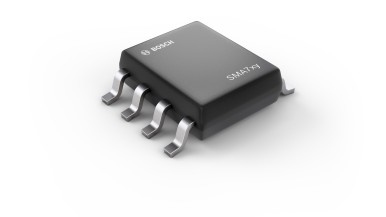
Munich and Reutlingen, Germany – Precision meets speed. At electronica, the world’s leading trade fair for electronics, Bosch announces a new generation of high-g acceleration sensors. The SMA7xy sensor family improves safety for car drivers and passengers. When the acceleration sensors detect a collision, the passive safety systems such as airbags can now be deployed earlier, and the restraining effect can be precisely set for the given accident scenario. In this way, the consequences of accidents can be further mitigated. The new SMA7xy family comprises of multiple sensors for airbag systems based on Bosch's market leading MEMS technology.Universally applicable, very fast crash sensors The sensors from the new SMA7xy product family enable extremely fast signal processing. Compared to the sensors of the preceding generation, Bosch has doubled the bandwidth, and thereby increased crash signal processing speeds by one hundred percent. The acceleration sensors are located either directly in the airbag ECU or in satellites located at the A- B- or C-pillar or at the front bumper. The sensors detect impact or a car rollover event within fractions of a second and send this information to the airbag ECU, which then deploys the vehicle's passive safety systems in time. One of the sensors from the SMA7xy family, the SMA760 precisely detects front and side impacts. A second sensor, the SMA720 contains one x and one z channel to measure acceleration along the vertical axis. This makes the SMA720 an ideal companion to the SMI860 for vehicle rollover detection. Both sensors support the SafeSPI communication interface standard. All sensors from the SMA7xy family conform to the ASIL D safety level of ISO 26262 and meet the VDA AK-LV27 specification. The PSI5 sensor versions, designed specifically for use along the periphery, offer a wide acceleration range: 30g, 60g, 120g, 240g, or 480g. For improved design flexibility Bosch offers a number of variants, for example an upright face mount option with a smaller footprint. Flexible options providing design freedom The peripheral-type sensors of the SMA7xy family are available in many variants, with two package options, four sensor axis configurations, several measurement range options and well over 80 different PSI5 modes – there is a suitable sensor to meet every requirement. One package option is the SOIC8, a well-established housing that is widely used and exceptionally robust, whilst the LGA System-in-package (SiP) houses integrated passive components.

MEMS sensors from Bosch make driving safer, more fun, and more relaxed

05.11.2018

Press release

Connected mobility

MEMS sensors from Bosch make driving safer, more fun, and more relaxed

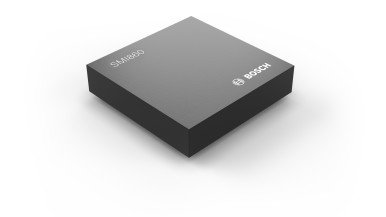
Munich and Reutlingen, Germany – Stable vehicle handling under all weather conditions and traffic situations makes car driving not only safer and more comfortable but also delivers a higher degree of enjoyment and dynamics to the driving experience. At the electronica exhibition in Munich, Bosch reveals for the first time its SMI860 five-axis inertial sensor. This extremely robust MEMS sensor enables a safe and natural driving experience – both in everyday as well as demanding situations – noticeably improving driving safety, comfort and dynamics.Car driving becoming even safer The intelligent SMI860 MEMS sensor provides important support for active safety and driver assistance systems inside the vehicle. For example, the ESP electronic stability control system (anti-skidding system), greatly increases traffic safety and has, to date, saved more than 8,500 lives in Europe alone. Necessary dynamic driving state data is delivered to the anti-skid system also from the SMI860. It recognizes whether the vehicle is travelling in the direction in which the steering wheel is turned. In the event that these values diverge, the skid protection system is activated. In addition, this new sensor can precisely determine the position of the vehicle, which can be utilized in precise vehicle heading applications. The SMI860 is the first example of a package from Bosch containing five inertial data measuring elements in a single sensor for active safety applications. The package includes two 16-bit gyroscopes for measuring yaw rate and roll rate, and three 16-bit acceleration sensors. Algorithms are used to calculate the dynamic driving state and position of the vehicle based on the received signals. Compact, robust, reliable, and temperature-tolerant This intelligent sensor is built on Bosch’s proven market-leading MEMS technology. Compared to its predecessor, it is better protected against vibrations and its exceptionally high offset stability will deliver reliable long-term operation. It has been developed according to ISO26262 for use in systems up to ASIL D. Thanks to its small bias instability, the SMI860 delivers low noise performance, thereby further improving its accuracy. Noise (rms) is just ±0.1 °/s for the gyroscope and 4 mg (x and y axes) and 6 mg (z axis) for the accelerometer. A signal conditioning ASIC provides on-chip processing and low-pass filtering, and an industry-standard SafeSPI interface is included for communication with other devices. To save space, the SMI860 is housed in a compact BGA package, measuring just 7mm x 7mm x 1.5mm. Required supply current for the sensor does not exceed 28mA. Its operating temperature range of -40ºC to +125ºC enables it to be installed in practically any location.

MEMS sensors from Bosch enable cars to navigate without GPS

05.11.2018

Press release

Connected mobility

MEMS sensors from Bosch enable cars to navigate without GPS

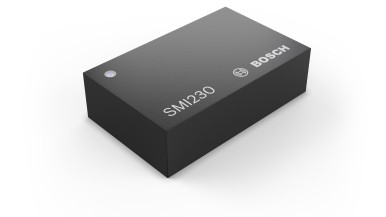
Munich and Reutlingen, Germany – The loss of a GPS signal has brought many relaxing car trips to an abrupt end. At Munich's world-renowned electronics exhibition: electronica, Bosch today announced the new SMI230 six-axis inertial sensor. With this sensor onboard, navigation systems will not take their eye off the destination – even when the GPS signal is interrupted. The SMI230 from Bosch provides the navigation system with motion data, enabling the current position of the travelling vehicle to be determined even when the GPS signal is weak or nonexistent. Navigation systems will become even more precise and reliable.No longer travelling blind when without GPS Millions of car drivers today rely on GPS navigation. If a satellite signal is weak, distorted or interrupted, e.g. due to mountains, tall buildings or even tunnels, then the navigation system will lose its direction. That is when the SMI230 MEMS sensor from Bosch comes into play: it precisely measures the yaw rate and acceleration of the vehicle. In this way the onboard navigation system continuously calculates the travel direction and position while the car is moving. The navigation is not disrupted when inside a tunnel or an 'urban canyon'. The capabilities of the sensor improve not only navigation but also find their niche in fleet management, toll systems and car alarm installations. Here too, precise determination of position is essential. Versatility brings flexibility The SMI230 conveniently combines one three-axis MEMS accelerometer with one three-axis MEMS gyroscope in a single compact package. Both sensors run digitally in 16-bit mode based on proven MEMS technology from Bosch. Adding to this already powerful combination is the fact that the gyroscope and accelerometer can either be operated individually or interconnected for data synchronization purposes. Accurate, stable and power efficient The SMI230 delivers high accuracy – the prerequisite for the best-possible precision in navigation: noise is only 0.02°/s/√Hz (rms) for the gyroscope and 0.12 mg/√Hz (rms) for the accelerometer. Also, the accelerometer has rock-solid temperature stability, with a low temperature coefficient offset (TCO) of typically below 0.2 mg/K and temperature coefficient sensitivity (TCS) of only 0.002 %/K. Typical bias instability of the gyroscope is well below 2°/h. Power consumption plays a decisive role in many applications. Therefore, the SMI230 supports three power saving modes - accelerometer: suspend mode; gyroscope: suspend mode and deep suspend mode. Backward compatible to accelerate the development cycle The SMI230 is pin-for-pin compatible with Bosch’s SMI130, and offers an identical gyroscope programming interface, making it fast and easy to integrate into existing platforms without any time-consuming layout re-work. The new sensor is housed in an ultra-compact 16-pin standard LGA package, measuring just 3 mm x 4.5 mm x 0.95 mm. The sensor will be available in May 2019.

Bosch and NIO sign strategic partnership agreement

09.07.2018

Press release

Business/economy

Bosch and NIO sign strategic partnership agreement

Berlin, Germany – The Bosch Group and electric vehicle company NIO signed a strategic cooperation agreement focused on sensor technology, automated driving, electric motor controls, and intelligent transport systems. The signing ceremony took place in Berlin in the presence of German Chancellor Dr. Angela Merkel and Chinese Premier Li Keqiang. NIO began delivering its 7-seat high performance electric SUV, ES8, to its users in China in June. The vehicle contains key components from Bosch, such as driver assistance systems, control units, sensors and the iBooster electromechanical brake booster. The components will be further developed for NIO’s future models.About Bosch in China Bosch has been present in China since 1909 and is active in all of its business sectors today. In the Mobility Solutions sector, the supplier of technology and services works together with international and local manufacturers as well as startups in China. Today, Bosch employs more than 60,000 associates at 60 locations in China and achieved sales of 14.9 billion euros on the Chinese market in 2017 – a double-digit growth year on year . Bosch focuses on strong localization in China. In addition to local partnerships, the focus is on local manufacturing, research and development for the Chinese market. In total, Bosch has invested more than 4.8 billion euros in its Chinese locations over the past ten years – in 2017 alone, the sum was almost 840 million euros. In Wuxi, the company has begun construction of a new mobility solutions facility, which will be the world’s first manufacturing facility for 48-volt batteries for electric cars. In November 2018, the first Bosch iBooster manufacturing site in Asia Pacific will be officially inaugurated in Nanjing to fulfill the increasing demand for electrified and autonomous solutions in China. Also this year, the second phase of the automotive electronics plant in Wujin, Changzhou, will be completed. Additionally, it is planned to open a center for artificial intelligence in China in 2018. About NIO NIO’s mission is to shape a joyful lifestyle by offering smart, premium electric vehicles and providing the best user experience. NIO was founded in November 2014 as a global electric vehicle company, with world-class research and development, design and manufacturing centers in Shanghai, Beijing, San Jose, Munich, London and nine other locations. Headed by Kris Tomasson, Vice President of Design, NIO’s global brand and product design is being developed in Germany. In November 2017, NIO’s German branch, NIO GmbH, was given an innovative leader award by the Chinese Chamber of Commerce in Germany. The NIO Formula E Team secured the inaugural Drivers’ Championship title in 2015. In 2016, NIO unveiled one of the fastest electric cars in the world, the EP9. The EP9 set the lap record for an electric vehicle at the Nürburgring Nordschleife and three other world-renowned tracks. In 2017, NIO unveiled its vision car EVE. NIO officially began deliveries of the ES8, a seven-seat high performance electric SUV, on June 28, 2018.