Search & find:
Media, press releases, events for your editorial coverage

Kilometre by kilometre, the eBike learns more

02.07.2024

Press release

Electrified mobility

Kilometre by kilometre, the eBike learns more

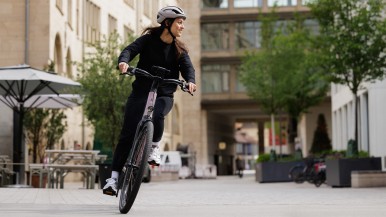
Stuttgart/Reutlingen – AI solutions are increasingly being used to make a variety of everyday tasks easier. They impress with personalised applications by analysing individual needs and continuously learning from them. Thanks to Connected Biking, the physical riding experience merges with the digital world. Consequently, the eBike has long become an intelligent companion. Connected via the eBike Flow app, it forms part of a modern, digital lifestyle and always remains up-to-date. Bosch eBike Systems integrates AI-based solutions into the smart system, which recognise user behaviour, learn from it and enable, for example, smarter route planning and navigation. We’re confident that Connected Biking is the future. Only by merging the physical riding experience with the digital world can the full potential of our eBike systems be realised....explains Gregor Dasbach, Vice President Digital Business at Bosch eBike Systems. “With the integration of AI, we are taking the next logical step in developing and creating priceless added value for eBikers: Kilometre by kilometre, the eBike learns more and unnoticed, becomes a smart and connected companion along the way.” Range Control: AI ensures greater reliability when it comes to range on the eBike The new, AI-based “Range Control” feature makes planning rides easier: eBikers no longer need to worry about their battery range. When you plan a route in the eBike Flow app, it immediately indicates the percent of battery charge remaining when you reach your destination. To display the most accurate range possible, the smart system gathers various information, including the system weight, the elevation profile of the route and your personal riding behaviour during your recent rides. Its predictions become increasingly precise: once the first activities have been recorded, the system is able to determine the battery status on arrival much more accurately than on the first journey. The predicted battery level is also updated during the journey and the current riding style is taken into account. This means that riders can concentrate fully on their eBike experience. To rule out every last worry about range during the journey, you can even set the desired minimum battery level at destination. The smart system takes care of the rest – extremely practical if, for example, charging isn’t possible before the return journey or the next ride. If required, eBikers can enable this additional feature via a toggle button in the eBike Flow app. A slider can then be used to precisely set the desired battery level at destination. Depending on the selection, the app indicates whether the route can be travelled with full, low or very low support. During the journey, the smart system then adjusts the motor support as necessary. This ensures that you arrive with the predetermined battery level. With this new development, wondering whether the battery will last to the destination is now a thing of the past for eBikes with a smart system from Bosch. Personalised arrival time and route planning The smart system also uses other AI features for personalised planning. The expected arrival time, for example, can be calculated and displayed before a ride. An analysis of previous riding behaviour on similar routes helps here. eBikers also benefit from personalised route suggestions: The smart system knows, for example, which road types, which surfaces and which gradients and speeds are preferred, and makes a corresponding route recommendation. Current charge level for easy planning and detailed maps for Kiox displays Further new functions make navigation and planning even easier. With the “current charge level” feature , users can track the battery status live during the charging process on the eBike Flow app and view it anytime and anywhere. So you can plan your next tour or onward journey at home on the couch or in a cosy café. The “extended navigation” feature enhances the navigation display on the Kiox 300 and Kiox 500 displays. This no longer only shows the planned route and junctions, but also all side roads. These new, additional map details ensure the best possible orientation and intuitive navigation. “Extended navigation” and “current charge level” are part of the Flow+ subscription service. New insights on completed journeys Bosch also presents numerous innovations in terms of the ride statistics. This means that all riders who have a Bosch eBike ABS installed on their eBike can view the percentage of braking manoeuvres with and without ABS as a direct comparison in the eBike Flow app. During the ride, the number of braking manoeuvres where ABS was activated is also displayed. The “riding mode usage” display is no longer only available during the ride, but also as a statistic afterwards. A clear pie chart shows the ratios of the riding modes used (including Off mode). The same applies to the “power share” screen. The “power share” screen provides insights into the average rider power compared to the average power of the drive unit, based on current activity and the selected riding mode. This information helps eBikers to improve their fitness level and optimise their training. Display of riding mode usage and power share after the ride are both part of Flow+. New Eco+ mode enables long ranges In addition to the digital features, Bosch is also introducing a new riding mode for the smart system. The new Eco+ mode blurs the boundaries between eBiking and normal cycling, saves energy and enables particularly long ranges. It is particularly suitable for eBikers who enjoy pedalling without support on flat terrain, but do not want to do without a motor on climbs or when overtaking, for example. Depending on the rider performance, the motor remains completely switched off until an activation threshold that can be customised in the eBike Flow app is exceeded. This is ideal for lightweight eBikes, but also for eSUVs and eTrekking bikes. When support is no longer required, the motor switches off automatically. This makes it easy to save energy and extend the range, making even lengthy tours possible without charging or replacing the battery. The Eco+ mode is available for all drive units with the smart system from Bosch eBike Systems and can be installed on your own eBike using the eBike Flow app. Even more customisation: display configuration on the Purion 200 The networking of components creates new possibilities for customisation. Like the Kiox 300 and Kiox 500 displays, the display of the Purion 200 control unit can now also be customised according to your own preferences: eBikers can sort, add or delete content in the eBike Flow app. You prefer the speed to be displayed on the left and always want the heart rate on the right? No problem, because two tiles per screen can be freely assigned. The screen order can also be redefined.


Bosch Hemoglobin Monitor: Early detection of anemia without blood tests

11.01.2021

Press release

Business/economy

Bosch Hemoglobin Monitor: Early detection of anemia without blood tests

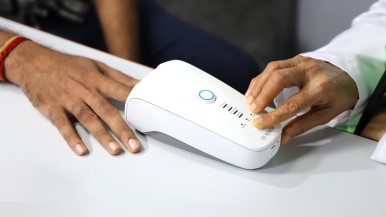
Bengaluru, India / Waiblingen, Germany – According to estimations by the WHO 1.6 billion people suffer from Anemia, a condition resulting from the reduced hemoglobin concentration in the blood. This has prompted the WHO to define the fight against anemia as one of its critical sustainable development goals for 2025. Bosch has developed a portable Hemoglobin Monitor Solution (HMS) especially for regions where routine access to medical care tends to be difficult. This HMS allows a large number of people to be screened for anemia rapidly, safely, using a non-invasive approach. The solution has been named a CES Innovation Award Honoree in the “Health and Wellness” category. “Bosch has developed the non-invasive Hemoglobin monitor as an innovative solution and as an alternative to traditional methods for the early detection of anemia. This should offer people better diagnosis options even in resource constrained conditions. The use of artificial intelligence is revolutionizing anemia management, specifically in point-of-care setups and closer to the patient”, explains Dattatri Salagame, President and Managing Director of Robert Bosch Engineering and Business Solutions Private Limited (RBEI). Bosch has developed the non-invasive Hemoglobin monitor as an innovative solution and as an alternative to traditional methods for the early detection of anemia. This should offer people better diagnosis options even in resource constrained conditions. The use of artificial intelligence is revolutionizing anemia management, specifically in point-of-care setups and closer to the patient....Dattatri Salagame, President and Managing Director of Robert Bosch Engineering and Business Solutions Private Limited (RBEI) Hemoglobin is a protein found in red blood cells and is responsible for carrying oxygen and carbon dioxide throughout the body. People with a low hemoglobin count may experience symptoms such as general fatigue, weakness, pale skin, and even serious illnesses. Anemia particularly affects women, even more so when they are pregnant, and also people suffering from malnutrition. In cancer patients undergoing chemotherapy or in palliative care, hemoglobin levels should be checked regularly. Hemoglobin results in 30 seconds using a non-invasive AI measurement The intelligent solution by Bosch is designed for use directly at the point-of-care and is completely pain-free with no need for a blood test, as the value is determined by a finger scanner using multi-wavelength spectrophotometry on the surface of the skin. The system uses an optical sensor to precisely and reliably measure the photoplethysmogram (PPG) signals. Photoplethysmography, or PPG, is an optical technique used to detect volumetric changes in blood in peripheral circulation. The device provides a reliable result within 30 seconds even for low hemoglobin concentrations. This is where machine learning comes in: the device’s algorithm monitors the wavelength of the light and uses 27 different characteristics to determine and classify the hemoglobin value. The algorithm has been trained with more than 10,000 anemia data points. These clinically collected data along with the corresponding ground truth data, are the basis for the machine learning algorithm. The more validated data sets are put into the continuously learning algorithm, the more precise the results will be. Lab-free results without risk of infection A laboratory analysis is not necessary and there is no risk of infection from contaminated needles. Participants receive their test results quickly at the point of care. The device is battery operated, does not need subsequent calibration, and is extremely easy to use. It is intended for use in outlying and remote regions by healthcare professionals. Location-based reporting ensures easy clinical traceability. Organizations that operate multiple devices can draw conclusions through heat maps about specific regions. Patient data remains anonymous. Market release in India is expected by mid-2021.

Bosch boosts its AI expertise: center for data science and AI opens at leading I ...

06.02.2019

Press release

Artificial Intelligence

Bosch boosts its AI expertise: center for data science and AI opens at leading I ...

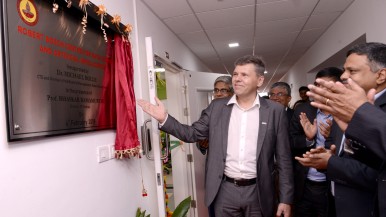
Chennai, India – Bosch today opened the Robert Bosch Center for Data Science and Artificial Intelligence (RBC-DSAI) at the Indian Institute of Technology Madras (IITM), one of the country’s leading engineering institutes. The center will contribute to basic research in the fields of data science and artificial intelligence (AI) and aim to work on an interdisciplinary basis with scientists, politicians, and businesspeople. Bosch’s investment will amount to 2.5 million euros over a five-year period. In supporting this new AI center at IITM, Bosch wants to further extend its expertise in the field of artificial intelligence and data science in India. Speaking at the inauguration ceremony in Chennai (formerly Madras), the company’s chief digital officer Dr. Michael Bolle underscored the importance of AI for the future of every aspect of connected living. “Artificial Intelligence is a core technology of the future. Our Indian engineers are playing a significant part in expanding our company’s AI skills set.” Since 2017, Bosch already has its own AI Center in India: the Bosch Center for Artificial Intelligence (BCAI) has one of its main locations in Bengaluru, alongside further locations in Sunnyvale and Pittsburgh in the United States and Renningen in Germany.About IITM The Indian Institute of Technology Madras was set up by the Indian government in 1959. Its work in various fields of engineering and science is carried out by 16 academic departments and several interdisciplinary research centers. IITM is a residential institute with nearly 550 faculty and 9,000 students. In 2016, 2017, and 2018, IITM was ranked the country’s top engineering institute. About Bosch in India The Bosch Group has been present in India since 1922. All four of its business sectors now operate in the country, where the company has 15 manufacturing sites. The 18,000 highly qualified engineers working for Bosch in India make the country its biggest development hub outside Germany. The company employs more than 31,000 associates in India, and generated sales revenue of some 2.1 billion euros there in 2017.

Bosch and NIO sign strategic partnership agreement

09.07.2018

Press release

Business/economy

Bosch and NIO sign strategic partnership agreement

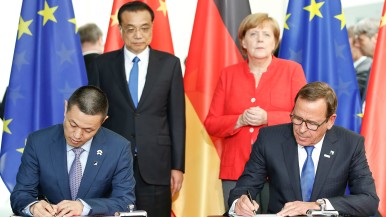
Berlin, Germany – The Bosch Group and electric vehicle company NIO signed a strategic cooperation agreement focused on sensor technology, automated driving, electric motor controls, and intelligent transport systems. The signing ceremony took place in Berlin in the presence of German Chancellor Dr. Angela Merkel and Chinese Premier Li Keqiang. NIO began delivering its 7-seat high performance electric SUV, ES8, to its users in China in June. The vehicle contains key components from Bosch, such as driver assistance systems, control units, sensors and the iBooster electromechanical brake booster. The components will be further developed for NIO’s future models.About Bosch in China Bosch has been present in China since 1909 and is active in all of its business sectors today. In the Mobility Solutions sector, the supplier of technology and services works together with international and local manufacturers as well as startups in China. Today, Bosch employs more than 60,000 associates at 60 locations in China and achieved sales of 14.9 billion euros on the Chinese market in 2017 – a double-digit growth year on year . Bosch focuses on strong localization in China. In addition to local partnerships, the focus is on local manufacturing, research and development for the Chinese market. In total, Bosch has invested more than 4.8 billion euros in its Chinese locations over the past ten years – in 2017 alone, the sum was almost 840 million euros. In Wuxi, the company has begun construction of a new mobility solutions facility, which will be the world’s first manufacturing facility for 48-volt batteries for electric cars. In November 2018, the first Bosch iBooster manufacturing site in Asia Pacific will be officially inaugurated in Nanjing to fulfill the increasing demand for electrified and autonomous solutions in China. Also this year, the second phase of the automotive electronics plant in Wujin, Changzhou, will be completed. Additionally, it is planned to open a center for artificial intelligence in China in 2018. About NIO NIO’s mission is to shape a joyful lifestyle by offering smart, premium electric vehicles and providing the best user experience. NIO was founded in November 2014 as a global electric vehicle company, with world-class research and development, design and manufacturing centers in Shanghai, Beijing, San Jose, Munich, London and nine other locations. Headed by Kris Tomasson, Vice President of Design, NIO’s global brand and product design is being developed in Germany. In November 2017, NIO’s German branch, NIO GmbH, was given an innovative leader award by the Chinese Chamber of Commerce in Germany. The NIO Formula E Team secured the inaugural Drivers’ Championship title in 2015. In 2016, NIO unveiled one of the fastest electric cars in the world, the EP9. The EP9 set the lap record for an electric vehicle at the Nürburgring Nordschleife and three other world-renowned tracks. In 2017, NIO unveiled its vision car EVE. NIO officially began deliveries of the ES8, a seven-seat high performance electric SUV, on June 28, 2018.