Search & find:
Media, press releases, events for your editorial coverage

World first: Bosch and Daimler obtain approval for driverless parking without hu ...

23.07.2019

Press release

Connected mobility

World first: Bosch and Daimler obtain approval for driverless parking without hu ...

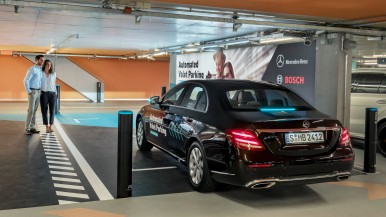
Stuttgart, Germany – Bosch and Daimler have reached a milestone on the way to automated driving: the two companies have now obtained approval from the relevant authorities in Baden-Württemberg for their automated parking system in the Mercedes-Benz Museum parking garage in Stuttgart. The automated valet parking service is accessed via a smartphone app and requires no safety driver. This makes it the world’s first fully automated driverless SAE Level 4 1 parking function to be officially approved for everyday use. This decision by the authorities shows that innovations like automated valet parking are possible in Germany first. ...Dr. Markus Heyn, member of the board of management of Robert Bosch GmbH “This decision by the authorities shows that innovations like automated valet parking are possible in Germany first,” says Dr. Markus Heyn, member of the board of management of Robert Bosch GmbH. “Driverless driving and parking are important building blocks for tomorrow’s mobility. The automated parking system shows just how far we have already progressed along this development path.” “This approval from the Baden-Württemberg authorities sets a precedent for obtaining approval in the future for the parking service in parking garages around the world,” says Dr. Michael Hafner, the head of drive technologies and automated driving at Daimler AG. “As a pioneer in automated driving, our project paves the way for automated valet parking to go into mass production in the future.” Driverless driving and parking are important building blocks for tomorrow’s mobility. The automated parking system shows just how far we have already progressed along this development path....Dr. Markus Heyn, member of the board of management of Robert Bosch GmbH Playing it safe: two partners with a common objective From the very beginning, Bosch and Daimler’s top priority for the driverless parking service was safety. Since there is as yet no official approval process for automated driving functions that do not require a driver, the local authorities – the Stuttgart regional administrative authority and the state of Baden-Württemberg’s transportation ministry – oversaw the project along with experts from the German technical inspection service TÜV Rheinland from the outset. Their aim was to assess the operating safety of the automotive and parking-garage technology. The result is a comprehensive safety concept with appropriate testing and approval criteria that can be applied beyond this pilot project. In the concept, the developers defined how the driverless vehicle detects pedestrians and other cars in its path and reliably comes to a halt when it encounters an obstacle. They also set up secure communications between all system components and took steps to ensure the reliable activation of the parking maneuver. The technology behind driverless parking Drive in to the parking garage, get out, and send the car to a parking space just by tapping on a smartphone screen – automated valet parking has no need for a driver. Once the driver has left the parking garage to go about their business, the car drives itself to an assigned space and parks. Later, the car returns to the drop-off point in exactly the same way. This process relies on the interplay between the intelligent parking garage infrastructure supplied by Bosch and Mercedes-Benz automotive technology. Bosch sensors in the parking garage monitor the driving corridor and its surroundings and provide the information needed to guide the vehicle. The technology in the car converts the commands from the infrastructure into driving maneuvers. This way, cars can even drive themselves up and down ramps to move between stories in the parking garage. If the infrastructure sensors detect an obstacle, the vehicle stops immediately. Project milestones Bosch and Daimler started developing fully automated driverless parking in 2015, and in the summer of 2017, their pilot solution in the Mercedes-Benz Museum parking garage in Stuttgart reached an important milestone: automated valet parking in real conditions, with and without drivers at the wheel, was presented to the public for the first time. This premiere was followed by an intensive testing and start-up phase. Starting in 2018, museum visitors could use the parking service live, accompanied by trained safety personnel, and share their experience. One aspect of the pilot project involved testing lighting concepts on the vehicles. Turquoise lighting indicates that a vehicle is in automated driving mode and informs passers-by and other road users that the vehicle is driving itself. The insights from these tests are reflected in the recently issued SAE standard 3134. Obtaining final approval from the authorities is a further major milestone for Bosch and Daimler: soon, interested parties will be able to experience the innovative valet parking service live in daily operation in the Mercedes-Benz Museum parking garage without additional supervision from a safety driver.

In automated vehicles, the seat-of-the-pants feel comes from the Bosch cloud

25.07.2018

Press release

Automated mobility

In automated vehicles, the seat-of-the-pants feel comes from the Bosch cloud

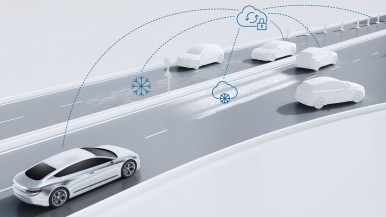
Stuttgart, Germany – Haptic sensation when driving is something that shouldn’t be underestimated. What condition is the road in, how well are the tires gripping? Having or developing a feeling for this can help drivers handle their cars appropriately and safely. Race drivers already have a word for it: seat-of-the-pants feel. They mean the contact between the seat of their pants and their driving seat, which allows them to feel the state of the road surface. Automated vehicles also urgently need information about road conditions. Unfortunately, however, they don’t have any feeling for such conditions – or haven’t up to now. Bosch has developed a system that gives automated vehicles seat-of-the-pants feel. “Wet roads, snow, ice – with our predictive road-condition services, we alert to hazards before critical situations can develop. We are helped here by the weather data provided by our partner Foreca. This means an automated vehicle will know exactly where it can drive autonomously, and how,” says the Bosch management board member Dr. Dirk Hoheisel. With our predictive road-condition services, we alert to hazards before critical situations can develop....Dr Dirk Hoheisel Foreca is one of the world’s leading providers of weather information, with two decades of experience in predicting road weather conditions. “Combining the expertise of Foreca and Bosch will lead to a new era of road-condition forecasting. Unlike weather forecasts in the media, the Bosch road-condition services take multiple possible forecast scenarios into consideration,” says Petri Marjava, Foreca’s sales director. The road-condition services boost driving safety and smoothness. In addition, the availability of automated driving functions is increased. The Bosch services package is to be rolled out worldwide in 2020, initially on the basis of weather data. As more and more connected cars appear on the roads, the service will be augmented by vehicle data. Automated vehicles adjust their speed in good time Up to the highly automated SAE level 4, the decision as to whether a car can assume the task of driving depends on factors such as road type, speed range, and environmental conditions. In future automated vehicles, this decision will also be based on the predictive road-condition services provided by Bosch. Thanks to their help, the automated vehicle will know in good time what environmental conditions to expect. This means it will have plenty of time to adapt its driving style, instead of having to hand over the driving task to the driver at the first sign of impaired road conditions, however minor. If the vehicle’s route takes it through rain, it will adapt its speed well in advance to a level that excludes any risk of aquaplaning and allows it to stop safely at any time. Whatever the SAE automation level, the result is a safe drive that is also smooth and comfortable. Driving automatically, whenever and wherever possible For its predictive road-condition services, Bosch is relying on a multiphase concept. By the time of its planned launch in 2020, it cannot be expected that there will be a sufficiently large proportion of connected vehicles on the roads. Bosch estimates it would take some 20 million connected cars to cover the roughly 80,000 kilometers of freeway in Europe alone. For this reason, road-weather forecasts will initially be the only reliable source of information for drawing sound conclusions about road conditions, especially in rural areas where there is less traffic. Bosch will get the constantly updated global road-weather data it needs for this from Foreca. Bosch’s thorough examination of several leading providers showed that the Finnish weather experts were the most accurate road-weather data provider globally. The more precisely hazardous conditions can be predicted and localized, the easier it will be to keep the availability of automated driving functions to a maximum. Thanks to a worldwide reference measuring fleet and machine learning methods, Bosch and Foreca have jointly been able to optimize the safety and availability of the road-weather models. In this way, the two companies have achieved a safety standard of the kind that will be necessary for life-critical systems such as automated driving. ESP interventions allow friction coefficient to be determined As a sufficient number of connected vehicles take to the roads, Bosch will supplement its predictive road-condition services with vehicle data. These data will include information stored on the CAN bus, the vehicle’s central data network, such as the temperatures measured inside and outside the vehicle, and whether the windshield wipers are in use. Thanks to connectivity, this data will not remain unused in the vehicle, but will find its way into the Bosch cloud via the respective automaker’s back-end server. In addition, Bosch will evaluate the regular interventions by the ESP anti-skid system. Using mathematical methods, engineers can measure the friction coefficient of the road surface at each individual wheel, as well as the status of each wheel. When all these data are combined and intelligently evaluated, the result is a package of smart Bosch services – and the comforting feeling of being in safe hands.


Bosch and NIO sign strategic partnership agreement

09.07.2018

Press release

Business/economy

Bosch and NIO sign strategic partnership agreement

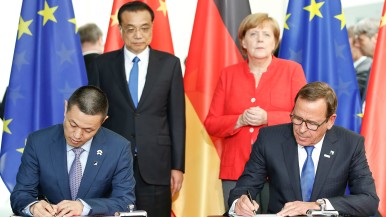
Berlin, Germany – The Bosch Group and electric vehicle company NIO signed a strategic cooperation agreement focused on sensor technology, automated driving, electric motor controls, and intelligent transport systems. The signing ceremony took place in Berlin in the presence of German Chancellor Dr. Angela Merkel and Chinese Premier Li Keqiang. NIO began delivering its 7-seat high performance electric SUV, ES8, to its users in China in June. The vehicle contains key components from Bosch, such as driver assistance systems, control units, sensors and the iBooster electromechanical brake booster. The components will be further developed for NIO’s future models.About Bosch in China Bosch has been present in China since 1909 and is active in all of its business sectors today. In the Mobility Solutions sector, the supplier of technology and services works together with international and local manufacturers as well as startups in China. Today, Bosch employs more than 60,000 associates at 60 locations in China and achieved sales of 14.9 billion euros on the Chinese market in 2017 – a double-digit growth year on year . Bosch focuses on strong localization in China. In addition to local partnerships, the focus is on local manufacturing, research and development for the Chinese market. In total, Bosch has invested more than 4.8 billion euros in its Chinese locations over the past ten years – in 2017 alone, the sum was almost 840 million euros. In Wuxi, the company has begun construction of a new mobility solutions facility, which will be the world’s first manufacturing facility for 48-volt batteries for electric cars. In November 2018, the first Bosch iBooster manufacturing site in Asia Pacific will be officially inaugurated in Nanjing to fulfill the increasing demand for electrified and autonomous solutions in China. Also this year, the second phase of the automotive electronics plant in Wujin, Changzhou, will be completed. Additionally, it is planned to open a center for artificial intelligence in China in 2018. About NIO NIO’s mission is to shape a joyful lifestyle by offering smart, premium electric vehicles and providing the best user experience. NIO was founded in November 2014 as a global electric vehicle company, with world-class research and development, design and manufacturing centers in Shanghai, Beijing, San Jose, Munich, London and nine other locations. Headed by Kris Tomasson, Vice President of Design, NIO’s global brand and product design is being developed in Germany. In November 2017, NIO’s German branch, NIO GmbH, was given an innovative leader award by the Chinese Chamber of Commerce in Germany. The NIO Formula E Team secured the inaugural Drivers’ Championship title in 2015. In 2016, NIO unveiled one of the fastest electric cars in the world, the EP9. The EP9 set the lap record for an electric vehicle at the Nürburgring Nordschleife and three other world-renowned tracks. In 2017, NIO unveiled its vision car EVE. NIO officially began deliveries of the ES8, a seven-seat high performance electric SUV, on June 28, 2018.

Bosch scores big in Japan with clever technology

07.06.2018

Press release

Business/economy

Bosch scores big in Japan with clever technology

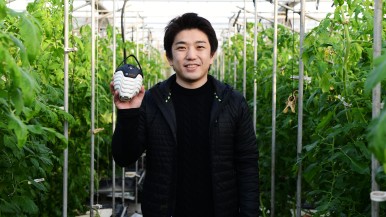
Tokyo – The Bosch Group is scoring big in Japan thanks to its innovative and intelligent solutions for the local market as well as for the global Japanese automotive industry. “Bosch has made impressive progress in Japan. We are working with Japanese automakers to drive forward the automation, electrification, and connectivity of mobility. In addition, we are increasingly focusing on IoT solutions, such as smart agriculture,” says Klaus Meder, the president of Bosch Japan. Last year, the leading supplier of technology and services recorded sales of 2.3 billion euros in Japan, an increase of roughly 10 percent over the previous year. Bosch Japan also made a good start to 2018, mainly due to strong growth for the Mobility Solutions business sector, which generates a significant share of the company’s sales in Japan. In 2017, the company grew twice as fast in this area as the local market. The Industrial Technology business sector also performed well. Bosch has been operating in Japan since 1911 and currently employs some 6,600 people in the country.Business with Japanese automakers sees double-digit growth In 2017, Bosch’s global sales to Japanese automakers rose year-on-year by around 11 percent, which makes it the sixth year in a row these have posted double-digit growth. Looking ahead, Bosch expects this trend to continue over the medium term. Bosch not only supplies Japanese automakers locally, but also works closely with them around the globe. In the ASEAN region, for example, Japanese automakers enjoy a market share of around 90 percent. Accordingly, the region is a focus of investment for the Bosch Group. For instance, at the end of 2017, the company opened its second plant for mobility solutions in Thailand, representing a total investment of 80 million euros. The new smart factory in Hemaraj manufactures components including injection valves, interconnect technology, and knock sensors. The site also houses a research and development center at which around 60 associates work on the further refinement of gasoline injection systems. Bosch is also expanding its manufacturing operations in Vietnam. Since 2008, the company has been producing push belts for continuously variable automatic transmissions in Dong Nai, which is located about 40 km east of Ho Chi Minh City. Bosch is currently investing around 60 million euros to convert this plant into a smart factory and increase its production capacity. By the end of 2018, total investment in the site will have exceed 320 million euros since 2011. Expanding IoT business: smart farming solutions In addition to its mobility solutions business, Bosch is also focusing on developing connected solutions in Japan, for which it is drawing on the country's high degree of innovative strength. Last year, for example, saw the launch of Plantec, a smart system for optimizing tomato cultivation in Japanese greenhouses. The solution is tailored to the local market, as greenhouse cultivation is particularly widespread in the country. Plantec uses sensors to measure humidity, temperature, carbon dioxide levels, and sunlight. These environmental parameters are crucial for plant growth and data on them is collected and sent via a gateway to a cloud server. There, a system analyzes the data and takes into account additional important agricultural parameters as well as the weather forecast. The results of the analysis are displayed in an app. The system can analyze the risk of infection and use artificial intelligence to plan the use of pesticides in advance. It can thus help farmers minimize crop loss. Work on this project is being carried out in conjunction with the Bosch Center for Artificial Intelligence (BCAI). At the end of 2018, the company plans to expand this service to strawberry and cucumber cultivation. Bosch's goal is to supply around 10 percent of Japan's greenhouses by 2020.

Bosch presents solutions to connect mobility in China at Auto Beijing 2018

26.04.2018

Press release

Connected mobility

Bosch presents solutions to connect mobility in China at Auto Beijing 2018

Beijing – Bosch is transforming driving with connected services to make mobility more flexible and less stressful. The leading global supplier of technology and services is highlighting its connected mobility solutions at Auto China 2018. Together with its comprehensive range of solutions for electrification and automation, the company aims to reshape the future of mobility in China. “China's automotive industry is in a phase of fast-paced development. Smart connected mobility and automated driving are on track to becoming part of our daily lives,” said Dr. Rolf Bulander, member of the board of management of Robert Bosch GmbH and chairman of the Mobility Solutions business sector. China's automotive industry is in a phase of fast-paced development. Smart connected mobility and automated driving are on track to becoming part of our daily lives,...said Dr. Rolf Bulander, member of the board of management of Robert Bosch GmbH and chairman of the Mobility Solutions business sector. Sales growth of Bosch Mobility Solutions in China outstrips domestic auto production Sales of Bosch‘s Mobility Solutions in China surged 25 percent year on year to 11 billion Euro (82.9 billion RMB) in 2017 – a growth rate far higher than that of domestic auto production and sales. To achieve this result, Bosch’s focuses on a strong localization strategy in China and provides a comprehensive range of solutions tailor-made for the local market. Rising demands for commercial and new energy vehicles have also been central to fueling this growth. Furthermore, the expansion of Bosch's driver assistance system business has been particularly strong in favor of the rapid introduction of automated driving in local markets. Sustained investment in China and advancements in manufacturing capabilities through R&D efforts have laid a solid basis for Bosch's stable and long-term growth. As testament to this, by the end of 2017, the Mobility Solutions division already had 23 automotive manufacturing locations in China. In May this year, the new plant of the Car Multimedia unit in Wuhu, which will produce infotainment systems, will commence operations. Then the first Bosch iBooster production base in the Asia Pacific will officially start production in Nanjing in November, helping to meet China's growing demand for electrified and automated driving solutions. The second phase of the Automotive Electronics plant in Wujin, Changzhou, will also be completed this year, marking a total investment in the facility of 800 million RMB. Partnerships with local companies are also being strengthened with United Automotive Electronic Systems Co., Ltd., a joint venture between Bosch and Zhong-Lian Automotive Electronics, scheduled to complete construction of new plants in Taicang and Liuzhou in April and June, respectively. The company mainly produces injection system and control units for cars. New division for connected mobility services As the government rolls out its nationwide smart connected driving strategy and given the young average age of car buyers in China, the demand for smart vehicles is rising. The explosion in the number of mobile internet users has also accelerated the pace at which the Chinese market for Internet-connected vehicles has grown. In addressing these trends, at the start of this year, Bosch established a new global Connected Mobility Solutions division to meet the increasingly diversified requirements for connected mobility services. China is a strategic market for growth for the new entity. “Bosch realized early on that internet-connected driving is an important growth area and besides providing a real-time connection between vehicles, users, and the internet, we are also looking at offering digital services that make mobility stress-free and enjoyable,” said Dr. Bulander. Building on Bosch's wealth of experience and proven accomplishments in the fields of vehicle technology and mobility, the new division will expand mobility options that are more suited to China's current driving conditions. This will include smart parking solutions, predictive diagnostics based on deep data mining, as well as advanced fleet management systems. Innovation also in electrification and automation Connected mobility is just one potential field of growth for Bosch in China, however. At China Auto Show, the company is presenting complete powertrain solutions to demonstrate a one-stop solution in the field of electrification. With an energy-saving and efficient intelligent thermal management system, a vehicle's heat flow can be effectively managed, extending the range of an electric vehicle and ensuring comfort of the driver and passengers. Bosch's latest powertrain solution innovatively integrates the motor, power and transmission components into a compact unit that directly drives the car’s axle – the eAxle. Bosch sells this electric axle drive to a wide range of customers – to established automakers and start-ups alike. Here, Bosch customers also benefit from the company’s global research and engineering network. The latter allows the company to carry out projects in China flexibly and close to its customers. Bosch driver assistance systems have already been installed in cars made by 24 Chinese auto brands. These are paving the way for automated driving in China. Bosch’s automated driving team in China continues to work actively with a number of domestic automakers on Level 2 automated technology.