Search & find:
Media, press releases, events for your editorial coverage

Bosch Hemoglobin Monitor: Early detection of anemia without blood tests

11.01.2021

Press release

Business/economy

Bosch Hemoglobin Monitor: Early detection of anemia without blood tests

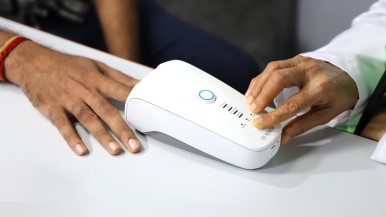
Bengaluru, India / Waiblingen, Germany – According to estimations by the WHO 1.6 billion people suffer from Anemia, a condition resulting from the reduced hemoglobin concentration in the blood. This has prompted the WHO to define the fight against anemia as one of its critical sustainable development goals for 2025. Bosch has developed a portable Hemoglobin Monitor Solution (HMS) especially for regions where routine access to medical care tends to be difficult. This HMS allows a large number of people to be screened for anemia rapidly, safely, using a non-invasive approach. The solution has been named a CES Innovation Award Honoree in the “Health and Wellness” category. “Bosch has developed the non-invasive Hemoglobin monitor as an innovative solution and as an alternative to traditional methods for the early detection of anemia. This should offer people better diagnosis options even in resource constrained conditions. The use of artificial intelligence is revolutionizing anemia management, specifically in point-of-care setups and closer to the patient”, explains Dattatri Salagame, President and Managing Director of Robert Bosch Engineering and Business Solutions Private Limited (RBEI). Bosch has developed the non-invasive Hemoglobin monitor as an innovative solution and as an alternative to traditional methods for the early detection of anemia. This should offer people better diagnosis options even in resource constrained conditions. The use of artificial intelligence is revolutionizing anemia management, specifically in point-of-care setups and closer to the patient....Dattatri Salagame, President and Managing Director of Robert Bosch Engineering and Business Solutions Private Limited (RBEI) Hemoglobin is a protein found in red blood cells and is responsible for carrying oxygen and carbon dioxide throughout the body. People with a low hemoglobin count may experience symptoms such as general fatigue, weakness, pale skin, and even serious illnesses. Anemia particularly affects women, even more so when they are pregnant, and also people suffering from malnutrition. In cancer patients undergoing chemotherapy or in palliative care, hemoglobin levels should be checked regularly. Hemoglobin results in 30 seconds using a non-invasive AI measurement The intelligent solution by Bosch is designed for use directly at the point-of-care and is completely pain-free with no need for a blood test, as the value is determined by a finger scanner using multi-wavelength spectrophotometry on the surface of the skin. The system uses an optical sensor to precisely and reliably measure the photoplethysmogram (PPG) signals. Photoplethysmography, or PPG, is an optical technique used to detect volumetric changes in blood in peripheral circulation. The device provides a reliable result within 30 seconds even for low hemoglobin concentrations. This is where machine learning comes in: the device’s algorithm monitors the wavelength of the light and uses 27 different characteristics to determine and classify the hemoglobin value. The algorithm has been trained with more than 10,000 anemia data points. These clinically collected data along with the corresponding ground truth data, are the basis for the machine learning algorithm. The more validated data sets are put into the continuously learning algorithm, the more precise the results will be. Lab-free results without risk of infection A laboratory analysis is not necessary and there is no risk of infection from contaminated needles. Participants receive their test results quickly at the point of care. The device is battery operated, does not need subsequent calibration, and is extremely easy to use. It is intended for use in outlying and remote regions by healthcare professionals. Location-based reporting ensures easy clinical traceability. Organizations that operate multiple devices can draw conclusions through heat maps about specific regions. Patient data remains anonymous. Market release in India is expected by mid-2021.


Bosch puts 5G machines in pole position

26.11.2019

Press release

Business/economy

Bosch puts 5G machines in pole position

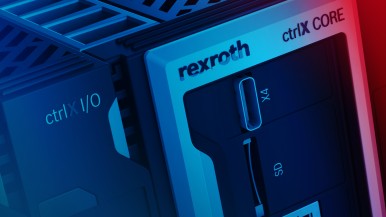
Stuttgart, Germany – 5G is coming. The new communications standard accelerates the internet of things and boosts Industry 4.0. Control systems and sensors of the kind built into facilities, machinery, and logistics chains stand to gain from this fast, reliable real-time wireless data transfer. Preparing machines for state-of-the-art communication involves making them 5G-capable. Now Bosch has the solution: Bosch Rexroth’s new ctrlX AUTOMATION control technology comes with 5G built in and can connect a wide range of industrial devices with the new communications standard. ctrlX AUTOMATION will be showcased at the SPS trade fair in Nuremberg.Bosch opens the door to a new industrial age 5G is set to turbocharge manufacturing. Our new 5G-capable automation platform lays the groundwork and opens the door to a new industrial age,...says Rolf Najork, the member of the Bosch board of management responsible for industrial technology. 5G is the first communications standard designed to enable connectivity for people as well as for the internet of things. The new standard has impressive characteristics: it is up to 20 times faster than 4G, transfers data virtually instantaneously with a latency of one millisecond, and is up to 99.9999 percent reliable – making the receipt of a “digital shipment” as certain as with transmission through a wire. "5G is a revolution and an important building block for the factory of the future", Najork says. Engineers and designers now face the challenges of integrating 5G into their machines and products. Bosch is introducing the solution that meets their needs: the new automation platform’s hardware can be fitted with a 5G module. The operating system and software for ctrlX AUTOMATION are 5G-capable from the outset and support rapid commissioning. Retrofit solutions are also available for adding the new technology to existing machinery. Bosch Rexroth’s new automation platform is scheduled to have its market launch in 2020. 5G will be a competitive factor for connected industry Experts estimate that there will be up to 70 billion connected devices worldwide by 2025. Many of them will be in manufacturing, meaning that 5G will become a competitive factor. The new communications standard will enable applications that require high-power, extremely reliable wireless connections to be integrated securely and efficiently into manufacturing facilities. These include mobile robotics, autonomous transport vehicles, and human-machine interactions. For instance, workers wearing augmented reality glasses can access additional information in their field of vision, optimizing how they monitor and maintain machinery. Combining tasks in the virtual world with those in the real world calls for real-time data flows. And that’s what 5G promises. "This new form of communication eclipses everything we’ve had until now. 5G is the first wireless protocol to truly meet the needs of the manufacturing industry", Najork says. Bosch takes on leadership role in Industry 4.0 and 5G Bosch is developing the factory of the future. In this endeavor, the company is relying on Industry 4.0 . The company first tests and validates products in-house before they are available on the market. Bosch is taking this approach with 5G, too. The company presented its first 5G-capable autonomous transport system, ActiveShuttle , at the Hannover Messe. To support the further development of its factories, Bosch has applied to the German Federal Network Agency for 5G licenses with which to set up local campus networks. Moreover, Bosch has taken on the chair of the global 5G Alliance for Connected Industries and Automation (5G-ACIA) with the aim of shaping the new mobile standard so that it meets the needs of the manufacturing industry from the outset.

Bosch boosts its AI expertise: center for data science and AI opens at leading I ...

06.02.2019

Press release

Artificial Intelligence

Bosch boosts its AI expertise: center for data science and AI opens at leading I ...

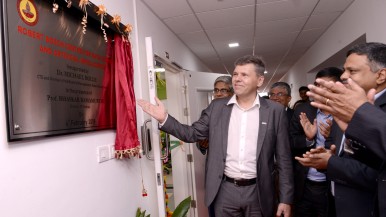
Chennai, India – Bosch today opened the Robert Bosch Center for Data Science and Artificial Intelligence (RBC-DSAI) at the Indian Institute of Technology Madras (IITM), one of the country’s leading engineering institutes. The center will contribute to basic research in the fields of data science and artificial intelligence (AI) and aim to work on an interdisciplinary basis with scientists, politicians, and businesspeople. Bosch’s investment will amount to 2.5 million euros over a five-year period. In supporting this new AI center at IITM, Bosch wants to further extend its expertise in the field of artificial intelligence and data science in India. Speaking at the inauguration ceremony in Chennai (formerly Madras), the company’s chief digital officer Dr. Michael Bolle underscored the importance of AI for the future of every aspect of connected living. “Artificial Intelligence is a core technology of the future. Our Indian engineers are playing a significant part in expanding our company’s AI skills set.” Since 2017, Bosch already has its own AI Center in India: the Bosch Center for Artificial Intelligence (BCAI) has one of its main locations in Bengaluru, alongside further locations in Sunnyvale and Pittsburgh in the United States and Renningen in Germany.About IITM The Indian Institute of Technology Madras was set up by the Indian government in 1959. Its work in various fields of engineering and science is carried out by 16 academic departments and several interdisciplinary research centers. IITM is a residential institute with nearly 550 faculty and 9,000 students. In 2016, 2017, and 2018, IITM was ranked the country’s top engineering institute. About Bosch in India The Bosch Group has been present in India since 1922. All four of its business sectors now operate in the country, where the company has 15 manufacturing sites. The 18,000 highly qualified engineers working for Bosch in India make the country its biggest development hub outside Germany. The company employs more than 31,000 associates in India, and generated sales revenue of some 2.1 billion euros there in 2017.