24.09.2024
Press release
Two Wheeler
New Bosch radar-based assistance system used for first time by KTM
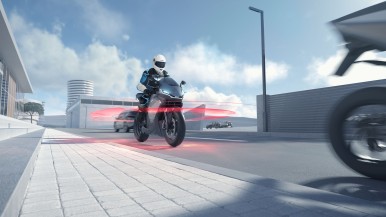
Stuttgart, Germany, and Yokohama, Japan – Thanks to Bosch, motorcyclists can now feel even safer in the saddle: the technology company has unveiled six new radar-based assistance systems, including five world-firsts. According to Bosch Accident Research, these could help prevent not just one in seven, like earlier systems, but as many as one in six accidents on German roads alone. Bosch already revolutionized the motorcycle market back in 2020 with its support functions for motorcyclists. Of the six new assistance functions, four will be unveiled in a new model from leading European motorbike manufacturer KTM in November 2024 and are set to enter production in 2025. “Bosch’s declared aim is to make motorcycling even safer and more comfortable by employing innovative new technologies – without diminishing riding enjoyment,” says Geoff Liersch, head of Two-Wheeler & Powersports at Bosch. “The new functions mark yet another step in this direction, and we’re delighted to have KTM as a customer.” The manufacturer will incorporate the four Bosch rider assistance functions that use front radar. This is not the first time Bosch and KTM have worked together: in 2013, the two companies collaborated on the successful launch of the MSC motorcycle stability control system. „We’re very satisfied with the longstanding collaborative relationship between our development teams, and we’re excited that KTM is the first to put these new functions to use,” says Stefan Haist, Lead KTM Chassis Control System – Street Development.Bosch assistance systems provide more support on two wheels Adaptive cruise control – stop and go (ACC S&G) For two-wheelers, traffic jams can be strenuous as well as dangerous. Riders have to constantly apply the clutch, use the brakes, and then start moving again. To make this task easier, Bosch launched ACC adaptive cruise control back in 2020. Once the desired speed has been set, this system constantly matches the vehicle’s speed to the flow of traffic while maintaining the necessary safe distance from the vehicle in front. Bosch has now taken this technology to a new level to offer increased riding comfort with its new ACC S&G function, which can bring the motorcycle to a controlled standstill in order to support the motorcyclist. This works best with an automatic transmission such as the one used in KTM’s new bike, which will be the first to incorporate this new function. If their motorcycle comes to a halt, there is no need for riders to use the clutch; they can set their bike in motion simply by pressing a button or briefly activating the throttle as soon as the vehicle in front starts moving. Group ride assist (GRA) Group riding in a staggered formation is popular among motorcyclists, though it can be challenging with ACC, because the function expects the motorcycles riding in front to be in the middle of the lane. GRA is a useful addition to ACC; using an algorithm, it detects when a group is riding in a staggered formation and regulates the speed to automatically maintain the same distance from the motorcycles in front. In this way, the function assists riders in achieving a natural group formation. When not riding in groups, the GRA system works the same as ACC. Riding distance assist (RDA) When traffic is flowing smoothly and RDA is activated, it helps maintain an appropriate distance from vehicles in front and thus prevent rear-end collisions. With ACC, a desired speed must be set; but when RDA is activated, the motorcycle can be controlled as normal via the throttle grip. While riding, the system automatically reduces the vehicle’s acceleration or applies the brakes as and when required. Riders can set the desired distance from the vehicle in front beforehand. If they wish, they can also use a switch to deactivate the function or apply the throttle to override the deceleration generated by the RDA system. This enables the function to blend naturally and comfortably into the dynamic flow of riding. Emergency brake assist (EBA) Hazardous situations on the road require not only a rapid response but, in many cases, emergency braking. Every second counts when it comes to preventing collisions and avoiding potentially serious consequences. EBA is triggered when the system detects a risk of collision and the rider doesn’t brake hard enough. In this case, the function actively increases the wheel brake pressure further to reduce the bike’s speed as quickly as possible. Rear distance warning (RDW) Even in a car, it can be hard to keep a constant eye on traffic approaching from behind; but on a motorcycle, it requires an extra level of concentration. RDW monitors the situation behind the rider and flashes a warning on the display if another vehicle gets too close. Based on this warning, the rider can take mitigating action to prevent a rear-end collision. Rear collision warning (RCW) RCW warns vehicles behind the motorcycle when a rear-end collision is imminent, for example by activating the hazard warning lights. In this way, the function protects motorcyclists from accidents caused by having to brake unexpectedly or by a vehicle failing to see them – whether waiting at traffic lights, sitting in a traffic jam, or riding in free-flowing traffic. These new functions supplement Bosch’s worldwide portfolio of radar-based assistance systems, thus expanding the “sensory world” of the motorcycle. In addition to basic safety features, increasing importance is also being given to convenience and experience features that focus on the motorcycle and take real-life riding situations into consideration – functions that ensure not only safety and convenience, but also unmatched riding enjoyment.