Search & find:
Media, press releases, events for your editorial coverage

High tech #LikeABosch – how we’re delivering better quality of life with connect ...

04.01.2022

Presentations

Business/economy

High tech #LikeABosch – how we’re delivering better quality of life with connect ...

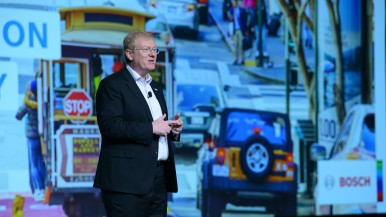
Dr. Tanja Rückert, chief digital officer of Robert Bosch GmbH, and Mike Mansuetti, president of Bosch in North America, at the Consumer Electronics Show on January 4, 2022 Check against delivery. Good morning everyone, and welcome to the Bosch press conference! We’re delighted to have you with us digitally today. Although we regret that the pandemic has once again prevented us from meeting face to face, of course everyone’s health has top priority. The good news is that we can safely come together in a virtual manner, all thanks to technology. And that fits in perfectly with what we want to talk to you about today. Specifically, we want to talk about the benefits and opportunities offered by technology, and the positive impact it can have. Technology for a better world – today and tomorrow You’ve just seen the premiere of the latest installment of our #LikeABosch” campaign: “high tech #LikeABosch.” “High tech” may be a familiar term here at CES, but we at Bosch have a slightly different take on things. Today, we want to tell you about how our approach to high tech is not just about pushing the envelope on what’s possible. Instead, it’s about using cutting-edge technology as a means to improve people’s lives wherever they are: at home, at work, on the road, in a hospital, or even in orbit! As a company committed to delivering life-enhancing innovations, we center our development around people. But especially at a time of such profound technological change, it’s not enough for companies to assume we have all the answers. To truly give people what they need and want, we have to understand what these are – and what hesitations and concerns are attached to them. And so we did exactly this: we conducted a comprehensive international survey to gauge opinions on a wide range of technology-related topics. We asked a representative sample of people in five countries – China, Germany, India, the U.K., and the U.S. – to tell us how technological progress looks from their point of view, what they want most from technology, and where they see both the most promise and the most risk. The inaugural Bosch Tech Compass is having its global debut right here at CES. Over the course of our press conference we’ll be sharing with you some of our most interesting and relevant findings. To start with, let’s look at what for us is perhaps the most significant finding of all. As the survey showed, confidence in technology and enthusiasm about its impact are high across the globe. A full 72 percent of respondents worldwide believe that technology is making the world a better place. Above all, they believe technology is bringing them increased comfort and safety, and that it’s making work easier. And they’re optimistic about its potential, too: most significantly, 76 percent of people globally are convinced that technology holds the key to combating climate change. At Bosch, we agree wholeheartedly. After all, we’re also firmly convinced that technology has the potential to make all our lives better – that’s why “Invented for life” is not just our claim, it’s our strategic imperative. We only need to look at our portfolio for proof: think of beneficial and even lifesaving innovations such as our vehicle electronic stability program ESP, airbag control units, our digital guardian angel Help Connect, or the rapid coronavirus PCR test we developed for our Vivalytic device last year. When it comes to climate change, we at Bosch take the fight against it very seriously: we were the first global industrial enterprise to achieve carbon neutrality at all our international locations. We’re working now on reducing emissions generated along our supply chains and during the lifecycle of our products by 15 percent by 2030. In terms of volume, this is 67 million metric tons, a figure roughly twenty times greater than what our locations emitted in our baseline year of 2018. We’re also sharing our experiences and supporting other companies’ carbon neutrality efforts via our consulting company Bosch Climate Solutions. We’re driving sustainability with our products as well, enabling those who use them to reduce their carbon footprint. For example, our U.S.-based building technology subsidiary Climatec won a 35 million-dollar contract from the City of Ontario in California to boost its energy efficiency, safety, and connectivity. Within the framework of the “Smart Ontario” project, we’ll be retrofitting the city’s infrastructure with smart, connected solutions such as building automation and LED streetlights that should reduce local greenhouse gas emissions by over 10,000 tons annually. And to pursue our longstanding vision of climate-friendly mobility, we supply a full range of components and systems solutions for electromobility – in fact, no other company offers as wide a range as Bosch: from battery-electric powertrains to regenerative braking systems to fuel cells, powering everything from e-bikes to commercial vehicles. Speaking of e-bikes, they’re at the intersection of two major drivers for our business: electrification and connectivity. It wasn’t too long ago that an e-bike was a niche product. Now it has become one of the most popular forms of personal transport worldwide. But what does connectivity have to do with an e-bike? It’s the basis for a personalized e-bike experience like never before. This is exactly what our new system generation – called the eBike Smart System – offers its users. This innovation, which is a 2022 CES ® Innovation Award Honoree, was first introduced late last year and will be available for a mass audience to see and demo for the first time in the U.S. here at CES. With this entirely new system consisting of our eBike Flow app, control unit, display, battery, and drive unit, we’re merging the physical experience of riding an e-bike with digital conveniences like connectivity, personalization, and services. For example, in the future, your e-bike will be able to adapt to your riding style, suggest routes you enjoy, and guide you safely to your destination while learning your preferences and interests. Thanks to connectivity, the bike is not a static product, but one that can continually evolve after purchase. The experience can be constantly enriched with new digital experiences thanks to over-the-air updates. This is just one example of how connectivity is at the heart of all our products. In fact, we’re delighted to announce that we reached an important goal set several years ago: 100 percent of all our electronic product classes are now web-enabled. This means that for nearly everything we produce, we can now realize functions such as wireless updates and web-based services. Just think of the beneficial services we’ve already realized by putting cars online: our emergency notification service eCall, for instance, or our wrong-way driver warning. Bosch is an IoT and software company This milestone is a key proof point for how Bosch has evolved into a software and IoT company. We currently employ approximately 35,000 software developers. Overall, our annual investments in building up software competence amount to more than four and a half billion dollars. This means that we understand both sides of the coin better than most other companies – particularly when it comes to connecting things to the internet. Just let me give you an idea of what we’ve achieved recently in two of our key domains: home and mobility. When it comes to technology for the home, Bosch sold 4 million web-enabled power tools, home appliances, and heating systems in 2020; in 2021 this number increased to over 6 million – which is 50 percent growth! In the mobility sector as well, software is paramount – cars are becoming internet nodes. This has been a Bosch vision for quite a while, and we’re ideally positioned to play a major role in creating the software-defined car. In our Mobility Solutions business sector, we’re investing nearly three and a half billion dollars annually in building up our software competence in this domain. At the beginning of last year, our new Cross-Domain Computing Solutions division started operations, bringing together hardware and software development for new automotive electronics architectures. This year we’re taking the additional step of pooling our work on application-independent vehicle software for cars and the cloud at our subsidiary ETAS GmbH. This means that we’ll be able to provide solutions to manufacturers and other suppliers more quickly, securely, and efficiently in the future. In addition to optimizing our organization and building up our expertise, we’re engaging in partnerships to propel our technology leadership in the mobility sector forward. For example, together with Microsoft we’re strengthening our position in software development for all domains – from the car to the cloud. It’s also enabling us to speed up feature development to bring new software functions to vehicles faster. In this collaboration we’re making great progress toward developing an open technology platform that will enable the acceleration of automotive development cycles. Last but not least, increasing demand for software comes along with an increasing need for software integration. Here, given our domain knowledge, Bosch is at home and can provide the necessary integration know-how. Take automated driving, for example. An automated vehicle must be able to do everything a human driver can do: perceive its surrounding, make decisions, and accelerate, brake, and steer. Bosch has all the different building blocks for automated driving in our portfolio and, step by step, we’re laying the technical groundwork. With our driver assistance systems, we’re already paving the way for all levels of automation. And this is paying off: to give you an example, over the past five years, Bosch made more than 10 billion dollars in sales with driver assistance systems. From components to systems, and from software to services – when it comes to tomorrow’s mobility, all roads lead to Bosch. To give you a sense of the range of technologies we offer, and how they’ll be seamlessly integrated in future vehicles, we are showing a glimpse in our booth of how software, personalization, automation, connectivity, and electrification will unlock infinite possibilities to shape the way we get from points A to B in the future. Bosch on its way to becoming a leading data-driven AI company Speaking of the future, when asked what they think the most influential technology will be in ten years, Bosch Tech Compass respondents across the globe agreed that it will be AI and 5G. At Bosch, we’ve made AI a major strategic focus. We want to use connectivity and data collected over the IoT combined with artificial intelligence – AIoT for short – to continuously improve our products and services. A milestone on our path to become a leading data-driven AI company was the establishment of the Bosch Center for Artificial Intelligence in 2017. The BCAI currently operates at 7 locations in the U.S., Germany, India, Israel, and China. So far it has worked on more than 200 projects in the mobility, manufacturing, agriculture, and smart-home domains, and has already contributed nearly 350 million dollars to our global result. In systematically building up our expertise in AI, we’re also working toward a concrete goal: by 2025, every Bosch product will either be equipped with AI or manufactured with its help. One new product featuring AI that we’re showcasing here is our latest Home Connect fridge, which can identify its contents and suggest recipes based on what’s inside – which might not only get you out of a dinnertime rut, but can also help you use up what might otherwise go to waste. Another very special example which demonstrates how we continue to develop solutions for maximum benefit is our SoundSee technology. This acoustic technology had its debut aboard the International Space Station, where it uses AI to help monitor the health of critical systems on the ISS, such as the space station’s environmental control and life-support systems. And today we’re announcing for the first time a new use case for audio AI based on the same technology currently aboard the ISS. Together with Highmark Health in Pittsburgh, Pennsylvania, we’re exploring the use of audio AI as a diagnostic tool in pediatric medicine. Specifically, we’re working on adapting these experimental sensors to detect pulmonary conditions such as asthma at an early age, just by listening to children’s breathing patterns. Our hypothesis is that each child has a sort of audio fingerprint, and that the use of audio AI can be used to learn a child’s normal pulmonary sounds. Should something change, then the idea is that the AI will pick this up, which will potentially lead to early therapy and better outcomes. Ideally this technology will enable us to monitor kids in a non-invasive manner and alert the parents at a far earlier stage when there is a variation from the child’s baseline. Ultimately, we see the combination of AI and the IoT as holding the key to leveraging the most user benefit from both of these technologies. Think of it as a continuous improvement loop. Connected products transmit data, which is then processed with the help of AI algorithms. Optimizations are identified, then fed back to the products in the form of software updates, and the cycle starts again. In effect, this allows customers to be an integral part of the development process, and for solutions to be tailored precisely to their needs. The result is better solutions for our customers – as well as new revenue streams for us, since it will enable us to turn the sale of every digital product into services-based revenue as well. Trust and responsibility are decisive for success Like the Bosch Tech Compass respondents, we also believe that the impact of artificial intelligence and next-generation connectivity will be huge. In order to realize the full potential of these new technologies, however, they must gain widespread acceptance. For this, we must not only make the benefits comprehensible for people, we need to build trust in the technology and in the companies that create it. In fact, the same is true of all new digital technologies: trust must be established, not taken for granted. Going back to the results of the survey, this was one of the strongest points of agreement among all the respondents. Four out of five people across the globe believe that a company’s success will ultimately depend on its ability to build digital trust with its customers. To gain trust, of course, companies must act responsibly: in dealing with sensitive data, in balancing economic and ecological considerations, and in leveraging innovation for the common good. Respondents to our survey agree on this as well: a whopping 83 percent of respondents think that technological progress should be more focused on confronting society’s challenges rather than on serving individual needs. Above all, what emerges from the Bosch Tech Compass is that people are more aware than ever of both the potential and the pitfalls offered by technology, and that they want those who create it as well as those who legislate its use – in other words, companies and policymakers – to take responsibility for steering its development in the right direction. At Bosch, we’ve always prioritized trust and responsibility in our pursuit of technological advancement. This was true for the analog world, and it’s even more true for the digital world, where trust is in short supply. Above all, we want to lead by example when it comes to using innovation as a force for good, not just for profit. That’s why we’ve published an AI code of ethics for our own developers, and why we’re explicitly and exclusively committed to AI that is safe, robust, and explainable. It’s also why we are the driving force behind the Digital Trust Forum, a global consortium of representatives from different stakeholder groups whose aim is to foster a high level of trust in AI and IoT-based solutions. In particular, we’re working with our partners to develop trust policy frameworks and eventual certification and conformity labels. The plan is that products that meet certain criteria will bear a Digital Trust seal – along the lines of the energy-efficiency labels you see on home appliances, for instance. Of course, trust and acceptance also depend on people seeing the concrete benefits a new technology can deliver. Here I’d like to highlight a Bosch innovation that again demonstrates the incredible potential of AI. It’s a gas sensor – the first one on the market equipped with artificial intelligence – and it’s being used in a truly revolutionary new product. Dryad’s Silvanet Wildfire Sensor is a pioneering new solution for ultra-early wildfire detection, and our gas sensor is its digital nose. Apart from the unfathomable devastation wildfires cause, did you know that they account for up to 20 percent of annual global carbon emissions? That’s as much as the entire transportation sector combined – in other words all the cars, ships, and planes on the planet. Dryad’s sensors are mounted on trees, where they continuously monitor the local microclimate in order to detect flames early – and wirelessly notify local authorities long before camera or satellite-based systems can. These sensors are going to help save lives, homes, and tons of CO 2 from entering the atmosphere – all thanks to AI and connectivity. Solutions for a better world At Bosch, our aim is and always has been to improve people’s daily lives with our products and solutions. The Bosch Tech Compass respondents are optimistic about the beneficial potential of technology, and so are we: that’s why we continue to work on cutting-edge innovations that are designed to make life better for everyone across the globe. This is light years beyond high tech, it’s “high tech #LikeABosch”! Thank you.

Beneficial AI – building trust together in the digital world

06.01.2020

Presentations

Business/economy

Beneficial AI – building trust together in the digital world

Dr. Michael Bolle, member of the board of management of Robert Bosch GmbH, and Mike Mansuetti, president of Bosch in North America, at the Consumer Electronics Show in Las Vegas on January 6, 2020Check against delivery.2001: A Space Odyssey. The Terminator. The Matrix. Ex Machina. It sounds like we’re sharinga list of our favorite movies. But actually, all these movies have something in common.They all depict a future in which machines have learned to think for themselves – with disastrous consequencesfor humanity. Whether the machines manipulate, enslave, or replace us, the message in the movies is the same: by developing artificial intelligence, we’re opening Pandora’s box. I like science fiction as much as anyone, and portraying AI as the villain has kept audiences entertained for decades. But the time has come to talk about the technology’s true potential – the potential to provide real value, for real people. “How can we make artificial intelligence beneficial? How can it be used to complement human intelligence?” These are some of the big questions at CES this year. So what’s our answer? Artificial intelligence is not science fiction anymore – it’s already an integral part of our daily lives. It’s fundamentally changing how we drive, how we work, how we learn, how we shop, how we travel. At Bosch, it’s also becoming part of the products we make – products that will assist and support us, and make life easier overall. Whether it’s being used in manufacturing, in smart homes, or in self-driving cars, one thing is for sure – in line with our “Invented for life” ethos, we want to make AI safe, robust, and explainable. Where the world of work is concerned, we’re not just facing a technological shift, we’re also facing a critical shortage of skilled workers. So it’s also against this backdrop that it will be essential for humans and machines to work together. At Bosch, we believe this is self-evident. And with this in mind, we’re trying to shape the digital transformation by educating and upskilling our workforce, and investing in our associates as well as in the intelligence of our products and machines. As a society, we must learn to accept a technology that is capable of learning itself. One way to do this is to invest more in our own learning – and that’s exactly what we’re doing. Over the next two years, we will be introducing wide-ranging training programs aimed at making nearly 20,000 of our associates AI-savvy. I’ll tell you more about that later. But the societal benefits of AI go far beyond our daily lives and work. It also holds tremendous potential to benefit our planet and its climate. We intend to use this potential to realize our goal to maintain a balance between our economic, ecological, and social responsibilities. At the end of 2019, we achieved carbon neutrality for all our locations in Germany. By the end of this year, all 400 Bosch locations worldwide will be completely carbon neutral. When this happens, we will be the first major industrial enterprise to have achieved this ambitious goal, all within a little over a year. And to do this, we will be making use of our own solutions as well: our energy platform, for example, already uses intelligent algorithms to monitor consumption in manufacturing. It quickly identifies deviations in individual machines’ energy use and offsets load peaks. This alone has reduced CO2 emissions at individual plants by more than ten percent over the last two years. For a company that has 270 manufacturing sites, that’s some significant savings potential! Our success here has prompted us to market the energy platform externally. And it won’t end there: AI means we’ll be able to forecast and reduce energy consumption over the long term as well.AI is creating markets, but digital trust is indispensable This example underlines that artificial intelligence also offers considerable business potential. A number of different studies support this notion. For example, AI is expected to boost GDP substantially in major economies across the globe by the end of this decade – PWC estimates a 15 percent boost in North America alone. At the same time, global AI software revenue is projected to reach nearly 120 billion dollars by 2025, a twelve-fold increase compared to 2018. And the World Economic Forum predicts that global job losses as a result of AI will actually be offset by the creation of new ones, resulting in a net gain of nearly 60 million new jobs by 2022. As mentioned earlier, these jobs will require significantly new competency profiles, which will necessitate a strong push to reskill and upskill people. It’s indisputable that the impact of artificial intelligence will be huge. However, we must make the benefits of AI comprehensible for people, and even more importantly, establish trust in the digital world. Our CES slogan captures our approach here nicely: “Beneficial AI – building trust together.” In this endeavor, Bosch is pursuing a two-pronged approach. On the one hand, we’re doing the technical groundwork, developing solutions, and using our innovations to open up new areas of business. On the other hand, we will use AI to realize our strategic imperative of creating technology that is “Invented for life,” and in doing so, convince society of the benefits of AI. Remember, it was our engineers that developed lifesaving inventions such as electronic stability control, airbag control units, and anti-lock braking systems for vehicles ranging from passenger cars to motorcycles to e-bikes. This is what we mean by technology “Invented for life” – and our work with AI is no exception. By putting it to use in automated vehicles, for example, it too will be a technology that saves lives, as we will explain in more detail later on.Trust, responsibility, and ethics in AI We take entrepreneurial responsibility seriously, and it defines our approach to new technologies like artificial intelligence. The decisive factor for responsibility in the digital world is trust. This trust will be just as important for our digital business as product quality is for our traditional business. We have to work on developing both AI and trust in AI – without the latter, the former will not be successful in the long run. But how can we establish this trust? By creating AI that is transparent, safe, secure, and robust. When it comes to building trust, another key aspect is data security and data privacy – especially where personal data is concerned. At Bosch, our approach is simple: when it comes to all our smart products and services, users have full transparency and control over the data collected and who gets to use it. Moreover, in order to build trust among our customers and partners, as early as 2015 we established guiding principles for data protection in our IoT business. This was several years before the GDPR regulatory framework was introduced as European standard. We’re now working on a similar set of principles for our future use of artificial intelligence: an AI code which sets out ethical guidelines for the development and usage of AI, especially in cases of doubt and dilemma. Going forward, it will be essential that people remain in control of systems that use AI. Take the example of driver assistance: here, we want to integrate AI in such a way that it can always be overridden by the driver. We don’t want to lock the algorithms from our AI models in a little black box. The rules and parameters behind decisions must remain comprehensible, at the very least for specialists. That said, Bosch and the big tech players differ in our approaches to AI in one fundamentally important way: our focus is on the application of AI for physical objects. Whether it’s deployed in an automotive emergency braking system or in factory production, our AI explains the physical world to machines. Our latest camera for automated driving uses AI to understand what it sees – to infer, say, whether a pedestrianis going to step out into the road or not. This will improve object recognition and make automatic emergency braking more reliable, thereby increasing safety. At Bosch, we want to harness the power of artificial intelligence to improve technology and the performance of our products and machines. We call this industrial AI, and we’re using it to develop smartsolutions in three key domains: mobility, residential, and manufacturing. It’s no coincidence that we emphasize the “things” when talking about IoT. We’re bringing connectivity and intelligence to our own products and machines. We know cars and traffic, factories and buildings, inside and out – no other tech company can match the breadth and depth of our cross-domain expertise. Our own sensors provide us with a massive amount of data. And if we apply AI methods to that data, we can create new services and applications. By the middle of this decade at the latest, each and everyone of our products will either have artificial intelligence itself, or have been developed or manufactured with its help. Ultimately, we plan to teach our products to function as assistants – for our customers, and for our own developers.Investing in AI research and development To achieve this, we want to become one of the global leaders in AI innovation as well. Our research and development activities are all geared toward this goal. Bosch currently invests more than 4 billion dollars annually in software development, and employs around 30,000 software engineers. Established in 2017, the Bosch Center for Artificial Intelligence is already working on more than 150 projects. It employs some 250 AI specialists at seven locations around the globe including two here in the U.S. – in Pittsburgh, Pennsylvania, and Sunnyvale, California. Our U.S. research teams play a key role in our AI development activities, above all in robotics and automated driving. But we’re not working in a vacuum here. Especially where AI is concerned, a technology company like Bosch sees itself as part of the larger scientific community. In Germany, for example, we’re a founding member of the “Cyber Valley” initiative – an AI research alliance between academia and industry. Among other things, as part of this we’re investing more than 110 million dollars in an AI campus, which from late 2022 will be home to 700 AI experts from Bosch as well as from external startups and research groups. Here in the U.S., we’re collaborating closely with Carnegie Mellon University on AI research. Carnegie Mellon has been working on artificial intelligence for 60 years, since the technology’s earliest days. They have been responsible for pioneering innovations in areas like self-driving cars, facial recognition, and language processing. As we see it, industry and academia each have an essential contribution to make. And we highly value the transfer of knowledge between our developers on both sides of the Atlantic.SoundSee hears what’s broken in space – with AI from Bosch A great example of an exciting collaboration with one of our U.S. partners is currently deployed about 240 miles above the Earth’s surface. It’s an innovative AI-based sensor system called SoundSee. This little device will be playing quite a big role in outer space. The SoundSee technology will be used to perform deep audio analytics on the ISS. Using highly-sensitive microphones, it will capture ambient noise emitted from the station’s systems and equipment, and then use AI to spot potential anomalies from the audio patterns. Basically, SoundSee will hear if something on the station is broken – and can tell whether it needs to be repaired or replaced. We developed this system together with the aerospace company Astrobotic Technology Inc. In November, it was sent into orbit and will be integrated into the Astrobee robot shortly. Of course, the new sensor system will also be very useful down here on earth. In manufacturing, for example, it can improve predictions about machine downtimes, thus helping to reduce maintenance costs and increase productivity. But on board the ISS, this technology could even be lifesaving.Virtual visor – a U.S. idea is a “Best of Innovation” award winner We’re showcasing another example of the ingenuity of our American workforce here at CES – and this world premiere also underlines their lateral thinking. Some of our engineers came up with a digital solution for a common and often dangerous hazard that drivers frequently face. It’s an innovation that replaces a nearly 100-year-old automotive product: the sun visor. According to a study by NHTSA, sun glare causes nearly twice as many accidents as any other type of weather-related condition. But we now have a solution: our “virtual visor.” At first glance, it looks like a see-through LCD display mounted at eye level. The special thing about it, though, is that it’s connected with a driver-facing camera equipped with AI facial detection and analysis. Its software calculates both the driver’s line of sight and the angle of the sun in order to strategically darken individual sections of the display. Everything else remains transparent. We think the Virtual Visor is another great example of technology “Invented for life,” and the CTA apparently thought so too. The product was honored with a prestigious CES 2020 Best of Innovation Award – you can test it out for yourself at our booth.3D vehicle display – our second Best of Innovation Award Our new 3D vehicle display also won a CES Best of Innovation Award – and I’ve been told it’s no small feat to win two of those. Vehicle displays in general offer huge business potential – after all, the global market volume is set to more than double by 2025, to 30 billiondollars. Our award-winning display uses a multi-view 3D technology which is especially affordable, since it works without the need for eye tracking and 3D glasses. To describe how it works, let’s go back to the movies for a moment. We’ve all seen 3D films, where the technology makes our experience more vivid and entertaining. Inside a vehicle, 3D performs a similar but more useful function: it helps people understand information more quickly. The display’s depth of field means drivers can grasp important visual information faster, whether it’s an alert from an assistance system or a hazard warning. Alerts seem to jump out of the display and are much more obvious and urgent, as well as far harder to overlook. I don’t know about you, Michael, but anything that tells me what I really need to be paying attention to is a win in my book.Interior monitoring – technology that can help keep children safe Think of the dangers posed by fatigue and distraction – the longer we’re behind the wheel and the more technology is present in the cockpit, the greater they are. Here, our driver monitoring system uses artificial intelligence to identify these distractions through cameras which recognize the driver’s line of sight, head position, and blink rate. When it determines a critical point has been reached, it reacts by sounding an alarm or providing driving assistance, depending on the automaker’s wishes, and also legal requirements. In the EU, this kind of system is set to be standard in new vehicles from 2022. This technology will also play an important role in automated driving. After all, the next few development stages will still require drivers to remain alert and ready to take over in critical or tricky situations. To ensure drivers are able to do this, the monitoring system calculates how ready they are to respond at any given time, and the transfer of driving responsibility is then timed accordingly. Depending on the design, some systems can also monitor the car’s other occupants and enhance their safety, for example by detecting changes in passengers’ sitting positions and adjusting their airbags and seatbelt tensioners for optimal crash protection. Or by identifying the presence of children inside parked cars. In 2018, parked cars claimed the lives of more than 50 children in the United States, either because they had been left inside for longer than intended or had climbed in unnoticed. Bosch’s new system can recognize the presence of children and warn parents in a flash by sending a message to their smartphone. In a critical situation, it can also alert the emergency services. As the Hot Cars Act currently being debated in Congress shows, there is considerable interest in solutions to prevent these tragedies. Once again, our technology doesn’t just make life better, it can help to save lives. Looking ahead, we plan to extend our interior monitoring systems to encompass in-vehicle sensing and deploy this inridesharing fleets. In-vehicle sensing will allow us to detect when a passenger leaves something behind in a shared car, for example, or if they need help in a critical situation. For us, offering real benefits is what it’s all about. Nearly all our driver assistance systems enhance both safety and convenience. We are one of the automotive industry’s leading suppliers in this field. In 2019, our sales rose by 12 percent to some 2.3 billion dollars. From a technical point of view, we’re using driver assistance as a stepping stone to automated driving. By 2022, we will have invested some 4.7 billion dollars in developing this technology and increased our workforce of dedicated engineers to 5,000. To this end, we’re working on making lidar sensors production-ready. Alongside our new video camera with AI and radar and ultrasonic sensors, Bosch will soon offer the complete sensor portfolio needed for automated driving. Few automotive suppliers worldwide have as much expertise in this area as Bosch. Our lidar will be the first of its kind that is suitable for use in automotive applications, since it’s scalable and can be manufactured in large volumes. It’s also the first lidar technology to be suitable for automated driving functions at SAE levels 3-5, offering long-range sensing capabilities in combination with a wide field of view and an exceptionally high resolution. Working together, our multiple sensor types will help to ensure extremely reliable environment recognition. To surmount the many challenges on the road to fully-automated driving, Bosch is bringing together its profound expertise in sensors and systems and that’s the type of expertise that only an automotive company can have. We’re already testing automated driving in a range of environments, including one that is widely regarded as the final frontier: city streets. I’m happy to report that our pilot project with Mercedes-Benz for an on-demand ride-hailing service with automated vehicles is now up and running. Automated S-Class vehicles are now providing an app-based shuttle service in California between West San José and downtown for selected users. Ultimately, the aim of this project is to gain valuable insights for the development of automated driving, and to answer the question of how self-driving cars can best be integrated into a multimodal mobility system. Our development work on this project encompasses both the use of AI as well as simulations and tests designed to address the kind of driving situations that occur very rarely in road traffic. We’re not just using our mobility solutions to teach cars how to drive. We’re also using them to make electric and connected driving a reality. This is enabling us to open up new areas of business and forge partnerships with new customers. For example, we’re developing a hydrogen powertrain for the heavy-duty trucks made by U.S. startup Nikola Motor Company. We’re also suppling our solutions to mobility service providers such as DiDi and Lyft. For DiDi, we’ll soon be providing a cloud service that helps to extend the service life of car batteries. When it comes to urban mobility for the future, you can experience our vision in an IoT concept shuttle at our booth. This year we’re showcasing what we offer mobility service providers to help them operate safe and efficient automated ridesharing and ride-hailing businesses.Bosch MEMS technology – for smart glasses without the sci-fi look Beyond this, we’re also using our expertise in everything related to mobility as the basis for innovation in other domains. The best example of this is sensors based on micromechanical systems – called MEMS for short. We’re the market leader for these sensors, which are used for automotive applications as well as smartphones. Our latest development in this area is being showcased here at CES: our light drive system for smart glasses. The smallest of its kind, it’s nearly a third slimmer than existing ones on the market and can be integrated into nearly any type of frame, becoming part of your everyday glasses. It uses a MEMS-based laser scanner and holographic mirror to project an image on the wearer’s retina. This image can contain any kind of text message – for example from the navigation system or your personal calendar. And you, in turn, can be kept constantly up to date – without looking like you’re on the way to a Star Trek convention every time you put them on. Another domain where AI has the potential to deliver enormous benefits is healthcare. Here, our Indian engineers have developed a cutting-edge innovation called Vivalution (brand name was changed) which is a CES® innovation award honoree. In a nutshell, it’s a smart pathology platform for medical diagnostics powered with advanced machine learning algorithms. With the help of AI, it analyzes human cells’ form, shape, and structure for deviations, thus providing physicians with information on possible diseases. And it does so in minutes, which dramatically shortens the testing process. Helping people diagnose health issues quicker and more accurately – this is also what we mean by technology “Invented for life.”AIoT to benefit everyone – training for tomorrow’s work As we see it, the IoT and AI should benefit everyone. To do this, they must be more than technological gimmicks and actually make people’s daily life and work easier. This is true for all our domains: connected mobility, connected homes, and also connected industry. Especially in the world of manufacturing, artificial intelligence can supplement human creativity, and more crucially, relieve workers of routine tasks. On every new path we tread, we take our workforce with us. On our way to creating the factories of the future, we want to prepare our associates for the work they’ll be doing in the future. This brings us full circle to our AI training program, which I mentioned earlier. It consists of three parts: First, we’re training roughly 16,000 executives on the business aspects of AI. Our digital transformation is enabling us to master a balancing act: on the one hand, remaining an industrial enterprise, and on the other, becoming a leading IoT and AI provider. For this, our leadership will have to be capable of making the right decisions, which is why we’re building up their AI expertise. Second, we’re expanding our AI learning platform. This platform is similar to an online university, but uses examples and exercises from real-life operations at Bosch. More than 1,500 of our engineers are already using the platform, a number that will likely double by next year. Some of its notable features are the exchange of experience our AI learning platform facilitates, as well as the use of best-practice examples and competitions. Third, we’re training nearly 500 experienced engineers in AI development methodology. This is the highest level of our training program, what is effectively a supplemental course of study in things like data engineering and data analysis. We’re not just increasing the number of AI engineers by hiring dedicated specialists; we’re also doing it by reskilling our existing people. All told, this will get 20,000 of our associates up to speed on the technology. As we see it, it’s not only part of our corporate responsibility to offer this kind of training, it’s also in our strategic interest.Conclusion Ladies and gentlemen, it’s clear that developing artificial intelligence will require us to focus on more than just technological innovation. On one hand, we need to invest heavily in human intelligence, and on the other, we need to convince people of the true potential of this technology. “Beneficial AI: building trust together” – it’s more than just a nice catchphrase we’re using here at CES. We truly believe that AI holds the key to making our lives safer, easier, and more eco-friendly. Please come visit our booth in the Central Hall to see some examples of this in action. And together, let’s work to dispel any doubts and usher in a new era of real-life science fiction, where AI is the hero.

Emissions-free mobility is coming – provided the solutions are affordable and fa ...

10.09.2019

Presentations

Business/economy

Emissions-free mobility is coming – provided the solutions are affordable and fa ...

Dr. Volkmar Denner chairman of the Bosch board of management, at the IAA press conference in Frankfurt on September 10, 2019 Check against delivery.This year’s IAA, ladies and gentlemen, is a catalyst – energizing not only the automotive industry and its customers, but also kindling debate and demonstrations. And more than ever, society is faced with critical questions: What could eco-friendly mobility look like? How can the technological progress we need be achieved economically? And how, finally, can we handle the social consequences of climate-friendly transport policy? We will have to find a new position that harmonizes the interests of ecology, economy, and society. There are no simple solutions, and no one person exclusively holds the key. We will have to hammer out a solution in an open debate. We’re here at a motor show, yet questions such as these are just as much on people’s minds as the latest models on four wheels. Our response to them has two parts. First, we want mobility that helps keep our planet healthy and the air in our cities clean. Bosch will be the first industrial enterprise to make all its locations worldwide carbon neutral within one year. And we’re applying the same determination to deliver efficient powertrains, from combustion engines to fuel cells. Second, what is ecologically correct must not be socially and economically incorrect. Emissions-free mobility is possible – if it remains affordable for people and its benefits capture their imagination. Only in this way can we make it a market success. That said, for some time now we’ve regarded mobility as much more than people driving their own cars. As we see it, tomorrow’s mobility will not only be electrified and automated, but also connected and personalized. And it is above all this personalized form that will be about much more than driving. For us, it means services that find the best way for each individual to get to their destination, whether on two or four wheels, by road or by rail. Supporting multimodal mobility is also a response to the critical issues surrounding road traffic. Key to the future: three billion euros annually for software But first, we’re developing the technological foundations for the mobility of the future. Our open sesame for all this is our profound expertise in electronics and software. Even now, our Mobility Solutions business sector employs some 14,000 software developers, and its annual software engineering expenditure comes to nearly 3 billion euros. The upshot is significantly more powerful vehicle electronics and software architecture, which is important for connected driving as well as automated and electrified driving. Computing power will increase by a factor of at least 1,000 at the start of the next decade. What we will be seeing is high-performance vehicle control units of the kind Bosch is already creating for the integration of infotainment systems and driver assistance functions. With computers such as these, vehicles will increasingly act as players on the internet of things. Growth at last: electromobility is turning the corner But how will they drive on tomorrow’s roads? We foresee a gradual transformation of the automotive powertrain. First of all, there’s still some mileage left in the combustion engine. In 2030, three-quarters of all new vehicles will feature a diesel or gasoline engine, whether with or without a hybrid option. For this reason alone, further refining these engines is environmentally expedient. Thanks to Bosch’s new exhaust technology, diesel engines’ NOx emissions have been almost completely eliminated, as independent tests have already shown. Our solution is already in production, and features in a number of vehicles being presented at this show. Our next goal is the reduction of particulates from gasoline engines. More specifically, this means 70 percent less particulate matter than permitted by the current Euro 6d standard – both on the road and at the test bench. But that’s not all. We can also reduce brake dust by more than 90 percent, whether with regenerative braking systems or with our iDisc brake disc. We are coming ever closer to our goal of road traffic that no longer pollutes the air in our cities. The electromobility market is also gaining speed at last. It is becoming ever more obvious that the electrical powertrain will be Bosch’s next success story. Both technologically and commercially, we lead the way. We lead the way in the efficiency of our components, and have a broader footprint than other suppliers – from bikes to trucks. And growth is on its way. In 2018, we acquired orders for 30 electromobility projects worth 8 billion euros, and the first half of 2019 has already seen a series of further orders worth 5 billion euros. The total value of the electromobility orders we have won in the last 18 months thus amounts to 13 billion euros. As early as 2020, our sales in this area will pass the one-billion-euro mark. For 2025, we have set ourselves a sales target of 5 billion euros – a target which we will surpass. Our products are finding a market, and our upfront investments are paying off. At the same time, we are commercializing the fuel-cell powertrain. To achieve this, we are preparing to manufacture a Bosch stack. More specifically, we are further refining the stack made by our partner Powercell, which already offers the highest power density in the market. The task now is to manufacture it cost-effectively. We will do this not only through economies of scale, but also through simultaneous engineering of the product and the manufacturing process. This is one of Bosch’s strengths. And one of the ways we will exploit this strength is by deploying engineers experienced in mass-production diesel projects to work on this new technology. We made common rail affordable, and we will do the same for alternative powertrains such as the fuel cell. It starts with parking: automated driving becomes everyday reality We’re also in the lead on the path to automated driving. In this endeavor, we will generate 12 percent growth with driver assistance systems this year, with sales rising to 2 billion euros. Sales of radar sensors alone will grow 20 percent in 2019, and those of video sensors by 30 percent. For the next levels of automated driving, we will invest 4 billion euros up to 2022. The next step is freeway assistants that allow drivers to take their hands off the wheel. We are currently developing such level 2 hands-off systems for the Asian and U.S. markets. At present, it is only there that such systems are legally permissible. We need them to be approved for exactly the same purpose in Europe, so that the next stage of automation can also happen on our roads. After all, we were given approval for the world’s first driverless parking system right here in Germany – for our joint project with Daimler in Stuttgart’s Mercedes-Benz Museum. The project is no longer a prototype, but is going into regular operation. I’ve brought along a film clip to show you how the automated valeting and parking service works. And of course, that’s not the end of the story. Here as well, we will work on costs. One way of doing so is by deploying the video cameras we use in our building technology. By the end of 2021, we will have set up automated valet parking in a dozen further parking garages, and by 2025, we aim to have it available at over one hundred more. But with this first approval, we can say that everyday automated driving starts with parking. Equipped for disruptive trends: projects with new market players Technologically, we are the innovation leader – but how do we foresee new business ideas in our rapidly changing industry? Bosch is deliberately entering into business with new market players that may also be antennae for disruptive trends. For example, we’re working with DiDi, Lyft, and Uber – the three biggest ride-hailing providers, who already arrange more than 50 million rides a day in total worldwide. For DiDi, we are using a cloud service to prolong batteries’ service lives. To give you an idea of the new approaches we’re taking in our collaboration with new providers, as well as of the visions we have for web-based mobility, I’ll now hand over to Stefan Hartung.

09.05.2019

Presentations

Business/economy

Bosch embraces sustainability: climate neutrality worldwide by 2020 and new solu ...

Presentation by Dr. Volkmar Denner, chairman of the board of management, Robert Bosch GmbH, and Prof. Stefan Asenkerschbaumer, deputy chairman of the board of management, at the annual press conference on May 9, 2019There are images, ladies and gentlemen… ...that can change how we see the world. So it was almost exactly 50 years ago with the Earthrise photo, which shows the Earth peeking out from beyond the lunar surface. More than anything else, it is an image of the vulnerability of our blue planet. Its effects continue to be felt to this day – up to and including this annual press conference, to which I wish to welcome you. More than ever, we’re concerned with the question of what companies can do to prevent our blue planet from overheating. Specifically, we want to quickly reduce a certain number to zero: the 3.3 million metric tons of CO₂ emissions Bosch produces every year. For the continued existence of our civilization and of our economic system, climate action is a crucial undertaking. Companies like Bosch must also act without delay. Today, therefore, we would like to announce our own corporate moonshot project. By 2020, all Bosch locations worldwide will be completely carbon neutral. Let me be clear: I mean that all our locations worldwide, not just German plants or new buildings, will effectively never again leave a carbon footprint. In a little over one year, we will be the first major industrial enterprise to achieve this ambitious goal.Climate change is not science fiction. It’s really happening. But all too often, the grand goal of climate action is seen as just a long-term aspiration – one that, when it comes down to it, should not cost our generation anything. Bosch is taking a different view, and swiftly and boldly investing in the future of our blue planet, and thus in its own future as well. Put simply, we will be spending a billion euros on carbon neutralization by 2030. Global warming is not something that will miraculously solve itself by the end of the century thanks to the power of wishful thinking. Such a “happily ever after” scenario will not materialize if energy consumption and CO 2 emissions continue to set new records, such as those just con-firmed by the International Energy Agency for 2018. Climate action certainly requires staying power, but equally it calls for immediate measures – and last but not least it needs the determination of companies like Bosch to aim for carbon neutrality, not at some distant point in the future, but here and now. • However, environmental protection is about more than climate action. I will also be addressing Bosch’s efforts to improve urban air quality as part of my strategy overview. We see ourselves as having responsibility that is both global and local. • First, however, let us look back at Bosch’s financial performance over the past business year. Despite a cooling economy, Bosch sales and re-sult once again reached record levels in 2018. • Our sales and result forecasts for the current business year are cautious. The economic outlook for 2019 is subdued. In addition, there are growing risks from trade barriers across the globe. Mr. Asenkerschbaumer will now discuss Bosch’s business performance this year and last in more detail.The business situation of the Bosch Group: Good progress in 2018, subdued outlook for 2019 Ladies and gentlemen, I would now like to walk you through the key financial figures. As Mr. Denner said, our company developed well overall in 2018, despite an ever stronger headwind in the automotive market, which is currently gathering force. First of all, let’s take a look at last year’s macroeconomic conditions: • On average for the year, the global economy developed better than expected in 2018. Global GDP grew by 3.2 percent, almost as much as in 2017. However, the global economy slowed down as the year progressed. • Moreover, the development of worldwide automotive production was already much less positive in 2018. We had expected slight growth here, but in fact production fell by around 1 percent to 97.3 million vehicles. One important factor was the slump in automotive production in China, the first time this had happened in decades. • By comparison, mechanical engineering experienced a robust recovery, even if here, too, there was less momentum than in the previous year. • The growth in global private consumption was at a level similar to last year’s, although it lagged behind expectations, particularly in China. • In addition, the growth in global construction activity decreased slightly year on year. Against this backdrop, Bosch Group sales developed well. Without consolidation effects, we were able to increase sales by 2.2 percent to 78.5 billion euros; after adjusting for exchange-rate effects, this figure is 5 percent. Accordingly, once adjusted for exchange-rate effects, sales growth exceeded our forecast. The consolidation effects of 1.3 billion euros mainly relate to the carve-out of the former Starter Motors and Generators division at the end of 2017. In addition, the exchange-rate burdens of 2.1 billion euros in 2018 were far above average. If we include consolidation effects, sales increased by 0.5 percent; adjusted for exchange-rate effects, the increase was 3.2 percent. How was performance by business sector and region? Again, the most significant figure is growth adjusted for consolidation effects. In these terms, our largest business sector Mobility Solutions increased its sales by 3.5 percent to 47.6 billion euros; or by 5.8 percent after adjusting for exchange-rate effects. This positive result was achieved despite a challenging market environment, thanks to a variety of product successes ranging from systems and components for exhaust-gas treatment, transmission technology, and driver assistance systems to attractive solutions for e-bikes, motorcycles, and commercial and off-highway vehicles. But we too felt the considerable slowdown in automotive production in China; on top of this, powertrain technology was affected by the continued decline in the proportion of newly registered diesel vehicles in Europe. The Industrial Technology business sector was very successful, increasing its sales by 8.8 percent to 7.4 billion euros; after adjusting for exchange-rate effects, this was a double-digit increase of 11.7 percent. This growth was driven by the Drive and Control Technology division, which developed very well following a successful realignment. Connected Industry 4.0 solutions also played an important role. As reported, after intensively and thoroughly considering all strategic options, we have decided to sell our packaging machinery business. The divestment process is currently underway. In Consumer Goods, performance was modest. Sales fell by 3.1 percent to 17.8 billion euros; after adjusting for exchange-rate effects, they increased slightly, by 0.7 percent. BSH Hausgeräte was hit somewhat harder than Power Tools by the decline in sales and by exchange-rate effects, which were particularly pronounced in this business sector. By contrast, the Energy and Building Technology business sector continues to grow, with sales rising in 2018 by 2.4 percent to 5.6 billion euros, or by 5.1 percent when adjusted for exchange-rate effects. Business performance also varied widely by region. Sales growth was encouraging in Europe, increasing by 3.3 percent, or 4.8 percent after adjusting for exchange-rate effects. If we take the exchange rate-adjusted growth figures as the basis, then the Americas grew the fastest. Our sales in North America rose 2.7 percent to 12.3 billion euros, or by as much as 7.4 percent after adjusting for exchange-rate effects. In South America, business also recovered with exchange rate-adjusted sales growth of 11.6 percent. Nominally, however, sales fell again by 6.2 percent to 1.4 billion euros. With an increase of 0.7 percent to 23.4 billion euros, and of 3.7 percent after adjusting for exchange-rate effects, growth in Asia Pacific including Africa has slowed considerably compared to previous years. A main reason for this is the weak development in China, where automotive production fell in 2018 for the first time in roughly two decades – and by a hefty 4 percent at that. In Africa, incidentally, we managed to surpass 500 million euros in sales, partly on account of the complete takeover of a Bosch Rexroth joint venture in South Africa. Despite the falloff in automotive production and substantial upfront investments in areas of future importance – whether in the form of research and development spending or capital expenditure – we again managed to increase our result from operations year on year, from what was already a high level. In the Bosch Group, we generated an EBIT from operations of 5.5 billion euros in 2018 compared to 5.3 billion euros the previous year, and an EBIT margin from operations of 7.0 percent compared to 6.8 percent the previous year. As in previous years, the impact from depreciation and amortization in connection with the full acquisition of the former joint ventures BSH Hausgeräte and Automotive Steering in 2015 has not been factored into the result from operations. The EBIT reported in the statement of income also rose to 5.5 billion euros, compared with 4.9 billion euros the previous year. This is also due to a non-recurring extraordinary effect resulting from a change in accounting standards, and more specifically to the changed reporting of the company pension scheme with regard to additional benefits in the event of disability or death. The good result also led to a further increase in the equity ratio to 47 percent from the previous year’s already high level of 46 percent. Moreover, all business sectors contributed to the good result from operations. In Mobility Solutions, EBIT from operations amounted to some 3.4 billion euros. Despite heavy upfront investments, this matched the previous year’s level, while the margin from operations was slightly below the previous year’s level. Industrial Technology saw its EBIT rise sharply to around 630 million euros and its margin increase to over 8 percent. Despite the drop in sales, the Consumer Goods business sector was able to achieve high levels for both result and margin, with 1.4 billion euros and 7.8 percent respectively. Energy and Building Technology achieved a result on a par with the previous year’s level. Moving on to research and development spending, we once again increased our upfront investments substantially in 2018. However, a portion of that – the development work charged directly to customers – is no longer recorded as development cost. Under the revised IFRS accounting standards that apply to the 2018 financial statements, this is now disclosed under cost of sales. But to give you an idea nonetheless: if the same standards had applied, our research and development expenditure would have increased by some 300 million euros to approximately 7.3 billion euros. Under the new accounting standard, research and development cost for 2018 amounts to 6 billion euros. The Mobility Solutions business sector accounted for three-quarters of our research and development spending. Key areas for upfront investments in this sector are electrification, automated driving, display and infotainment systems, and sensors. Our comprehensive upfront investments in the future are also apparent in our capital expenditure, which rose significantly to 4.9 billion euros compared to 4.3 billion euros the previous year. The increase in capital expenditure in the Mobility Solutions business sector was particularly pronounced. The main focus areas were electromobility, automated driving, and our new wafer fab for 300-mm technology in Dresden. So much for the good business year in 2018. The outlook for 2019 is decidedly more subdued. We are skeptical about the prospects not only for the global economy, but also for most of our major market segments. Only in global construction activity do we expect the rate of growth to remain unchanged, albeit with regional differences. Accordingly, we are expecting growth of global GDP growth to slow considerably in 2019, to just 2.3 percent. In addition, the risks posed by the worldwide trade disputes, the high levels of debt in major European countries, and the Brexit situation remain high. Particularly affected by the economic slowdown is our largest market, the automotive sector. We expect automotive production to fall by 3 percent to 94.7 million vehicles. This will be the first time that production figures have contracted in two successive years since the financial crisis. In fact, figures will probably drop below 2016 levels. This trend affects all regions. In Asia, another sharp decline in China and much slower growth in India will play a major role. But in Europe and especially in Germany, we expect automotive production to decrease considerably. In North America, we expect production to be slightly weaker. At Bosch, we are also feeling the effects of this business climate. In the first three months of 2019, Bosch Group sales were nearly on a par with the previous year. For the year as a whole, we currently expect sales to be slightly better than the previous year. EBIT margin from operations should be some 6 percent – partly due to substantial upfront investments in areas of future importance, but also due to the costs associated with our company’s transformation. And speaking of “the future,” I would like to hand over to Mr. Denner again. Bosch strategy and logic: “Invented for life” ...Thank you, Mr. Asenkerschbaumer. In my remarks about Bosch strategy, I will show just how serious we are about our “Invented for life” imperative. We firmly believe that we can make the world a better place with more technology. And environmental questions also call for technological answers. Even when faced with negative consequences of technology, such as the risk of accidents on our roads, we respond positively with new and improved technical solutions. That is the logic of Bosch – and the best thing an innovative company can do. Specifically, we are currently focusing on two topics: • First, the issue of climate change is becoming more pressing than ever before. Rising sea levels, extreme weather conditions, droughts, flooding – I don’t need to spell out the foreseeable consequences of climate change here. But this much I will say: they endanger the stability of our world. A company like Bosch, which wants to improve people’s lives with technology, cannot ignore this. Consequently, we are taking a fast route to carbon neutrality in all our locations worldwide. • As well as climate action, Bosch wants to make a contribution to air quality – and that is my second sustainability topic. A lot of things have improved over the past decades, yet the WHO still cites air pollution as the greatest environmental threat to human health. According to the OECD, it also causes major economic damage: health costs in particular are set to increase worldwide from 21 billion dollars at present to 176 billion dollars by 2060. Studies like these assume that no progress will be made, but this makes us want to do even more. Confirmation for this point of view comes in the form of the recommendations made by the Leopoldina academy of sciences to the German federal government. It says that driving bans fall short of the mark, and that what is really needed is a traffic sea-change. Responsibility here and now: Bosch to become first carbon-neutral industrial enterprise by 2020 But first, let us look at carbon dioxide, which is obviously not a contaminant in our air, but the principal greenhouse gas. Like no other topic, climate change epitomizes the ecological side of globalization. And hardly anything else is as symbolic of global responsibility as the Paris Climate Agreement. However, the temptations to shift responsibility are unmistakable – whether into the future, as the changes are in any case long term, or into other people’s backyards − polluters who, either in fact or allegedly, emit more CO 2 . Bosch is countering this with its “here and now” approach. Climate change waits for no one. We must respond in shorter timeframes to reach the Paris targets: limiting the temperature increase in the Earth’s atmosphere to a maximum of 2 degrees Celsius by 2100, and if possible to 1.5 degrees, compared to pre-industrial levels. The latest special report by the Intergovernmental Panel on Climate Change (IPCC) calls us even more urgently to action. According to the report, the 1.5-degree target only has a chance of success if global energy consumption becomes carbon neutral by the middle of our century. It is precisely this carbon neutrality that Bosch wants to achieve – not in 2050, not in 2030, but in 2020. It wants to become the first industrial company with locations around the globe to accomplish this. Why do we think we can do it? Well, partly because we have clearly exceeded all our CO 2 -reduction targets up to now. In 2007, Bosch undertook to reduce the CO 2 emissions of its locations by 20 percent relative to value added by 2020. We achieved this goal by 2014, in just half the time. So we decided to raise our target to a reduction of 35 percent. And we will achieve that, too. After all, last year the CO 2 emissions of our locations, measured as a proportion of value added, were some 30 percent lower than the baseline value twelve years ago. The question that then arose was what we would do beyond 2020. Making all locations carbon neutral – we initially discussed this possibility with an eye to the next decade. But prompted by the latest IPCC special report, the scientific discussion grew more intense again. Against this backdrop, we moved up the deadline for Bosch’s major climate-neutrality goal from 2030 to 2020. The calculations show that it is possible. So what are we waiting for? Climate action is taking concrete shape: Rapid measures by 2020, further refinement by 2030 Basically, we can apply four levers in striving for our goal: one, increase energy efficiency; two, expand our supply of green energy; three, procure more green electricity; and four, offset unavoidable CO 2 emissions. We will be moving the latter two levers more in the near future, and beyond next year, we will increase our use of the other two. This means that we can reach our major goal of carbon neutrality next year, but we won’t then discontinue our efforts to achieve a transition to a green energy economy. Instead, we will further improve the quality of our climate action. But what will we be doing up to 2020? We will be stepping up our energy-saving efforts right from the start, which I’ll say more about in a moment. However, it is impossible to immediately and radically reduce Bosch’s energy consumption – in 2018, it was around 7.8 terawatt hours, which is equivalent to the annual power consumption of all the private households in Berlin and Munich put together. But it is possible to completely neutralize the corresponding CO 2 emissions – some 3.3 million metric tons last year. We will be using two rafts of measures in particular to counterbalance these emissions next year: • First, by buying in green electricity, we will be ensuring our energy mix is much greener than the current worldwide energy mix. According to our plans, this bought-in energy will make up almost 40 percent of our energy consumption. And by green electricity, we mean sourced from existing solar or wind farms, and no fossil energy sources. • Second, we will seek to offset just under 40 percent of our energy consumption. The reasoning behind this is clear: we are ensuring that the same amount of CO 2 emissions that is still unavoidable in a foundry, for example, is avoided somewhere else. Wind farms in the Philippines and the Caribbean, forest conservation in Africa, reforestation in Panama, taking emissions of the greenhouse gas methane and converting it into electricity – with measures like these, we are already offsetting all our natural gas consumption in Germany this year. Very importantly, these projects promote social as well as environmental development, and are certified by independent third parties according to strict standards It is above all these two levers that will bring Bosch’s carbon footprint down to zero by 2020. But we’re not stopping there: instead, in the years up to 2030, we’ll be increasing the ecological quality of our carbon-neutrality measures. For example, we’re planning to roll back the proportion of green electricity we buy in from existing plants. Instead, over the next decade, two other levers will come to the fore: • First, we want to increase energy from renewables as a proportion of our power consumption to as much as 40 percent. To this end, we’re also expanding our own photovoltaic plants – indeed, recently we built the largest plant of this kind in the Indian automotive industry at our Nashik site. In total, the installed capacity of our on-site renewable energy supply will increase tenfold by 2030. In addition, we’re backing “new clean power.” That means we are concluding long-term, exclusive supplier contracts with new wind and solar farms. We’re also seeking to sign such contracts outside Germany. In Mexico, we’re already covering over 80 percent of our energy demand with such new clean power. • Second, we’re striving to cut energy consumption by 1.7 terawatt hours, more than a fifth of our current annual consumption, equivalent to the power consumption of all private households in Cologne. Energy efficiency is hard work, but we will not stop once we reach carbon neutrality. On the contrary, our efforts are more ambitious than in earlier years, as we want to reduce energy consumption and CO 2 emissions in absolute terms and no longer just in relation to value added. We will therefore reduce our consumption by 1 to 2 percent each year up to 2030 – something we managed to do in 2018 with almost 500 energy-efficiency projects. We’re well on our way, and it’s worth noting that the significant progress we’re making is coming from the cumulative effect of many small projects. These include measures like heat recovery and on-demand ventilation and cooling. Moreover, connectivity in manufacturing has now become a main driver of efficiency. We’re already using the energy platform from our Industry 4.0 solutions portfolio in more than 30 plants around the globe. This allows the plants to monitor and control the power consumption of each individual machine. In Homburg, more than 10,000 measurement points are connected via the platform. The result on site: almost 5,000 metric tons of carbon dioxide have been saved over the past two years alone – a reduction of 11 percent. Because of the success of the solution internally, we’re also marketing it externally. Viewed systematically, two of our major strategic fields converge here: energy efficiency and connectivity. Energy efficiency has always been a driver of innovation at Bosch. Since the first oil crisis in 1973, energy-saving priorities have been at the forefront of our product development. At that time, we first launched our “3S” program to make driving safer, cleaner, and more economical, or “sicher, sauber, sparsam.” That was the starting point of our “Invented for life” strategy, which is now the guiding principle for all the business sectors in our portfolio. When we tap the market of the connected world today, then we do so again with three S’s – with know-how in sensors, software, and services. This also results in all kinds of efficiency solutions, and not least with regard to energy efficiency. It is precisely here that Bosch makes climate action technically feasible and commercially viable. Climate action pays off: energy efficiency makes environmental goals economically attainable There remains the question of how our efforts to achieve climate neutrality will pay off over the coming years. Once again, energy efficiency is key. There are three main points in particular in our model calculation up to 2030: • First, we will incur added costs of a billion euros for buying in green power, offsetting CO 2 , and increasing our supply of renewable energy. • Second, we will invest a billion euros in increasing our energy efficiency. • Third, we will save a billion euros by virtue of increasing energy efficiency. After all, every kilowatt hour we do not consume avoids CO 2 and saves money at the same time. Ultimately, then, the cost of the carbon-neutrality project will be reduced to one billion euros. That said, we’re very much aware that the value of climate action goes far beyond such considerations. The foremost of Bosch’s values is future and result focus – and it is precisely this value that we’re re-imagining and placing in a wider context. We think that a company like Bosch should also focus on the future of its environment. Whenever we forgo revenue, then it’s generally in favor of upfront investments in research and development: that is, for the business of tomorrow. But climate action also needs upfront investments – this time for the future of our blue planet. And yet we’re not splashing out wildly, as business sense and environmental action converge in the topic of energy efficiency. And one of the reasons why we’re laying bare our calculations is because we hope that other companies will follow our example. Beyond the car hood: Bosch works to improve air quality, also with new solutions for mobility Finally, ladies and gentlemen, climate action hinges on global efforts – but the air we breathe can only ever be improved locally. Nonetheless, the quality of air in cities around the globe is a no less pressing issue – and Bosch has things it can contribute, as I will show in my second topic. Last year at this point, we reported on our breakthrough in diesel technology. And we have further progress to show this year. At the same time, however, we’re looking beyond the car’s hood, working together with cities to develop clean air solutions that are aimed at road traffic as a whole. But first of all, what progress have we made beneath the hood? We’ve made our breakthrough in diesel technology even more robust – bringing emission levels down even lower, including in critical driving situations. These advances are being incorporated into all customer projects for upcoming diesel vehicles. Even now, some of them feature in production vehicles, as is attested by 70 independent test reports: they state that 84 percent of newly tested diesel vehicles fall well within the emissions limits that will apply only as of next year. The emissions from modern internal-combustion engines will no longer make any appreciable contribution to air pollution in our cities. Particulate emissions are also no longer an issue – neither for diesel nor gasoline engines. Nonetheless, we’re continuing the work, which includes going above and beyond upcoming emissions standards. Although we estimate that around 25 percent of new cars and light commercial vehicles on the world’s roads will be all-electric by 2030, the flipside of this is that some 75 percent will still have an internal-combustion engine on board. In addition, environmental legislation is getting tighter across the globe. This is serving to drive technological development. To this end, we’re employing artificial intelligence as part of our approach – for example, to predictively control exhaust-gas treatment according to patterns in individual driving behavior. The growing legal requirements are also acting as a market driver. For example, exhaust-gas treatment and exhaust sensor technology are two growing business units at Bosch – they currently employ 3,500 associates worldwide and collectively generated sales of 2.3 billion euros in 2018. This figure is set to reach 3 billion euros by 2025. With the expertise from these business units, we’re now also developing mobile analyzer units to continuously measure urban air pollution. We’re already testing them in the Stuttgart metropolitan area as well as in Paris and Marseille. In addition, we use the driving behavior of individual cars to draw reliable inferences from the vehicle fleet as a whole and thus derive the emissions for the current traffic situation. To do this, we work with simulation models. In the future, we want to gain a much better understanding of the relationship between emissions and air pollution: that is, between road traffic and the environment. In the end, the question is how traffic needs to change to bring about an improvement in air quality. This is precisely what we want to determine with our analyzer units used in conjunction with the simulation models. For example, we’ve been able to demonstrate that steady traffic flows can lead to an almost 20 percent reduction in pollutants. In the future, it will be possible to create new services based on the data from mobile analyzer units. This can include things like high-resolution pollutant concentration maps, which would permit more precise traffic management. It is our goal to provide the necessary data and services. This is just one example of how we can improve the air quality in cities with a broader approach. Our vision is a smart city that will also be a clean city. Bike-leasing, ridesharing, telecommuting: Bosch associates in cities can leave their cars at home We recently set up a new project at Bosch to pursue the vision of near-zero air pollution from traffic. The project brings together what we’re doing for air pollution in cities both beneath and beyond the car’s hood – that is, the development of extremely low-pollutant powertrain technologies coupled with approaches to achieve steady traffic flows. Another pillar of the project is our company mobility management system. We may be automotive suppliers, but specifically in conurbations we help our associates leave their cars at home. This begins with shuttle buses that we run for our large locations – and incidentally not just in the Stuttgart region, but also in Brazil, China, India, and Turkey. It also encompasses new measures, such as those we are initially trialing in the Stuttgart metropolitan area. In addition, we have formed a Clean Air Alliance with other employers. Three examples show how we’re changing the mobility of our associates: • First, you don’t need four wheels to get places quickly in conurbations. We offer our associates an attractive leasing model for bicycles and pedelecs and pay a subsidy for them. • Second, we support telecommuting wherever possible. One in five associates in the Stuttgart metropolitan area works from home on average one day per week – that avoids trips to and from work and helps the environment and families alike. • Third, we’re bringing connectivity to commuting. We’re already trialing the SPLT ridesharing platform in Mexico, and now we are introducing it in the Stuttgart metropolitan area, too. To begin with, the associates at our Reutlingen location have been able to use the ridesharing app since March. Harnessing connectivity for commuting is another effective way of reducing traffic. The mobility of tomorrow also helps improve air quality: Bosch delivers progress in automated and electrified driving The last example suggests how we will take the progress we make in the mobility of the future and apply it toward the goal of improved air quality. Our engineers are working on three development paths – making driving not only connected, but automated and electrified as well. On these three strategic paths, we’re making huge strides: • First, automated driving – this also helps reduce consumption and emissions, already by virtue of the positive impact its steady driving speeds have on traffic flows. Above all, however, it can avoid one in every four accidents that result in injury, according to our accident researchers. So right from the start, we see that automation furthers sustainable mobility in two ways. We’re pushing forward this development – with upfront investments totaling 4 billion euros by 2022, and with more than 5,000 engineers, twice as many as two years ago. This is a strong team that is already getting a front camera with artificial intelligence ready for production this year. The camera understands what it sees. Its artificial intelligence, for example, infers from a pedestrian’s movement whether they are going to step out into the road or not, making the reaction times of automatic emergency braking even faster. Moreover, our developers are working together with Daimler on driverless robotaxis, such as the ones we will be testing in San José, California, before the year is out. It’s very important here that legislation in Germany and Europe keeps pace with this rapid technological progress. Lawmakers must ensure that each subsequent level of automated driving functions is given the green light on European roads as well. In any case, the path to automation is already a commercial success. Its starting point is driver assistance, with which we’ll also grow by 15 percent in 2019, with sales of around 2 billion euros. Sales of radar sensors alone will grow 20 percent this year, and those of video sensors by 30 percent. Technologically and commercially, we’re leading the way in driver assistance. It is an area of future promise that’s already a growth area for us today. • In the area of electric driving as well, we are growing rapidly. By 2025, we expect to generate 5 billion euros of sales in this field, ten times what it was in 2018. At the same time, however, we foresee growing competition for value added in the powertrain of the future. One reason we see opportunities for Bosch here is the unique economies of scale that enable us to supply a large number of automakers. Bosch powertrain components already feature in over a million electric cars around the world. By the end of 2022, this number is set to rise to nearly 14 million. We’ve already carried out powertrain projects for 50 electric vehicle platforms; last year alone, we managed to acquire 30 new projects worth a total of nearly 8 billion euros. Accordingly, we can say that our development work for electromobility is thoroughly energized. It’s not enough that we offer powertrain technologies from bikes to trucks – we doing this on a technology-neutral basis. For example, we’re preparing for the breakthrough of fuel-cell technology in cars, and particularly in trucks. Just recently, we entered an alliance with Powercell, a Swedish manufacturer of fuel-cell stacks. Such stacks convert hydrogen into electrical energy and make up two-thirds of the value of a fuel-cell system. Through the alliance, we want to commercialize the stacks; that means manufacturing them cost effectively and launching them by 2022 at the latest. Whatever the technology behind electric driving, it is emissions-free if the electricity is generated from renewable energy sources. Last but not least, because electric cars largely use regenerative braking, we’re also able to reduce brake dust with them by over 95 percent. And this brings us back nicely to air quality in cities. Companies don’t have to wait for politics: environmental and climate action without abandoning growth Ladies and gentlemen, a company like Bosch has to understand and realize sustainability primarily in technological terms. From brakes to artificial intelligence, we’re exploring all innovative possibilities. We want to do more for air quality than we have to. And beyond that, I’m convinced that it’s time to take unconventional approaches to climate action. It’s a subject that affects everyone, but it’s not enough if everybody waits for others to make the first move. Everyone has to play their part. And a company like Bosch is not prepared to wait any longer either. The manufacturing industry must not of course lapse into environmental activism, but it can nonetheless be environmentally active – and its technological capabilities will make it particularly effective. To this end, it’s vitally important that we should not have to abandon growth – not even for the goal of carbon neutrality. As Bosch is demonstrating, energy efficiency helps bring climate action and cost effectiveness down to a common denominator, showing us that with innovative environmental solutions, it is still possible to achieve growth. Consequently, we can absolutely strike a commercial balance between economic and ecological responsibility. But it’s about more than that, including the responsibility we bear for the stability of our society. The yellow vest protests in France, the demonstrations by diesel drivers here in Stuttgart – both these phenomena indicate that large sections of the population believe that environmental protection and climate action cannot be reconciled with economic necessity. Although companies cannot provide direct political answers, they can ease the strain on politics with their technical solutions. If we successfully manage to bring about climate action that makes business sense, if we manage to noticeably improve the air quality in cities with new solutions for engines and transport, then we will also stabilize the social climate. At Bosch, we take on responsibility – beyond the boundaries of our company – true to the example set by Robert Bosch.


Bosch: sales and result once again on record level in 2018

30.01.2019

Presentations

Business/economy

Bosch: sales and result once again on record level in 2018

Presentation by Dr. Volkmar Denner, chairman of the board of management of Robert Bosch GmbH, and Prof. Stefan Asenkerschbaumer, deputy chairman of the board of management of Robert Bosch GmbH, at the press briefing on January 29, 2019 Check against delivery. Ladies and gentlemen,Thank you for coming to our 2019 press briefing on preliminary figures. We’re pleased to welcome you as our guests this evening, and glad to see representatives of international media here again. “Like a Bosch” – the energetic young man you just saw in the video is always on top of things and has everything under control, thanks to our connected solutions. “Like a Bosch” is the slogan of our global campaign for the internet of things, or the IoT, which we launched at the start of the year at CES in Las Vegas. With this tongue-in-cheek approach, our aim is to show how normal connectivity over the IoT has now become. We want to highlight how Bosch connected solutions are already making people’s everyday lives better and improving their quality of life – and doing so “like a Bosch.” That is our focus this evening as well. Ladies and gentlemen, automation, electrification, and connectivity will significantly transform the ways in which people and goods move around. An age in which the negative effects of traffic are the focus of attention, some of it critical, means technological challenges for companies. However, it also means business opportunities. That’s what we want to talk about today. When it comes to the transformation in mobility, artificial intelligence is a key technology. But its significance goes beyond that. It also heralds a technological, economic, social, and ethical revolution, the full impact of which is still difficult to assess. We will be touching on this topic this evening as well. But before we do, allow me to tell you a bit about our venue. We have already talked about the history of the building. Right now we are on the premises of the Bosch Connectory. Along with Chicago and Guadalajara, Stuttgart is home to what we call a co-innovation space: a location in an urban setting where we collaborate with partners, learn from one another, and put joint projects into practice. Each Connectory focuses on specific IoT domains. In Stuttgart, for instance, the focus is on digital supply chains and logistics. We bring together various partners, including established companies, startups, municipal institutions, and universities, to form an IoT community. Such partnerships and alliances are fundamental to success in the connected world. For now though, we want to focus on how well we did last year, and for that I will now hand over to Mr. Asenkerschbaumer. After a detailed review of business developments in 2018, he will present the outlook for the current year.Business year 2018: strong result, stable sales Thank you, Mr. Denner. Ladies and gentlemen, good evening and welcome. Over the past few months, there have been signs that the global economic climate is changing. Indeed, our cautious forecast for 2018 anticipated this. So how did the Bosch Group do in the end? I will answer that by looking at our figures from operations. These rounded figures are adjusted for extraordinary effects resulting from changes in the consolidated group as well as from methodological changes. The figures are also adjusted for depreciation and amortization resulting from purchase price allocation. Let me state upfront that we were able to increase our sales and secure our result in an adverse environment. Bosch Group sales rose by 1.2 billion euros to 77.9 billion euros. Sales growth was 1.5 percent. After adjusting for exchange-rate effects, sales grew 4.3 percent. EBIT from operations stands at roughly 5.3 billion euros. EBIT margin from operations is expected to be 6.9 percent. Considering the economic environment, business developed well overall in 2018. Despite the difficult economic conditions and weak markets, sales and result reached last year’s high level. Adjusted for exchange-rate effects, our 4.3 percent sales growth was better than forecast. The negative impact of exchange rates amounted to 2.1 billion euros. This is the third time in a row that considerable exchange-rate effects have had a major impact on sales – a sign of political instability. Even though the figures also reflect exchange-rate effects and higher costs of materials, we were still able to achieve a strong result. Our EBIT margin also remains on a par with the previous year. Given the economic environment and the development of our markets, we can be satisfied with the way business developed.Business developments in 2018 by business sector A look at the individual business sectors shows how strong growth was at Bosch, despite unfavorable economic conditions. Mobility Solutions , the business sector which generates the highest share of sales, increased its sales revenue by 2.3 percent (4.7 percent after adjusting for exchange-rate effects) to 47 billion euros. This means that the sector’s sales once again outperformed global automotive production, which dipped below its previous-year level in 2018. Driving this encouraging development were our supplier business for commercial and off-road vehicles, the demand for driver assistance and exhaust-gas treatment systems, and e-bike drive units. Our Consumer Goods business sector posted a drop in sales revenue to 17.8 billion euros. Both the BSH Hausgeräte and Power Tools divisions were hit especially hard by exchange-rate effects and intense price pressure in their core markets. Adjusted for exchange-rate effects, sales are slightly above their previous-year level. Sales of the Industrial Technology business sector saw the strongest growth, with sales rising to 7.4 billion euros – an increase of 8.9 percent, or 11 percent after adjusting for exchange-rate effects. The main factor in this excellent development was the Drive and Control Technology division, which benefited from the recovery in the mechanical and industrial engineering market. As you know, we are currently planning to sell the sector’s packaging machinery business. The Energy and Building Technology business sector grew its sales to 5.5 billion euros, an increase of 2.3 percent, or 4.7 percent taking exchange-rate effects into account. Notable growth drivers include connected solutions for energy and building technology, and rising demand for services.Business developments in 2018 by region So how did business develop across our various regions? In 2018, all regions except South America were able to achieve growth in nominal terms. Our company posted positive business developments in Europe , with sales rising to 41 billion euros. This equates to an increase of 2.1 percent, or 3.7 percent after adjusting for exchange-rate effects. Developments in Germany and Austria were particularly good, and Romania and Bulgaria saw double-digit growth. Bosch’s business in North America performed better year on year. Sales rose 2.8 percent to 12.3 billion euros. After adjusting for exchange-rate effects, sales increased by 7.9 percent. Here Bosch benefited primarily from its automotive business. In South America , Bosch Group business saw a year-on-year decline. Sales totaled 1.4 billion euros. Adjusted for exchange-rate effects, this is an increase of 8.9 percent. Nominally, however, it is a decline of 7.8 percent. This was mainly due to the extremely negative exchange-rate effects in our core markets of Brazil and Argentina. In Asia Pacific including Africa , sales came to 23.2 billion euros, as in the previous year. After adjusting for exchange-rate effects, sales grew 3.1 percent. Bosch was unable to evade the economic slowdown in China. Nonetheless, we have tripled our sales in China over the past five years. Asia Pacific now accounts for nearly 30 percent of total sales.Headcount development in 2018 Before my outlook for the current year, let’s look at how headcount developed. We saw encouraging development here as well: as of December 31, 2018, the Bosch Group employed some 410,000 associates worldwide. This is a year-on-year increase of 7,800. The largest increases in headcount took place in Europe and Asia Pacific. In our German home market, headcount rose by 1,700 to 139,500.Business year 2019: economic slowdown puts damper on expectations Ladies and gentlemen, despite exceptionally volatile local economic conditions, the 2018 business year was a positive one. As we enter the new year, however, our expectations are subdued. We expect the global economy to grow just 2.3 percent in 2019. There are a series of geopolitical developments that will have a negative impact on private consumption and willingness to invest. They include the ongoing trade dispute between China and the United States as well as Brexit. A common pattern can be observed here, and not just behind the two developments I just mentioned. It is a rising, and at times aggressive, wave of nationalism, which manifests itself economically in protectionism, punitive tariffs, and withdrawal from free-trade agreements. In Europe, we are preparing ourselves for slightly weaker economic development. One reason for this is Brexit. It remains unclear just what course it will take. Of course, we plan in scenarios, but business would appreciate clarity on where it stands, as well as planning certainty. We expect momentum in North America to be subdued. The uptick in economic output last year came on the back of the reduced tax burden arising from tax reform as well as of substantial wage increases. This year, we anticipate a slight slowdown. Muted developments are also in the forecast for the emerging economies of South America. The region will continue to be affected by the crises in Venezuela and Argentina. Developments in Brazil depend on the new government and are difficult to predict at present. In Asia Pacific, we expect slow but stable growth. The main reason for this is the continued cooling of the Chinese economy, which is due in part to the high level of private-sector debt and the impact of the trade conflict with the United States. A look at the key industries that are important for Bosch bears out our cautious economic forecast. We assume global automotive production will decline further in 2019. This will affect all the major vehicle-producing countries, especially China. We are forecasting growth in only India and South America. The mechanical and industrial engineering sector will not be able to avoid fallout from economic and political developments. In the mechanical engineering sector, for example, order intake has recently taken a noticeable dip worldwide. This is why we are predicting considerably slower growth than in previous years. Private consumption, too, will not be able to maintain its high rate of expansion. Still, with the labor market in most countries remaining good and a growing higher-spending middle class in emerging Asian economies, it seems we can expect an above-average increase in consumer spending. So what does this mean for Bosch’s business targets? In the current year, we again want to develop more positively than the markets that are relevant for our business. In light of the uncertainty we face, we cannot yet say what that means for sales developments in concrete terms. Nonetheless, and despite considerable upfront investments, we want to secure a high level of earnings in 2019, and achieve EBIT of more than 5 billion euros. At the same time, we plan to make all our business sectors even more competitive in a bid to finance and drive forward the company’s transformation and its future viability. As an innovation leader, we want to shape change in our markets in both a technological and a business sense. This is especially true for the transformation in mobility. Mr. Denner will now address this topic, as well as the role of artificial intelligence.Transforming mobility: individuals’ needs and environmental protection Thank you, Mr. Asenkerschbaumer. Ladies and gentlemen, when we look into the future, we of course look beyond 2019. Let’s consider the year 2050. The global population will be 9.7 billion. Of these people, 70 percent, or just under 7 billion, will live in cities (source: UN). Some 140 million people will be displaced persons, but not as a result of war and persecution. 140 million climate refugees will be escaping from drought, failed harvests, storm surges, and rising sea levels. The World Bank warns that climate change will be a driver of migration. But it also points out that things needn’t develop this way. The number of climate refugees can be reduced by 80 percent. One way of doing so is by reducing greenhouse-gas emissions. As an innovation leader, Bosch wants to play a leading part in this. With its technology “Invented for life,” it is in a position to do so. We see climate action as a driver of innovation. Energy efficiency has thus always been a recurring theme in the development departments of all Bosch business sectors. Climate change is a driving force behind our innovativeness. More than half our research and development expenditure is dedicated to products that conserve resources and protect the environment. Last year alone, we invested some 400 million euros in emissions-free mobility. After all, mobility is more than traffic and transport. Mobility is part of our individual quality of life. Mobility is freedom. Mobility determines how people come together, how people participate, how people are able to seize opportunities. Mobility and traffic are closely bound up with social and economic development. Mobility is vital. This is why our goal is to create mobility that has no negative impact on the environment. Climate action and environmental protection are also about changing mobility. Let me give you three facts: Fact 1: road traffic accounts for 18 percent of global CO 2 emissions. Fact 2: apart from CO 2 emissions, we also have to consider air quality. While it is becoming steadily better in many cities worldwide, in many emerging markets, it is getting worse as these economies grow. Fact 3: people around the world want to be mobile; they want to get from A to B in a way that is safe and stress-free. Demand for mobility is growing. Between 2015 and 2030, passenger traffic will increase by 50 percent. Goods traffic is expected to nearly double over the same period (source: ITF). But what must not be allowed to rise at the same rate is global and local emissions. So while we need more mobility, we also have to reduce environmental impact. The keys to this are automation, electrification, and connectivity. Local emissions in particular – improving air quality, in other words – is an area in which the search for completely new technological options should not be our sole focus. Existing powertrain concepts can also play a role here. Our engineers have achieved a breakthrough in diesel technology: a trial vehicle equipped with our diesel technology now emits just 13 milligrams of nitrogen oxide per kilometer in an RDE cycle. Thanks to this drastic reduction, vehicles can already meet future limits today. And not only that: diesel vehicles featuring our technology still consume less fuel and thus retain their superior carbon footprint. The use of non-fossil fuels, known as synfuels, could further improve the carbon footprint of combustion engines. Regrettably, the EU’s recent CO 2 regulation missed the chance to further incentivize the use of these alternative fuels as a way of reducing mobility-related emissions. Potential for reducing carbon emissions is thus going untapped. To meet the EU’s more than ambitious CO 2 regulation, plans for the mobility of tomorrow must be technology-neutral. Reducing CO 2 emissions by 37.5 percent translates into average fleet consumption levels of 2.3 liters per 100 kilometers for diesel or 2.6 liters for gasoline – targets that are increasingly difficult to reach with current technology. Moreover, consumption should be measured under real driving conditions, as that is the only way to determine a realistic carbon footprint for each kilometer driven. And if we ignore the way fuel is produced and electricity generated, we will not be telling the whole story about road traffic’s carbon footprint. For this reason, we need to take a well-to-wheel view. Ladies and gentlemen, automated driving will also play a part in reducing carbon emissions. It consumes 30 percent less fuel, and 15 percent less on German freeways (source KEConsult). As we strive for mobility that is emissions-free, stress-free, and accident-free, therefore, one focus of our R&D spend is and will continue to be the automation of transport.Automation: game changer for individual mobility The path to accident-free mobility requires a supreme effort – technologically and financially. Technologically, automated driving is much more than sensors, control units, and computing power; it also requires expertise in hardware, software, and services. Our advantage is that our engineers understand the vehicle as a whole, not just its individual parts. The amount of time and effort involved in developing automation is enormous, and correspondingly expensive. In the period up to 2022 alone, we expect upfront investments to total 4 billion euros. We are in a strong position here thanks to our solid financial position and good profitability. As we head toward accident-free mobility, we are pursuing two development paths. One is to continue writing a success story that began many years ago. Bosch premiered its first driver assistance system, ACC adaptive cruise control, back in 2000. Today we are the global leaders of that market. Sales of driver assistance systems will reach 2 billion euros this year, up from one billion three years ago. In private vehicles, these systems are gradually enabling partly automated driving in what we call automation levels 2 and 3. The second development path will take us to levels 4 and 5. Together with Daimler, we will be testing an automated ridesharing service this year in San José, California. The objective of this development partnership is driverless driving. But amid all the fascination with self-driving cars, we must not lose sight of the goal of automated transport: to make mobility accident-free. Traffic accidents are the most common cause of death among children and young people aged 5 to 29. Every 24 seconds, somebody is killed in road traffic (source: WHO). One-fourth of these victims are pedestrians and cyclists. That is precisely why we invest so much R&D effort in automated driving. For our customers, the benefit will be the highest safety standards for automated driving. Ladies and gentlemen, driverless driving will become a game changer for individual mobility, for both users and providers. It will open the door to disruptive business models such as robotaxis and shuttle-based mobility. Thanks to automation, driverless commercial vehicles can be available 24 hours a day, 7 days a week. Indeed, this is the only way the considerable investment in this expensive technology will pay for itself. The market potential is huge: over the next ten years, analysts expect the market for automated-driving hardware and software to be worth some 60 billion dollars (source: Roland Berger). By 2025, there will be 2.5 million on-demand shuttle buses on the roads in Europe, the U.S., and China alone – the majority of them driverless (source: Roland Berger). In 15 years, people using ridesharing vehicles will account for 20 percent of all kilometers driven (source: BCG). As early as 2030, one-third of people living in Europe will find it cheaper to use self-driving taxis than to purchase a car (source: BCG). Our portfolio features components for automating, electrifying, and connecting the vehicles themselves, and also includes our mobility services. The Bosch ecosystem combines solutions and services for reservations, payment, parking, recharging, administration, maintenance, and infotainment. At CES, we debuted our portfolio in a concept shuttle. It is also clear that most of these shuttles or pods will be electric vehicles.Electrification: leadership in the mass market Our objectives here are no less ambitious: we aim to lead the mass market for electromobility. In this endeavor, we are relying on our systems expertise and the development and manufacture of key components, such as the electric motor, power electronics, and battery systems. Just as today we say “there’s no car on the planet without a bit of Bosch in it,” in the future we will say that there’s no electric car on the planet without a bit of Bosch in it. In the electromobility business, no company is as broadly diversified as Bosch. From bicycles to trucks, we electrify all powertrains. Our e-bike drives have made us leaders of a market we created ourselves. Today, more than a million cars around the world are equipped with Bosch electric or hybrid components. By 2025, we plan to increase our sales in electromobility more than tenfold to 5 billion euros. In 2018 alone, we acquired 30 projects worth several billion euros. For example, we entered into a strategic partnership with the Chinese electric vehicle manufacturer NIO for automated and electric driving. Our 48-volt battery, suitable for compact and sub-compact cars as well, went into mass production a few weeks ago in Wuxi, China. By 2030, a 48-volt system will support the combustion engine in 20 percent of new vehicles. Also in China, this year will see the start of production for the e-axle, our drive solution for electric cars. One further important step is the complete acquisition of EM-motive GmbH. It is one of the most successful manufacturers of electric motors in Europe. This new ownership structure will allow us to benefit even more from the fast-growing global demand for electric motors. Ladies and gentlemen, we want trucks to be beasts of burden, but not a burden for the climate or for air quality. Again, the keys here are optimized combustion engines and electrification – particularly last-mile logistics, or inner-city delivery traffic. More than ten million packages are delivered every day in Germany alone (source: Bundesverband Paket und Expresslogistik, or Germany’s Federal Association for Delivery and Express Logistics). Each package is responsible for 500g of CO 2 emissions (source: DHL). As early as 2030, one in four new commercial vehicles worldwide – nearly one in three in China – will be at least partly electrically powered. Regarding the electrification of goods transport, we will be ready when the market is. Our product portfolio covers the entire spectrum of possible applications: 36-volt power packs for cargo e-bikes, electric motors for light commercial vehicles – such as those powering the roughly 10,000 StreetScooters already on Germany’s roads – e-axles for light and heavy vans, electrified axles for semitrailers, and, in the future, fuel-cell powertrains for 40-ton trucks. Fuel cells in particular could one day realize their full potential on long-haul routes, in vehicles with few stationary periods, and in commercial vehicles. And if hydrogen infrastructure is further expanded for commercial vehicles, the filling stations may eventually welcome passenger cars one day as well. We are currently working with commercial vehicle manufacturers worldwide to make fuel-cell powertrains a reality. At the same time, we are looking into partnerships for developing and manufacturing the components. When it comes to fuel cells as well, therefore, we are ready for the market. Electromobility is clearly gaining momentum. China, the largest market for electric vehicles, broke the one-million mark in 2018 for the number of electrified vehicles sold, an increase of more than 60 percent. Bosch is the market leader there for passenger cars. In Germany, too, sales in 2018 saw a year-on-year increase of more than 25 percent (source: Center of Automotive Management). This year, manufacturers around the world will have over 130 new electric vehicles – some fully electric, some hybrid – in their salesrooms (source: McKinsey). As supply grows, so too does demand. In fact, nearly 40 percent of German drivers now consider electric models when purchasing a new car (source: McKinsey). However, more than two-thirds of those surveyed name long recharging times, too few charge spots, or limited range as reasons for not buying an electric vehicle (source: Statista). That is why our electromobility strategy goes far beyond the powertrain. We have expertise throughout the entire electromobility ecosystem. We not only electrify powertrains, but we make electromobility suitable for everyday use – for example, with our Convenience Charging service, a connected navigation and recharging solution for electric vehicles.Connectivity: digital services for stress-free recharging Convenience Charging combines vehicle data such as battery charge, the driver’s driving style, and the energy consumed by heating or air conditioning systems with information from the vehicle’s surroundings, such as the current temperature and traffic situation. This allows us to predict vehicle range especially accurately. Furthermore, Convenience Charging scans its database of 40,000 charge spots across Europe to find the ideal one, which it can reserve in advance. And thanks to a standardized access and payment system, recharging is easier and more stress-free than ever. Our first regular customer is the German electric vehicle manufacturer Sono Motors, and we are in talks with several other manufacturers. Convenience Charging is one of 25 mobility services in the portfolio of our new Connected Mobility Solutions division. These services also include sharing of electric vans in cooperation with the toom DIY chain and the SPLT ridesharing service. The transformation in mobility is also a transformation in user behavior. By 2025, there will be more than 470 million connected vehicles on the world’s roads (source: PwC). Just three years from now, the market for mobility services and associated digital services will be worth 140 billion euros (source: PwC). Similarly, we expect our connected mobility solutions business to see double-digit growth.Artificial intelligence: technological progress, social debate Ladies and gentlemen, one technology in particular will do more than any other to advance the transformation in mobility: artificial intelligence. Self-driving and driverless cars, for example, are artificial intelligence on four wheels. I’m talking here about industrial AI; in other words, smart algorithms combined with expertise in the traffic, industry, and building domains. It offers far more potential than the consumer-industry AI which is dominated by American and Chinese players. The promise of AI lies primarily in its potential as a basic technology that enables numerous subsequent innovations. AI will do more than revolutionize traffic; It will support people in many aspects of everyday life, in their work, in their free time, and in looking after their health. Our objectives for AI are clear. First, as an innovation leader, we want to master the technology ourselves. We want to be a global leader in AI research. Second, by the middle of the next decade, all our products are to be equipped with AI, or AI is to have played a part in their development and manufacture. Third, we want to leverage AI to make meaningful and purposeful use of the data that products generate in the internet of things. We want to turn Bosch products into intelligent assistants for people. The Bosch Center for Artificial Intelligence is working on nearly 150 projects in the domains of mobility, manufacturing, smart homes, and agriculture. One of these is the Bosch SoundSee sensor system. By precisely predicting machine downtimes, the system makes it possible to reduce maintenance costs and improve productivity. To do so, the SoundSee algorithm analyzes subtle acoustic clues in the characteristic sounds of motors and pumps to determine if anything is broken. It can also “hear” whether the problem affects the entire machine or only individual components. By the middle of this year, the SoundSee solution will be deployed on the International Space Station (ISS) to analyze the station’s acoustics. We see commercial applications in manufacturing, buildings, and automotive engineering. Another example is the multi-purpose camera, on display in the exhibit. It takes automotive camera technology to a new level. Vehicles equipped with this camera can perceive their surroundings much more reliably – a key requirement for automated driving. The camera combines image-processing algorithms with AI methods for the first time. For example, machine learning helps the camera detect a driving lane even if there are no markings. It can also distinguish between surfaces such as asphalt, gravel, and grass. As a result, the vehicle remains in its lane at all times. Furthermore, the multi-purpose camera is better than the human eye. For instance, it can spot pedestrians on the side of the road and analyze line of sight, head position, and direction of movement to deduce whether they are about to step out onto the road and there is a risk of them being hit. Ultimately, it will not least be user acceptance that determines the extent to which humanity benefits from AI. We also have to prepare ourselves for the AI revolution from an ethical and regulatory perspective. We are researching and developing AI that is safe, robust, and explainable. “Explainable” means that the decisions AI makes have to be open and transparent. In addition, human intelligence is the ultimate decision-making authority for artificial intelligence, too. Societies must discuss the ethical and moral implications and set regulatory guidelines. At the same time, regulation must not act as a brake on innovation and investment. The German government’s AI strategy acknowledges this balance, and sees a need for action especially on the use of data. We are currently engaged in an intensive discussion with associates, customers, partners, and top researchers in the natural sciences and the humanities on precisely the subject of AI security and AI ethics. The aim of this dialog is to draw up a set of AI principles that provide our engineers with an ethical and moral frame of reference for their work, especially for gray areas and dilemmas. Bosch views AI as a core area of expertise. Over the next three years, we aim to quadruple the number of AI experts in the company – from 1,000 today to 4,000. In the international competition for AI talent, our position is a strong one, and this for three reasons: first, talented people always want to work with other talented people. Second, an algorithm needs the right learning material if it is to become smart – and that material is data. And who better to provide this data than a company that in the past year alone sold 52 million web-enabled products and operates 280 manufacturing plants around the world? Third, our values-based way of working with technology sets us apart from the competition.Culture: new forms of learning and collaboration We are also building up digital skills among our current associates. Every year we invest more than 250 million euros in further training for them. Digital skills are part of all occupational training programs. Rethinking mobility and technology also means rethinking how we learn. With the Bosch Learning Company initiative, further training today is more than off-the-job training with the company; instead, further training is an integral part of our corporate strategy. We have two goals here: one is to make sure our associates are ready and willing to enter new business areas. This means providing them with training. The other is to encourage them to take responsibility for their own learning in less structured settings. One example of this is the Working Out Loud initiative you heard about earlier on. We view working and learning as two parts of a whole. This is why we are integrating learning into our associates’ daily routines. We supplement traditional classroom learning with video options through virtual classrooms and apps for learning on the go. Since the start of the year, our associates have been able to share their knowledge and expertise on Bosch Tube, the company’s version of YouTube. It not only includes all the educational videos that Bosch offers, but also allows associates to create and upload their own video tutorials. After all, further training also means learning from one’s colleagues. Collaboration and leadership are two fundamental elements of any corporate culture. We have taken a long, hard look at both aspects. The result was the “We are Bosch” mission statement as well as the “We lead Bosch” leadership principles. Both are important guides for agile everyday work in a volatile environment. As part of the ongoing transformation, we have also redesigned the way corporate headquarters works with the operating units. Headquarters has just one task: to provide the best possible support for our businesses. Specifically, this means helping to shape the transformation of our business with mobility solutions and IoT connectivity. To this end, at the start of the year we simplified structures in corporate service areas such as purchasing and human resources. From now on, instead of reporting to eight management board members, the corporate departments will be headed by four of us – the four here tonight. The other members will be responsible solely for the operating units. For example, Mr. Hartung represents the Mobility Solutions sector. We are calling this project “Bosch Aheadquarters.” The name expresses our motivation and the task we have set ourselves of always staying ahead of the times. Ladies and gentlemen, this brings me to my closing remarks. Always staying ahead of the times is not a maxim that applies to our headquarters alone. It is precisely what an innovation and technology leader aspires to do. Our strategy is still the same: to understand and shape technologies, and to expand and create markets – and do it “like a Bosch.” Thank you very much. My colleagues and I are now looking forward to your questions.

07.01.2019

Presentations

Smart Home

IoT “Like A Bosch”: How we’re turning our vision of a better tomorrow into reali ...

Dr. Markus Heyn, Member of the board of management of the Robert Bosch GmbH, and Mike Mansuetti, President of Bosch in North America at the Bosch Press Conference, CES 2019, Las Vegas, Nevada (USA), January 7, 2019 Check against delivery. Good morning, everyone. Thank you for joining us! It’s great to see so many seats filled at this, our seventh press conference here at CES! Today actually marks the global premiere of our new IoT campaign “Like A Bosch”. We’re very excited to be able to launch it here, since what better platform could there be than our press conference at CES, the beating heart of the IoT universe? I can imagine, though, that a few of you are scratching your heads about one thing. What exactly is IoT “Like A Bosch”? Well, it’s simple, really. These days, a lot of companies are trying to position themselves as an IoT leader, an IoT expert. And with good reason: by next year, IoT market volume is forecast to reach 250 billion dollars, an annual increase of 35 percent. And by 2025, it’s estimated that there will be 55 billion IoT devices globally, and an aggregate IoT investment of nearly 15 trillion dollars. Still, when you look closely, you’ll see that not all IoT companies are created equal. “Like A Bosch” refers to what sets us apart – to how we do things differently. It refers, for example, to the emphasis we place on the beneficial aspects of our innovations – after all, we put humans at the heart of our solutions, not technology. Behind every solution we develop is the question: “How is this going to improve someone’s life?” For us, that’s not a nice-to-have, it’s non-negotiable. Here at CES, we’re showcasing some of our latest technological answers to this very question in two key domains: mobility and the home. “Like A Bosch” also refers to the sense of responsibility we demonstrate to our customers, our communities, and the environment that drives our innovation. And just as important, it refers to our unwavering commitment to treating our customers’ data with care, and giving them full control over how it’s used. Essentially, “Like A Bosch” is how we translate our “Invented for life” ethos into our IoT activities. We want to enable people to live more easily, efficiently, and safely in a connected world. And that’s exactly what we offer with our solutions – solutions that reflect our unique perspective on the IoT. IoT is firmly rooted at Bosch Over the past few years, Bosch has evolved from an industrial enterprise into a leading global IoT company. Of Bosch’s more than 400,000 associates worldwide, 27,000 are software engineers, nearly 20 percent of whom are working exclusively on the IoT. We have technical expertise across the entire spectrum: in addition to having more than 130 years’ experience with hardware and manufacturing, today we are a leading provider on all three levels of the IoT – sensors, software, and services. For example, our Bosch IoT Suite now connects 8.5 million sensors, devices, and machines with users and company applications – an increase of nearly 40 percent over last year. Among these are four million cars, whose connectivity and over-the-air updates are enabled by our software platform. We also have our own IoT cloud, which hosts more than 270 IoT projects in various areas, such as mobility, smart cities, and agriculture. You could even say that where Silicon Valley connects the digital world, Bosch connects the real world. But not only that: we also enable connectivity at the most fundamental level. We’re the leading global producer of micro-electro-mechanical sensors, or MEMS. Since 1995, Bosch has produced more than ten billion of them. Semiconductors in general are an extremely fast-growing market and reached some 450 billion dollars in global sales last year. After all, no vehicle can drive without them these days. These sensors supply a vehicle with important information regarding its handling, such as if the vehicle is braking, accelerating, or skidding. The electronic stability program then uses this information to keep cars, trucks, and even motorcycles safely on track and in their lanes. And as a key technology for the IoT, sensor applications extend far beyond mobility. Bosch MEMS sensors appear in more than half of all smartphones worldwide, as well as in millions of health, fitness, and smart-home devices. To open up even more possibilities for these tiny wonders, we’re working with various partners like California-based SiTime Corporation to develop next-generation MEMS timing technology. Stable, reliable MEMS timing devices are needed for the successful operation of next-generation electronics, and will enable things like the higher speeds of 5G communications, longer battery life for IoT devices, and increased reliability for driver assistance systems. The IoT is opening up one of the newest technological frontiers: artificial intelligence. We see tremendous potential in this technology and we believe that AI solutions hold the key to bringing down the number of road deaths worldwide, reducing energy costs in factories, making agriculture greener, and keeping ourselves and our living spaces safe, secure, and healthy, to name just a few examples. This is why we’re on the forefront of AI research. Our center for artificial intelligence employs 170 experts at four locations: Renningen, near our headquarters in Stuttgart, Germany; Bangalore, India; Pittsburgh, Pennsylvania, and Sunnyvale in Silicon Valley. We plan to increase the number of experts to at least 400. Our aim is that within ten years, all Bosch products will either have AI integrated into them, or will have been produced or developed using it. For example, we’re currently applying AI to video-based fire detection. Here, security cameras use smart image analysis to identify fires within a few seconds. This is far faster than conventional fire or smoke-detection systems, in which precious minutes are often lost before heat or smoke reaches the system’s sensor. It’s a great example of what we mean by technology “Invented for life.” We’re also pursuing numerous partnerships in this field. For example, we’re partnering with Pittsburgh-based Astrobotic Technology Inc. to send experimental sensor technology to the International Space Station as early as May of this year. Onboard the ISS, we’ll be using machine learning to analyze the noises emitted by machinery, with the goal of identifying whether something needs to be repaired or replaced before it breaks. Now let’s take a look at some of the specific innovations we’re showcasing in the domains of connected mobility and connected living. Connected mobility – Move “like a Bosch” First, let’s look at mobility. Or as we would now say, moving “like a Bosch.” Around the globe, how we get from A to B is changing on a fundamental level. At Bosch, we’re working toward a vision of mobility that is as accident-free, stress-free, and emissions-free as possible. We also want to make it accessible and affordable. To achieve this, we’re harnessing our innovation leadership in the automotive domain to develop pioneering technologies and business models for the mobility of the future. Let me tell you how we see it. Imagine this: it’s a few years from now. You want to head downtown to do some shopping, so you pull out your smartphone and bring up the app to call a shuttle. With the press of a button, you’ve booked one and paid for the trip; a couple minutes later the shuttle pulls up outside your door. With the press of another button, the car unlocks and you step inside. You’re alone, but an automated voice greets you by name and informs you of your journey time – it’s just enough time to check your email and catch up on the news. Thanks to its electric drive, the shuttle is whisper-silent at full speed. Despite the number of vehicles on the road – many of them shuttles like yours – there is no congestion anywhere. That’s because they’re all in constant communication with one another and with the infrastructure, which keeps traffic flowing like clockwork. Before you know it, you’ve reached your destination. The car lets you out in a drop-off zone at the shopping center’s entrance. In years past, a similar journey in downtown traffic would have left you frazzled, on-edge, and probably running late. Today, though, you’re relaxed and caught up on the day’s news as you head inside to do your shopping. This scenario is just around the corner. In the U.S., Europe, and China alone, some one million on-demand shuttles are expected to be in service by 2020. By 2025, that number is forecast to rise to 2.5 million, and many of those will also be fully electric and self-driving. This new kind of transportation will bring numerous benefits: not only will city-dwellers of all ages enjoy increased freedom of movement, but everyone will benefit from the shuttles’ reduced ecological footprint, increased safety for all road users, and improved traffic flow. And as it happens, Bosch already has most of the technologies needed to realize such shared, self-driving urban shuttles. And we’re working to put them on city streets tomorrow. What’s more, we want to make them completely electric and fully connected to the internet. And to prove it to you, we’re showing you what this kind of mobility could look like in an actual concept shuttle at our booth. Every square inch of this concept shuttle contains existing Bosch solutions – from our e-axle , an electric powertrain that’s compact, efficient, and affordable, to 360-degree surround sensors for automated driving, to our connectivity control unit for full V2X connectivity and state-of-the-art vehicle computers. It also features the system we call Perfectly keyless. This CTA honoree can gain or grant access to your car with the touch of a button on your phone. With our system, user identification happens via a digital fingerprint on each individual smartphone. Compared with keyless entry systems already on the market, this offers a major advantage in terms of security. Here at CES, we’re also offering a separate demo of Perfectly keyless in a Ford Mustang – come by and try it out for yourself! Importance of mobility services Bringing this vision to life will take more than just developing sophisticated hardware and systems. When it comes to getting around in the future, services are going to be a central element of the mobility landscape. Worldwide, their market volume is projected to grow to 160 billion dollars by 2022 – an annual increase of more than 25 percent. At Bosch, we’re so convinced of the importance of digital mobility services that we set up a division dedicated to developing and selling them. Our current portfolio encompasses everything from road condition services, which notify automated cars in real time about conditions along the route, to predictive diagnostics, which help minimize servicing time and breakdowns in fleet vehicles, to automated valet parking, to over-the-air software update s that enhance vehicles’ capabilities and keep them secure. Worth a special mention is our new suite of convenience charging services for electric vehicles, which offer real-time information on range and recommendations for recharging. With these, we’re ensuring it will be as easy to recharge the shared electric shuttles of the future as it is to refuel a conventional car today. Another example of our service offerings is a web-based ridesharing service, thanks to our acquisition of the U.S. startup SPLT. This service offers a platform for employers to coordinate ridesharing offers for their employees. We’re also exploring its potential to benefit other groups as well. For instance, the startup was recently awarded a grant from the state of Michigan to develop a pilot project focused on transporting the elderly in rural areas. We’re also pleased to announce the first service resulting from our partnership with Mojio, which provides a cloud platform and software solutions for connected cars. By combining our advanced crash-detection algorithm and emergency call services with Mojio’s cloud platform service, we can connect any type of vehicle directly with the cloud. This means help will arrive quicker in case of an accident. Looking ahead, there is of course one final obstacle that still needs to be surmounted before shuttles like the one we’re showcasing can become reality. That’s the self-driving technology to cope with complex urban environments. Well, we’re getting awfully close to overcoming this challenge, too. We’re partnering with Daimler to bring driverless vehicles to urban streets within the next decade. As soon as the second half of this year, we plan to launch a pilot on-demand ride-hailing service with automated vehicles on selected routes in San José, California. The field testing of this project will take us one step closer to improving traffic flow and road safety in cities. These partnerships demonstrate the value of collaboration . Only by pooling our expertise will we succeed in bringing about a true revolution in mobility. And this is true for how we work with traditional car manufacturers, as well as with newer players, such as Tesla, Rivian, and Byton and even completely new mobility customers, such as service providers and cities. In order to better harness the huge business potential here, Bosch just established a dedicated unit in Silicon Valley. Via this new unit, we will be stepping up our partnership activities with new mobility players across the globe. And also on the topic of partnerships, we recently entered into a promising one with U.K.-based Ceres Power, a leading player in the development of solid-oxide fuel-cell technology (SOFC). Together, we’re exploring the use of next-generation fuel cells as the basis of connected, decentralized, low-emissions power supply. In the mobility sphere, applications for these cells include large-scale facilities like vehicle charging stations. Beyond that, they could be used to power commercial buildings, industrial applications, and data centers. The IoT needs a resilient energy supply, and we believe that fuel cells will play a key role in facilitating this, while also contributing to a CO 2 reduction in energy systems overall. For example, data centers alone account for about two percent of U.S. electricity use [source: U.S. Department of Energy’s Lawrence Berkeley National Laboratory], and this technology could allow them to someday unplug from the power grid entirely. Connected living – Live “like a Bosch” And just as exciting are the changes coming to life within our own four walls:connected living – or in other words, living “like a Bosch.” Did you know that by 2020, some 230 million households worldwide are expected to feature intelligent connectivity? That’s approximately 15 percent of all households. At Bosch, we’re working toward a vision of homes that can think for themselves, that get to know their occupants, and can anticipate what they want. What if your home could make you an extra-strong cup of coffee in the morning when you’ve had a restless night, help you reduce food waste by reminding you of what’s about to expire in your fridge, or recognize when you’re not at home and automatically close any doors or windows left open? In this domain as well, our solutions are designed to measurably improve life by meeting real needs and offering real benefits. For one, our smart home technologies help maximize energy efficiency and minimize resource consumption. And we’re constantly getting better: since the beginning of this century, we’ve improved the energy efficiency of our household appliances by up to 68 percent. For another, our solutions take over many of our most monotonous and time-consuming household chores, helping you reclaim your time for the things that matter. And just as important, they provide peace of mind that your property is secure and your loved ones are healthy and safe from harm. In developing all these solutions, we make it as easy and intuitive as possible to integrate them into your daily life, and we also design them to be future-proof. That means we build them to remain on the technological cutting edge: by harnessing their connectivity, we can send security and functional upgrades as well as innovative new features to the products you already own. Our motto here is “smart today, smart tomorrow.” For example, we’re regularly rolling out new features for our expanding range of Home Connect appliances –features that save you even more time and resources. Take our smart fridges with internal cameras. They now offer what we call smart food storage, where your fridge automatically identifies dozens of different food items and helps you store them properly so they stay fresh longer. And since we’re in the kitchen already, let’s talk about cooking. Whether you enjoy doing it or not, cooking is a messy affair. Well, you’ll never have to worry about sauce splatter on your phone or tablet again thanks to our solution called PAI. Essentially, it’s a projector mounted over any work surface which turns your countertop into a touchscreen. It registers your hand movements and lets you look up recipes, watch videos, or even have a Skype call while you cook. And it doesn’t take up any space on your counter, so you have more room for cooking equipment! As I mentioned, our household solutions are also designed to relieve you of time-consuming housework. One way we’re enabling this is by equipping them with artificial intelligence. For example, the latest model of our Indego robot lawnmower incorporates AI for improved obstacle recognition. With every cut, Indego collects and analyzes sensor-based data until it knows every square inch of your lawn – so you can spend your free time enjoying your perfectly-mowed grass rather than tending to it. Of course, no discussion about smart-home solutions would be complete without addressing what for many people is the elephant in the room – namely, what happens to all the information they collect. Your information. Before we wrap up, I want to say a few words about our approach to data protection and privacy. Unlike many companies, we’ve put this issue at the top of our agenda in all our IoT activities. In a nutshell, making responsible use of people's personal data is a top priority for Bosch. That includes being open about what information we store and process, and what we use it for. When it comes to all of our smart solutions, you as the user have full transparency and control over the data they collect – if you don’t want it leaving your premises, it won’t. Conclusion Ladies and gentlemen, we live in exciting times. Thanks to connectivity, the world we live in and the way we interact with it is changing on a fundamental level. At Bosch, we believe connectivity holds the key to a safer, more efficient, and less stressful life for everyone. As you can see, we’re working hard on translating this belief into solutions that enable people to move and live better than ever before. Or as you could also say, to move and live “Like A Bosch.” Please stop by our booth in Central Hall this week and see for yourself how we’re already turning our vision of a better tomorrow into reality today. Thank you.

More road freight, less impact on the environment and road network: Bosch is enh ...

19.09.2018

Presentations

Business/economy

More road freight, less impact on the environment and road network: Bosch is enh ...

Presentation by Dr. Rolf Bulander and Dr. Markus Heyn, members of the board of management of Robert Bosch GmbH, at the press conference on September 19, 2018, at IAA Commercial Vehicles in Hannover Check against delivery.There are moments, ladies and gentlemen, when we tend to see trucks, the beasts of burden on our roads, as more of a burden than anything else. When they slow down traffic in the freeway fast lane, or block the off-ramps leading to service stations, we see them as more of a curse than a blessing. And as if that were not enough, road freight will increase by another 50 percent by 2040. What can we do to minimize its impact on the environment, people, and the road network? This is one of the most pressing issues of traffic policy. Bosch has some technical solutions, and not just under the hood, but also on the internet. With our hardware and software, we are increasing trucks’ utility. We want them to be beasts of burden, but not a burden for others. More specifically, what are the issues that concern the logistics industry? Let me sketch out six points: The first is climate action. The European Union has announced its first ever CO 2 standards for trucks. Regardless of the powertrain technology used, Bosch systems help improve new trucks’ carbon footprint. The second is clean air. Emissions standards for trucks are becoming tighter – worldwide. In 2020, for example, India will leapfrog from Euro 4 to Euro 6. In the United States, emissions are to be measured in real driving conditions, like in Europe. And the emissions limits will be significantly lower. Bosch offers truck manufacturers the solutions they need to satisfy these ecological demands. Third, urbanization. Today, half the global population lives in cities. By 2050, the share will be two-thirds. Road freight will take on a dual role as a result. While heavy trucks will tend to deliver goods to depots on city outskirts, the final mile will be the job of light trucks and vans. Logistics needs to be reimagined, especially in conurbations. And Bosch has solutions for this new-look urban freight transport, including cargo scooters and cargo bicycles. Fourth, online commerce. In Germany alone, the number of packages delivered topped three billion for the first time in 2017, and market studies expect the figure to reach 3.8 billion by 2020. This development is being driven by the increasing number of orders over the internet. But it is the internet, or rather the internet of things, that is helping Bosch to make deliveries significantly more efficient. Fifth, accident prevention. Trucks are involved in one in ten accidents resulting in personal injury. And when trucks are involved in accidents, the risk of fatalities is twice as high as when only passenger cars are involved. This is reason enough to use Bosch driver assistance systems to make truckers’ lives easier and our roads safer. Sixth, economic considerations, or more specifically cost pressure on logistics companies. Fuel accounts for one-third of trucks’ operating costs, and drivers for roughly another third. Even now, there are 50,000 too few truckers in the United States, and that figure is likely to triple within ten years. There are signs that this lack of drivers will also affect Europe. Bosch’s answer to this is to teach trucks to drive – this will prevent accidents, and the fuel savings will reduce CO 2 emissions. What benefits logistics companies will also benefit people and the environment. It’s a win-win situation. Technology for trucks, services for logistics: Bosch’s dual strength Beyond the question of costs, therefore, the major issues of mobility also concern the commercial-vehicle and logistics industries. The road freight of the future should ideally be as free of emissions, accidents, and stress as possible. To achieve this, we have to increasingly electrify, automate, and connect it. It is not only in passenger cars that we are taking this development path, but also in road freight, with all its peculiar characteristics. We are one of the world’s leading IoT providers, as well as one of the biggest suppliers in the commercial-vehicle industry – few other companies can combine logistics services and truck technology the way we can. For the modernization of freight traffic, Bosch can bring both economic and technological strength to the table. This year, our Mobility Solutions business sector is expected to increase its sales from day-to-day business by four percent, and will thus continue to grow twice as fast as automobile production. It generates every fourth euro of its sales revenue from technology for commercial vehicles, from vans to mega-trucks. Our business with solutions for trucks and off-highway vehicles is growing especially rapidly. Like last year, growth will be between seven and eight percent. Beyond the current year, we will be continuing our growth trajectory by investing in innovations. By the end of the year, Bosch will have over 54,500 R&D associates working on mobility solutions – 5,000 more than at the beginning of the year. This is also the team that will create new solutions for transport and logistics. For example, 2,600 engineers alone are working on the truck powertrain of the future. Diesel, battery, and fuel cell: for Bosch, there is more than one alternative powertrain What will this powertrain be? We can imagine a number of alternatives, but are also deliberately continuing to develop diesel technology. Given that 80 to 90 percent of all trucks will be diesel-powered in 2025, this is not least a matter of necessity. Bosch engineers will play their part in helping diesel-powered trucks meet emissions and consumption standards worldwide. It’s a question of combating global warming and protecting the environment – as we already said, these are the logistics industry’s top two challenges. Every milligram of reduced emissions counts, and every percentage-point reduction in fuel consumption means an average 700 euro reduction in annual operating costs for a long-distance truck. How do we want to go about this? For us, reducing fuel consumption and CO 2 emissions means increasing the efficiency of injection systems. And when it comes to reducing NOx emissions, one of our solutions is the same active management of exhaust-gas temperature we have applied in passenger cars. For us, this is both a technological challenge and a business opportunity. By the start of the next decade, our global business with exhaust-gas treatment systems will have doubled from its 2016 level. And unit sales of our common-rail injection systems grew by one-third in 2017 alone, and even faster in China. In the years ahead, these sales will stabilize on a high level. All this clearly shows that environmental protection is both a challenge and a boost for our truck-diesel business. Nonetheless, there will be a growth in electromobility in freight traffic over the course of the next decade, and Bosch will be involved. By 2030, every fourth new commercial vehicle worldwide – nearly every third in China – will be electrically driven. Initially, these vehicles will mainly be urban buses and delivery vans. This is a field in which we scored business success early on: our powertrain components are to be found in Europe’s largest electric vehicle fleet, the German Post Office’s StreetScooters. It is our objective to be the global market leader for electromobility as well. To achieve it, we offer a wide portfolio for commercial-vehicle electrification – from bicycles, as the smallest delivery vehicles, all the way to 40-ton trucks. The portfolio starts with our 36-volt powertrains for cargo bikes that can weave flexibly through urban traffic. Our e-bike business alone already supplies them to four cargo-bike manufacturers. And in 2019, our 48-volt powertrain system will debut in an e-trike for mail and package deliveries. Here, we make use of a modular system, which means that it takes a maximum of 18 months from the awarding of a contract to start of production. Next in line is our e-axle for vans, which goes into production in 2019. Easy to integrate, this system significantly cuts development times for both established automakers and new market entrants. With this system as well, we are giving urban delivery traffic a new electric look. Indeed, we can even electrify today’s semitrailers. Here in Hannover, we are showcasing an electrified trailer axle that can be integrated into existing truck trailers. During braking, the axle recuperates energy and feeds it back into the trailer power units. In a refrigerated trailer, this saves nearly 10,000 euros a year. This money-saving electromobility feature can also be retrofitted. Finally, the ultimate question to be solved is the electrification of heavy tractor units. For medium-range trucks, we are developing battery-electrical powertrains. But how can heavy, long-haul delivery trucks be electrified? A battery would be too heavy and too expensive, and its range too short – the cost-driven freight transportation business has long regarded trucks that drive electrically over long distances as technically and economically unfeasible. Our solution is the fuel cell. Let’s compare the figures. A 40-ton truck capable of driving long distances electrically would have to have nearly ten tons of state-of-the-art batteries on board. A hydrogen tank for a fuel cell would weigh one-tenth of that. Bosch is using two alliances to take up this technology. The first is with the U.S. start-up Nikola Motors, which wants not only to build the necessary vehicles but also to establish a network of hydrogen filling stations. The second is with the Chinese engine manufacturer Weichai Power. Its prospects are good, not least because one million fuel-cell vehicles are expected to be driving on China’s roads by 2030. Worldwide, we are making new energy available for trucks. For many years to come, the development of commercial-vehicle powertrains will involve a number of disciplines. We would be well advised to approach their electrification with a technologically open mind. And let’s not forget that we also need to tackle synfuels, where alternative fuels are produced using electricity from renewables. Nobody who wants to give heavy trucks a secure future can afford to rule out this option. When driverless trucks shuttle between depots: Bosch is initially focusing automated truck development on the U.S. Electrification is one major growth area in commercial-vehicle technology. Automation is another. In both areas, the signs are set for double-digit market growth over the next decade. Driver assistance systems are a stepping stone on the road to automation. They are crucially important for accident prevention, one of the six main points outlined at the start of our talk. Truck turn assistants, for example, help prevent trucks injuring pedestrians and cyclists. Bosch supplies the necessary radar sensors. Not least, we can interface assistance and steering systems. Our new generation of electronically controlled steering systems, for example, supports lane-keeping functions and automation. It is on show in a number of trucks at this year’s IAA. As we move toward automated driving over the next five years, demand for smart steering systems in heavy trucks will double annually, and Bosch will lead the way. In the United States, Bosch sees huge potential for automation in trucks. It is there that the lack of truckers is greatest, and there that every tenth truck sticks to the same highway routes. First of all, let’s consider what we call “hub-to-hub” automation. By this we mean driverless trucks that shuttle continuously back and forth between two or three depots. This saves labor costs, increases transport volumes, shortens the payback time for investments in vehicles, and provides security – solving several of the industry’s problems in one fell swoop. Even if automation like this is worthwhile, the technical challenges are considerable, whether in terms of computing power, which would have to increase 1,000-fold in a 40-ton truck, or whether in terms of the control center, which would have to resemble air traffic control. Nonetheless, the result could be an unprecedented services business. One other logical development is platooning, or trucks driving in automated fashion in each other’s wind shadow. This saves not only labor costs, but also fuel. However, it also means that legislation, technology, and infrastructure have to satisfy stricter requirements. Bosch is involved in major research projects in the field. And we are developing the telematics components needed for data exchange among platooning trucks. The first prototypes will be tested starting in 2019. We could well see car-to-car communication in trucks before we see it in passenger cars, since platooning is clearly an application that makes economic sense. Where’s the container, where are the goods? Digitally connected logistics solutions, from freeway to front door Especially in trucks, connected driving is more than just an essential requirement for automated driving. The internet offers the possibility of a new efficiency for transport systems, and of relief for our congested roads as well as for logistics companies. It’s our job to exploit this potential – indeed, this was one of the issues we outlined at the start of our presentation. When it comes to the logistics of the future, Bosch can contribute twofold technical expertise. On the one hand, its broad knowledge of the commercial-vehicle domain, and on the other its profound IoT expertise. These two factors allow us to offer digitally connected logistics solutions, from the freeway to the front door. But first, we connect trucks with the outside world. Today, nearly every new truck in Europe and the United States is part of the internet. In this context, we supply truck manufacturers with telematics platforms that make things such as software updates or predictive diagnostics possible. All in all, our sales of connectivity control units for trucks are growing by 15 to 20 percent annually. By means of connected driving, ladies and gentlemen, Bosch is also moving directly into the business of connected services. And it is this business that is taking us beyond our role as a supplier to the commercial-vehicle industry. Even now, our service centers are monitoring the condition of especially critical deliveries of goods around the clock. In some cases, these are vital goods such as blood plasma. Every year, our control centers monitor nearly 40,000 high-value truck loads in transit. In addition, we are expanding our platform that provides secure truck parking along freeways. The Hamburg cruise terminal is the latest example of this. From next month, we will be offering long-haul trucks secure parking spaces there. This service is also intended for truck drivers waiting for their handling slot at one of the container terminals. The internet of things can not only make freight transport more secure than ever – it can also make it even more efficient. If we consider that nearly every fifth truck journey is unladen, there is clearly a lot of potential to be exploited here. Moreover, Bosch is helping to create clarity in what was previously a logistical blind spot. Using the internet of things, we are automating delivery tracking by making a digital track and trace function possible. Our solution uses sensors on goods and containers that transfer information about position, temperature, and vibration to the cloud. Where is the transport container, and how are the goods doing? Finding answers to these questions used to take several hours: now they can be found in a matter of seconds. Initial experience in the field shows that the real-time logistics solutions we offer mean that dispatchers can cut their search and inventory effort by more than half. Moreover, the availability of reusable containers is increased by as much as 30 percent. We call this logistics 4.0. This final point is a perfect illustration of the path Bosch wants to take in the logistics industry. Electrifying and automating trucks is one part of the story. Connectivity also contributes to this, but it can also increase the productivity of road freight as a whole. We are using the internet to reduce the burden on the road network. There is no doubt that more and more goods need to be transported. Bosch solutions are helping to ensure that this demand does not come up against the limits to growth.

Simply.Connected. in your neighborhood: How Bosch is boosting the IQ of cities t ...

08.01.2018

Presentations

Business/economy

Simply.Connected. in your neighborhood: How Bosch is boosting the IQ of cities t ...

Introduction [Stefan Hartung] Good morning, everyone. A very warm welcome to all of you, and thank you for joining our press conference. This is the first time I have the honor of representing Bosch at CES. I’m thrilled to finally have this opportunity because I’m probably one of the biggest techies on the Bosch board of management and have been following this event for several years. When we entered the smart home business, I made a point of personally trying out as much of our technology as I could in my own house. Some of my neighbors thought I had gone off the deep end when they saw me installing cameras everywhere and sensors in the doors and windows. [Mike Mansuetti] For all of us, the quality of the environment we live in is very important. And this is particularly true for those who live in cities. That’s why we want to show you today how we’re using our technical strengths to make a mark on cities around the globe. Let me start with a question – what do you imagine when you hear the term “connected” or “smart” cities? [Stefan Hartung] For my part, I think of cities in which we as citizens are more engaged and empowered, thanks to technologies that take care of things for us and save us time, and allow us to move, breathe, and actually LIVE better. Cities that utilize connectivity to help optimize traffic and reduce congestion. Cities in which we can minimize our ecological footprint because energy needs are met primarily by renewable sources. Cities that are full of smart homes that we can operate from anywhere, and buildings that arrange their own maintenance and repair before we even need to care. Cities that employ technology to reduce pollution and fight crime. In short, cities that are intelligent and sustainable, and offer us a safe, energy-efficient, and all-around great place to live. Sounds almost too good to be true, right? You might even say utopian. But it’s not. In fact, technologies to create this kind of urban environment exist, and many are already in use – perhaps even in your neighborhood. Step by step, cities and communities around the world are boosting their IQ. And we know this because we at Bosch are helping them do it. As one of the companies with the broadest and most comprehensive portfolios of smart-city solutions, as well as decades of cross-domain expertise, there’s no one better equipped for this job. [Mike Mansuetti] Market potential of smart cities Globally, the smart city market is booming. Sales are expected to grow by 19 percent each year, reaching as much as 800 billion dollars worldwide by 2020. By 2025, at least 80 urban areas worldwide will be smart. Some places are already synonymous with smart-city initiatives: Barcelona, Seoul, London… or Columbus, Ohio, which as you may know, was the winner of the U.S. Department of Transportation Smart City Challenge. Around the globe, cities of all sizes are investing in and reaping the benefits of these technologies. In fact, the city of Las Vegas recently announced a 500 million dollar investment in smart city infrastructure over the next seven years. [Stefan Hartung] About the smart city market: one reason it’s taking off now is because we have the right technology. The arrival of the IoT a few years ago, with its innovations in sensors, artificial intelligence, big data, and predictive analytics, means that many smart city initiatives are for the first time not only possible, but also economically viable. Perhaps more importantly, though, cities are realizing that technological solutions could hold the key to solving many of today’s pressing urban problems – as well as tomorrow’s. The fact is that our world is becoming increasingly urbanized: by 2025, 34 cities worldwide will have a population of more than 10 million people. By 2050 at the latest, two-thirds of the world’s population will be living in these megacities, putting a tremendous amount of pressure on local infrastructure and the environment – and ultimately on our quality of life, whether the air we breathe, the time we waste in traffic, the energy we consume, or our safety. Smart city technologies offer a way of confronting these challenges, and of mitigating their impact. Above all, they help make cities – and towns, and neighborhoods – better places to live. We’re pursuing exactly this aim in 14 smart-city beacon projects around the world, for example in Tianjin, China, Berlin, Germany, and San Francisco, California. Sensors, software, and services Smart cities begin and end with connectivity. Our solutions not only encompass connected mobility, energy, building, and industrial technology, they enable connectivity at the most fundamental level. Nearly 50 years ago, we introduced semiconductor technology for automotive applications. Today we’re the leading global producer of micromechanical sensors, shipping more than four million a day. [Mike Mansuetti] You could say that our sensors are the eyes and ears of the connected city. In this case, its brain is our software. Of Bosch’s nearly 400,000 associates worldwide, more than 20,000 are software engineers, nearly 20 percent of whom are working exclusively on the IoT. We supply an open software platform called the Bosch IoT Suite, which offers all the functions necessary to connect devices, users, and companies. And we’re increasingly bringing artificial intelligence into play here as well – at the start of last year we even opened a dedicated AI research center, which employs some 100 experts at three locations, one of them in Silicon Valley. Since 2016, we’ve been operating our own IoT cloud in Germany. Over the past 18 months, we have implemented some 100 IoT projects and connected one-point-five million vehicles with our IoT software. Later this spring, we plan to launch the Bosch cloud on this side of the Atlantic. In fact, we intend to make all the electronic products in our portfolio web-enabled by 2020, and offer them with a corresponding service package. Sensors, software, services – these three S’s are not only the building blocks of smart cities, at Bosch they are our core competencies. [Stefan Hartung] And they’re also the basis of our smart city solutions, which I’d like to tell you about now in more detail. What’s important to understand here is that there is no switch that gets flipped to make a city smart. Instead, intelligence comes in stages, as cities start implementing technology to overcome the four major challenges they face, one step at a time. Challenge 1: air quality The first challenge, and one of the biggest currently faced by cities around the globe, is air quality. The importance of this cannot be overstated – it’s fundamental to our mental and physical well-being, wherever in the world we live. We at Bosch believe that there is no single magic bullet that will solve this problem. Instead, what will have a lasting impact on air quality is an array of measures working in parallel. Where mobility is concerned, these include state-of-the-art combustion engines, hybrid solutions, and pure electromobility, as well as connectivity that goes beyond individual vehicles. Another key piece of the puzzle is climate monitoring systems. These gather data about air quality in a particular region which can be used to develop targeted measures for reducing pollution. Here at CES, we’re presenting our innovative new microclimate monitoring system which is flexible, affordable, and easy to deploy. [Mike Mansuetti] And it has a name you can easily remember – Climo. To give you some context, most microclimate monitoring stations are usually roughly the size of shipping containers – not to mention expensive. We’ve packaged ours into this little box, 1/100th of the conventional size, and 1/10th of the cost. In addition to pollution, it also measures humidity and pollen levels in real time – a great advantage for local residents. For cities, the data provided can be utilized in a variety of ways, such as for traffic flow management and as the basis for future policy and planning decisions. The Consumer Technology Association was so impressed with Climo that they gave it one of the coveted CES Innovation Awards in the smart city category – one of three awards we received this year. We recently provided the city of Las Vegas with several Climo systems. During CES, Bosch will be monitoring the local air quality in real time. [Stefan Hartung] Challenge 2: mobility Let’s move on to the second challenge, and another major focus of smart city initiatives – mobility. It’s no wonder: growing populations mean more traffic. In fact, urban traffic is predicted to triple by 2050. To help cities and their inhabitants cope with this, Bosch is developing a wide variety of solutions for the transportation of people and goods. Our vision is to create an urban environment that is free of emissions, stress, and accidents. This is tied to three technological developments: automation, electrification, and connectivity. Today, half of our 14 smart city projects include urban mobility solutions such as connected parking, automated driving, fleet management, multimodal transport, and electromobility. Let’s start with parking, one of the most common frustrations of city life. [Mike Mansuetti] In the U.S., we currently spend over 40 hours a year stuck in traffic, wasting more than 160 billion dollars in time and fuel. The search for parking accounts for more than a third of this wasted time. You have personal experience with this, right? I know I certainly do. Our solutions for connected and automated parking save fuel and time while reducing stress. In one of these solutions, community-based parking, we at Bosch are taking over the search for a parking spot. It works by cars automatically reporting vacant spaces to the cloud as they drive past. After a successful pilot phase, we’re currently planning to launch community-based parking in 20 U.S. cities this year. In places such as L.A., Miami, and Boston, we’ll make real-time information about on-street parking available to car manufacturers. Drivers will be able to see on their navigation systems where there’s a free space and drive directly to it – which will save them time, fuel, and stress, while reducing congestion and pollution in downtown areas. [Stefan Hartung] Our latest innovation is called automated valet parking. We recently won a Frost & Sullivan's 2017 Technology Innovation Award for this solution. It works like this: cars drive themselves into parking garages and find their own spaces at the touch of a button – while you, the driver, can attend to more important things. In cooperation with Daimler, we recently demonstrated this futuristic solution live at the Mercedes-Benz museum in Stuttgart. Speaking about automated mobility, Bosch has over 3,000 engineers worldwide working to make this a reality. In one of our projects, we’re again collaborating with Daimler to bring self-driving robocabs to city streets by the start of the next decade. This will open up new horizons in particular for people with limited mobility – such as the elderly, or those with disabilities. We’re also taking steps to realize another requirement for self-driving cars, namely high definition maps. To this end, we recently acquired a stake in the map provider HERE Technologies, and together with them, we’re working on a manufacturer-independent solution for cars to share traffic information collected by their sensors, which can be used to update maps in real time. We’ll also be working together on applications for this technology beyond the automotive domain – for example in connected industry, where high-definition indoor maps could be used to automate and streamline flows of goods all the way to the production line. [Mike Mansuetti] But to return to mobility: smart cities will also rely heavily on multimodal transportation – in other words, getting from A to B on four wheels, two wheels, or by rail. One way Bosch is facilitating this is with innovative shared mobility services. A great example is our Coup e-scooter sharing service, which we’ve so far successfully launched in Berlin and Paris. We know there is an increasing population of people who want to remain mobile without owning a car, and this kind of service offers them that opportunity. According to Gartner, 250 million cars around the world will be connected by 2020. Along with this development, automotive services are also gaining in importance. Come to our booth to see what we call our connected vehicle platform – it brings together the numerous vehicle services we now offer. From wrong-way driver alert and preventive diagnostics to stolen vehicle tracking and smart-home control from behind the wheel, we’re not only making driving easier, safer, and more convenient than it’s ever been before, we’re turning the car into a new, fully-connected living environment. Our new Telematics eCall Plug is enabling another kind of service that combines safety with savings. The device itself is a plug which fits into a standard 12 volt outlet in any passenger vehicle. In addition to offering our lifesaving eCall emergency accident notification, the plug now also has a sensor that monitors driving behavior. An insurance company could use this information to offer you lower rates when you’re a careful driver. [Stefan Hartung] Challenge 3: energy Energy use presents the third major challenge for cities. Cities already account for some 75 percent of power consumption around the world, with 40 percent going to buildings alone. Smart city technology can not only help reduce consumption, but also make the use of renewables a more viable prospect. This means that ultimately it can help people save money and reduce their ecological footprint – good for cities, and good for their inhabitants. At Bosch, our energy solutions include virtual power plants, which store power or feed it into the grid as needed, and stationary energy storage systems – essentially massive batteries that can store enough energy to power dozens of homes. [Mike Mansuetti] We’re also at the forefront of microgrid technology. Without getting too technical, microgrids are relatively small, independently controlled energy-management systems. Think of them as miniature versions of municipal grids, generating and distributing electricity on a much smaller scale. Their ability to run on a variety of fuel sources, including renewables, means they have excellent ecological credentials. Another major advantage is increased self-sufficiency – microgrids can provide power for local residents and critical facilities if an outage affects the larger grid. In 2015, we outfitted a facility at Fort Bragg in North Carolina with a solar-based microgrid solution that supplies cost-effective, eco-friendly electricity. [Stefan Hartung] Challenge 4: safety and security That brings me to the final challenge, safety and security. Anyone who lives in a city knows that these are already major concerns, and growing populations will only make the situation more acute. At Bosch, we also have a full portfolio of solutions designed to keep individuals and communities safe. For example, our connected surveillance cameras can be used to fight crime, and they can also identify where help is needed in the event of a catastrophe. Another security solution we’re debuting here is our new flood monitoring system. This provides early warning about potential flooding by digitally monitoring water levels in real time. Up to now, such measurements have been made using mechanical means, which means several hours can pass before a warning is issued. Our system uses a combination of ultrasonic sensor probes and cameras to monitor changes to water level, speed, and throughput, and immediately sends out notifications when critical thresholds have been surpassed. A local municipality could install our system on bridges and allow residents to access data and receive alarms, for instance, or a business owner could set up a private system to protect their premises. We currently have a test system in place on the Neckar river near the Bosch headquarters in Stuttgart. Smart homes and buildings will unlock potential of smart cities Looking beyond these major challenges, we believe that in order to unlock the full potential of smart cities, the homes and buildings inside them will need to be intelligent as well. Smart home technologies offer countless benefits: they can take care of time-consuming chores for us, enable us to save energy and money, and make our living spaces more secure. At Bosch, we have been on the forefront of smart-home technology for years. In addition to our ever-growing range of connected appliances, lighting, and indoor climate systems, which by the way, can now be controlled with Amazon’s Alexa, we’re constantly expanding the scope of the smart home’s capabilities. For instance, we have a new robotic vacuum cleaner equipped with AI that can memorize your floor plan, and save you up to 40 hours of work each year. We also received a CES Innovation Award this year for a new acceleration sensor that is small and powerful, yet extremely energy-efficient. Among other things, the sensor can recognize whether windows are open or closed, and automatically adapt heating and cooling systems accordingly. Isn’t that smart? This saves money and power. [Mike Mansuetti] On a public scale, we’re helping to make all types of buildings smart – among them hospitals. For example, sensor-based video technology, lighting, and motion detectors can be used in hospitals to boost safety and security. Connected solutions also provide greater convenience and efficiency for both patients and administrators. Our U.S. subsidiary Climatec is a longstanding partner of the nonprofit provider Banner Health. We currently supply building automation, security, and fire detection equipment for 15 Banner facilities. In the years ahead, we expect continued growth with our global building technology business, and plan to increase our revenue in this sector by more than 20 percent. Beacon projects: SF Shipyard and San Leandro Before we wrap up, I’d like to tell you about a couple of the smart-city projects we’re involved in. Two of them are, in fact, right next door in California. The first is a partnership with the city of San Leandro, in the Bay Area. There, we’ve outfitted 5,000 streetlights with smart LED lighting that will switch on only when needed. The city estimates that this alone will save them more than 8 million dollars over the next 15 years. We’ve also equipped the streetlights with sensors that measure air quality and intelligent cameras that monitor traffic and automatically redirect cars in case of congestion. So besides enhancing quality of life, smart city technology can also save you – and cities – money. The other partnership is in San Francisco. This waterfront site is comprised of two neighborhoods – the former Hunters Point Navy Shipyard and Candlestick Park, where the 49ers used to play. Together, The SF Shipyard and Candlestick are entitled for up to 12,000 homes, five million sf of commercial space and one million sf of retail, all of which are being developed by FivePoint. At The SF Shipyard, we’re providing residents with a state-of-the-art surveillance system. We do this with our intelligent cameras and on-site monitoring systems. Both of these are connected to our smart community app. This app contributes to creating a sense of community and enhances the quality of the neighborhood by helping residents find local business information, check real-time transportation schedules and share information with other community members. A number of other cost-effective and eco-friendly solutions, including a DC microgrid powered by solar energy, are currently being explored. [Stefan Hartung] Conclusion: focusing on the bigger picture As you can see, we have no shortage of cutting-edge solutions for smart cities. With all this talk about technology, though, we shouldn’t lose sight of the bigger picture. We at Bosch are committed to helping make cities smart not just because it makes good business sense, but because it actually improves people’s lives. Smart cities facilitate civic engagement. They allow the use of finite resources to be reduced and renewables to be increased. They enable the elderly and people with disabilities to enjoy more independence. They help protect people’s health and make streets safer. And they take the stress out of many everyday activities. This is what we mean when we say our technology is “Invented for life.” Ladies and gentlemen, in closing let me repeat that the smart city of the future is no utopian vision: it’s already here, and communities around the globe are reaping the benefits. At the same time, though, the challenges faced by cities are formidable. Overcoming them will require pulling out all the stops, both technologically and politically. This is exactly where Bosch has the advantage: not only do we have a truly comprehensive portfolio and cross-domain expertise, we have experience working with municipalities to supply exactly the solutions they need. Solutions that will make life tangibly better for you, me, and everyone living in our neighborhoods. But don’t just take our word for it. Come and visit our booth in Central Hall this week, and experience for yourself Bosch’s connected and life-enhancing solutions for the smart cities of tomorrow – and today. Thank you.