Search & find:
Media, press releases, events for your editorial coverage

Facts, figures, and amazing truths about semiconductors

25.05.2021

Factsheet

Connected mobility

Facts, figures, and amazing truths about semiconductors

The market In 2020, some 440 billion dollars’ (385 billion euros) worth of semiconductors were sold worldwide, an increase of around 7 percent over 2019 (source: World Semiconductor Trade Statistics [WSTS]). WSTS estimates that the market will grow roughly 11 percent in 2021, to 488 billion dollars (427 billion euros). In 2020, the European semiconductor market was worth 38 billion dollars (33 billion euros), with 12.3 billion dollars (10.8 billion euros) of this amount accounted for by Germany (source: ZVEI). ZVEI expects sales across Europe to grow 5 percent in 2021, to roughly 40 billion dollars (35 billion euros). In 2020, semiconductors for automotive applications accounted for 10.6 percent of the global semiconductor market. In the EMEA semiconductor market, these chips have a market share of 35 percent (source: ZVEI, WSTS). Since 2009, micro- and nanoelectronics has been one of Europe’s six key enabling technologies (KETs). The European Commission regards these technologies as decisive for Europe’s future competitiveness. Bosch is one of the leading manufacturers of semiconductors for automotive applications. It is also one of the leading companies for the manufacture of MEMS sensors for automotive applications and consumer electronics. Production Semiconductor chips are manufactured on circular discs of e.g. silicon or silicon carbide, known as wafers. Depending on the size of the chip, an eight-inch (200-millimeter) wafer will yield anything between a few hundred and a few thousand chips. Although the silicon chips measure just a few square millimeters, they contain complex circuits, sometimes featuring several millions of individual electronic functions. While three-inch (76-millimeter) wafers were standard in the 1970s, most of the wafers produced today are either 8 inches (200 millimeters) or 12 inches (300 millimeters) in diameter. Bigger wafers mean that more chips can be produced in one manufacturing cycle. Semiconductor production is carried out under cleanroom class 1 conditions. Every cubic foot (approx. 28 liters) of normal ambient air contains 100,000 particles. When manufacturing semiconductors, by contrast, there must be no more than one particle weighing half a microgram in every cubic foot of air. That is roughly the equivalent of having a single cherry pit in all of Lake Constance. The process of turning raw wafers into semiconductor chips is a complex one, and can last up several month. In 1994, Bosch developed the “Bosch process” for manufacturing MEMS sensors. For this work, the developers Jiri Marek, Michael Offenberg, and Frank Melzer received the German Future Prize in 2008. Bosch holds more than 1,500 patents and patent applications in the field of semiconductors, 1,000 of which are for MEMS technology. The development of semiconductor technology at Bosch Bosch has been manufacturing a wide range of semiconductor chips for more than 60 years. These include application-specific integrated circuits (ASICs), power semiconductors, and microelectromechanical systems (MEMS). In the mid-1950s, Bosch research began to explore the development of particularly robust semiconductor components that are suitable for use on the road. In the 1960s, Bosch developed the first power semiconductor for cars. Back then, special generator diodes made generators more reliable and longer-lasting. At the end of the 1960s, Bosch built its first semiconductor factory in Reutlingen due to the growing demand for the components from within the Bosch Group. Production of integrated circuits started 1970. In 1970, Bosch launched the world’s first mass-produced ASICs for cars. Specifically, they were power transistors for voltage regulators and integrated circuits. When Bosch began producing its Motronic – a digital engine control system (ignition and injection in one control unit) – in 1979, it had an eight-bit microprocessor on board. Together with the erasable memory used, this was effectively the world’s first use of a computer in a car in a driving-relevant role. Bosch has been producing MEMS sensors for more than 25 years; the first model was a pressure sensor for the Bosch Motronic. In 2010, Bosch took its 200-millimeter semiconductor factory in Reutlingen into operation. With a total outlay of 600 million euros, this was the biggest single investment ever made in the company’s history. In June 2018, Bosch laid the foundation stone for the construction of one of the world’s most advanced semiconductor factories: starting in 2021, it will produce semiconductor chips based on 300-millimeter technology. Bosch is investing roughly a billion euros in this high-tech plant. Use in vehicles Worldwide, the average value of the microelectronics per vehicle will have grown from 138 dollars (120 euros) in 1998, to 559 dollars (489 euros) in 2018, to 685 dollars (600 euros) by 2023 (source: ZVEI). According to the experts, most of this growth will be due to driver assistance systems, infotainment, and powertrain electrification. Semiconductors account for some 80 percent of innovations in new vehicles (source: ZVEI). They can be found, for example, in the powertrain, in the cockpit, and in the infotainment and driver assistance and safety systems. While every car rolling off the production lines worldwide in 2016 had on average nine Bosch chips on board, this figure had risen to 17 chips by 2019. Use in consumer and entertainment electronics For 15 years, Bosch MEMS sensors have also been used in consumer electronics. 2006 saw the market launch of the first MEMS sensor for this sector. It enhanced the fun of games consoles. In 2020, just under 1.3 billion smartphones were sold (source: International Data Corporation [IDC]). In addition, wearables – the collective term for electronics that can be worn on the body, such as smart watches, fitness armbands, and data goggles – are growing in popularity. In 2020, sales of wearables were around 445 million units (source: IDC). All these devices contain sensors that evaluate a very wide range of information. On average, five MEMS sensors are built into every smartphone. They enable the mini-computers to recognize when the screen has been turned, and they stabilize photos and facilitate navigation. Amazing but true When Bosch began the production of micromechanical sensors in 1995, the edge length of an acceleration sensor was 133 millimeters. The edge length of the smallest MEMS sensor currently in Bosch’s portfolio is 1.56 millimeters. That is smaller than a pinhead and represents a miniaturization of the sensor size by factor 85 within about 25 years – while simultaneously featuring more functions. More than 80 of these microchips would fit on a thumbnail. To date, Bosch has manufactured well in excess of 15 billion MEMS sensors in Reutlingen, with several million more added to the tally every day. On average, Bosch semiconductors are two millimeters thick. If the 15 billion MEMS sensors already manufactured by Bosch were laid end to end, the row of chips would be about 30,000 kilometers long. That is roughly the distance from the North to the South Pole and back to the equator. In consumer electronics, MEMS sensors are less than one millimeter in height. Some components inside the sensors measure a mere four micrometers – 17 times thinner than a human hair.


300 mm wafer fab in Dresden

30.09.2019

Factsheet

Connected mobility

300 mm wafer fab in Dresden

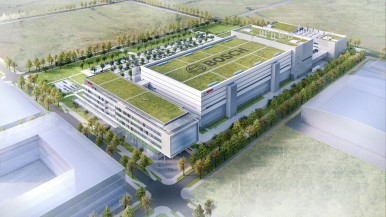
General information Total investment approx. 1 billion euros Site approx. 100,000 m2 (about 14 soccer fields) Total floor space approx. 72,000 m² of production area and office space Construction timeline Groundbreaking in spring 2018, installation of machinery mid-/end 2019, pilot production to start at end of 2021 Associates in the completed plant Up to 700 Qualified professionals needed Experts from the semiconductor industry, such as process, production, and maintenance engineers, mathematicians, software engineers, as well as professionals with degrees in physics, chemistry, and microsystems technologies Manufacturing technology Highly automated wafer production (300 mm silicon substrate wafers with structures up to 65 nm in width – 1 nm equals one millionth of a millimeter) Connected manufacturing Every second, the machines will transmit one gigabit of production data. The volume of data produced is equivalent to more than 42 million written sheets of paper, weighing 22 metric tons.Details on the building Total building volume 600,000 m³ Concrete approx. 66,500 m³ (about 8,300 concrete mixer trucks) Steel approx. 16,400 metric tons (about 30 A380 passenger jets) Earth moved/excavated approx. 90,000 m³ (some 7,500 truckloads) Bored piles for the foundation approx. 860 Floor slabs 100 cm thick Length of piping and ductwork approx. 80 km Length of electrical cabling approx. 380 km (from Dresden to Berlin and back)Internet For job seekers www.bosch-career.de/jobs Site for the Dresden location https://www.bosch.de/en/our-company/bosch-in-germany/dresden/ Bosch semiconductors http://www.bosch-semiconductors.com/

25.06.2018

Factsheet

Business/economy

Bosch in Brazil

About Hermann Scholl: Hermann Scholl has been the honorary chairman of the Bosch Group since mid-2012. Prior to that, he was chairman of the board of management of Robert Bosch GmbH until 2003 and, until 2012, chairman of the supervisory board of Robert Bosch GmbH and managing partner of Robert Bosch Industrietreuhand KG since mid-1995. Further informationQuotes: “ It has been some 25 years since I worked very closely with Bosch Brazil in my role as chairman of the board of management at Bosch. I am delighted that the German-Brazilian Chamber of Commerce still takes such a positive view of that time. This award is an honor for me. ” “ Bosch can look back on a long and successful history in Brazil. ” “ Brazil is a wonderful country with many impressive highlights. I remember the people as very endearing, open, and pragmatic. ” Bosch looks back on a long and successful history in Brazil Tradition: Bosch opened its first branch office in Brazil in 1910. The local subsidiary Robert Bosch Ltda. was established in 1954. The headquarters of Bosch Brazil, which remain responsible for the entire Latin America region to this day, were built just a few years later in Campinas, near São Paolo. Bosch has thus been active in Brazil for more than 100 years. All four business sectors operate there today. Local presence: In Brazil, the company focuses on localization. In Campinas, Bosch manufactures mobility solutions such as vehicle retrofitting components, powertrain systems, driver assistance systems, and power tools. The plant in Curitiba produces diesel injection systems. Aratu makes spark plugs, and Pomerode is home to a plant for hydraulic systems. Since 2010, the Bosch service center in Joinville has been providing service solutions for South America. Sales: A successful business year in 2017: sales rose to 4.9 billion reais (1.4 billion euros), with exports accounting for 28 percent in total. Bosch’s business in Brazil accounted for 80 percent of total sales in Latin America. The Mobility Solutions business sector in particular saw positive developments in 2017 due to growth in vehicle production in Brazil and Argentina. Investment: In 2017, Bosch invested some 53 million euros in Brazil. Headcount: Bosch employs some 8,300 associates in Brazil at 14 locations. Dual education model at Bosch in Brazil: In 1960, Bosch became one of the first companies to set up a dual education system in Campinas and Curitiba. Using this model, which is well-established in Germany, we train professionals such as mechatronics engineers according to German standards. To date, a total of over 1,400 young people have accordingly completed their occupational training. Bosch has also opened a center in Campinas that conveys and enhances knowledge throughout the spectrum of industrial occupations to facilitate efficient training. In addition, Bosch Brazil supports the promotion of talent and occupational training programs in the country. Local innovation: Strong localization is an important part of the Bosch strategy worldwide. The electronic control system for the flex-fuel engine is a good example of this. In 2003, Bosch developed a unique local solution for Brazil with this innovation, which allows drivers to choose flexibly between gasoline and ethanol at the pump. As a vehicle fuel, ethanol continues to have tremendous economic significance for Brazil. The flex-fuel engine is still used in most of the vehicles manufactured in Brazil. Smart solutions for Brazil: Demand for connected products is also growing in Latin America. In Brazil, Bosch is developing connected solutions for mining, logistics, and Industry 4.0. For the field of smart farming, Bosch offers a sensor system that reports animals’ weights to farmers and increases productivity on farms in Brazil. Corporate social responsibility: In Campinas, Bosch established the Centro Medico hospital in 1973. Originally set up to improve medical care for Bosch associates, the hospital was spun off into a foundation in 2004, ultimately opening it up to the general public. Instituto Bosch, which makes project funding of up to 3.5 million reais available every year, was also established in 2004. The school and vocational training projects it funds help to improve career opportunities for some 7,700 children and young people. The Primavera aid organization, established and financed by Bosch associates, operates worldwide and also receives donations from Brazilian associates. In Brazil, Primavera supports projects that are spearheaded by NGOs and schools, allowing it to reach an additional 2,000 children nationwide.

25.06.2018

Factsheet

Business/economy

Laying the foundation stone for 300 mm wafer fab in Dresden

General information Total investment approx. 1 billion euros Site approx. 100,000 m2 (about 14 soccer fields) Total floor space approx. 72,000 m² of production area and office space Construction timeline Groundbreaking in spring 2018 installation of machinery mid-/end 2019 pilot production to start at end of 2021 Associates in the completed plant Up to 700 Qualified professionals needed Experts from the semiconductor industry, such as process, production, and maintenance engineers, mathematicians, software engineers, as well as professionals with degrees in physics, chemistry, and microsystems technologies Manufacturing technologye Highly automated wafer production (300 mm silicon substrate wafers with structures up to 65 nm in width – 1 nm equals one millionth of a millimeter) Connected manufacturing Every second, the machines will transmit one gigabit of production data. The volume of data produced is equivalent to more than 42 million written sheets of paper, weighing 22 metric tons.Details on the building Total building volume 600 000 m³ Concrete approx. 66,500 m³ (about 8,300 concrete mixer trucks) Steel approx. 16,400 metric tons (about 30 A380 passenger jets) Earth moved/excavated approx. 90,000 m³ (some 7,500 truckloads) Bored piles for the foundation approx. 860 Floor slabs 100 cm thick Length of piping and ductwork approx. 80 km Length of electrical cabling approx. 380 km (from Dresden to Berlin and back)Internet For job seekers www.bosch-career.de/jobs Site for the Dresden location https://www.bosch.de/en/ourcompany/bosch-in-germany/dresden Bosch semiconductors www.bosch-semiconductors.com