Search & find:
Media, press releases, events for your editorial coverage

The journey to a more sustainable future

02.07.2024

Press release

Electrified mobility

The journey to a more sustainable future

Stuttgart/Reutlingen – The eBike is an important building block for the mobility revolution. It helps to reduce traffic and its impact on the environment, takes up little space and does not cause noise or local emissions 1 . Compared to cars, eBikes are not only cheaper, but also more environmentally friendly, space-saving and often faster in city traffic. They offer an important alternative to the car, especially for short distances of up to around 5 to 10 kilometers 2 . In an international study conducted by Bosch eBike Systems this year, 49 percent of eBike users surveyed stated that half of the journeys they used to make by car are now made by eBike 3 . This active form of mobility not only helps to reduce CO₂ emissions in cities, but also benefits each and every individual: Travelling by bike or eBike is good for your health and is also fun!As an evaluation by the Federal Environment Agency shows, the eBike is one of the lowest-emission means of transport. When using an eBike, the electricity consumption results in average CO₂ emissions of 3 g CO₂/person-kilometer (pkm), depending on the electricity mix. In comparison, a motor vehicle with an internal combustion engine emits about 166 g CO₂/pkm, while public transport emits between 58 and 93 g CO₂/pkm 4 . eBikers using the smart system from Bosch can now view their CO₂ savings compared to a car after every ride via the activity tracking function of the eBike Flow app 5 . "Bosch eBike systems are already driving a society in which people are travelling more sustainably. With our products and solutions, we make a contribution to future-proof mobility. It is also important to us to continue to improve our eBike systems in terms of sustainability throughout the entire product life cycle," explains Claus Fleischer, CEO of Bosch eBike Systems. "Because sustainability is not an additional task, but an integral part of our corporate culture." From vision to realisation: Bosch eBike Systems focuses on three pillars of sustainability Bosch eBike Systems has defined three pillars of sustainability and firmly anchored them in its strategy: The "Carbon footprint" pillar aims to measure, identify and reduce CO₂ emissions at company, product and material level. The "Responsibility in the supply chain" pillar defines measures to ensure that all materials and primary products are selected sustainably and responsibly and that social standards are adhered to. The "Circular economy" pillar is concerned with the goal of extending the service life of products, i.e. reusing raw materials and further increasing recycling efficiency, for example. For Bosch eBike Systems, the pillars are strategic guard rails that contribute to a common goal: to make eBike systems even more future-proof. To achieve this goal, the company derives specific measures that are implemented both internally and externally in collaboration with partners and suppliers. CO₂ analysis focusing on savings potential To intensify efforts to reduce emissions, Bosch eBike Systems, together with TÜV Rheinland, conducted a holistic analysis of the eBike's carbon footprint in 2022 and refined and updated it in 2024. Using the results of the analysis, the company has calculated the carbon footprint for each product in its portfolio. The aim of the analysis was to identify and evaluate the greatest CO₂ savings potential that can be found both in the system components and in the entire supply chain. Around 79 percent of an eBike's CO2 emissions are caused by the materials used and in production, and 13 percent through use. The remaining eight percent is accounted for by transport, packaging and recycling. Overall, an eBike has an average carbon footprint of 263 kg of CO₂ equivalents over its entire life cycle. If the eBike components are considered individually with approximately 84 kg of CO₂ equivalents, approx. 50 percent of the emissions are attributable to the battery, 48 percent to the drive unit and 2 percent to the display. If you ride around 515 kilometers on an eBike instead of using a motor vehicle with an internal combustion engine, the Bosch eBike system will have already paid for itself in terms of CO₂ consumption. The CO₂ savings potential identified in the display are the electronic components (53 percent) and the screen (41 percent). In the drive unit, the housing accounts for the largest share of CO₂ at 55 percent, followed by the electronic components at 17 percent. In the battery, the greatest savings potential comes from the cells, which account for 73 percent of the CO₂ emissions, followed by the housing at 12 percent and the cell holder at four percent. Reducing emissions along the entire supply chain In the purchasing process, the carbon footprint is an important decision-making criterion when it comes to supplier selection, alongside other sustainability criteria. For this purpose, the CO₂ emissions of the materials used and purchased parts are requested from suppliers. Claus Fleischer emphasises: "The joint analysis with TÜV Rheinland has shown us which areas we can and will prioritise to further reduce the carbon footprint of our eBike systems. Our measures focus on optimising materials and reducing emissions in production and the supply chain. Together with our partners and suppliers, we are making enormous efforts here, which are gradually paying off." In the production of the new Bosch CompactTube 400, for example, the company uses alternative materials for the cell holders, which make up the largest plastic parts within the PowerTubes, in order to reduce the carbon footprint. For this purpose, a plastic is used whose emission factor is 64 percent lower than that of the plastic previously used. This material change will in future become the standard for all Bosch eBike Systems batteries integrated within the frame. Beyond material and product level, Bosch eBike Systems also focuses on the corporate carbon footprint of its direct suppliers and makes this an important decision-making criterion in the purchasing process. By participating in the global system for the disclosure of environmental data provided by the non-profit organisation CDP, the company can record and assess the efforts of its direct suppliers to take climate protection measures. The aim is to make climate protection the standard: Suppliers that have a low CDP ranking and do not commit to the goals of the Paris Climate Agreement through an SBTi voluntary commitment 6 will be given a lower rating in the purchasing process. Suppliers that disclose via the CDP currently account for 97 percent of the purchasing volume of Bosch eBike Systems – this figure is set to rise to 100 percent by 2025. An important factor for reducing CO₂ is the use of green electricity. Bosch eBike Systems expects its suppliers to switch their production to electricity from renewable sources in order to reduce their emissions. Responsibility and transparency as selection criteria in the purchasing process Bosch eBike Systems places great value on the transparency and traceability of its supply chain, particularly with regard to batteries. In doing so, Bosch eBike Systems goes beyond the legal obligations stipulated by the Supply Chain Act and not only checks and qualifies its direct suppliers, but also endeavours to understand the entire supply chain in order to avoid potential risks in the procurement of raw materials. This applies in particular to the raw materials in the battery cells, which are comprehensively traced back to the mines. This approach will also be extended to the drive unit and displays in the future. With regard to environmental protection, Bosch eBike Systems expects its suppliers to set up and develop an environmental management system in accordance with ISO 14001. As of this year, 100 percent of our direct suppliers have appropriate certification. Circular economy: Remanufacturing & recycling at the end of the product life cycle For Bosch eBike Systems, the high quality, safety and long service life of its products are paramount. The useful life of an eBike and the number of journeys with other modes of transport it replaces make a significant contribution to reducing the impact on the environment. Nevertheless, it is inevitable that the products will reach the end of their lifetime at some point. This is where the circular strategy comes in, with which Bosch eBike Systems aims to improve the sustainability of products throughout their entire life cycle. This includes the procurement, production, utilisation, return, reprocessing and recycling of materials. Since 2014, Bosch eBike Systems has been investing specifically in the recycling of its drive units through remanufacturing. Defective Bosch eBike drive units that qualify after testing are subjected to a detailed reconditioning process. They undergo a complete technical overhaul and are made available to dealers with full functionality after a final test. "With our commitment to remanufacturing, we are sending a clear signal of our commitment to protecting the environment and promoting sustainable mobility – and have been doing so for over 10 years now," says Claus Fleischer. Further drive units will be added to the remanufacturing portfolio this year. To be able to reuse valuable raw materials at the end of their lifetime, batteries need to be recycled properly. Bosch eBike Systems supports new and sustainable recycling methods worldwide. The efficiency of recovery depends on the recycling process. In the processes used by the German GRS industry solution, almost 71 percent of many valuable raw materials can be recovered 7 and can be reused for new products. In future, Bosch eBike Systems will increasingly focus on the use of recyclates in its circular economy. In all sales countries where it is legally possible, Bosch eBike Systems voluntarily assumes responsibility for recycling obligations and the associated costs through local service partners. In countries where recycling solutions are not yet available or existing recycling solutions are inadequate, Bosch eBike Systems works closely with its partners, promotes pilot projects and supports the development of industry solutions. The company currently supports battery collection systems in 18 countries, including the Czech Republic and the United Kingdom as of this year. Moving forward together Through its measures, Bosch eBike Systems contributes to the overarching sustainability goals of the Bosch Group. With more than 400 locations worldwide, the Bosch Group has been carbon-neutral overall since 2020 (Scope 1 & 2) 8 . At the same time, the company intends to shape climate protection beyond its direct sphere of influence and also systematically reduce upstream and downstream emissions – the aim is to reduce emissions by 15 percent by 2030 (Scope 3). "We are aware that we still face a number of challenges on our path to a sustainable future. Responsible and sustainable behaviour is very important to us as a company and is already daily practice in many areas at Bosch eBike Systems. Both small and large improvements have already had a positive impact – and we want to achieve more and more of these in the future," says Claus Fleischer.Sources 1 World Health Organization (2022): "Walking and cycling: latest evidence to support policy-making and practice", p. 1, https://apps.who.int/iris/rest/bitstreams/1426622/retrieve (retrieved on 30 May 2024). 2 Federal Environment Agency (2023): "Welche Umwelttipps Sie bei Elektrofahrrädern beachten sollten" (Environmental tips to consider when using electric bikes), https://www.umweltbundesamt.de/umwelttipps-fuer-den-alltag/mobilitaet-reisen/e-bike-pedelec#gewusst-wie (retrieved on 30 April 2024). 3 Bosch eBike Systems, n= 4,200, countries: Denmark, Netherlands, USA, UK, Poland, Switzerland, Germany, Austria, Italy, field time: 30 November 2023 – 29 December 2023 4 Federal Environment Agency (2022): "Vergleich der durchschnittlichen Emissionen einzelner Verkehrsmittel des Linien- und Individualverkehrs im Personenverkehr in Deutschland 2022" (Comparison of the average emissions of individual means of regular and private passenger transport in Germany in 2022), https://www.umweltbundesamt.de/bild/vergleich-der-durchschnittlichen-emissionen-0 (retrieved on 30 April 2024) 5 The emissions saved relate to the use phase. The calculation is based on the Federal Environment Agency's assumption (2022): Car = 166 g CO₂/pkm, eBike = 3 g CO₂/pkm 6 The SBTi voluntary commitment allows companies to set science-based targets for reducing greenhouse gas emissions. Through this voluntary commitment, companies demonstrate their willingness to actively contribute to climate protection and align their business practices with the goals of the Paris Agreement. 7 Gemeinsames Rücknahmesystem Servicegesellschaft mbH (2023): "Nachhaltigkeit durch Rücknahme von Altbatterien aus E-Bikes und anderen elektrischen Kleinfahrzeugen steigern" (Increasing sustainability by taking back used batteries from eBikes and other small electric vehicles), presented at Eurobike 2023 8 Since 2020, the Bosch Group with its more than 400 locations worldwide has been carbon-neutral overall (Scope 1 & 2 according to Greenhouse Gas Protocol Corporate Accounting and Reporting Standard ). Bosch uses four levers to achieve this: increasing energy efficiency, generating its own energy from renewable sources, purchasing green electricity and offsetting remaining CO₂ emissions with carbon credits. Further information on the Bosch Group's sustainability strategy can be found at nachhaltigkeit.bosch.com

CES 2020: Bosch raises the bar when it comes to artificial intelligence

06.01.2020

Press release

Business/economy

CES 2020: Bosch raises the bar when it comes to artificial intelligence

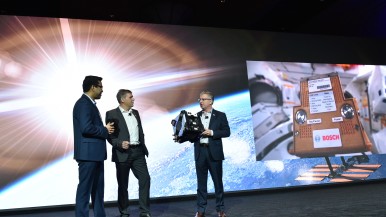
Las Vegas, NV, USA – Whether for automated driving, the smart home, or manufacturing: artificial intelligence (AI) has become an integral part of everyday life. Bosch uses AI and the internet of things (IoT) to make life easier for people and as safe as possible. Here, the slogan “Beneficial AI. Building trust together” sums up the technology and services company’s approach. The focus is on safe and robust AI for the manufacture of smart products, which Bosch will be showcasing at this year’s CES. One of these products is the Virtual Visor: an AI-based digital vehicle sun visor that will be making its debut at the world’s largest trade fair for consumer electronics. The product has also won a CES® Innovation Award, as has Bosch’s 3D display for the car.Other Bosch AI highlights at the show include an application for predictive maintenance of the International Space Station, a system for monitoring vehicle interiors, and a smart platform for medical diagnostics. “The solutions we’re showcasing at CES make it clear that Bosch aims to become an innovation leader in AI as well,” says Bosch management board member Michael Bolle. “As of 2025, every Bosch product will either contain artificial intelligence or will have been developed or manufactured with the help of AI.” The global market volume for AI applications is expected to be around 120 billion dollars over that same period, a twelvefold increase compared to 2018 (source: Tractica ). Bosch wants to tap into that potential: the company already invests 3.7 billion euros each year in software development, currently employs more than 30,000 software engineers, and has 1,000 associates working on AI. In addition, Bosch has established a comprehensive training program. “We plan to make nearly 20,000 associates AI-savvy over the next two years,” Bolle explains. “We must invest not only in artificial intelligence, but in human intelligence as well.” The program includes training formats at three different levels for managers, engineers, and AI developers and includes guidelines for using AI responsibly. To that end, Bosch has drawn up its own set of AI principles that address issues of AI security and ethics. With this in combination with its expertise, the company intends to build trust with customers and partners alike: “Anyone who has internalized technical and ethical principles knows how important data security and sovereignty are,” Bolle says. “In a way, trust is the product quality of the digital world.”Expertise saves lives In the future, Bosch believes one core area of expertise will be the industrial application of artificial intelligence. “We want to harness the power of artificial intelligence not for the purpose of creating models of human behavior, but instead to improve technology to benefit people,” Bolle says. “For this reason, industrial AI has to be safe, robust, and explainable.” According to Bosch, that means people should always remain in control, whether on the street, at home, or in manufacturing. As a pioneer in the development of life-saving driver safety systems such as ABS, ESP, and airbag control units, the company has already proved in the past that people benefit from reliable machines. AI can also make driver assistance systems even more efficient and intelligent: when Bosch’s AI camera for automated driving identifies partially concealed pedestrians, for example, the automatic emergency braking assistant can react even more reliably. Bosch is creating learning technology that is “Invented for life.”Bosch invests 100 million euros in an AI campus Innovations require investment. In addition to spending on software development, Bosch is investing worldwide in people and in competence centers. For example, the company is investing 100 million euros in the construction of a new AI campus in Tübingen, Germany. The move into the new research complex is planned for the end of 2022. It will then offer some 700 AI experts space for creative and productive exchange. These experts come from Bosch, external startups, and public research institutions. The new campus should strengthen exchange among experts in Cyber Valley. “Building trust together” will be a living reality there. Bosch is a founding member of Cyber Valley , which was established in 2016. This joint research venture brings together partners from industry, academia, and government to drive forward AI research and quickly transfer research findings into real-world industrial applications. In addition, the Bosch Center for Artificial Intelligence (BCAI) operates at seven locations worldwide, including two in the U.S.: in Sunnyvale, California and Pittsburgh, Pennsylvania. The BCAI currently has a total of some 250 AI specialists working on more than 150 projects in the domains of mobility, manufacturing, smart homes, and agriculture.World-first Virtual Visor originated in the U.S. Bosch has creative AI minds developing product innovations for mobility, the smart home, and Industry 4.0. Its AI world first for the automotive sector, which is celebrating its world premiere in Las Vegas, originated in the U.S.: the Virtual Visor, which is a transparent digital sun visor. A transparent LCD display connected to the interior monitoring camera detects the position of the driver’s eyes. Using intelligent algorithms, the Virtual Visor analyzes this information and darkens only the portion of the windshield through which the sun would dazzle the driver. The Virtual Visor scored the highest in its category at the CES Best of Innovation Awards. Bosch’s new 3D display won its category as well. Using passive 3D technology, the display generates a realistic three-dimensional effect for images and alerts. This allows visual information to be grasped faster than when displayed on conventional screens, increasing road safety. Additional safety comes from Bosch’s new interior monitoring system for vehicles. It detects when the driver is drowsy or looks at a smartphone based on eyelid movements, direction of gaze, and head position – and alerts the driver to critical situations. It also monitors the vehicle interior to determine how many occupants are present and where and in what position they are sitting. This makes it possible to optimize the operation of safety systems such as the airbags in an emergency. In 2019, Bosch sales of driver assistance systems rose by 12 percent to around 2 billion euros. They are paving the way for automated driving. In the future, when vehicles are in partially automated driving mode for sections of the journey such as on the freeway, the driver monitoring system will become an indispensable partner: In these situations, the camera will ensure that the driver can safely take the wheel again at any time. By 2022, the company will have spent around 4 billion euros on automated driving and will employ more than 5,000 engineers. To round out its sensor portfolio in this domain, Bosch is now working on making lidar sensors production-ready as well. In addition to radar and cameras, lidar is the third essential sensor technology. The Bosch long-range lidar sensor can also detect non-metallic objects at a great distance, such as rocks on the road.Bosch AI used in space and in medicine The company is aiming high with its SoundSee sensor system, which was sent into space at the end of 2019. Riding on NASA’s autonomous flying Astrobee robot, SoundSee will isolate unusual sounds on the ISS, analyze the audio using AI-driven analytics, and indicate when maintenance is necessary. Starting in early 2020, audio data captured by Soundsee will be delivered to a ground control facility configured to meet NASA specifications and built into the Bosch Research Center in Pittsburgh, PA. The system, which is barely bigger than a lunchbox, was developed in the U.S. together with Astrobotic as part of a NASA research collaboration.A completely earthbound but no less innovative product is Vivalution, a smart pathology platform that helps in medical diagnosis. Vivalution magnifies specimens like blood and other bodily fluids, digitizing the microscopic findings, and analyzing them with the help of artificial intelligence-powered algorithms. It is capable of precisely and rapidly identifying cell anomalies and providing physicians with useful support in evaluation and diagnosis.Smartglasses Light Drive make everyday glasses smart Bosch is also showcasing many non-AI innovations at CES. For example, its Light Drive smartglasses module is the world’s first sensor-based solution for making a normal pair of glasses smart. It is more than one-third thinner than other solutions on the market and weighs less than ten grams. The crystal-clear images projected into the wearer’s field of vision, which are clearly discernible even in direct sunlight, range from navigation information and text messages to calendar entries and operating instructions – depending on the information received from a smartphone or smartwatch. At CES, Bosch is using its IoT shuttle technology showpiece to present the solutions that the company offers automakers and mobility service providers for the electrification, automation, connectivity, and personalization of ridesharing vehicles. Its portfolio goes beyond components to include seamlessly connected mobility services that give users flexibility in how they operate, manage, charge, and maintain their fleet vehicles, as well as making each journey safe. At the Bosch booth, visitors can also see improved drive and sensor technologies for the connected and emissions-free mobility of the future.Solutions for the entire house: expanded portfolio for residential IoT Bosch is expanding the scope of its services for the residential internet of things (IoT). The highlight here is the open Home Connect platform, which is being showcased at CES. Starting in mid-2020, the platform’s app will also offer control of lighting and shade, entertainment, and smart gardening equipment from different manufacturers. The number of partner companies, which is currently at 40, is set to more than double, making life at home even more convenient and efficient.Smart technology protects the environment Underlying all these innovative products is Bosch’s entrepreneurial mindset. “We want to harmonize commercial, environmental, and social responsibility,” Bolle says. Climate protection is also a major concern here. According to Bolle, “Bosch not only develops environmentally friendly solutions, but also acts as a role model. By the end of 2020, all our 400 locations worldwide will be climate neutral and from development to manufacturing to administration no longer leave a carbon footprint. We’ve already achieved this for our German locations.” Artificial intelligence plays a role here, too: at individual locations, for example, an in-house energy platform uses intelligent algorithms to identify deviations in energy consumption. This alone has enabled some plants to reduce their CO2 emissions by more than 10 percent over the past two years. Considering that Bosch operates a total of 270 such plants, the savings potential is enormous. As Bolle explains, “That’s how we sum up our message at CES: Bosch has big plans for AI in many respects.”