01.07.2020
Press release
Research
Bosch opens hydrogen-compatible fuel cell pilot installation at Wernau plant
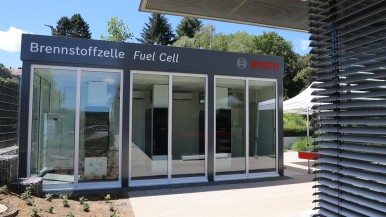
Bosch is opening a new chapter in the energy transition: At the Bosch training center in Wernau, Germany, a fuel cell pilot installation based on SOFC technology, short for Solid Oxide Fuel Cell, is launched. The system consists of three fuel cell devices for stationary applications, which supplement the existing power supply of Wernau plant in a CO 2 -saving manner and drive the further development of these decentralized energy systems.Franz Untersteller, Baden-Württemberg's State Minister for the Environment, Climate, and Energy, Andreas Schwarz, Member of the Baden-Württemberg Parliament, and Armin Elbl, mayor of Wernau, were among those who accepted Bosch Thermotechnology’s invitation to attend the official inauguration ceremony. "As you see, Bosch has recognized the enormous economic potential associated with hydrogen and fuel cell technology, both in the mobility sector and in the field of stationary energy supply. And that's not all: With hydrogen, the economic prospects complement the ecological benefits wonderfully. This technology is a key technology for climate protection," explained Franz Untersteller during the event. Fuel cell devices from Bosch with a wide range of applications The development of these novel fuel cell systems was only made possible by close cooperation between the Bosch Corporate Research, Powertrain Solutions, and Thermotechnology divisions. Further SOFC pilot installations for testing and validation are located at the Bosch sites in Bamberg, Homburg, Renningen, and Schwieberdingen. Demonstration facilities are also planned in Stuttgart-Feuerbach and Salzgitter. From 2020, the Bosch Group locations worldwide will no longer leave a CO 2 footprint. The further development of the solid oxide fuel cell as an efficient and sustainable energy system also plays an important role in this respect, reports Uwe Glock, chairman of the board of management of Bosch Thermotechnology: "The energy transition can only succeed if we invest in sustainable, renewable energies over the long term. For Bosch, the highly efficient fuel cell is therefore an important contribution to the reliability of supply and flexibility of the energy system of the future.” Focus on CO 2 reduction: Operation with hydrogen, eco/biogas or natural gas With the recently adopted hydrogen strategy of the Federal Government, hydrogen will become an important energy carrier of the future. The SOFC fuel cell can be operated flexibly with hydrogen, eco/biogas, or natural gas: "The gradual switch to hydrogen as an energy carrier over the next few years makes the stationary fuel cell particularly future-proof in terms of achieving climate targets," explains Dr. Wilfried Kölscheid, head of the Solid Oxide Fuel Cell project at Bosch. Compared to the electricity mix in Germany, a SOFC fuel cell system saves up to 40 percent in CO 2 emissions, even when operated with natural gas. If the fuel cell is operated with hydrogen or ecogas, there are no direct CO 2 emissions at all. A single SOFC unit with a power output of 10 kW can cover the annual electricity demand of more than 20 four-person households. At Wernau plant, this means that the energy requirements of an industrial building within the plant can be almost completely covered by the three fuel cell units. "With the SOFC pilot installation in Wernau, Bosch is demonstrating that a reliable, environmentally friendly and flexible energy supply can be guaranteed decentrally by systems such as the fuel cell," reports Uwe Glock. "The installation underlines our efforts to drive forward the energy transition and the associated mitigation of climate change in all energy and heating solutions from Bosch," adds Wilfried Kölscheid. SOFC devices with an overall efficiency of more than 85 percent In a purely electrochemical process, oxygen ions pass through a thin ceramic electrolyte from an anode to the cathode in the SOFC fuel cell, where they react with hydrogen to form water. This produces electricity with an efficiency of more than 60 percent. The additional heat generated can be used to supply heating and hot water systems via a heat exchanger. With this dual use, an overall efficiency of more than 85 percent is achieved for SOFC devices.