04.10.2019
Press-Feature
Connected mobility
Did you know... Facts, figures, and amazing truths about semiconductors
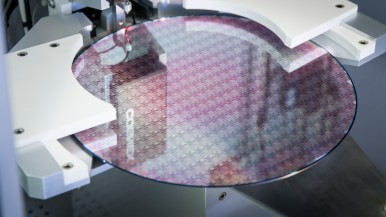
The market In 2018, some 469 billion dollars (427 billion euros) worth of semiconductors were sold worldwide, an increase of around 15 percent over 2017 (source: World Semiconductor Trade Statistics). At 40 billion dollars (36 billion euros), memory chips make up the largest market share. The German semiconductor market grew by around 8 percent in 2018 and was worth 16 billion euros (source: ZVEI). While the semiconductor share in smartphones, tablet computers, PCs, and TVs will stagnate over the coming years, it will grow in vehicles as a result of increasing electrification, automation, and connectivity. Bosch today is one of the leading manufacturers of semiconductors for automotive applications and has been the leader in the manufacture of MEMS sensors since 2013.Production Semiconductor chips are manufactured on circular discs of silicon or silicon carbide, known as wafers. Up to 50,000 semiconductor chips fit on an eight-inch (200-mm) silicon wafer. Wafer production is carried out under cleanroom class 1 conditions. Every cubic foot (approx. 28 liters) of normal ambient air contains 100,000 particles. When manufacturing semiconductors, by contrast, there must be no more than one particle weighing half a microgram in every cubic foot of air. That is roughly the equivalent of having a single cherry pit in all of Lake Constance. In a complex production process lasting up to 14 weeks, the raw silicon wafers are made into semiconductor chips. In 1994, Bosch developed the “Bosch Process” for manufacturing MEMS sensors. For this work, the developers Jiri Marek, Michael Offenberg, and Frank Melzer received the German Future Prize. Bosch holds more than 1,500 patents and patent applications in the field of semiconductors, 1,000 of which are for MEMS technology. The development of semiconductor technology at Bosch Bosch has been manufacturing a wide range of semiconductor chips for nearly 50 years. These include application-specific integrated circuits (ASICs), power semiconductors, and microelectromechanical systems (MEMS). In the mid-1950s, Bosch research began to explore the development of particularly robust semiconductor components that are suitable for use on the road. In the 1960s, Bosch developed the first power semiconductor for cars. Back then, special generator diodes made generators more reliable and longer-lasting. At the end of the 1960s, Bosch built its first semiconductor factory in Reutlingen due to the growing demand for the components from within the Bosch Group. In 1970, Bosch launched the world’s first mass-produced ASICs for cars. Specifically, they were power transistors for voltage regulators and integrated circuits. When Bosch began producing its Motronic – a digital engine control system (ignition and injection in one control unit) – in 1979, it had an eight-bit microprocessor on board. Together with the erasable memory used, this was effectively the world’s first use of a computer in a car in a driving-relevant role. Bosch has been producing MEMS sensors for 25 years; the first model was a pressure sensor for the Bosch Motronic. In 2010, Bosch took its 200-millimeter semiconductor factory in Reutlingen into operation. With a total outlay of 600 million euros for the wafer fab, this was the biggest single investment ever made in the history of the Bosch Group. In June 2018, Bosch laid the foundation stone in Dresden for the construction of the Bosch Group’s most advanced semiconductor factory. The company is investing around one billion euros in this facility. In the plant, the company will manufacture semiconductors based on 300-millimeter technology. Use in vehicles In 2018, every new vehicle featured semiconductors worth 370 dollars (337 euros) on average. By 2021, this figure is set to rise to around 406 dollars (369 euros) (source: ZVEI). Experts predict that the biggest growth will be in the compact and middle-class segments, as typical high-end functions gradually seep into the mass market. Today’s vehicles feature around 50 MEMS sensors. Semiconductors account for some 75 percent of innovations in new vehicles. They can be found, for example, in the powertrain, in the cockpit, and in the infotainment and driver assistance and safety systems. In 2016, every car rolling off the production lines worldwide had on average more than nine Bosch chips on board, of which five were MEMS sensors. Use in consumer and entertainment electronics For more than ten years, Bosch MEMS sensors have also been used in consumer electronics. 2006 saw the market launch of the first MEMS sensor for consumer electronics. It enhanced the fun of games consoles. In 2018, more than 1.4 billion smartphones were sold (source: International Data Corporation (IDC)). In addition, wearables – the collective term for electronics that can be worn on the body, such as smart watches, fitness armbands, and data goggles – are growing in popularity. In 2018, sales of wearables were around 172 million units (source: IDC). All these devices contain sensors that evaluate a very wide range of information. On average, five MEMS sensors are built into every smartphone. They enable the mini-computers to recognize when the screen has been turned, and they stabilize photos and facilitate navigation. Every second smartphone has at least one Bosch semiconductor chip (MEMS sensor). Amazing but true When Bosch began the production of micromechanical sensors in 1995, the edge length of an acceleration sensor was 133 millimeters. The edge length of the smallest MEMS sensor currently in Bosch’s portfolio is 1.56 millimeters. That is smaller than a pinhead and represents a miniaturization of the sensor size by a factor of 85 within about 25 years – while simultaneously featuring more functions. More than 80 of these microchips would fit on a thumbnail. To date, Bosch has manufactured well in excess of 10 billion MEMS sensors in Reutlingen, with several million more added to the tally every day. On average, Bosch semiconductors are two millimeters thick. If the 10 billion semiconductors already manufactured by Bosch were laid end to end, the row of chips would be about 20,000 kilometers long. That is roughly the distance from the North to the South Pole. In consumer electronics, MEMS sensors are less than one millimeter in height. Some components inside the sensors measure a mere four micrometers – 17 times thinner than a human hair.