Search & find:
Media, press releases, events for your editorial coverage

The Factory of the Future: Bosch is turning vision into reality

27.03.2019

Factsheet

Industry 4.0

The Factory of the Future: Bosch is turning vision into reality

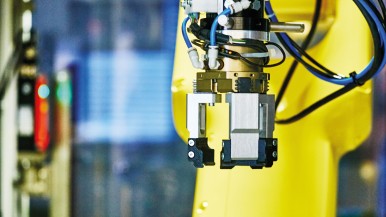
From theory to practice: at Hannover Messe 2019, Bosch is showcasing the connected factory live and up close. Autonomous transport systems deliver components to digital work stations, while robotics systems support workers. Software applications analyze and visualize data in the background. Artificial intelligence makes quality inspections ever more precise, while 5G enables communication in near real time.Industry 4.0 is an integral part of Bosch’s corporate strategy. The company is a pioneer that is setting the pace for connected manufacturing and logistics. At Hannover Messe, Bosch is presenting product innovations, introducing research and development projects, and showcasing what the factory of the future will look like. At a booth measuring some 1,300 square meters, the company is exhibiting the factory of tomorrow, today. A large stage at the center of the booth displays no mere reproduction of the factory – this model is live and interactive. Through a combination of real exhibits and futuristic animations, the company illustrates how Industry 4.0 makes the work in manufacturing and logistics easier, more efficient, and more flexible. Wireless power and communication In the factory of the future, the only fixed elements are the floor, the walls, and the roof – everything else is movable and flexible. LED lighting on the smart floor indicates where autonomous transport systems will be needed next and how they get there. The necessary power comes directly and wirelessly from the factory floor. Communication among the sensors, systems, and machinery is wireless as well. Here Bosch employs the new 5G mobile communications standard, which at more than ten gigabits per second is ten times faster than the top speed currently available. 5G also significantly increases the real-time capability and the reliability with which data can be sent and received. At Hannover Messe, the company is highlighting the standard’s advantages using Bosch Rexroth’s new autonomous transport system as an example: thanks to 5G, the ActiveShuttle maintains a constant and highly reliable connection with the local manufacturing network. The result is security – both in planning and in ongoing operations. 3D printing for industrial applications The manufacturing scenario starts with a BigRep PRO, the first 3D printer of its kind to be equipped with automation solutions from Bosch Rexroth and connected via 5G. Bosch Rexroth and BigRep, one of the leading suppliers of large-format 3D printers, are working on establishing 3D printing as industrial production technology. Automated additive manufacturing not only makes it possible to produce prototypes and models quickly and efficiently, it also makes the technology fit for serial manufacturing. According to estimates, the market for additive manufacturing could be worth some 20 billion euros. At Hannover Messe, the BigRep printer is additionally equipped with IoT solutions from Bosch Rexroth and Bosch Connected Industry. IoT devices, software and intelligent sensors monitor all machine conditions and help to optimize product quality. This data also increases the quality of the printed components. The software is able to detect wear and errors before they lead to machine downtime, thus enhancing the printer’s availability. ActiveShuttle sets intralogistics in motion Intralogistics is becoming increasingly important. After all, what use is highly automated manufacturing if the materials don’t arrive at the production line on time and in the right quantities? Autonomous transport systems make intralogistics flexible and transparent. Bosch Rexroth’s new ActiveShuttle moves loads weighing up to 260 kg quickly and safely through the production facility. An integrated hub platform helps in the fully automated loading and unloading of dollies equipped with small load carriers (SLC). This means ActiveShuttle can facilitate many kinds of transport concepts, ranging from cyclical deliveries to consumption-based material supply. Even when people are present and other transport vehicles are in play, the vehicle merges effortlessly into the intralogistics environment: dynamic map updates mean that ActiveShuttle has no difficulty handling changes in its driving area. Nexeed software for transparent value streams In the background, the Nexeed software harmonizes, analyzes, and visualizes huge volumes of data. It is an example of how the Bosch Connected Industry operating unit, set up in 2018, is further expanding the company’s expertise in Industry 4.0 software. The demand is there: internal Bosch projects indicate that by using Nexeed, it is possible to increase productivity at individual locations by up to 25 percent while reducing stock levels by up to 30 percent. Nexeed also makes plants more flexible: manufacturers can retool machines faster and gear them up for customized production – all the way down to batch sizes of one. Nexeed also facilitates higher transparency in the intralogistics material flow and in international supply chains. Visual inspection with artificial intelligence Artificial intelligence offers enormous potential for improving quality and productivity in manufacturing. At Hannover Messe, Bosch is offering insights derived from its own research project, ViPAS. This visual inspection unit can inspect all sorts of components, ranging from screws and pumps to common-rail injectors – or any part its integrated robot can pick up and hold in front of its camera in the lighting dome. After comparing the images with the stored information, it classifies the parts as either OK or NOK (defective). Deep learning lets the system train itself using sample images, so ViPAS can be deployed for various visual inspection duties. Connected hydraulics from Bosch Rexroth Hydraulics are used to generate high forces, achieve high efficiencies, ensure safety and reliability and guarantee uniform performance over a long period of time. This also applies to industrial production. Bosch Rexroth uses the CytroBox to show how hydraulic components can be connected and integrated into the factory of the future. The sensors in the hydraulic power unit provide information on the current filter, oil or drive status. A dashboard shows maintenance staff everything they need to know about the CytroBox – from component and operating status to upcoming maintenance work and predictive maintenance analyses. Combined with a significant noise reduction to 75 dB(A), the CytroBox makes working more pleasant.


A look at the company’s local operations

27.03.2019

Factsheet

Industry 4.0

A look at the company’s local operations

Bosch has a long history in Sweden . The international technology and services company has been operating there since 1904, and today all four of its business sectors – Mobility Solutions, Industrial Technology, Energy and Building Technology, and Consumer Goods – have local operations. Bosch employs more than 1,600 associates at nine locations in Sweden, including three plants. Bosch Rexroth manufactures high-performance hydraulic drives in Mellansel under the Hägglund brand name for a wide range of applications. This subsidiary also operates a cylinder factory in the Älvsjö district of Stockholm. The Thermotechnology division manufactures heat pumps in Tranas. The Swedish headquarter is located in Kista, a district in the northwest of Stockholm. In 2018, Bosch generated around 1.1 billion euros in domestic sales.An IoT innovation hub down south The company set up an R&D site at Lund at the southern tip of Sweden in 2016 to develop software and hardware solutions for the internet of things (IoT). The number of experts working there has doubled to around 100 since it opened. The Lund location develops connected mobility solutions for infotainment, cybersecurity, and other applications, as well as apps for vehicles and e-bikes. Its experts also create cross-domain IoT solutions for connected mobility, for example, in combination with energy and building technology. Testing in the Arctic Circle, at the cradle of automotive safety technology Bosch has been testing vehicle safety systems on ice and snow for more than 45 winters on the far-north Vaitoudden peninsula. Its first anti-lock braking system, for example, was born there. Bosch opened its Vaitoudden winter test center in 2003 for the company and its customers to test and further refine automated mobility solutions. Bosch locations in Sweden

07.12.2018

Factsheet

Connected mobility

Bosch steps up efficiency in breakdown service

Frankfurt/Main, June 4, 2018 – No matter whether you are driving on vacation in a rental car, on the road in your personal or company vehicle or using a car-sharing service: if you break down or get into an accident, you need quick assistance. Starting now, Bosch is offering an especially quick and efficient breakdown service. In emergencies, drivers can quickly call for assistance by phone or app. Thanks to digitalized and automated processes, it takes on average just 35 minutes for the roadside assistance to arrive. That saves an average of two hours waiting time compared to manually dispatched breakdown services. In addition to the shorter waiting times, the driver benefits from greater transparency of the call status. The Bosch staff or the virtual map in the app provide information in real time on where the service vehicle is and when it will reach the breakdown location. If the driver needs additional support, in addition to roadside assistance, Bosch can also help. "We can combine our various services for mobility across the board. For example, we can supplement the breakdown service with our Concierge Service. In this case, we will also look after logistical details, such as arranging a replacement vehicle or a hotel room", says Stefan Gross, Mobility Services Manager at Bosch Service Solutions in Frankfurt.Partnership with MySchleppApp For the implementation, Bosch has enlisted the services of the MySchleppApp startup venture founded in 2016. The company has placed its infrastructure, including more than 800 partners and its mobility technology, at the disposal of Bosch. MySchleppApp founder and Chief Executive, Santosh Satschdeva, remarked: "We are delighted to support Bosch with our network and technology. Customers will benefit from yet another innovative mobility solution that makes their lives easier". Individual solutions through the Bosch Service Center Inquiries go directly to the Bosch Service Center and are handled by specially trained staff. These service experts set up the appropriate solution for the situation with the aid of the close-knit partner network with more than 6,200 service vehicles – everything from simple assistance to get the car started through to the towing service and rescue following an accident. Corporate customers benefit from uncomplicated breakdown service The new service from Bosch has attracted interest not only from the automotive industry, but many other sectors. Theses include fleet managers, such as car-sharing providers or car rental companies and also insurance companies that often provide roadside assistance as an integral part of the contract. The breakdown service is now available in the Germany-Austria-Switzerland region and in the USA. Bosch Service Solutions aims to build a global partner network capable of serving the needs of international customers.

19.11.2018

Factsheet

Research

Bosch AI mission-bound to the ISS

SoundSee The SoundSee module is integrated in NASA’s AstroBee. This autonomous robot will be able to find its way around inside the International Space Station on its own. The device will be transported to the ISS in May 2019. The SoundSee module is a Bosch AI-based system designed to monitor sounds made by ISS’s mission-critical infrastructure. Partners The Bosch Research and Technology Center Pittsburgh and Astrobotic Technology developed the instrument in a joint effort with the NASA Ames Research Center. Function & objective This technology is based on an audio analysis function that will detect and recognize noise signals from machines on board the ISS, such as motors and pumps. Its machine learning capabilities will enable the AI module to eventually understand these sounds. The system will report any acoustical anomalies, with the result that repairs can be made early on, before a machine fails. This means it will be possible to quickly identify any deviation from normal operation, enabling the crew and ground personnel to respond that much faster, and gain deeper insight into the space station’s technical status. Bosch will also use the data collected on the ISS for further research, with the aim of deploying similar modules in other systems, such as car engines. AI CON 2018 Model The Bosch Center for Artificial Intelligence (BCAI) will exhibit a model of this device. An expert from the Bosch Research and Technology Center Pittsburgh will be on hand to answer questions about the project.

25.06.2018

Factsheet

Business/economy

Laying the foundation stone for 300 mm wafer fab in Dresden

General information Total investment approx. 1 billion euros Site approx. 100,000 m2 (about 14 soccer fields) Total floor space approx. 72,000 m² of production area and office space Construction timeline Groundbreaking in spring 2018 installation of machinery mid-/end 2019 pilot production to start at end of 2021 Associates in the completed plant Up to 700 Qualified professionals needed Experts from the semiconductor industry, such as process, production, and maintenance engineers, mathematicians, software engineers, as well as professionals with degrees in physics, chemistry, and microsystems technologies Manufacturing technologye Highly automated wafer production (300 mm silicon substrate wafers with structures up to 65 nm in width – 1 nm equals one millionth of a millimeter) Connected manufacturing Every second, the machines will transmit one gigabit of production data. The volume of data produced is equivalent to more than 42 million written sheets of paper, weighing 22 metric tons.Details on the building Total building volume 600 000 m³ Concrete approx. 66,500 m³ (about 8,300 concrete mixer trucks) Steel approx. 16,400 metric tons (about 30 A380 passenger jets) Earth moved/excavated approx. 90,000 m³ (some 7,500 truckloads) Bored piles for the foundation approx. 860 Floor slabs 100 cm thick Length of piping and ductwork approx. 80 km Length of electrical cabling approx. 380 km (from Dresden to Berlin and back)Internet For job seekers www.bosch-career.de/jobs Site for the Dresden location https://www.bosch.de/en/ourcompany/bosch-in-germany/dresden Bosch semiconductors www.bosch-semiconductors.com