27.08.2020
Press release
Automated mobility
Ford, Bedrock and Bosch are exploring highly automated vehicle technology in Det ...
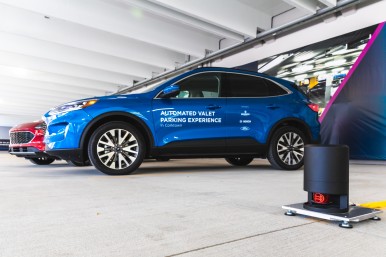
DETROIT – Many people enjoy driving… until it’s time to park. So why not leave the task to the vehicle?Ford Motor Company, Bedrock and Bosch are launching a demonstration project with connected Ford Escape test vehicles that can drive and park themselves inside Bedrock’s Assembly Garage in Detroit using Bosch smart infrastructure. This is the first U.S. infrastructure-based solution for automated valet parking where the vehicle will park itself inside a parking garage. The research will take place in the Corktown neighborhood, the site of Ford’s new mobility innovation district, anchored by Michigan Central Station. The district will draw mobility innovators and disruptors from around the world to develop, test, and launch new solutions to solve urban transportation challenges, improve mobility access for everyone and prepare for the increasingly connected and autonomous world ahead. “We are continually searching for opportunities to expand our leading suite of Ford Co-Pilot360 driver-assist technologies that help people drive more confidently and we believe automated valet parking technology holds great promise,” said Ken Washington, chief technology officer at Ford Motor Company. “Our work with Bosch and Bedrock also aligns with our vision for the future, which includes increasingly automated vehicles that are more aware of their surroundings while requiring less on-board computing to help improve design, packaging and affordability.” The demonstration project will be on display on the ground floor of Bedrock’s Assembly Garage, the real estate developer’s first residential redevelopment project in the Corktown neighborhood. The project aligns with Bedrock’s vision of combining ground up and historical developments with the newest technology in parking and mobility - including the current installation of the Midwest’s first automated parking stall, which parks and retrieves vehicles in the basement of the Free Press Building using street-level load bays. “We strive to be at the forefront of parking and mobility initiatives in Detroit because we recognize the importance of interconnectivity between real estate and mobility,” said Heather Wilberger, chief information officer at Bedrock. “In addition to drastically reducing park time, we see this solution as the first step to bringing automated parking to our city, providing the ultimate convenience for our tenants, visitors, neighborhoods and residents.” The automated valet parking technology will be running for Assembly tenant and private demonstrations through the end of September. Connected vehicle and smart infrastructure enhance automated parking The connected Ford test vehicles operate in a highly automated fashion by vehicle-to-infrastructure (V2I) communication with Bosch’s intelligent parking infrastructure. The infrastructure sensors recognize and localize the vehicle to guide its parking maneuver, including the ability to help avoid pedestrians and other hazards. If the infrastructure senses something in the vehicle’s path, it can stop the vehicle immediately. “For Bosch, automated valet parking brings together our deep cross-domain experience in mobility and building technologies to deliver a smart infrastructure solution that improves everyday life,” said Mike Mansuetti, president of Bosch in North America. “This technology enables consumers to see the benefit of highly automated technology as the vehicle handles a task such as parking in a garage.” Upon arriving into the garage, a driver will leave the vehicle in a designated area and use a smartphone app to send the vehicle into an automated parking maneuver. Drivers will also use the app to request the return of the vehicle to the designated pick-up area, expediting the parking experience and removing the responsibility of finding the vehicle upon return to the garage. New mobility requires collaboration The demonstration project at Assembly Garage brings together one of the world’s largest automakers, Ford, the largest property developer in the City of Detroit, Bedrock, and the world’s largest automotive supplier, Bosch, to demonstrate how organizations are working together on new mobility initiatives. “Michigan continues to lead the way through unprecedented investments in the smart infrastructure that is critical to developing and deploying the most advanced forms of mobility,” said Garlin Gilchrist II, Lt Governor. “With the Office of Future Mobility and Electrification, we are ensuring our state solidifies its position not only in the manufacturing of advanced automobiles, but also in the future of smart, connected roadways and parking areas. We will continue finding innovative ways to work with partners across both the public and private sector to deliver real-world solutions to today’s transportation challenges.” The demonstration project will enable the three companies to gain valuable insights regarding user experience, vehicle design, parking structure design and application to expand the technology and its application. “The City of Detroit continues to be at the forefront of mobility and the heart of the automotive industry,” said Mike Duggan, mayor of the City of Detroit. “Ford has a long and storied history with the Motor City and it is exciting to see them collaborate with Bosch and Bedrock on this innovative effort to propel the region into the future of mobility. I look forward to the day when Detroit residents and visitors alike will see a benefit from future technologies such as automated valet parking – it will undoubtedly save space in our garages and make the entire parking experience more convenient.” Efficient use of space and vehicle services make the case Automated parking solutions bring value to garage owners by allowing for the more efficient use of spaces inside a parking garage. With automated valet parking, the same amount of space can accommodate up to 20 percent more vehicles. The solution can be deployed via retrofitted solutions like the one in the Assembly Garage or with embedded infrastructure planned into construction of new garages that enables optimized design for maximum capacity. In addition to simply parking, a vehicle could also drive itself to areas within the garage for specific services such as vehicle charging or a car wash. During the demonstration project, Ford, Bedrock and Bosch will demonstrate vehicle paths showing how a vehicle would move between service areas and ultimately to a parking spot before the user calls it back to leave the garage.