

Farmington Hills, Mich – As automakers focus on the efficiency and performance of internal combustion and hybrid powertrains as part of a multi-lane approach to vehicle propulsion, Bosch is advancing technologies that help to reduce real-world emissions without requiring major vehicle redesigns.
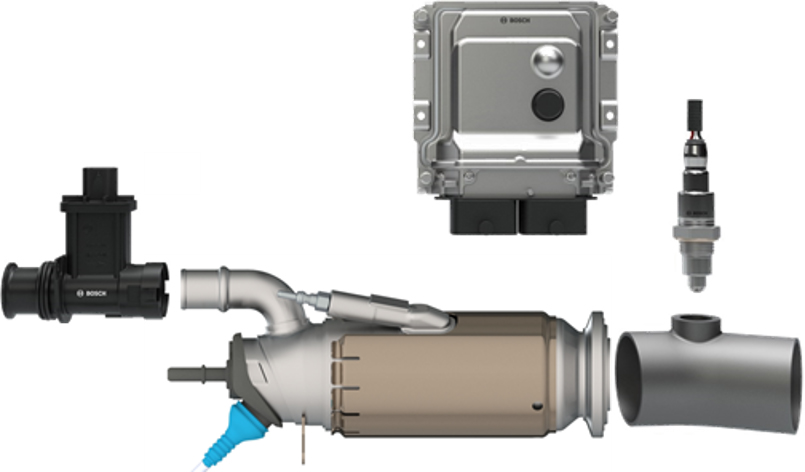
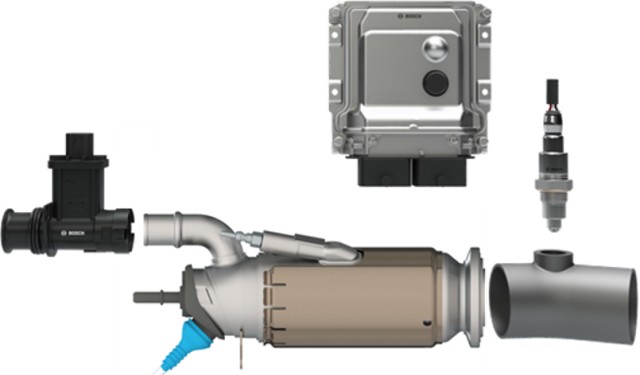
Bosch is introducing Rapid Catalyst Heating (RCH), a system designed to reduce cold-start emissions in gasoline-powered vehicles. The RCH system accelerates catalyst activation (i.e., catalyst “light-off”) during the first seconds of operation, when tailpipe emissions can be highest. By rapidly elevating exhaust temperature, Bosch’s RCH system minimizes light-off delay while enhancing catalyst efficiency during the engine start.
Cold-start emissions – those that occur prior to catalyst light-off – commonly account for the majority of a vehicle’s emissions footprint. Although more severe during colder ambient temperatures, catalyst heating is required across the full range of environmental conditions. Traditional catalyst heating strategies rely on engine-based methods that compromise efficiency for elevated exhaust temperatures. To address this challenge, Bosch developed the RCH system to accelerate catalyst warm-up and reduce cold-start emissions without requiring significant changes to vehicle architecture. Unlike electrically heated catalysts or engine-based warm-up strategies, RCH delivers high thermal power using existing vehicle systems without requiring high-voltage architectures or major aftertreatment redesign.
“As the industry transitions across multiple propulsion technologies, internal combustion engines will continue to play a major role globally for years,” said Peter Tadros, regional president, Power Solutions, Bosch in North America. “That reality makes it critical to reduce emissions from the vehicles entering the market with conventional ICE powertrains. Cold start emissions are a key challenge, and the Bosch Rapid Catalyst Heating addresses that issue in a way automakers can deploy at scale without disrupting existing vehicle architectures.”
How the RCH system works
The Rapid Catalyst Heating system features an integrated, fuel-based auxiliary burner that delivers additional thermal energy directly to the exhaust stream, rapidly increasing catalyst temperature during cold start and early drive-off. Key features include:
- 25+ kilowatts (nominal) of available thermal power to help accelerate catalyst warm-up.
- Operates independently from the engine, reducing calibration complexity and efficiency trade-offs.
- Compatible with existing vehicle architectures, operating on a 12-volt electrical system and low-pressure gasoline fuel supply.
- Allows flexible integration with both closely coupled and underfloor catalyst configurations.
By decoupling catalyst heating from engine operation, the system helps enable earlier and more consistent emissions conversion during periods when tailpipe emissions are typically highest. Exhaust thermal management is particularly important in hybridized powertrains – when catalyst temperatures can drop below critical “light-off” thresholds during all-electric operation.
Emissions benefits
Vehicle testing shows that RCH can help reduce emissions by up to 70 percent during cold start and early drive-away conditions. These reductions persist across passenger vehicles and larger platforms, including pickup trucks, under standard and quick drive-away cycles.* Faster catalyst activation may also reduce the needed density of precious metal loading and calibration complexity, helping offset system costs while supporting reduced emissions standards.
RCH aligns with the broader Bosch strategy to advance emissions reductions across multiple propulsion systems while focusing on solutions automakers can implement today. Bosch continues validation with OEM partners, emphasizing durability, packaging flexibility and readiness for series production.
*Note: For a technical overview of RCH development, implementation and performance, see: Disch, C., O’Donnell, R., Singh, R., Chutipassakul, S., et al., “A Rapid Catalyst Heating System for Gasoline-Fueled Engines,” SAE Int. J. Adv. & Curr. Prac. in Mobility 7(2):773-797, 2025, https://doi.org/10.4271/2024-01-2378