Search & find:
Media, press releases, events for your editorial coverage

CES 2020: Bosch raises the bar when it comes to artificial intelligence

06.01.2020

Press release

Business/economy

CES 2020: Bosch raises the bar when it comes to artificial intelligence

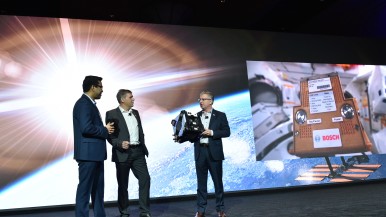
Las Vegas, NV, USA – Whether for automated driving, the smart home, or manufacturing: artificial intelligence (AI) has become an integral part of everyday life. Bosch uses AI and the internet of things (IoT) to make life easier for people and as safe as possible. Here, the slogan “Beneficial AI. Building trust together” sums up the technology and services company’s approach. The focus is on safe and robust AI for the manufacture of smart products, which Bosch will be showcasing at this year’s CES. One of these products is the Virtual Visor: an AI-based digital vehicle sun visor that will be making its debut at the world’s largest trade fair for consumer electronics. The product has also won a CES® Innovation Award, as has Bosch’s 3D display for the car.Other Bosch AI highlights at the show include an application for predictive maintenance of the International Space Station, a system for monitoring vehicle interiors, and a smart platform for medical diagnostics. “The solutions we’re showcasing at CES make it clear that Bosch aims to become an innovation leader in AI as well,” says Bosch management board member Michael Bolle. “As of 2025, every Bosch product will either contain artificial intelligence or will have been developed or manufactured with the help of AI.” The global market volume for AI applications is expected to be around 120 billion dollars over that same period, a twelvefold increase compared to 2018 (source: Tractica ). Bosch wants to tap into that potential: the company already invests 3.7 billion euros each year in software development, currently employs more than 30,000 software engineers, and has 1,000 associates working on AI. In addition, Bosch has established a comprehensive training program. “We plan to make nearly 20,000 associates AI-savvy over the next two years,” Bolle explains. “We must invest not only in artificial intelligence, but in human intelligence as well.” The program includes training formats at three different levels for managers, engineers, and AI developers and includes guidelines for using AI responsibly. To that end, Bosch has drawn up its own set of AI principles that address issues of AI security and ethics. With this in combination with its expertise, the company intends to build trust with customers and partners alike: “Anyone who has internalized technical and ethical principles knows how important data security and sovereignty are,” Bolle says. “In a way, trust is the product quality of the digital world.”Expertise saves lives In the future, Bosch believes one core area of expertise will be the industrial application of artificial intelligence. “We want to harness the power of artificial intelligence not for the purpose of creating models of human behavior, but instead to improve technology to benefit people,” Bolle says. “For this reason, industrial AI has to be safe, robust, and explainable.” According to Bosch, that means people should always remain in control, whether on the street, at home, or in manufacturing. As a pioneer in the development of life-saving driver safety systems such as ABS, ESP, and airbag control units, the company has already proved in the past that people benefit from reliable machines. AI can also make driver assistance systems even more efficient and intelligent: when Bosch’s AI camera for automated driving identifies partially concealed pedestrians, for example, the automatic emergency braking assistant can react even more reliably. Bosch is creating learning technology that is “Invented for life.”Bosch invests 100 million euros in an AI campus Innovations require investment. In addition to spending on software development, Bosch is investing worldwide in people and in competence centers. For example, the company is investing 100 million euros in the construction of a new AI campus in Tübingen, Germany. The move into the new research complex is planned for the end of 2022. It will then offer some 700 AI experts space for creative and productive exchange. These experts come from Bosch, external startups, and public research institutions. The new campus should strengthen exchange among experts in Cyber Valley. “Building trust together” will be a living reality there. Bosch is a founding member of Cyber Valley , which was established in 2016. This joint research venture brings together partners from industry, academia, and government to drive forward AI research and quickly transfer research findings into real-world industrial applications. In addition, the Bosch Center for Artificial Intelligence (BCAI) operates at seven locations worldwide, including two in the U.S.: in Sunnyvale, California and Pittsburgh, Pennsylvania. The BCAI currently has a total of some 250 AI specialists working on more than 150 projects in the domains of mobility, manufacturing, smart homes, and agriculture.World-first Virtual Visor originated in the U.S. Bosch has creative AI minds developing product innovations for mobility, the smart home, and Industry 4.0. Its AI world first for the automotive sector, which is celebrating its world premiere in Las Vegas, originated in the U.S.: the Virtual Visor, which is a transparent digital sun visor. A transparent LCD display connected to the interior monitoring camera detects the position of the driver’s eyes. Using intelligent algorithms, the Virtual Visor analyzes this information and darkens only the portion of the windshield through which the sun would dazzle the driver. The Virtual Visor scored the highest in its category at the CES Best of Innovation Awards. Bosch’s new 3D display won its category as well. Using passive 3D technology, the display generates a realistic three-dimensional effect for images and alerts. This allows visual information to be grasped faster than when displayed on conventional screens, increasing road safety. Additional safety comes from Bosch’s new interior monitoring system for vehicles. It detects when the driver is drowsy or looks at a smartphone based on eyelid movements, direction of gaze, and head position – and alerts the driver to critical situations. It also monitors the vehicle interior to determine how many occupants are present and where and in what position they are sitting. This makes it possible to optimize the operation of safety systems such as the airbags in an emergency. In 2019, Bosch sales of driver assistance systems rose by 12 percent to around 2 billion euros. They are paving the way for automated driving. In the future, when vehicles are in partially automated driving mode for sections of the journey such as on the freeway, the driver monitoring system will become an indispensable partner: In these situations, the camera will ensure that the driver can safely take the wheel again at any time. By 2022, the company will have spent around 4 billion euros on automated driving and will employ more than 5,000 engineers. To round out its sensor portfolio in this domain, Bosch is now working on making lidar sensors production-ready as well. In addition to radar and cameras, lidar is the third essential sensor technology. The Bosch long-range lidar sensor can also detect non-metallic objects at a great distance, such as rocks on the road.Bosch AI used in space and in medicine The company is aiming high with its SoundSee sensor system, which was sent into space at the end of 2019. Riding on NASA’s autonomous flying Astrobee robot, SoundSee will isolate unusual sounds on the ISS, analyze the audio using AI-driven analytics, and indicate when maintenance is necessary. Starting in early 2020, audio data captured by Soundsee will be delivered to a ground control facility configured to meet NASA specifications and built into the Bosch Research Center in Pittsburgh, PA. The system, which is barely bigger than a lunchbox, was developed in the U.S. together with Astrobotic as part of a NASA research collaboration.A completely earthbound but no less innovative product is Vivalution, a smart pathology platform that helps in medical diagnosis. Vivalution magnifies specimens like blood and other bodily fluids, digitizing the microscopic findings, and analyzing them with the help of artificial intelligence-powered algorithms. It is capable of precisely and rapidly identifying cell anomalies and providing physicians with useful support in evaluation and diagnosis.Smartglasses Light Drive make everyday glasses smart Bosch is also showcasing many non-AI innovations at CES. For example, its Light Drive smartglasses module is the world’s first sensor-based solution for making a normal pair of glasses smart. It is more than one-third thinner than other solutions on the market and weighs less than ten grams. The crystal-clear images projected into the wearer’s field of vision, which are clearly discernible even in direct sunlight, range from navigation information and text messages to calendar entries and operating instructions – depending on the information received from a smartphone or smartwatch. At CES, Bosch is using its IoT shuttle technology showpiece to present the solutions that the company offers automakers and mobility service providers for the electrification, automation, connectivity, and personalization of ridesharing vehicles. Its portfolio goes beyond components to include seamlessly connected mobility services that give users flexibility in how they operate, manage, charge, and maintain their fleet vehicles, as well as making each journey safe. At the Bosch booth, visitors can also see improved drive and sensor technologies for the connected and emissions-free mobility of the future.Solutions for the entire house: expanded portfolio for residential IoT Bosch is expanding the scope of its services for the residential internet of things (IoT). The highlight here is the open Home Connect platform, which is being showcased at CES. Starting in mid-2020, the platform’s app will also offer control of lighting and shade, entertainment, and smart gardening equipment from different manufacturers. The number of partner companies, which is currently at 40, is set to more than double, making life at home even more convenient and efficient.Smart technology protects the environment Underlying all these innovative products is Bosch’s entrepreneurial mindset. “We want to harmonize commercial, environmental, and social responsibility,” Bolle says. Climate protection is also a major concern here. According to Bolle, “Bosch not only develops environmentally friendly solutions, but also acts as a role model. By the end of 2020, all our 400 locations worldwide will be climate neutral and from development to manufacturing to administration no longer leave a carbon footprint. We’ve already achieved this for our German locations.” Artificial intelligence plays a role here, too: at individual locations, for example, an in-house energy platform uses intelligent algorithms to identify deviations in energy consumption. This alone has enabled some plants to reduce their CO2 emissions by more than 10 percent over the past two years. Considering that Bosch operates a total of 270 such plants, the savings potential is enormous. As Bolle explains, “That’s how we sum up our message at CES: Bosch has big plans for AI in many respects.”

CES 2020: Bosch presents intelligent technology that is “Invented for life”

06.01.2020

Press release

Smart Home

CES 2020: Bosch presents intelligent technology that is “Invented for life”

Stuttgart, Germany / Las Vegas, NV, USA – At CES® 2020 in Las Vegas, Central Hall, booth #12401 from January 7 to 10, 2020 , Bosch is presenting connected products for mobility and the home. Among the highlights at the trade fair are solutions that either make use of artificial intelligence (AI) or that were developed or manufactured with its help. The international supplier of technology and services wants to make AI safe, robust, and explainable, whether in manufacturing, smart homes, or automated driving.CES 2020 Innovation Awards: award-winning Bosch solutions In the run-up to CES 2020, Bosch twice received the highest score in the Innovation Awards and was also a three-time Honoree. The CES Innovation Awards are an annual program run by the Consumer Technology Association (CTA) covering 28 categories, and serve as an indicator of future trends. In addition to the 3D display for cars, a world first from the Car Multimedia division also received the coveted Best of Innovation award: the virtual visor. Both innovations were also designated Honorees in other categories. The third Honoree distinction goes to Bosch Vivalution (brand name was changed) – a smart platform for medical diagnostics.A world first: virtual visor – the transparent digital sun visor (AI inside): Conventional sun visors shield car drivers from dazzling light. But folding them down often also blocks significant areas of the driver’s field of vision. Bosch has solved this problem with a new, transparent LCD display that replaces opaque visors. The virtual visor is connected to the interior monitoring camera, which detects the position of the driver’s eyes. Using intelligent algorithms, the virtual visor analyzes this information and darkens only the portion of the windshield through which the sun or other light sources would dazzle the driver. The rest remains transparent, leaving the driver’s view of the road unobstructed.3D display – bringing the third dimension to the cockpit: The new Bosch 3D display uses passive 3D technology to generate a realistic three-dimensional effect for images and warning signals. This allows visual information to be grasped faster than when displayed on conventional screens, reducing driver distraction. Furthermore, this display system with spatial depth works completely without additional features such as eye tracking or 3D glasses.Vivalution (brand name was changed)– a smart pathology platform for medical diagnostics (AI inside): Bosch Vivalution can magnify microscopic samples of blood and other bodily fluids, take a digital picture of them, and analyze them using artificial intelligence powered algorithms. The device has already been trained on more than 30,000 images and some nine million discrete points of cells using machine learning methods – and it is still learning. It is able to determine irregularities in cells quickly and precisely, supporting doctors during evaluation and diagnosis.A Bosch must-see SoundSee – intelligent ears for the ISS (AI inside): Barely bigger than a lunch box, Bosch’s SoundSee is packed with state-of-the-art artificial intelligence (AI). SoundSee is already in orbit and will soon be deployed onboard on the International Space Station (ISS.) Riding on NASA’s flying autonomous Astrobee robot, the SoundSee uses integrated microphones to capture ambient noise in space and then analyze the audio using AI-driven analytics. By using artificial intelligence, SoundSee can analyze audio data to spot potential anomalies and give an indication of when maintenance work is needed. In early 2020, audio data captured by SoundSee will be delivered to a NASA-spec’d ground control facility built into the Bosch Research Center in Pittsburgh, PA. SoundSee was developed together with Astrobotic as part of a NASA research collaboration.Light Drive smart glasses – keeping information always in view : Bosch Sensortec is presenting Light Drive smart glasses – the world’s first solution for making a normal pair of glasses smart. The integrated projection system consists of MEMS mirrors, optical elements, sensors, and an intelligent software connection. Light Drive smart glasses are more than one-third thinner than previous solutions on the market and weigh less than ten grams. The crystal-clear images they project into the wearer’s field of vision, which are clearly discernible even in direct sunlight, range from navigation information and text messages to calendar entries and operating instructions – depending on the information they receive from a smartphone or smartwatch.Interior monitoring – safety, comfort, and convenience for all occupants (AI inside) : Based on eyelid movements, direction of gaze, and sitting position, this Bosch vehicle interior monitoring system detects when the driver is drowsy or looks at a smartphone – and alerts the driver to critical situations. It also monitors the vehicle interior to determine how many occupants are present and where they are seated. This makes it possible to optimize the operation of safety systems such as the airbags in an emergency. What’s more, the system increases occupants’ comfort and convenience. For instance, it automatically activates stored personal settings such as seat position. In the future, when vehicles are in partially automated driving mode for sections of the journey such as on the freeway, the driver monitoring system will become an indispensable partner: the camera will ensure that the driver can safely take the wheel again at any time.Bosch IoT Shuttle – the future of mobility : In the future, mobility service providers (MSPs) will increasingly use shuttles to offer customized on-demand mobility – whether for road freight or passenger transport. At CES, Bosch is using its IoT Shuttle technology showpiece to present the solutions that the company offers automakers and MSPs for the electrification, automation, connectivity, and personalization of shuttles. Its offering goes beyond components to include seamlessly connected mobility services that give users flexibility in how they operate, manage, recharge, and maintain their fleet vehicles, as well as making each journey safe.Mobility of the future: selection of solutions and services Intelligent front camera : understanding what it sees with computer vision and AI (AI inside) : This camera detects objects, categorizes them into classes such as vehicles, pedestrians, or bicycles, and measures their movement. The camera is also capable of interpreting what it sees to distinguish between the lane and the grass shoulder or roadside structures – even in the absence of road markings. In congested urban traffic, the camera can also recognize and classify partially obscured or crossing vehicles, pedestrians, and cyclists quickly and reliably. This allows the vehicle to trigger a warning or emergency braking. This camera intelligence is based on Bosch know-how and integrated into a chip, known as V3H, made by the Japanese company Renesas. It can also improve legacy driver assistance systems and extend their application range. For instance, it could enhance automatic emergency braking systems to prevent vehicles hitting various types of animals.Lidar sensors – the third type of sensor technology needed for automated driving, alongside radar and camera: Bosch is extending its sensor portfolio for automated driving and is starting production of long-range lidar sensors. Bosch long-range lidar will be the first solution available on the market suitable for automotive use. This means that it can be manufactured in large volumes and will work reliably throughout a car’s service life. Lidar plays a key role in ensuring that highly-automated vehicles can reliably detect hazards even in challenging driving situations – situations where radar and cameras come up short. The long-range lidar can also detect non-metallic objects at a great distance, such as rocks on the road.Radar sensors – surround sensors for complex driving situations : The latest generation of Bosch radar sensors are even better at capturing the vehicle’s surroundings – including in bad weather or poor light conditions. Their greater detection range, wide aperture, and high angular resolution mean automatic emergency braking systems can react more reliably.Automated valet parking – fully automated valet parking service : This joint development by Bosch and Daimler is the first SAE Level 4 system to be officially approved for everyday use in Germany. The sensors for the parking garage infrastructure and the communications technology come from Bosch. By the end of 2021, it is expected that a dozen other parking garages will be equipped with automated valet parking. Bosch is working on this together with parking garage operators and developers of major real-estate projects.Vehicle computer – next-generation electronics architecture : One key to the future of connected, automated, and electrified mobility is vehicles’ electronics architecture. Not only will new, high-performance vehicle control units make vehicles considerably more powerful in the future, but by reducing the number of ECUs, they will also reduce vehicle weight and complexity in the interactions between components and systems. Bosch vehicle computers will increase computing power by a factor of 1,000 by the start of the next decade. The company is already creating these kinds of computers for automated driving, the powertrain, and the integration of infotainment systems and driver assistance functions.Perfectly keyless – the smartphone as car key : In the future, Perfectly keyless will use not only Bluetooth for communication between the vehicle and a smartphone, but also ultra-wideband (UWB), a new communications technology that is already available in some smartphones. UWB lets smartphones be localized to within a few centimeters. It also makes communication with the vehicle particularly secure. Bosch is currently working with partners to standardize data transmission between smartphones and vehicles. At CES, Bosch is presenting a demonstration vehicle in which Perfectly keyless makes use of UWB for the first time.Fuel-cell system – electromobility for the long haul : Mobile fuel cells offer long ranges, short refueling times, and – with hydrogen produced using renewable energy – emissions-free operation of electric vehicles. Bosch is currently commercializing a fuel-cell stack together with the Swedish company Powercell. In addition to the stack, which converts hydrogen into electrical energy, Bosch is developing all the essential system components to a production-ready stage.Rolling chassis – electromobility platform : Electrical powertrains, steering systems, brakes – Bosch has all the building blocks of electromobility in its portfolio. As part of a development partnership with the chassis and automotive technology expert Benteler, the company is demonstrating how all Bosch products for electric vehicles can be integrated with one another. The rolling chassis showpiece is, among other things, helping Bosch to strategically refine products to meet such requirements.E-axle – SiC technology for high-performance electric vehicles : Bosch is presenting its new Performance e-axle, which incorporates new technological solutions to further increase the efficiency and power density of electrical powertrains. The new drive unit features improved system efficiency of up to 96 percent, which extends vehicle range by up to 6 percent in the WLTP test cycle. And at 3 kilowatts of power per kilogram, the power density is 50 percent higher than in the previous e-axle. These improvements are due to the pioneering use of silicon carbide (SiC) semiconductors in the power electronics as well as a space-saving arrangement of the electric motor, power electronics, and transmission.Connected biking – solutions that deliver a cycling experience 2.0 : The Kiox on-board computer keeps training data such as speed, pulse, and the rider’s own performance in view throughout the ride. Once the ride is over, users can evaluate the data in the eBike Connect smartphone app or in the online portal. Kiox also boasts a new premium function called Lock, which provides digital protection against theft. Meanwhile, the new SmartphoneHub lets e-bikers enjoy all-around connectivity when riding thanks to the COBI.Bike app, which offers a wide range of functions – from navigation and fitness tracking to connections with third-party services and apps such as Apple Health, Google Fit, and komoot.Intelligent assistants: safety and comfort on the road and at home Home Connect – an expanded platform for everyone : Bosch is expanding the scope of its services for the residential internet of things (IoT). Home Connect, the open IoT platform for all things relating to household appliances from Bosch and other brands, on which some 40 partners are already collaborating, is extending from the kitchen to the rest of the home. Starting in mid-2020, Home Connect will also offer control of connected devices such as lighting, heating, security, entertainment across different manufacturers. The number of partner companies is set to more than double, making life at home even more comfortable, convenient, and efficient.Bosch Smart Home – new degrees of openness: Bosch Smart Home is soon to be compatible with Apple HomeKit. In the future, it will be possible to control the Bosch smart-home system using the Apple Home app and the Siri voice assistant. To enhance customer benefits even more, in the future Bosch will offer its partners the option of including Bosch smart-home devices and services in their own offerings via an application programming interface (API).Application Store – everything under one roof : IoT connectivity has a key role to play, especially when it comes to security technology. Now the Bosch subsidiary Security and Safety Things has developed its own IT platform in an effort to make coordinating devices, software, and data for video and security applications in commercial buildings as effective as possible. Thanks to this platform, it takes no time at all to test the compatibility of an app with its intended application or to implement systems. Sample applications in the area of connected living and mobility will be on display at CES.A feeling of safety anytime, anywhere : This compact mobile alarm device can be placed wherever safety is paramount. Whether at home, in the car, in the motorhome, or in the shed – the new sensor is integrated into the intelligent Twinguard smoke alarm device. . The device is fitted with noise, motion, and air-pressure sensors, as well as GPS. If the device detects an intruder, it sends a warning to the user’s smartphone via Wi-Fi or the low power wide area (LPWA) IoT wireless technology standard.Bosch at CES 2020: PRESS CONFERENCE : In Ballrooms B, C, and D, Mandalay Bay Hotel, Las Vegas South Convention Center, Level 2 , from 9:00 to 10:30 a.m. local time on Monday, January 6, 2020 . BOOTH: Tuesday to Friday, January 7–10, 2020 , in the Central Hall, booth #12401 FOLLOW the Bosch CES 2020 highlights on Twitter: #BoschCES PANELS WITH BOSCH EXPERTS : Wednesday, January 8, 2020, 10:15 to 11:15 a.m. (local time) Event entitled “Growth of Apprenticeships for ‘New Collar’ Jobs” with Charlie Ackerman, Senior Vice President of Human Resources, Las Vegas, South Convention Center

Software from Bosch Connected Industry boosts productivity in production

25.11.2019

Press release

Industry 4.0

Software from Bosch Connected Industry boosts productivity in production

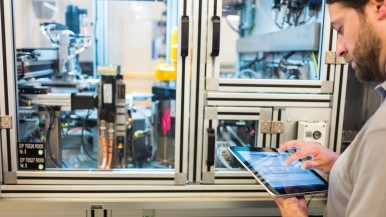
Stuttgart / Nuremberg, Germany – Intelligent software reduces complexity, simplifies processes; the factory of the future is unthinkable without this tool. Bosch Connected Industry is now presenting a solution at the SPS trade fair in Nuremberg that makes production and logistics even more transparent, efficient and productive. The Nexeed Industrial Application System makes data available in a compatible and standardized form and provides information at a glance. NEXEED is the brain of the intelligent factory, in which every employee knows what has to be done when and where,...null says Sven Hamann, Senior Vice President of Bosch Connected Industry. Using open interfaces, the Bosch software can also be easily integrated into common industrial platforms and existing infrastructures. "NEXEED breathes new life into old systems and makes them fit for Industry 4.0," says Hamann. This makes it easier to implement this intelligent form of production and ensures manageable investments. To this end, Bosch Connected Industry uses solutions that successfully optimize production in Bosch plants all over the world.Nexeed Industrial Application System for connected manufacturing With the Nexeed Industrial Application System, Bosch relies on interoperability: "All components of the system speak the same language and work together optimally. NEXEED forms the basis for a fully connected, transparent production process," explains Hamann. The basic functionalities make work easier for users and administrators through simple operation, clear master data management and individually defined access rights. The applications enable, for example, live monitoring of production processes or central management of IIoT devices such as routers, machine controls and sensors. "With our solutions no one has to update the devices individually with the USB stick anymore. This enables us to consistently close security gaps in the factory," explains Hamann. If required, the system can be expanded with additional applications or subject-specific packages. Significant increase in productivity through intelligent software By connecting NEXEED with the new automation platform ctrlX AUTOMATION from Bosch Rexroth, production efficiency can be significantly increased: "Industry 4.0 solutions from Bosch provide a productivity boost. With the new automation platform, we are improving the overall equipment effectiveness of machines by up to ten percent. In conjunction with NEXEED, another ten percent can be added," says Hamann. Bosch software makes a decisive contribution to higher availability, better performance, and higher quality. It enables access to production-relevant information in real time, for example on the status of production or the whereabouts of individual components. In the event of malfunctions, employees can react more quickly or avoid them completely thanks to preventive maintenance. Strong demand for software and services for Industry 4.0 Since its establishment in 2018, Bosch Connected Industry has expanded its business considerably: NEXEED is already used successfully by around 100 international customers, including BMW, Sick and Trumpf. Users benefit from the experience of the Bosch plants and warehouses: all NEXEED solutions are developed, tested and evaluated there, before Bosch offers them to external customers. More than 100 Bosch factories now use solutions from the NEXEED portfolio. Bosch Connected Industry at SPS: November 26-28, 2019, booth 450, hall 7

CES 2018: Bosch sees future in smart-city business

08.01.2018

Press release

Business/economy

CES 2018: Bosch sees future in smart-city business

Las Vegas, NV – Urban populations are growing: according to the United Nations , roughly two-thirds of the global population will live in conurbations by 2050. In 2014, this figure was just one-half. Urbanization is increasing, and with it the challenges cities have to solve. Even today, therefore, there is a considerable need for smart solutions. Speaking at CES in Las Vegas, the Bosch management board member Stefan Hartung said: “We need a new conception of the city. One key factor here is technologies that make cities smart and worth living in. In the long run, cities without intelligence will not survive, but succumb to gridlock.”Bosch is working to equip cities and neighborhoods for the future, offering smart mobility, better air quality, more convenience, greater security, and many new services. In short, the aim is significantly better quality of life in cities and neighborhoods. “When it comes to smart cities, few other companies can match Bosch’s comprehensive portfolio, cross-domain knowledge, and outstanding expertise in sensors, software, and services – and all this from a single source,” Hartung said. From January 9 to 12, the supplier of technology and services will be presenting many new solutions that make cities smart at CES 2018, the world’s largest electronics show. These range from a new compact unit that measures and analyzes air quality in real time, to a system that digitally monitors river water levels and gives early warning of flood risks, to a completely automatic parking space service that makes drivers’ lives easier. For more business: the smart-city market is booming Some of the world’s major metropolises are already synonymous with the term “smart,” among them Barcelona, Seoul, and London. Across the globe, cities large and small are investing in smart-city technologies. According to a study on behalf of Bosch, the smart-city market will grow 19 percent each year between now and 2020, reaching a volume of 800 billion dollars (680 billion euros). Bosch believes this is a great business opportunity: “For a long time, the smart city was a vision. We’re helping make it reality. Bosch is in an excellent position to make the connected city a technological and commercial success,” Hartung said. The company is currently involved in 14 extensive smart-city projects in places such as San Francisco, Singapore, Tianjin, Berlin, and Stuttgart. Others are planned to follow. Within the past two years, the company has doubled its sales from cross-domain projects to nearly one billion euros, and this figure is set to rise further. For a long time, the smart city was a vision. We’re helping make it reality. Bosch is in an excellent position to make the connected city a technological and commercial success....Stefan Hartung, Bosch management board member In the Bay Area city of San Leandro, for example, the company has equipped roughly 5,000 streetlights with LEDs and supplied a system for remote management of the city’s street lighting. In this way, the lights are only switched on when they are actually needed. With this solution, San Leandro will be able to save roughly 8 million dollars over the next 15 years. At the Bosch CES press conference, Mike Mansuetti, the president of Bosch North America, said: “Whether cities are big or small, our smart solutions will help them save energy, and money too.” In the case of San Leandro and its 100,000 inhabitants, sensors can be used to measure and analyze air quality, and cameras can automatically re-route traffic in the event of congestion. For more connectivity: IoT and artificial intelligence The internet of things (IoT) has laid one of the main foundations for the connected city. The IoT is finding its way into all walks of life: a Gartner study predicts that some 230 million homes worldwide – roughly 15 percent of all homes – will be intelligently connected by 2020. Here as well, the potential is huge, with market volume estimated to reach 250 billion dollars annually by 2020. By the same year, more than 20 billion devices worldwide will be connected with each other – smoke detectors, burglar alarms, electricity meters, home appliances, and many more. “Bosch recognized this potential early on,” Hartung said. “Even now, more than half our electronic product classes are web-enabled – and the aim is for this to be 100 percent by 2020. Not only that: for each of our products, we want to offer accompanying services.” Another driver of the rapid development of smart cities is artificial intelligence (AI). Bosch intends to further expand its research in this field. Last year, the company opened a research center for artificial intelligence, which now employs some 100 associates in Renningen, Germany, Palo Alto, CA, and Bengaluru, India. By 2021, Bosch will invest some 300 million euros in expanding the center. The company anticipates that, ten years from now, scarcely any product will be conceivable without AI. For better air quality: Climo creates basis for targeted action Air quality is one of the greatest challenges cities face. Thanks to smart technologies, cities can take faster and more targeted action to improve it. However, this depends on accurate measurements. At CES 2018, Bosch is presenting a new solution that it developed together with Intel – the Climo microclimate monitoring system. Climo measures and analyzes 12 parameters that are important for air quality, including carbon dioxide, nitrogen oxide, temperature, and relative humidity. The appliance is one-hundredth the size of conventional systems – and one-tenth the cost. Climo won a CES Honoree Innovation Award in the “smart cities” category. For early warning: digital monitoring of rivers In many regions, climate change is resulting in unpredictable weather. Researchers expect that heavier rainfall will result in more frequent flash flooding. Up to now, mechanical devices have been used to measure river water levels. Hours may pass before these measurements become available for others. However, the flood monitoring system changes all this. In real time, it monitors the water level in rivers and other bodies of water close to cities, and warns of an impending flood. In a pilot project, Bosch is testing the new system on the Neckar river near Ludwigsburg, Germany. Ultrasonic sensor probes and cameras track changes in water level, speed, and throughput. The data is sent to the Bosch IoT Cloud for processing. Should critical thresholds be exceeded, the affected municipalities, residents, and business owners are alerted well in advance by text message. This gives them enough time to take precautions against flooding and flood-related damage. Among those interested in the solution are a number of Indian and South American municipalities that frequently have to combat flooding. For more time: connected parking Urban traffic will increase by roughly one-third by 2050 . Bosch is working to make tomorrow’s mobility free of accidents, stress, and emissions. At CES 2018, the company is presenting many solutions that lead toward this goal. Urban traffic plays a role in roughly half the smart-city projects Bosch is involved in. Parking is a particular focal point. U.S. drivers now spend more than 40 hours a year stuck in congestion, wasting some 160 billion dollars in the process. Of this time, roughly one-third is wasted on the search for parking alone. This is where Bosch can help: with its community-based parking, the company simplifies the search for a suitable space. As they drive by, cars automatically recognize and measure the size of the gaps between parked cars, transmitting the data in real time to a digital map. In this way, drivers can have themselves guided directly to free parking spaces. Bosch is already testing this service in German cities, including Stuttgart. This year, as many as 20 U.S. cities will follow, including Los Angeles, Miami, and Boston. In early 2018, moreover, Bosch and Daimler will be launching a new automated valet parking service. Cars in the Mercedes-Benz Museum parking garage in Stuttgart will look for a parking space and park themselves, without a driver. This cuts out stress, and makes more efficient use of parking lots – the same amount of space can accommodate up to 20 percent more vehicles. One factor making fully automated parking a reality is smart parking-garage infrastructure, which connects with the vehicle’s on-board software. Bosch recently won a Frost & Sullivan’s 2017 Technology Innovation Award for this driverless parking solution. For energy and cost savings: Bosch DC microgrids According to the International Panel on Climate Change (IPCC) , cities account for roughly 75 percent of total global energy consumption. Forty percent of this is attributable to buildings alone. And the BP Energy Outlook 2035 estimates that global energy consumption will rise 30 percent by 2035. Bosch has many smart energy management solutions that can reduce power consumption. One of these is the Bosch DC (direct current) microgrid, which can be used to supply power to large buildings or building complexes. Since microgrids are generally fed by renewable sources, they are especially eco-friendly. DC microgrids consume up to 10 percent less energy than conventional power plants. Another major advantage is their self-sufficiency, which makes them a reliable source of power when a weather- or security-related outage affects the broader grid. Bosch at CES 2018: PRESS CONFERENCE: In Ballrooms B, C, and D, Mandalay Bay Hotel, Las Vegas South Convention Center, Level 2 , from 8:00 to 8:45 a.m. local time on Monday, Jan 8 . BOOTH: Tuesday to Friday, Jan 9–12 , in the Central Hall, booth #14028 FOLLOW the Bosch CES 2018 highlights on Twitter: #BoschCES PANELS WITH BOSCH EXPERTS: Tuesday, January 9, 1:30 – 3:15 p.m. (local time): “ Connect2Car: Next-Gen Automobility ” session with Kay Stepper, Vice President of Bosch in North America, head of driver assistance and automated driving, Las Vegas, Convention Center, North Hall, N256 Wednesday, Jan 10, 1:45–2:30 p.m. (local time): “ Connected Vehicles in Connected Ecosystems ” session with Mike Mansuetti, President Bosch North America, Smart Cities Conference, Westgate. Thursday, Jan 11, 11:30 a.m to 12:30 p.m. (local time): “ The Future of Robots at Work and Home ” session with Phil Roan, Senior Engineer Robotics, BSH Hausgeräte GmbH, Las Vegas Convention Center, North Hall, N258