Search & find:
Media, press releases, events for your editorial coverage

Beneficial AI – building trust together in the digital world

06.01.2020

Presentations

Business/economy

Beneficial AI – building trust together in the digital world

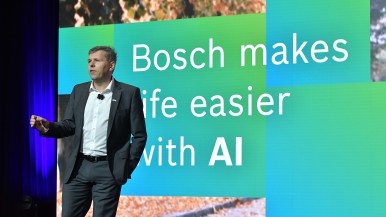
Dr. Michael Bolle, member of the board of management of Robert Bosch GmbH, and Mike Mansuetti, president of Bosch in North America, at the Consumer Electronics Show in Las Vegas on January 6, 2020Check against delivery.2001: A Space Odyssey. The Terminator. The Matrix. Ex Machina. It sounds like we’re sharinga list of our favorite movies. But actually, all these movies have something in common.They all depict a future in which machines have learned to think for themselves – with disastrous consequencesfor humanity. Whether the machines manipulate, enslave, or replace us, the message in the movies is the same: by developing artificial intelligence, we’re opening Pandora’s box. I like science fiction as much as anyone, and portraying AI as the villain has kept audiences entertained for decades. But the time has come to talk about the technology’s true potential – the potential to provide real value, for real people. “How can we make artificial intelligence beneficial? How can it be used to complement human intelligence?” These are some of the big questions at CES this year. So what’s our answer? Artificial intelligence is not science fiction anymore – it’s already an integral part of our daily lives. It’s fundamentally changing how we drive, how we work, how we learn, how we shop, how we travel. At Bosch, it’s also becoming part of the products we make – products that will assist and support us, and make life easier overall. Whether it’s being used in manufacturing, in smart homes, or in self-driving cars, one thing is for sure – in line with our “Invented for life” ethos, we want to make AI safe, robust, and explainable. Where the world of work is concerned, we’re not just facing a technological shift, we’re also facing a critical shortage of skilled workers. So it’s also against this backdrop that it will be essential for humans and machines to work together. At Bosch, we believe this is self-evident. And with this in mind, we’re trying to shape the digital transformation by educating and upskilling our workforce, and investing in our associates as well as in the intelligence of our products and machines. As a society, we must learn to accept a technology that is capable of learning itself. One way to do this is to invest more in our own learning – and that’s exactly what we’re doing. Over the next two years, we will be introducing wide-ranging training programs aimed at making nearly 20,000 of our associates AI-savvy. I’ll tell you more about that later. But the societal benefits of AI go far beyond our daily lives and work. It also holds tremendous potential to benefit our planet and its climate. We intend to use this potential to realize our goal to maintain a balance between our economic, ecological, and social responsibilities. At the end of 2019, we achieved carbon neutrality for all our locations in Germany. By the end of this year, all 400 Bosch locations worldwide will be completely carbon neutral. When this happens, we will be the first major industrial enterprise to have achieved this ambitious goal, all within a little over a year. And to do this, we will be making use of our own solutions as well: our energy platform, for example, already uses intelligent algorithms to monitor consumption in manufacturing. It quickly identifies deviations in individual machines’ energy use and offsets load peaks. This alone has reduced CO2 emissions at individual plants by more than ten percent over the last two years. For a company that has 270 manufacturing sites, that’s some significant savings potential! Our success here has prompted us to market the energy platform externally. And it won’t end there: AI means we’ll be able to forecast and reduce energy consumption over the long term as well.AI is creating markets, but digital trust is indispensable This example underlines that artificial intelligence also offers considerable business potential. A number of different studies support this notion. For example, AI is expected to boost GDP substantially in major economies across the globe by the end of this decade – PWC estimates a 15 percent boost in North America alone. At the same time, global AI software revenue is projected to reach nearly 120 billion dollars by 2025, a twelve-fold increase compared to 2018. And the World Economic Forum predicts that global job losses as a result of AI will actually be offset by the creation of new ones, resulting in a net gain of nearly 60 million new jobs by 2022. As mentioned earlier, these jobs will require significantly new competency profiles, which will necessitate a strong push to reskill and upskill people. It’s indisputable that the impact of artificial intelligence will be huge. However, we must make the benefits of AI comprehensible for people, and even more importantly, establish trust in the digital world. Our CES slogan captures our approach here nicely: “Beneficial AI – building trust together.” In this endeavor, Bosch is pursuing a two-pronged approach. On the one hand, we’re doing the technical groundwork, developing solutions, and using our innovations to open up new areas of business. On the other hand, we will use AI to realize our strategic imperative of creating technology that is “Invented for life,” and in doing so, convince society of the benefits of AI. Remember, it was our engineers that developed lifesaving inventions such as electronic stability control, airbag control units, and anti-lock braking systems for vehicles ranging from passenger cars to motorcycles to e-bikes. This is what we mean by technology “Invented for life” – and our work with AI is no exception. By putting it to use in automated vehicles, for example, it too will be a technology that saves lives, as we will explain in more detail later on.Trust, responsibility, and ethics in AI We take entrepreneurial responsibility seriously, and it defines our approach to new technologies like artificial intelligence. The decisive factor for responsibility in the digital world is trust. This trust will be just as important for our digital business as product quality is for our traditional business. We have to work on developing both AI and trust in AI – without the latter, the former will not be successful in the long run. But how can we establish this trust? By creating AI that is transparent, safe, secure, and robust. When it comes to building trust, another key aspect is data security and data privacy – especially where personal data is concerned. At Bosch, our approach is simple: when it comes to all our smart products and services, users have full transparency and control over the data collected and who gets to use it. Moreover, in order to build trust among our customers and partners, as early as 2015 we established guiding principles for data protection in our IoT business. This was several years before the GDPR regulatory framework was introduced as European standard. We’re now working on a similar set of principles for our future use of artificial intelligence: an AI code which sets out ethical guidelines for the development and usage of AI, especially in cases of doubt and dilemma. Going forward, it will be essential that people remain in control of systems that use AI. Take the example of driver assistance: here, we want to integrate AI in such a way that it can always be overridden by the driver. We don’t want to lock the algorithms from our AI models in a little black box. The rules and parameters behind decisions must remain comprehensible, at the very least for specialists. That said, Bosch and the big tech players differ in our approaches to AI in one fundamentally important way: our focus is on the application of AI for physical objects. Whether it’s deployed in an automotive emergency braking system or in factory production, our AI explains the physical world to machines. Our latest camera for automated driving uses AI to understand what it sees – to infer, say, whether a pedestrianis going to step out into the road or not. This will improve object recognition and make automatic emergency braking more reliable, thereby increasing safety. At Bosch, we want to harness the power of artificial intelligence to improve technology and the performance of our products and machines. We call this industrial AI, and we’re using it to develop smartsolutions in three key domains: mobility, residential, and manufacturing. It’s no coincidence that we emphasize the “things” when talking about IoT. We’re bringing connectivity and intelligence to our own products and machines. We know cars and traffic, factories and buildings, inside and out – no other tech company can match the breadth and depth of our cross-domain expertise. Our own sensors provide us with a massive amount of data. And if we apply AI methods to that data, we can create new services and applications. By the middle of this decade at the latest, each and everyone of our products will either have artificial intelligence itself, or have been developed or manufactured with its help. Ultimately, we plan to teach our products to function as assistants – for our customers, and for our own developers.Investing in AI research and development To achieve this, we want to become one of the global leaders in AI innovation as well. Our research and development activities are all geared toward this goal. Bosch currently invests more than 4 billion dollars annually in software development, and employs around 30,000 software engineers. Established in 2017, the Bosch Center for Artificial Intelligence is already working on more than 150 projects. It employs some 250 AI specialists at seven locations around the globe including two here in the U.S. – in Pittsburgh, Pennsylvania, and Sunnyvale, California. Our U.S. research teams play a key role in our AI development activities, above all in robotics and automated driving. But we’re not working in a vacuum here. Especially where AI is concerned, a technology company like Bosch sees itself as part of the larger scientific community. In Germany, for example, we’re a founding member of the “Cyber Valley” initiative – an AI research alliance between academia and industry. Among other things, as part of this we’re investing more than 110 million dollars in an AI campus, which from late 2022 will be home to 700 AI experts from Bosch as well as from external startups and research groups. Here in the U.S., we’re collaborating closely with Carnegie Mellon University on AI research. Carnegie Mellon has been working on artificial intelligence for 60 years, since the technology’s earliest days. They have been responsible for pioneering innovations in areas like self-driving cars, facial recognition, and language processing. As we see it, industry and academia each have an essential contribution to make. And we highly value the transfer of knowledge between our developers on both sides of the Atlantic.SoundSee hears what’s broken in space – with AI from Bosch A great example of an exciting collaboration with one of our U.S. partners is currently deployed about 240 miles above the Earth’s surface. It’s an innovative AI-based sensor system called SoundSee. This little device will be playing quite a big role in outer space. The SoundSee technology will be used to perform deep audio analytics on the ISS. Using highly-sensitive microphones, it will capture ambient noise emitted from the station’s systems and equipment, and then use AI to spot potential anomalies from the audio patterns. Basically, SoundSee will hear if something on the station is broken – and can tell whether it needs to be repaired or replaced. We developed this system together with the aerospace company Astrobotic Technology Inc. In November, it was sent into orbit and will be integrated into the Astrobee robot shortly. Of course, the new sensor system will also be very useful down here on earth. In manufacturing, for example, it can improve predictions about machine downtimes, thus helping to reduce maintenance costs and increase productivity. But on board the ISS, this technology could even be lifesaving.Virtual visor – a U.S. idea is a “Best of Innovation” award winner We’re showcasing another example of the ingenuity of our American workforce here at CES – and this world premiere also underlines their lateral thinking. Some of our engineers came up with a digital solution for a common and often dangerous hazard that drivers frequently face. It’s an innovation that replaces a nearly 100-year-old automotive product: the sun visor. According to a study by NHTSA, sun glare causes nearly twice as many accidents as any other type of weather-related condition. But we now have a solution: our “virtual visor.” At first glance, it looks like a see-through LCD display mounted at eye level. The special thing about it, though, is that it’s connected with a driver-facing camera equipped with AI facial detection and analysis. Its software calculates both the driver’s line of sight and the angle of the sun in order to strategically darken individual sections of the display. Everything else remains transparent. We think the Virtual Visor is another great example of technology “Invented for life,” and the CTA apparently thought so too. The product was honored with a prestigious CES 2020 Best of Innovation Award – you can test it out for yourself at our booth.3D vehicle display – our second Best of Innovation Award Our new 3D vehicle display also won a CES Best of Innovation Award – and I’ve been told it’s no small feat to win two of those. Vehicle displays in general offer huge business potential – after all, the global market volume is set to more than double by 2025, to 30 billiondollars. Our award-winning display uses a multi-view 3D technology which is especially affordable, since it works without the need for eye tracking and 3D glasses. To describe how it works, let’s go back to the movies for a moment. We’ve all seen 3D films, where the technology makes our experience more vivid and entertaining. Inside a vehicle, 3D performs a similar but more useful function: it helps people understand information more quickly. The display’s depth of field means drivers can grasp important visual information faster, whether it’s an alert from an assistance system or a hazard warning. Alerts seem to jump out of the display and are much more obvious and urgent, as well as far harder to overlook. I don’t know about you, Michael, but anything that tells me what I really need to be paying attention to is a win in my book.Interior monitoring – technology that can help keep children safe Think of the dangers posed by fatigue and distraction – the longer we’re behind the wheel and the more technology is present in the cockpit, the greater they are. Here, our driver monitoring system uses artificial intelligence to identify these distractions through cameras which recognize the driver’s line of sight, head position, and blink rate. When it determines a critical point has been reached, it reacts by sounding an alarm or providing driving assistance, depending on the automaker’s wishes, and also legal requirements. In the EU, this kind of system is set to be standard in new vehicles from 2022. This technology will also play an important role in automated driving. After all, the next few development stages will still require drivers to remain alert and ready to take over in critical or tricky situations. To ensure drivers are able to do this, the monitoring system calculates how ready they are to respond at any given time, and the transfer of driving responsibility is then timed accordingly. Depending on the design, some systems can also monitor the car’s other occupants and enhance their safety, for example by detecting changes in passengers’ sitting positions and adjusting their airbags and seatbelt tensioners for optimal crash protection. Or by identifying the presence of children inside parked cars. In 2018, parked cars claimed the lives of more than 50 children in the United States, either because they had been left inside for longer than intended or had climbed in unnoticed. Bosch’s new system can recognize the presence of children and warn parents in a flash by sending a message to their smartphone. In a critical situation, it can also alert the emergency services. As the Hot Cars Act currently being debated in Congress shows, there is considerable interest in solutions to prevent these tragedies. Once again, our technology doesn’t just make life better, it can help to save lives. Looking ahead, we plan to extend our interior monitoring systems to encompass in-vehicle sensing and deploy this inridesharing fleets. In-vehicle sensing will allow us to detect when a passenger leaves something behind in a shared car, for example, or if they need help in a critical situation. For us, offering real benefits is what it’s all about. Nearly all our driver assistance systems enhance both safety and convenience. We are one of the automotive industry’s leading suppliers in this field. In 2019, our sales rose by 12 percent to some 2.3 billion dollars. From a technical point of view, we’re using driver assistance as a stepping stone to automated driving. By 2022, we will have invested some 4.7 billion dollars in developing this technology and increased our workforce of dedicated engineers to 5,000. To this end, we’re working on making lidar sensors production-ready. Alongside our new video camera with AI and radar and ultrasonic sensors, Bosch will soon offer the complete sensor portfolio needed for automated driving. Few automotive suppliers worldwide have as much expertise in this area as Bosch. Our lidar will be the first of its kind that is suitable for use in automotive applications, since it’s scalable and can be manufactured in large volumes. It’s also the first lidar technology to be suitable for automated driving functions at SAE levels 3-5, offering long-range sensing capabilities in combination with a wide field of view and an exceptionally high resolution. Working together, our multiple sensor types will help to ensure extremely reliable environment recognition. To surmount the many challenges on the road to fully-automated driving, Bosch is bringing together its profound expertise in sensors and systems and that’s the type of expertise that only an automotive company can have. We’re already testing automated driving in a range of environments, including one that is widely regarded as the final frontier: city streets. I’m happy to report that our pilot project with Mercedes-Benz for an on-demand ride-hailing service with automated vehicles is now up and running. Automated S-Class vehicles are now providing an app-based shuttle service in California between West San José and downtown for selected users. Ultimately, the aim of this project is to gain valuable insights for the development of automated driving, and to answer the question of how self-driving cars can best be integrated into a multimodal mobility system. Our development work on this project encompasses both the use of AI as well as simulations and tests designed to address the kind of driving situations that occur very rarely in road traffic. We’re not just using our mobility solutions to teach cars how to drive. We’re also using them to make electric and connected driving a reality. This is enabling us to open up new areas of business and forge partnerships with new customers. For example, we’re developing a hydrogen powertrain for the heavy-duty trucks made by U.S. startup Nikola Motor Company. We’re also suppling our solutions to mobility service providers such as DiDi and Lyft. For DiDi, we’ll soon be providing a cloud service that helps to extend the service life of car batteries. When it comes to urban mobility for the future, you can experience our vision in an IoT concept shuttle at our booth. This year we’re showcasing what we offer mobility service providers to help them operate safe and efficient automated ridesharing and ride-hailing businesses.Bosch MEMS technology – for smart glasses without the sci-fi look Beyond this, we’re also using our expertise in everything related to mobility as the basis for innovation in other domains. The best example of this is sensors based on micromechanical systems – called MEMS for short. We’re the market leader for these sensors, which are used for automotive applications as well as smartphones. Our latest development in this area is being showcased here at CES: our light drive system for smart glasses. The smallest of its kind, it’s nearly a third slimmer than existing ones on the market and can be integrated into nearly any type of frame, becoming part of your everyday glasses. It uses a MEMS-based laser scanner and holographic mirror to project an image on the wearer’s retina. This image can contain any kind of text message – for example from the navigation system or your personal calendar. And you, in turn, can be kept constantly up to date – without looking like you’re on the way to a Star Trek convention every time you put them on. Another domain where AI has the potential to deliver enormous benefits is healthcare. Here, our Indian engineers have developed a cutting-edge innovation called Vivalution (brand name was changed) which is a CES® innovation award honoree. In a nutshell, it’s a smart pathology platform for medical diagnostics powered with advanced machine learning algorithms. With the help of AI, it analyzes human cells’ form, shape, and structure for deviations, thus providing physicians with information on possible diseases. And it does so in minutes, which dramatically shortens the testing process. Helping people diagnose health issues quicker and more accurately – this is also what we mean by technology “Invented for life.”AIoT to benefit everyone – training for tomorrow’s work As we see it, the IoT and AI should benefit everyone. To do this, they must be more than technological gimmicks and actually make people’s daily life and work easier. This is true for all our domains: connected mobility, connected homes, and also connected industry. Especially in the world of manufacturing, artificial intelligence can supplement human creativity, and more crucially, relieve workers of routine tasks. On every new path we tread, we take our workforce with us. On our way to creating the factories of the future, we want to prepare our associates for the work they’ll be doing in the future. This brings us full circle to our AI training program, which I mentioned earlier. It consists of three parts: First, we’re training roughly 16,000 executives on the business aspects of AI. Our digital transformation is enabling us to master a balancing act: on the one hand, remaining an industrial enterprise, and on the other, becoming a leading IoT and AI provider. For this, our leadership will have to be capable of making the right decisions, which is why we’re building up their AI expertise. Second, we’re expanding our AI learning platform. This platform is similar to an online university, but uses examples and exercises from real-life operations at Bosch. More than 1,500 of our engineers are already using the platform, a number that will likely double by next year. Some of its notable features are the exchange of experience our AI learning platform facilitates, as well as the use of best-practice examples and competitions. Third, we’re training nearly 500 experienced engineers in AI development methodology. This is the highest level of our training program, what is effectively a supplemental course of study in things like data engineering and data analysis. We’re not just increasing the number of AI engineers by hiring dedicated specialists; we’re also doing it by reskilling our existing people. All told, this will get 20,000 of our associates up to speed on the technology. As we see it, it’s not only part of our corporate responsibility to offer this kind of training, it’s also in our strategic interest.Conclusion Ladies and gentlemen, it’s clear that developing artificial intelligence will require us to focus on more than just technological innovation. On one hand, we need to invest heavily in human intelligence, and on the other, we need to convince people of the true potential of this technology. “Beneficial AI: building trust together” – it’s more than just a nice catchphrase we’re using here at CES. We truly believe that AI holds the key to making our lives safer, easier, and more eco-friendly. Please come visit our booth in the Central Hall to see some examples of this in action. And together, let’s work to dispel any doubts and usher in a new era of real-life science fiction, where AI is the hero.

Simply.Connected. in your neighborhood: How Bosch is boosting the IQ of cities t ...

08.01.2018

Presentations

Business/economy

Simply.Connected. in your neighborhood: How Bosch is boosting the IQ of cities t ...

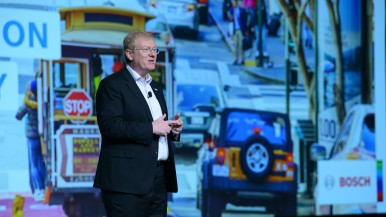
Introduction [Stefan Hartung] Good morning, everyone. A very warm welcome to all of you, and thank you for joining our press conference. This is the first time I have the honor of representing Bosch at CES. I’m thrilled to finally have this opportunity because I’m probably one of the biggest techies on the Bosch board of management and have been following this event for several years. When we entered the smart home business, I made a point of personally trying out as much of our technology as I could in my own house. Some of my neighbors thought I had gone off the deep end when they saw me installing cameras everywhere and sensors in the doors and windows. [Mike Mansuetti] For all of us, the quality of the environment we live in is very important. And this is particularly true for those who live in cities. That’s why we want to show you today how we’re using our technical strengths to make a mark on cities around the globe. Let me start with a question – what do you imagine when you hear the term “connected” or “smart” cities? [Stefan Hartung] For my part, I think of cities in which we as citizens are more engaged and empowered, thanks to technologies that take care of things for us and save us time, and allow us to move, breathe, and actually LIVE better. Cities that utilize connectivity to help optimize traffic and reduce congestion. Cities in which we can minimize our ecological footprint because energy needs are met primarily by renewable sources. Cities that are full of smart homes that we can operate from anywhere, and buildings that arrange their own maintenance and repair before we even need to care. Cities that employ technology to reduce pollution and fight crime. In short, cities that are intelligent and sustainable, and offer us a safe, energy-efficient, and all-around great place to live. Sounds almost too good to be true, right? You might even say utopian. But it’s not. In fact, technologies to create this kind of urban environment exist, and many are already in use – perhaps even in your neighborhood. Step by step, cities and communities around the world are boosting their IQ. And we know this because we at Bosch are helping them do it. As one of the companies with the broadest and most comprehensive portfolios of smart-city solutions, as well as decades of cross-domain expertise, there’s no one better equipped for this job. [Mike Mansuetti] Market potential of smart cities Globally, the smart city market is booming. Sales are expected to grow by 19 percent each year, reaching as much as 800 billion dollars worldwide by 2020. By 2025, at least 80 urban areas worldwide will be smart. Some places are already synonymous with smart-city initiatives: Barcelona, Seoul, London… or Columbus, Ohio, which as you may know, was the winner of the U.S. Department of Transportation Smart City Challenge. Around the globe, cities of all sizes are investing in and reaping the benefits of these technologies. In fact, the city of Las Vegas recently announced a 500 million dollar investment in smart city infrastructure over the next seven years. [Stefan Hartung] About the smart city market: one reason it’s taking off now is because we have the right technology. The arrival of the IoT a few years ago, with its innovations in sensors, artificial intelligence, big data, and predictive analytics, means that many smart city initiatives are for the first time not only possible, but also economically viable. Perhaps more importantly, though, cities are realizing that technological solutions could hold the key to solving many of today’s pressing urban problems – as well as tomorrow’s. The fact is that our world is becoming increasingly urbanized: by 2025, 34 cities worldwide will have a population of more than 10 million people. By 2050 at the latest, two-thirds of the world’s population will be living in these megacities, putting a tremendous amount of pressure on local infrastructure and the environment – and ultimately on our quality of life, whether the air we breathe, the time we waste in traffic, the energy we consume, or our safety. Smart city technologies offer a way of confronting these challenges, and of mitigating their impact. Above all, they help make cities – and towns, and neighborhoods – better places to live. We’re pursuing exactly this aim in 14 smart-city beacon projects around the world, for example in Tianjin, China, Berlin, Germany, and San Francisco, California. Sensors, software, and services Smart cities begin and end with connectivity. Our solutions not only encompass connected mobility, energy, building, and industrial technology, they enable connectivity at the most fundamental level. Nearly 50 years ago, we introduced semiconductor technology for automotive applications. Today we’re the leading global producer of micromechanical sensors, shipping more than four million a day. [Mike Mansuetti] You could say that our sensors are the eyes and ears of the connected city. In this case, its brain is our software. Of Bosch’s nearly 400,000 associates worldwide, more than 20,000 are software engineers, nearly 20 percent of whom are working exclusively on the IoT. We supply an open software platform called the Bosch IoT Suite, which offers all the functions necessary to connect devices, users, and companies. And we’re increasingly bringing artificial intelligence into play here as well – at the start of last year we even opened a dedicated AI research center, which employs some 100 experts at three locations, one of them in Silicon Valley. Since 2016, we’ve been operating our own IoT cloud in Germany. Over the past 18 months, we have implemented some 100 IoT projects and connected one-point-five million vehicles with our IoT software. Later this spring, we plan to launch the Bosch cloud on this side of the Atlantic. In fact, we intend to make all the electronic products in our portfolio web-enabled by 2020, and offer them with a corresponding service package. Sensors, software, services – these three S’s are not only the building blocks of smart cities, at Bosch they are our core competencies. [Stefan Hartung] And they’re also the basis of our smart city solutions, which I’d like to tell you about now in more detail. What’s important to understand here is that there is no switch that gets flipped to make a city smart. Instead, intelligence comes in stages, as cities start implementing technology to overcome the four major challenges they face, one step at a time. Challenge 1: air quality The first challenge, and one of the biggest currently faced by cities around the globe, is air quality. The importance of this cannot be overstated – it’s fundamental to our mental and physical well-being, wherever in the world we live. We at Bosch believe that there is no single magic bullet that will solve this problem. Instead, what will have a lasting impact on air quality is an array of measures working in parallel. Where mobility is concerned, these include state-of-the-art combustion engines, hybrid solutions, and pure electromobility, as well as connectivity that goes beyond individual vehicles. Another key piece of the puzzle is climate monitoring systems. These gather data about air quality in a particular region which can be used to develop targeted measures for reducing pollution. Here at CES, we’re presenting our innovative new microclimate monitoring system which is flexible, affordable, and easy to deploy. [Mike Mansuetti] And it has a name you can easily remember – Climo. To give you some context, most microclimate monitoring stations are usually roughly the size of shipping containers – not to mention expensive. We’ve packaged ours into this little box, 1/100th of the conventional size, and 1/10th of the cost. In addition to pollution, it also measures humidity and pollen levels in real time – a great advantage for local residents. For cities, the data provided can be utilized in a variety of ways, such as for traffic flow management and as the basis for future policy and planning decisions. The Consumer Technology Association was so impressed with Climo that they gave it one of the coveted CES Innovation Awards in the smart city category – one of three awards we received this year. We recently provided the city of Las Vegas with several Climo systems. During CES, Bosch will be monitoring the local air quality in real time. [Stefan Hartung] Challenge 2: mobility Let’s move on to the second challenge, and another major focus of smart city initiatives – mobility. It’s no wonder: growing populations mean more traffic. In fact, urban traffic is predicted to triple by 2050. To help cities and their inhabitants cope with this, Bosch is developing a wide variety of solutions for the transportation of people and goods. Our vision is to create an urban environment that is free of emissions, stress, and accidents. This is tied to three technological developments: automation, electrification, and connectivity. Today, half of our 14 smart city projects include urban mobility solutions such as connected parking, automated driving, fleet management, multimodal transport, and electromobility. Let’s start with parking, one of the most common frustrations of city life. [Mike Mansuetti] In the U.S., we currently spend over 40 hours a year stuck in traffic, wasting more than 160 billion dollars in time and fuel. The search for parking accounts for more than a third of this wasted time. You have personal experience with this, right? I know I certainly do. Our solutions for connected and automated parking save fuel and time while reducing stress. In one of these solutions, community-based parking, we at Bosch are taking over the search for a parking spot. It works by cars automatically reporting vacant spaces to the cloud as they drive past. After a successful pilot phase, we’re currently planning to launch community-based parking in 20 U.S. cities this year. In places such as L.A., Miami, and Boston, we’ll make real-time information about on-street parking available to car manufacturers. Drivers will be able to see on their navigation systems where there’s a free space and drive directly to it – which will save them time, fuel, and stress, while reducing congestion and pollution in downtown areas. [Stefan Hartung] Our latest innovation is called automated valet parking. We recently won a Frost & Sullivan's 2017 Technology Innovation Award for this solution. It works like this: cars drive themselves into parking garages and find their own spaces at the touch of a button – while you, the driver, can attend to more important things. In cooperation with Daimler, we recently demonstrated this futuristic solution live at the Mercedes-Benz museum in Stuttgart. Speaking about automated mobility, Bosch has over 3,000 engineers worldwide working to make this a reality. In one of our projects, we’re again collaborating with Daimler to bring self-driving robocabs to city streets by the start of the next decade. This will open up new horizons in particular for people with limited mobility – such as the elderly, or those with disabilities. We’re also taking steps to realize another requirement for self-driving cars, namely high definition maps. To this end, we recently acquired a stake in the map provider HERE Technologies, and together with them, we’re working on a manufacturer-independent solution for cars to share traffic information collected by their sensors, which can be used to update maps in real time. We’ll also be working together on applications for this technology beyond the automotive domain – for example in connected industry, where high-definition indoor maps could be used to automate and streamline flows of goods all the way to the production line. [Mike Mansuetti] But to return to mobility: smart cities will also rely heavily on multimodal transportation – in other words, getting from A to B on four wheels, two wheels, or by rail. One way Bosch is facilitating this is with innovative shared mobility services. A great example is our Coup e-scooter sharing service, which we’ve so far successfully launched in Berlin and Paris. We know there is an increasing population of people who want to remain mobile without owning a car, and this kind of service offers them that opportunity. According to Gartner, 250 million cars around the world will be connected by 2020. Along with this development, automotive services are also gaining in importance. Come to our booth to see what we call our connected vehicle platform – it brings together the numerous vehicle services we now offer. From wrong-way driver alert and preventive diagnostics to stolen vehicle tracking and smart-home control from behind the wheel, we’re not only making driving easier, safer, and more convenient than it’s ever been before, we’re turning the car into a new, fully-connected living environment. Our new Telematics eCall Plug is enabling another kind of service that combines safety with savings. The device itself is a plug which fits into a standard 12 volt outlet in any passenger vehicle. In addition to offering our lifesaving eCall emergency accident notification, the plug now also has a sensor that monitors driving behavior. An insurance company could use this information to offer you lower rates when you’re a careful driver. [Stefan Hartung] Challenge 3: energy Energy use presents the third major challenge for cities. Cities already account for some 75 percent of power consumption around the world, with 40 percent going to buildings alone. Smart city technology can not only help reduce consumption, but also make the use of renewables a more viable prospect. This means that ultimately it can help people save money and reduce their ecological footprint – good for cities, and good for their inhabitants. At Bosch, our energy solutions include virtual power plants, which store power or feed it into the grid as needed, and stationary energy storage systems – essentially massive batteries that can store enough energy to power dozens of homes. [Mike Mansuetti] We’re also at the forefront of microgrid technology. Without getting too technical, microgrids are relatively small, independently controlled energy-management systems. Think of them as miniature versions of municipal grids, generating and distributing electricity on a much smaller scale. Their ability to run on a variety of fuel sources, including renewables, means they have excellent ecological credentials. Another major advantage is increased self-sufficiency – microgrids can provide power for local residents and critical facilities if an outage affects the larger grid. In 2015, we outfitted a facility at Fort Bragg in North Carolina with a solar-based microgrid solution that supplies cost-effective, eco-friendly electricity. [Stefan Hartung] Challenge 4: safety and security That brings me to the final challenge, safety and security. Anyone who lives in a city knows that these are already major concerns, and growing populations will only make the situation more acute. At Bosch, we also have a full portfolio of solutions designed to keep individuals and communities safe. For example, our connected surveillance cameras can be used to fight crime, and they can also identify where help is needed in the event of a catastrophe. Another security solution we’re debuting here is our new flood monitoring system. This provides early warning about potential flooding by digitally monitoring water levels in real time. Up to now, such measurements have been made using mechanical means, which means several hours can pass before a warning is issued. Our system uses a combination of ultrasonic sensor probes and cameras to monitor changes to water level, speed, and throughput, and immediately sends out notifications when critical thresholds have been surpassed. A local municipality could install our system on bridges and allow residents to access data and receive alarms, for instance, or a business owner could set up a private system to protect their premises. We currently have a test system in place on the Neckar river near the Bosch headquarters in Stuttgart. Smart homes and buildings will unlock potential of smart cities Looking beyond these major challenges, we believe that in order to unlock the full potential of smart cities, the homes and buildings inside them will need to be intelligent as well. Smart home technologies offer countless benefits: they can take care of time-consuming chores for us, enable us to save energy and money, and make our living spaces more secure. At Bosch, we have been on the forefront of smart-home technology for years. In addition to our ever-growing range of connected appliances, lighting, and indoor climate systems, which by the way, can now be controlled with Amazon’s Alexa, we’re constantly expanding the scope of the smart home’s capabilities. For instance, we have a new robotic vacuum cleaner equipped with AI that can memorize your floor plan, and save you up to 40 hours of work each year. We also received a CES Innovation Award this year for a new acceleration sensor that is small and powerful, yet extremely energy-efficient. Among other things, the sensor can recognize whether windows are open or closed, and automatically adapt heating and cooling systems accordingly. Isn’t that smart? This saves money and power. [Mike Mansuetti] On a public scale, we’re helping to make all types of buildings smart – among them hospitals. For example, sensor-based video technology, lighting, and motion detectors can be used in hospitals to boost safety and security. Connected solutions also provide greater convenience and efficiency for both patients and administrators. Our U.S. subsidiary Climatec is a longstanding partner of the nonprofit provider Banner Health. We currently supply building automation, security, and fire detection equipment for 15 Banner facilities. In the years ahead, we expect continued growth with our global building technology business, and plan to increase our revenue in this sector by more than 20 percent. Beacon projects: SF Shipyard and San Leandro Before we wrap up, I’d like to tell you about a couple of the smart-city projects we’re involved in. Two of them are, in fact, right next door in California. The first is a partnership with the city of San Leandro, in the Bay Area. There, we’ve outfitted 5,000 streetlights with smart LED lighting that will switch on only when needed. The city estimates that this alone will save them more than 8 million dollars over the next 15 years. We’ve also equipped the streetlights with sensors that measure air quality and intelligent cameras that monitor traffic and automatically redirect cars in case of congestion. So besides enhancing quality of life, smart city technology can also save you – and cities – money. The other partnership is in San Francisco. This waterfront site is comprised of two neighborhoods – the former Hunters Point Navy Shipyard and Candlestick Park, where the 49ers used to play. Together, The SF Shipyard and Candlestick are entitled for up to 12,000 homes, five million sf of commercial space and one million sf of retail, all of which are being developed by FivePoint. At The SF Shipyard, we’re providing residents with a state-of-the-art surveillance system. We do this with our intelligent cameras and on-site monitoring systems. Both of these are connected to our smart community app. This app contributes to creating a sense of community and enhances the quality of the neighborhood by helping residents find local business information, check real-time transportation schedules and share information with other community members. A number of other cost-effective and eco-friendly solutions, including a DC microgrid powered by solar energy, are currently being explored. [Stefan Hartung] Conclusion: focusing on the bigger picture As you can see, we have no shortage of cutting-edge solutions for smart cities. With all this talk about technology, though, we shouldn’t lose sight of the bigger picture. We at Bosch are committed to helping make cities smart not just because it makes good business sense, but because it actually improves people’s lives. Smart cities facilitate civic engagement. They allow the use of finite resources to be reduced and renewables to be increased. They enable the elderly and people with disabilities to enjoy more independence. They help protect people’s health and make streets safer. And they take the stress out of many everyday activities. This is what we mean when we say our technology is “Invented for life.” Ladies and gentlemen, in closing let me repeat that the smart city of the future is no utopian vision: it’s already here, and communities around the globe are reaping the benefits. At the same time, though, the challenges faced by cities are formidable. Overcoming them will require pulling out all the stops, both technologically and politically. This is exactly where Bosch has the advantage: not only do we have a truly comprehensive portfolio and cross-domain expertise, we have experience working with municipalities to supply exactly the solutions they need. Solutions that will make life tangibly better for you, me, and everyone living in our neighborhoods. But don’t just take our word for it. Come and visit our booth in Central Hall this week, and experience for yourself Bosch’s connected and life-enhancing solutions for the smart cities of tomorrow – and today. Thank you.