Search & find:
media, releases and events to support your reporting about the Bosch Group.

Bosch: Renewable synthetic fuels for less CO₂

01.10.2019

Press release

Powertrain systems

Bosch: Renewable synthetic fuels for less CO₂

Stuttgart, Germany – The Paris Agreement calls for global warming to be limited to 2℃ above pre-industrial levels, preferably even 1.5°C. The fossil CO₂ emitted by road vehicles will have to be reduced to nearly zero over the next three decades for that to happen. The big question is how. Electromobility is just now picking up momentum. Electric cars are only as emissions-free as the production of electricity that charges their batteries. Besides, around half the vehicles that will be on the road in 2030 have already been sold, most with gasoline or diesel engines. Legacy vehicles will also have to play their part in cutting CO₂ emissions. One path to achieving this is with renewable synthetic fuels.Seven reasons why renewable synthetic fuels will be part of tomorrow’s mobility mix: 1) Time Renewable synthetic fuels have long since left the basic research phase. Technically speaking, it is already possible to manufacture synthetic fuels. First, they apply electricity generated from renewable sources to obtain hydrogen from water. Then they add carbon. Finally, they combine CO₂ and H₂ to make synthetic gasoline, diesel, gas, or kerosene. The production process is viable, but capacity is lacking. It has to be expanded rapidly to meet demand. Incentives could come from fuel quotas, offsetting CO₂ savings against fleet consumption, and long-term planning certainty. 2) Climate neutrality As their name suggests, renewable synthetic fuels are made exclusively with energy obtained from renewable sources such as the sun or wind. In the best-case scenario, manufacturers capture the CO₂ needed to produce this fuel from the surrounding air, turning a greenhouse gas into a resource. This creates a virtuous cycle where the CO₂ emitted by burning renewable synthetic fuels is reused to produce new fuels. Vehicles on the road, when powered by synthetic fuel, are ultimately climate-neutral. 3) Infrastructure and powertrain technology The Fischer-Tropsch process produces renewable synthetic fuels that can be used with today’s infrastructure and engines. Experts call them “drop-in” synthetic fuels because they can be deployed without first modifying infrastructure and vehicles, and they have an immediate impact and deliver faster results. They may also be added to conventional fuel to help reduce CO₂ emissions from vehicles already on the road today. This way, these fuels could contribute to the cause even before they are ramped up for larger-scale production. The chemical structures and basic properties of gasoline remain intact, so even vintage cars can run on synthetic gas. 4) Costs Producing synthetic fuels is still a costly process. Renewable synthetic fuels will become considerably more affordable when production capacities are expanded and the cost of electricity generated from renewable sources comes down. Present studies suggest that a pure fuel cost of between 1.20 and 1.40 euros a liter can be achieved (excluding any excise duties) by 2030, and as little one euro by 2050. These fuels’ cost disadvantage compared with fossil fuels could be significantly reduced if value was ascribed to the environmental advantage of renewable synthetic fuels. The fact that they are compatible with today’s infrastructure and automotive technology gives them an advantage over other alternative powertrains. 5) Potential applications Even at the point in the future when all cars and trucks are powered by batteries or fuel cells, airplanes, ships, and parts of the heavy-goods transport sector will continue to rely on conventional fuels. Combustion engines powered by carbon-neutral synthetic fuels are therefore a crucial path to explore. 6) Resources Fuel in the tank or food on a plate – this question does not come up with synthetic electricity-based fuels. Innovative biofuels, which are for example produced from waste materials, are useful – however, the supply is limited. When renewable energy is used, synthetic fuels can be produced in unlimited quantities. Sufficient renewable energy can be generated worldwide to produce fuel that can then be stored and transported relatively easily. 7) Storage and transport Synthetic fuels are produced with renewable energy. This process yields a gas or liquid. And that makes renewable synthetic fuels a good medium for storing large amounts of renewable energy and even transporting it across the globe cost-effectively. They can serve as a buffer for fluctuating solar or wind energy or to circumvent regional restrictions on the expansion of renewable energy production. This also affects efficiency ratings. A compact electric car charged in Germany with renewable electricity from Germany converts around 60 to 70 percent of that grid power into road performance. If the electricity comes from further afield and the energy has first to be stored in a chemical medium before being converted back into electricity, efficiency drops to 20–25 percent. This is the same efficiency as a vehicle run on renewable synthetic fuels.

More technology for better air: Bosch is helping cities worldwide in the battle  ...

02.08.2019

Press release

Powertrain systems

More technology for better air: Bosch is helping cities worldwide in the battle ...

Around the world, people are flocking from rural areas to cities. By 2050, there will be more than six billion people living in megacities, twice as many as now. Over the same period, the volume of urban traffic is set to increase threefold, not least because the continuing boom in online commerce will feed further growth in delivery traffic. A denser population and more traffic mean deteriorating air quality. Across the globe, from Paris to Shanghai, major cities therefore face a major challenge: providing mobility for people and goods while also improving the quality of the air we breathe. This is no easy task: according to the World Health Organization (WHO), around 90 percent of the world’s population now live in areas where air quality is poor. The Organization for Economic Cooperation and Development (OECD) estimates that the economic impact of air pollution is around 5 trillion dollars worldwide. Rising healthcare costs account for the lion’s share of this sum. “Clean air concerns us all,” says Dr. Volkmar Denner, the chairman of the board of management of Robert Bosch GmbH. “At Bosch, we recognize not only our global responsibility for climate action but also our local responsibility for combating air pollution. And to meet that, we need more technology, not less. With technology that is ‘Invented for life,’ we can help cities and make the world a better place.” Bosch is therefore working both beneath and beyond the engine hood in order to make mobility as emissions-free as possible. Moreover, as an employer, the company is also taking on responsibility for improving air quality around the globe.Understanding the factors behind air quality: different cities, different challenges Technological advances and policy changes have significantly improved air quality, especially in Europe and the United States. Poor air quality is not caused by vehicle emissions alone. Industry, agriculture, and the energy sector also contribute to air pollution in varying degrees around the world. Air composition varies sharply from one location to another – as do levels of airborne pollutants such as particulate matter, ozone, sulfur dioxide, and nitrogen oxides. Other factors impacting air quality include chemical processes in the atmosphere triggered by temperature gradients, wind conditions, and solar radiation. For example, sunlight increases ozone concentration, and ozone can react with nitrogen monoxide to form nitrogen dioxide (NO2). To gain a better understanding of these processes and to collect more data on air pollutants at various locations in urban areas, Bosch has developed a system for measuring pollution. Installed in a compact housing, this technology is currently being trialed in the Stuttgart metropolitan area, Paris, and Marseille. Its purpose is to deliver reliable data on air quality, which can then be used, for example, to map air quality in real time across a city as a basis for more efficient traffic management. Beneath the engine hood: focusing on nitrogen oxide and particulate emissions Bosch is using its know-how and considerable financial resources to make cars fit for the future. This involves a two-pronged strategy: advancing the development of electromobility and achieving further refinements to the internal-combustion engine. The aim is to design an internal-combustion engine that no longer makes any appreciable contribution to air pollution in our cities. With the development of new technology for diesel-powered vehicles, Bosch has taken a major step in this direction. This technology, which is now being successively rolled out in production vehicles, will reduce the emission of nitrogen oxides to well below the level of future limits. In other words, nitrogen-oxide emissions from new diesel cars will no longer be relevant. Thanks to the introduction of the particulate filter, this has also been true of particulate emissions from diesel vehicles for quite some time now. Bosch is also pursuing this aim for gasoline engines, and making good progress: modifications to engines and efficient exhaust-gas treatment can bring particulate emissions down to a level roughly 70 percent lower than the Euro 6d temp standard. In Europe, Bosch no longer carries out any development work for gasoline engines that are not fitted with a particulate filter. At the same time, the company is also seeking to minimize the particulate emissions produced by braking systems. Developments here include the iDisc, which generates as little as ten percent of the brake dust produced by a conventional brake disc, and the regenerative braking system, which can cut brake dust by over 95 percent in electric vehicles. Beyond the engine hood: understanding, planning, and managing city traffic Bosch’s activities to improve air quality go beyond the engine hood as well. “We’re focusing on the big picture here,” Denner says, “and looking at long-term mobility trends, particularly in urban areas.” Bosch is now in talks with over 100 municipalities and regions across Europe. The aim is to improve air quality. On the basis of the acceleration and braking patterns of single vehicles, Bosch can reliably extrapolate to the behavior of the total fleet of vehicles on the road and thus to the total current emissions. Bosch is therefore now collecting anonymous data in Stuttgart and neighboring municipalities in order to determine how traffic must change to reduce emissions. It is on this basis that Bosch is advising cities on traffic planning and traffic management. In Stuttgart, for example, at Germany’s busiest traffic junction, Bosch has shown that by maintaining a steady flow of traffic, it is possible to reduce current vehicle emissions by as much as 20 percent. This is just one of many lines of attack currently being pursued by Bosch. Another is the launch of the e-scooter sharing service COUP. This Bosch subsidiary operates a combined fleet of 5,000 electric scooters, providing locally emissions-free mobility for people in Berlin, Paris, and Madrid. Bosch is also employing pure software solutions to improve air quality. The Triffix app, supplied by the Bosch startup of the same name, provides real-time customized routing information from A to B, including alternative routes, direct from the city’s traffic control center. In so doing, it helps prevent urban traffic from grinding to a halt. Responsibility as an employer: mobility management for associates Yet the very best way to stop traffic from coming to standstill is to prevent congestion altogether. This is the basic principle behind the mobility management system that Bosch operates for its associates. In the Stuttgart metropolitan area alone, some 50,000 Bosch associates, though only one-eighth of the company’s global headcount, cover a combined total of over 1.5 million kilometers a day. The solution is to use shuttle buses, which eliminates many of these individual journeys. Bosch runs shuttles not only in Stuttgart but also in Istanbul (Turkey), Curitiba and Campinas (Brazil), and Changsha, Beijing, Shanghai, and Suzhou (China). In Shanghai, for example, ten long-haul and seven short- haul buses transport more than 1,000 passengers a day. Alternatively, by using the ride- share platform SPLT, which Bosch acquired in 2018, associates can create their own carpool and commute to work together. This platform was recently introduced in Mexico and is now being used in the Stuttgart metropolitan area. In addition, Bosch associates are also being offered the option of telecommuting from home or from a more convenient company location. As Bosch’s broad-based approach shows, it will take a whole range of measures to improve air quality. Only by adopting such strategies will cities around the world be able to breathe easily again and continue to provide their swelling populations with a high quality of life.

Bosch trialing fully renewable diesel fuel

13.12.2018

Press release

Powertrain systems

Bosch trialing fully renewable diesel fuel

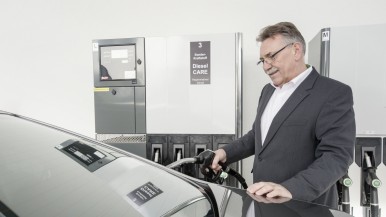
Since early November, the cars chauffeuring the management board members of Robert Bosch GmbH have been running on fully renewable diesel. Known as “C.A.R.E. diesel,” this fuel is synthesized mainly from by-products and waste materials. Its supplier Toolfuel claims that C.A.R.E. diesel reduces the CO2 emissions of these cars by around two-thirds, or 65 percent, from well to wheel. “Renewable and synthetic fuels can contribute greatly to limiting global warming. Their use has a much faster ecological impact than replacing vehicles and infrastructure, as existing filling stations can remain in operation,” says Dr. Volkmar Denner, CEO of Robert Bosch GmbH. For him, the consequences are clear: “Synthetic and renewable fuels should be factored into the CO2 fleet regulation for passenger cars and trucks.” Since C.A.R.E. diesel has yet to be included in the German law on the prevention of airborne pollution, it is not currently available at regular filling stations. In its trials with fully renewable diesel, Bosch wants to show if and how it could be adopted on a broad scale.Bosch is offering partly renewable diesel at certain company filling stations The company is encouraging the use of renewable and synthetic fuels. R33 Blue Diesel, an approved fuel made by Shell, has been available for trial and company car pool vehicles at the filling stations at the Bosch locations in Feuerbach, Schwieberdingen, and Hildesheim for some weeks now. This fuel contains up to 33 percent renewables. The carbon footprint of the more than 1,000 Bosch vehicles that regularly refuel at these three filling stations could thus be reduced by as much as 20 percent from well to wheel. On top of that, Bosch aims to make synthetic and renewable fuels available for company cars and internal delivery vehicles at all its company filling stations across Germany. The supplier of technology and services is also gradually incorporating battery-powered electric vehicles into its fleet. Fewer diesel vehicles mean more CO2 emissions from Europe’s road traffic Since it accounts for 18 percent of global CO2 emissions, road traffic also contributes to the greenhouse effect. On the upside, there has been some progress. In Germany, the CO2 emissions of newly registered vehicles have fallen by one quarter since 2007. On the downside, the CO2 emitted by traffic on European roads is rising again. One reason for this is the shrinking share of newly registered diesel vehicles. They have a great advantage over gasoline models when it comes to CO2 emissions. Compared with its gasoline variant, a diesel model’s carbon footprint is around 15 percent lower on average. “We need diesel and other solutions such as renewable and synthetic fuels in addition to electromobility to further reduce greenhouse gas emissions,” Denner says. If renewable and synthetic fuels were widely used by European passenger cars, this alone could save up to 2.8 gigatons of CO2 by 2050, and that is without electrification factored into the equation. This is three times the amount of carbon dioxide Germany emitted in 2016. Bosch has been exploring renewable and synthetic fuels for some time now. The company’s fuel-carrying components for diesel engines, such as the fuel pump and injection nozzles, have been rigorously tested, and vehicle manufacturers are free to approve them for use with renewable and synthetic fuels. Bosch aims to make transportation as resource-friendly as possible Bosch is approaching future powertrain technology with an open mind. The company is committed to a vision of virtually emissions-free driving. While it will continue to improve the internal-combustion engine, it also aims to become a leader in the market for electromobility. After years of research and development effort, Bosch presented a new diesel technology in April 2018. It is capable of cutting NOx emissions from diesel vehicles to well below the statutory 120 milligram-per-kilometer limit that will come into effect in 2020 – and it can do so in any real traffic conditions. These results were achieved in test vehicles with heavily modified engine and emission settings. The vehicles were also equipped with leading-edge technology and components, just recently introduced to the market. A combination of advanced fuel-injection technology, a newly developed air management system, and intelligent temperature management made such low readings possible. Bosch customers can now tap this system know-how to develop future lines of mass-manufactured vehicles. Q&A about renewable C.A.R.E diesel What is C.A.R.E. diesel? C.A.R.E. diesel is a fully renewable fuel made mainly of by-products and waste materials, recycled cooking oils, and grease. It contains no conventional diesel – that is, fossil fuel. Neste, a Finnish mineral oil company and biofuel manufacturer, makes C.A.R.E. diesel; the company’s partner Toolfuel distributes it in Germany. C.A.R.E., a trademark of Toolfuel, is short for CO2 Reduction, Arctic Grade, Renewable, Emission Reduction. What does Bosch hope to gain by using C.A.R.E. diesel? Bosch is making every effort to optimize internal combustion engines and believes diesel powertrains help reduce CO2 emissions in road traffic. This reduction in CO2 emissions is even greater when vehicles run on renewable paraffinic fuels such as C.A.R.E. diesel, which helps protect the environment and conserve resources. Why only a 65 percent reduction in CO2 emissions? The CO2 advantage here is that only the CO2 emissions resulting from the conversion of waste materials into fuel are taken into account. The waste materials themselves are deemed to be CO2 neutral, as they already exist. What technical upgrades do vehicles need to run on C.A.R.E. diesel? C.A.R.E. diesel is a paraffinic fuel and, as such, has a slightly lower density and higher ignitability than conventional diesel fuel. This is why regulatory authorities have drafted an additional standard, EN 15490, for paraffinic diesel fuels. The EN 590 standard applies to conventional diesel fuel. Manufacturers have to specifically approve vehicles for fuels with the properties set out in EN 15940. This is important, as they must first investigate component compatibility, potential increases in peak pressure during combustion, and other factors. When will C.A.R.E. diesel be available at regular filling stations? Various test fleets are already running on C.A.R.E. diesel. As it stands now, C.A.R.E. diesel is unavailable in quantities sufficient to supply filling stations on a wide scale across Europe. Also, many countries have national laws regulating the fuel sold at public filling stations. In these countries, including Germany, the EN 15940 standard has yet to be adopted. The decision to amend EN 15940 to the 10th German law on the prevention of airborne pollution is still pending. How much does a liter of C.A.R.E. diesel cost at the pump? With approval still pending, C.A.R.E. diesel is currently unavailable at filling stations. A liter of C.A.R.E. diesel is a little more expensive than conventional diesel fuel. This markup is due to manufacturing costs.