Search & find:
media, releases and events to support your reporting about the Bosch Group.

AI code of ethics: Bosch sets company guidelines for the use of artificial intel ...

19.02.2020

Press release

Internet of Things

AI code of ethics: Bosch sets company guidelines for the use of artificial intel ...

Stuttgart and Berlin, Germany – Bosch has established ethical “red lines” for the use of artificial intelligence (AI). The company has now issued guidelines governing the use of AI in its intelligent products. Bosch’s AI code of ethics is based on the following maxim: Humans should be the ultimate arbiter of any AIbased decisions. “Artificial intelligence should serve people. Our AI code of ethics provides our associates with clear guidance regarding the development of intelligent products,” Bosch CEO Volkmar Denner said at the opening of Bosch ConnectedWorld (BCW), the company’s annual IoT conference in Berlin. “Our goal is that people should trust our AI-based products.” AI is a technology of vital importance for Bosch. By 2025, the aim is for all Bosch products to either contain AI or have been developed or manufactured with its help. The company wants its AI-based products to be safe, robust, and explainable. “If AI is a black box, then people won’t trust it. In a connected world, however, trust will be essential,” said Michael Bolle, the Bosch CDO and CTO. Bosch is aiming to produce AI-based products that are trustworthy. The code of ethics is based on Bosch’s “Invented for life” ethos, which combines a quest for innovation with a sense of social responsibility. Over the next two years, Bosch plans to train 20,000 of its associates in the use of AI. Bosch’s AI code of ethics governing the responsible use of this technology will be part of this training program.AI offers major potential Artificial intelligence is a global engine of progress and growth. The management consultants PwC, for example, project that between now and 2030, AI will boost GDP in China by 26 percent, by 14 percent in North America, and by around 10 percent in Europe. This technology can help overcome challenges such as the need for climate action and optimize outcomes in a host of areas such as transportation, medicine, and agriculture. By analyzing huge volumes of data, algorithms are able to reason and make decisions. Well in advance of the introduction of binding EU standards, Bosch has therefore taken the decision to actively engage with the ethical questions that the use of this technology raises. The moral foundation for this process is provided by the values enshrined in the Universal Declaration of Human Rights. Humans should retain control Bosch’s AI code of ethics stipulates that artificial intelligence should not make any decisions about humans without this process being subject to some form of human oversight. Instead, artificial intelligence should serve people as a tool. Three possible approaches are described. All have the following in common: in AI-based products developed by Bosch, humans should retain control over any decisions the technology makes. In the first approach (human-in-command), artificial intelligence is purely an aid – for example, in decision-supporting applications, where AI can help people classify items such as objects or organisms. In the second approach (human-in-the-loop), an intelligent system autonomously makes decisions that humans can, however, override at any time. Examples of this include partially automated driving, where the human driver can directly intervene in the decisions of, say, a parking assistance system. The third approach (human-on-the-loop) concerns intelligent technology such as emergency braking systems. Here, engineers define certain parameters during the development process. Here, there is no scope for human intervention in the decision-making process itself. The parameters provide the basis on which AI decides whether to activate the system or not. Engineers retrospectively test whether the system has remained within the defined parameters. If necessary, these parameters can be adjusted. Building trust together Bosch also hopes its AI code of ethics will contribute to public debate on artificial intelligence. “AI will change every aspect of our lives,” Denner said. “For this reason, such a debate is vital.” It will take more than just technical know-how to establish trust in intelligent systems – there is also a need for close dialogue among policymakers, the scientific community, and the general public. This is why Bosch has signed up to the High-Level Expert Group on Artificial Intelligence, a body appointed by the European Commission to examine issues such as the ethical dimension of AI. In a global network currently comprising seven locations, and in collaboration with the University of Amsterdam and Carnegie Mellon University (Pittsburgh, USA), Bosch is working to develop AI applications that are safer and more trustworthy. Similarly, as a founding member of the Cyber Valley research alliance in Baden-Württemberg, Bosch is investing 100 million euros in the construction of an AI campus, where 700 of its own experts will soon be working side by side with external researchers and startup associates. Last but not least, the Digital Trust Forum, a committee established by Bosch, aims to foster close dialogue among experts from leading international associations and organizations. Its 11 members are meeting up at Bosch ConnectedWorld 2020. “Our shared objective is to make the internet of things safe and trustworthy,” Bolle said. More than 170 speakers and 80 exhibitors Bosch ConnectedWorld (February 19–20, 2020) brings together more than 80 exhibitors showcasing the latest trends and developments in the connected world. Among the more than 170 speakers are Bosch CEO Volkmar Denner and Bosch CDO/CTO Michael Bolle, as well as Roland Busch (the deputy CEO of Siemens), Axel Stepken (the chairman of the board of management of TÜV Süd), and Scott Guthrie (executive vice president of Microsoft’s cloud and AI group). The event’s main features include keynote speeches, a major exhibition, and a hackathon. This year marks the seventh time Bosch ConnectedWorld has taken place. It is one of the world’s largest international conferences devoted to the internet of things. At a glance: The guidelines in Bosch’s AI code of ethics All Bosch AI products should reflect our “Invented for life” ethos, which combines a quest for innovation with a sense of social responsibility. AI decisions that affect people should not be made without a human arbiter. Instead, AI should be a tool for people. We want to develop safe, robust, and explainable AI products. Trust is one of our company’s fundamental values. We want to develop trustworthy AI products. When developing AI products, we observe legal requirements and orient to ethical principles.

#LikeABosch: Bosch to launch IoT image campaign

10.01.2019

Press release

Internet of Things

#LikeABosch: Bosch to launch IoT image campaign

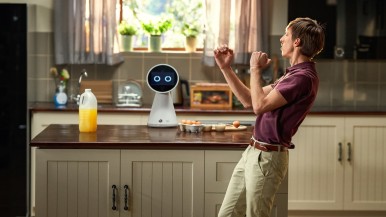
“Like a Bosch” is the tagline of a new global image campaign the technology and service company is set to launch next year, when CES, the world's largest consumer electronics fair, gets underway in Las Vegas on January 7, 2019. This campaign aims to get the message across that Bosch is the leading provider of connected products and solutions. The main plank of the campaign is a hip-hop video clip featuring a protagonist who is a savvy IoT user. Bosch is entering new territory with its “Like a Bosch” campaign; the decidedly different approach and tone marks a departure for the company, which was founded in 1886. This PR move capitalizes on a rash of “like a boss” videos and memes that have gone viral on the internet, attracting tens of millions of clicks. These videos feature everyday people who stage bizarre stunts, perform impressive athletic feats, or find their way out of predicaments with technical finesse. The corporate “Like a Bosch” campaign changes a few letters in order to put a fresh spin on this internet phenomenon. The young man in the Bosch video is always on top of things, thanks to connected solutions from Bosch. Smartphone in hand, he operates his car, lawn mower, or coffee machine in a cool, smart, and confident way – he’s in charge of things “like a Bosch.”Sparking a viral IoT movement “We’ve picked up on a global internet sensation and reinterpreted it with a humorous touch,” says Boris Dolkhani, head of brand management at Bosch. “Where the internet of things is concerned, all roads lead to Bosch. That’s the campaign’s clear message.” The company aims to spark a viral IoT movement, spreading this message across all the relevant communication channels in order to reach a mass audience. Bosch is counting on its 400,000 or more associates to further the cause by liking and sharing these videos. Further clips featuring products for the two IoT domains of connected mobility and connected living are to follow later in the year. The image campaign created by Jung von Matt, a Hamburg, Germany-based advertising agency, is to be rolled out across digital and social media channels. A company on the move Bosch continues to expand its position as a leading IoT company and sold 38 million web-enabled products in 2017. Today, 20 percent of its roughly 27,000 software developers focus exclusively on the IoT. Bosch expects the global IoT market to grow by 35 percent a year to reach an annual volume of 250 billion U.S. dollars by 2020. Those prospects have prompted the company to pursue ambitious goals, and it is now aiming to have internet connectivity in all its electronic devices by that time. Moreover, data-based services will be offered for each device, with artificial intelligence set to play a key role here. Additional information on the “Like a Bosch” campaign: iot.bosch.com

CES 2019: Bosch extends its position as a leading IoT company

08.01.2019

Press release

Internet of Things

CES 2019: Bosch extends its position as a leading IoT company

Las Vegas, NV – More and more, the internet of things (IoT) is changing our world. At CES 2019 in Las Vegas, Bosch is showing what it is already capable of today. From a concept for a shuttle vehicle that makes a new kind of mobility tangible, to fridges with connectivity that give advice on food storage, to smart lawn mowers that learn by doing – the spectrum of solutions Bosch is presenting at the world’s largest consumer electronics show is huge. “Bosch recognized the huge opportunities of the IoT early on. We have been actively shaping the connected world for nearly ten years now,” says the Bosch board of management member Dr. Markus Heyn. “Today, we are a leading IoT company. Step by step, we have extended our software and IT expertise.” Using its own IoT cloud, the company has already carried out more than 270 projects in field such as mobility, smart homes, smart cities, and agriculture. The number of sensors and devices connected over the Bosch IoT Suite has risen nearly 40 percent since last year, and now stands at 8.5 million.One of the keys to further growth and new business opportunities on the internet of things is artificial intelligence (AI). This is also a field in which Bosch is playing a decisive part in driving developments. “We will best be able to unlock the potential of the IoT if we combine it with AI, and take our IoT and AI activities forward in parallel,” Heyn says. In his view, the relationship between the two fields is complementary: “The IoT needs intelligence. The use of connected things to gather data can be a decisive boost for the development of AI. It is only through AI that connected things become intelligent and learn to draw their own conclusions. Above all, we aim to achieve concrete improvements in people’s real, everyday lives – things such as more time, more security, more efficiency, and more convenience.” Here, Heyn cites the example of video-based fire detection: by using intelligent image analysis, security cameras are able to identify fires within a few seconds, even before the system’s sensors detect heat and smoke. In this way, fires can be detected considerably earlier than with conventional fire or smoke alarm systems. This saves valuable minutes in which lives can be saved. A second key to success on the path to the IoT age is partnerships. Here, Bosch is opting for a mix of traditional and new players. The alliance recently agreed with the Canadian platform provider Mojio has already resulted in the first integrated IoT platform for connected vehicles: in the event of an accident, a special Bosch algorithm can identify where and when the accident happened, and how severe it is. Via the Mojio cloud, the data are transmitted without any delay to the Bosch emergency service center, which automatically sends an emergency call to local rescue services. At the same time, a message is sent to a predetermined list of recipients, either as a text message or via the Mojio app. “Together with Mojio, we are connecting vehicles directly with the cloud. This means rescue services can get to the scene of an accident even faster than before,” says Mike Mansuetti, the president of Bosch North America. From the middle of next year, the IoT emergency solution will be available for nearly a million drivers in North America and Europe. IoT on the roads: Bosch presents connected mobility of the future With the concept shuttle vehicle it developed in-house, Bosch is celebrating a world first at CES. In this vehicle, the company is presenting solutions for the automation, connectivity, and electrification of vehicles, and is giving visitors the chance to experience at first hand a new kind of mobility: driverless shuttles, which will soon be a feature on the streets of the world’s cities. “This will pay into our vision of mobility that is as emissions-free, accident-free, and stress-free as possible,” Heyn says. For shuttle- based mobility such as this, Bosch will be supplying not only components and systems, but also a complete range of mobility services, such as reservation, sharing, and connectivity platforms, as well as parking and recharging services. Bosch believes that such connected services are essential for the shuttle-based mobility of the future. The forecast market volume for these services is also high: while it was 47 billion euros in 2017, it is estimated that it will be as much as 140 billion euros by 2022 (source: PwC). Bosch also wants to have a share in this, and aims for significant double-digit growth with the solutions it offers. For Heyn, there is no doubt: “In the future, every vehicle on the road will make use of Bosch digital services. We will consolidate them into a smart, seamlessly connected ecosystem.” One of the final obstacles for putting shuttle-based mobility into practice is the automation of vehicles in complex urban environments. Here, Bosch believes partnerships are the answer: In the second half of this year, San José in California’s Silicon Valley is set to become the pilot city for testing a fully automated, driverless ridesharing service provided by Bosch and Daimler. The three parties have already signed a letter of intent to this effect. With their development alliance, Bosch and Daimler want to improve urban traffic flows, enhance road safety, and provide an important building block for the traffic of the future. Their aim is to develop a driving system for fully automated driverless driving (SAE level 4/5) that is ready for production by the beginning of the next decade. IoT in the home: connected appliances make home owners’ lives noticeably easier It’s not just on the roads that connected products and services that make user’s lives easier are in demand. “We’re working on the idea of a connected home, and on appliances that think autonomously and understand what users want,” Heyn says. At CES, for example, the company is presenting a new function for web-enabled fridges that can recognize types of food and provide recommendations on storage. The interior camera automatically recognizes some 60 kinds of fruits and vegetables and suggests the ideal place to store them by means of an app. As a result, food is stored in the best possible way, stays fresh for longer, and doesn’t have to be thrown away so often. Another new development is the PAI projector, which can project a virtual user interface onto a kitchen counter top. An integrated 3D sensor captures any hand movements, allowing touch-screen operation of the interface. In this way, users can conveniently call up recipes online and make phone calls over the internet while they are cooking and baking. Designed especially for the kitchen environment, PAI does not have to be used with as much care as a smartphone or tablet. Even with sticky fingers, the projector can still be controlled perfectly. PAI is set to debut in China in February 2019, to be followed by market launch in the United States. Bosch is also presenting the Indego S+, its new robot lawn mower with internet connectivity, at CES. It is one of the first robot lawn mowers in the market to offer voice control by Amazon Alexa. It is also the only robot lawn mower that can use weather forecasts on the web to automatically decide when best to mow the lawn again. Bosch is using artificial intelligence to improve the way its robot lawn mower recognizes obstacles on the lawn by evaluating data such as motor flow, acceleration, motor speed, and direction. “We are using AI to make lawn care even easier and more convenient. Our vision is an Indego that adapts to its garden in order to mow the lawn perfectly every time,” Heyn says. IoT #LikeABosch: Bosch launches digital IoT campaign Bosch is also using CES 2019 to premiere its new IoT image campaign. The main plank of the campaign is a hip-hop video clip featuring a protagonist who is a savvy IoT user. Bosch is entering new territory with its “Like a Bosch” campaign; the decidedly different approach and tone marks a new departure for the company, which was founded in 1886. This PR move capitalizes on a rash of “like a boss” videos and memes that have gone viral on the internet, attracting tens of millions of clicks. These videos feature everyday people who stage bizarre stunts or find their way out of predicaments with technical finesse. The IoT image campaign changes a few letters in order to put a fresh spin on this internet phenomenon. The protagonist in the Bosch video is a young man who is always on top of things, thanks to connected solutions from Bosch. Smartphone in hand, he operates his car, lawn mower, or coffee machine in a cool, smart, and confident way – he’s in charge of things “like a Bosch.”

Bosch is digitalizing construction sites

17.09.2018

Press release

Internet of Things

Bosch is digitalizing construction sites

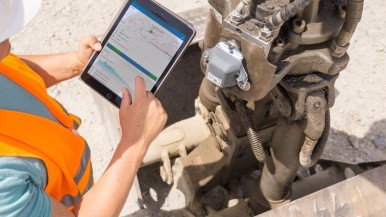
It is a real headache, as well as a potential cause of delay, when vehicles such as excavators or dump trucks cannot be located on huge construction sites. Where exactly are my vehicles? And how many hours have they been in operation? It is questions like these that fleet operators in the construction industry and agricultural sector have to be able to answer if they want to deploy their vehicles as efficiently as possible. This is where the Bosch asset tracing solution – or Bosch TRACI for short – comes into its own. The robust, IoT-based connectivity solution can be easily retrofitted to existing vehicles. “Bosch TRACI provides all the relevant data needed to enhance the efficiency and utilization rate of any vehicle fleet,” says Jan Philipp Büchner, the product manager responsible for Bosch TRACI. “It helps keep wait, search, and transportation times to a minimum.” The Bosch solution comprises a sensor box, cloud-based evaluation software, and a wide array of digital services.Improvements through tracking Productivity growth is substantially lower in the construction industry than elsewhere, and the reasons for this include the growing difficulty of keeping track of all pieces of machinery on increasingly larger and more complex building projects. Bosch TRACI helps improve how much the machinery is used, while speeding up the process of materials distribution. Every vehicle is first equipped with a Bosch TRACI tag, a compact sensor box with its own power supply that captures the vehicle’s position, state of motion, as well as a lot of other data. The data is encrypted and transmitted via a LoRaWAN network to the Bosch IoT cloud, where it is decrypted. Customers and users can then access the sensor data, integrating it into their existing software systems for logistics, scheduling, and operations planning. Of course, the data can also be visualized directly on a smartphone app or in a web browser. Keeping tabs on vehicle fleets and machinery In agricultural scenarios, Bosch’s asset tracing solution dovetails with existing agricultural machinery systems as well as with the sensor-based monitoring solutions provided by the Bosch startup Deepfield. It can also be used to record the operating hours of coupled machines (such as seeding machines without an independent power supply) and to determine when the operators should be reminded of important maintenance work. That can substantially lower the risk of breakdowns and expensive repairs. Bosch’s Connected Agriculture platform ensures an easy exchange of data and trouble-free interaction with existing Bosch solutions. Robust, long-lasting, versatile During Bosch TRACI’s development, special emphasis was placed not only on data security and ease of integration, but also on the need to withstand rough ambient conditions on construction sites and farm fields. Bosch TRACI tags are tested to meet such stringent tightness requirements that the machines on which they are installed can be cleaned with high-pressure jets of steam. The tags are also especially resistant to shock and liquids. In typical applications, the service life of a sensor is three to six years. That can be extended to ten years if the measurement and transmission intervals for sensor data are reduced. The sensor’s clever software algorithms achieve this, for example, by limiting the capture of positional data to situations in which the sensor is moved. High levels of robustness and a long service life also point to potential use cases in other markets. Deployed in smart-city scenarios, for instance, the sensors can make the management of local-government vehicles and technology easier. They can capture movements in infrastructure such as power pylons, enabling fatigue and damage to be detected in good time. In open- cut mines, they can serve to check the condition of machinery and conveyor belts so that maintenance work can be performed as needed. LoRaWAN – a cost-efficient, energy-saving network Bosch TRACI uses the LoRaWAN (long-range wide-area network) IoT wireless network. The development of this standard is being promoted by the LoRa Alliance. The standard allows users to set up their own networks, in similar fashion to a wi-fi network at home. Unlike wi-fi, a LoRa network has a range of several kilometers, but with lower bandwidths. Nonetheless, these bandwidths are more than adequate for the data the Bosch TRACI tag transmits. There are also publicly accessible LoRaWAN networks run by commercial operators. Like existing mobile networks, these collect and transmit data from LoRa sensors. Virtually seamless LoRaWAN networks are already in place in France, Switzerland, and the Benelux countries, and a public one is under construction in Germany. Bosch is already working together with several providers in these countries, and can offer its customers the option of using such public networks for its TRACI solution. Bosch TRACI can also be utilized in The Things Network, an open, community-based initiative that invites everyone to form part of a global IoT network and make use of it themselves. As of early 2018, there were over 3,400 LoRa stations in operation in more than 80 countries.

Bosch smart city solution Climo helps to manage air quality

05.03.2018

Press release

Internet of Things

Bosch smart city solution Climo helps to manage air quality

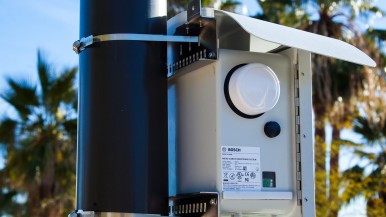
LAS VEGAS – Thanks to smart city technology, cities can now take action on the topic of air pollution. A first step towards improving air quality is the provision and management of data. At CES 2018, Bosch is presenting its micro-climate monitoring system Climo – a new solution, which helps cities around the world manage air-quality parameters in real time and at a much lower cost than existing technologies. The tiny box enables rapid and accurate measurement of data. It has been honored with a CES 2018 Innovation Award in the Smart Cities category. During CES 2018, Climo is monitoring air quality in the city of Las Vegas.“Sensors throughout the city provide a variety of valuable data. Climo gives cities quicker and easier access to this data, allowing them to take action on air quality,” said Mike Mansuetti, president of Bosch in North America at CES 2018. “The Bosch portfolio of sensors, software and services – combined with a wealth of cross-domain expertise – position us to be a partner for cities to solve challenges and positively impact quality of life of its inhabitants.” The Climo system, developed by Bosch in collaboration with Intel, enables the rapid and accurate measurement of air-quality parameters. It combines sensors and software to deliver a range of air-quality data, covering key air pollutants including: particulate matter, carbon monoxide, nitric oxide, nitrogen dioxide, sulphur dioxide and ozone. It also provides data from environmental parameters such as temperature, relative humidity, light, sound, pressure – and even pollen. Benefits for citizens in real time Ambient air quality is a key objective for urban environmental planning. The data provided by the Climo system can be utilized by cities in a variety of proactive approaches such as traffic-flow management. It can also serve to proactively message the local population with tips and information. For example, citizens who are asthmatic or suffer from allergies can instantly know whether it is better to stay indoors or avoid a certain part of the city. It is also a source of data generation for cities to make other decisions, such as future policy and planning. In rural or park areas, the system can also provide an early warning for fires. Wireless sensors that can connect over Wi-Fi and cellular networks The ability to enable micro-climate data collection comes via the connection of compact wireless sensors. Secure remote calibration and monitoring is enabled through both wireless (Wi-Fi and 3G) as well as a wired connection. The Climo system is powered with Intel IoT technologies and features cloud-based analytics, data management and visualization software. Units are pre-configured by location and can be further configured using over- the-air updates. The easy update capabilities are part of the Climo design to scale with future technologies, such as 5G, as they become available. Hundred times smaller, ten times more cost-effective While air-quality monitoring systems can often require large infrastructure investments and are complex to operate, the Climo system was designed for simple deployment and management. It measures 1/100th the size and 1/10th the cost of a traditional air quality monitoring system. Climo was designed to withstand a variety of weather conditions. Climo units feature options for power via either 110/220 V or 12V DC. This makes it an interesting solution for cities and countries around the globe – in different weather zones and with different economic environment. Originally, it was developed by Bosch engineers in India. Real time data of air quality in Las Vegas during CES 2018 At CES Unveiled in Las Vegas, Bosch will present a live demonstration utilizing Climo that shows air-quality measurements from cities around the world – including Las Vegas. It will also show an updated management interface for Climo that provides an even more comprehensive view for city officials.

Bosch is showcasing the following highlights at Bosch ConnectedWorld in Berlin

26.02.2018

Press release

Internet of Things

Bosch is showcasing the following highlights at Bosch ConnectedWorld in Berlin

Berlin and Stuttgart, Germany – An intelligent glove in the factory, a digital guardian angel for people on the go, and connected kitchens: Bosch is showcasing these and other solutions at Bosch ConnectedWorld in Berlin, where the IoT sector meets to discuss tomorrow’s world. Innovative products and services are making everyday life not only more convenient, but also safer and more efficient – at home, at work, and on the move.Products and solutions for all aspects of connected manufacturing ActiveAssist – the assembly assistant: The assembly assistance system guides users step by step through each individual stage in the manufacturing process. It identifies the next workpiece using RFID (radio frequency identification) and provides information about the required processing steps. For instance, the system uses light signals to mark those grab containers that hold the screws or other parts required to complete the next step. A 3D camera tracks the user’s movements. All in all, the system makes it possible to correct errors and prevents the wrong parts from being used. The benefits are a reduction in user strain and an increase in product quality. Intelligent glove: The iGlove features highly sensitive sensors and is designed for use in connected manufacturing. It maps hand movements and can greatly reduce workforce training times. Furthermore, it helps users learn the correct assembly steps and can document production steps such as the removal of parts. Without any need for physical contact, the data is sent via Bluetooth to a computer or smartphone, where it is compared to previously stored movement patterns. ActiveCockpit – the manufacturing assistant: A gigantic screen informs associates in the factory about the current status of production. The benefits are faster information processing, clear analysis, and subsequent definition of tasks for more efficient processes. As a result, manufacturing becomes transparent. Users and companies benefit thanks to the immediate identification of problems, such as screws that are slightly too small or too large. This reduces downtimes, increases the level of product quality, and avoids any recall costs. Connected solutions and products for better living: Vivatar app – a digital guardian angel: Going jogging in the dark or heading home on foot after the last bus has left is enough to make anyone feel uneasy. This is where the Bosch Vivatar app comes in; it acts as a digital guardian angel for people on the go. It enables users to contact friends and family and be digitally “escorted” home via GPS, and decide for themselves when they should be accompanied and by whom. Vivatar Premium grants users 24/7 access to the Bosch Emergency Assistant, a professionally trained emergency team. Climo – a small box for better air quality: It’s the size of a shoebox and measures air quality in real time. Developed by Bosch in collaboration with Intel, Climo is a hundredth of the size and a tenth of the cost of conventional systems. It measures and analyzes a total of 12 parameters, including temperature and humidity as well as carbon dioxide, nitrogen oxide, and even pollen count. Using the information gathered, cities can swiftly take action to improve air quality. They can also use it to help with traffic management, for instance. And by using the app, people suffering from asthma or allergies can find out if they should stay indoors or avoid certain areas of the city. Home Connect – a platform for the connected kitchen: The platform for the connected kitchen from Bosch subsidiary BSH is called Home Connect. No matter where users are, they can use devices such as smartphones to control and monitor Bosch household appliances and those of other manufacturers. With some 30 partners around the world, Home Connect already has the largest digital ecosystem in the connected kitchen, and the company is continuously entering into new partnerships and adding helpful functions and services. At the end of last year, BSH acquired a 65 percent stake in Berlin-based start-up Kitchen Stories. The plan now is to integrate the cooking app into Home Connect. Voice control is also among the services provided. In this way, Bosch products can be controlled by the likes of Amazon Alexa (Germany), Google Home (UK), or Ding Dong (China). Predictive maintenance – remote diagnostics for elevators: Bosch has already spent over 30 years working on emergency call systems in order to quickly free people trapped in broken-down elevators. Now the company is going a step further by preventing elevators from failing in the first place. The key is predictive maintenance. Connected sensors and cameras are integrated into the elevator system and wirelessly notify the service team when a breakdown is imminent. Maintenance and repair work can thus be carried out before the elevator stops working. Connected building platform – a smart building solution: The sensor- and cloud-based solution analyzes data from a building, for instance regarding occupancy or air quality. In this way, the platform provides a solid foundation for efficient building management. Windows and doors open and close as required, which reduces energy consumption. The platform also provides information about room use and whether workspaces are occupied. In offices that offer flexible workspaces, for example, this allows people to quickly find the nearest free desk, lights can be efficiently controlled, and cleaning services can be utilized to maximum effect. Knowing where people and equipment are helps optimize building processes, for instance in commercial buildings or hospitals. The solution is based on the Bosch IoT Suite, the company’s own IoT software platform.

Bosch establishes division for connected mobility services

23.02.2018

Press release

Internet of Things

Bosch establishes division for connected mobility services

Berlin and Stuttgart, Germany – Bosch continues to drive forward its transformation into a provider of mobility services. Its new Connected Mobility Solutions division will bring together over 600 associates to develop and sell digital mobility services. These include vehicle sharing, ridesharing, and connectivity-based services for car drivers. “Connectivity will fundamentally change how we get from A to B, and in the process it will help to solve today’s traffic problems. We are using it to realize our vision of emissions-free, stress-free, and accident-free mobility,” said Dr. Volkmar Denner, chairman of the Bosch board of management, at the Bosch ConnectedWorld 2018 IoT conference in Berlin. Connectivity offers tremendous business potential. By 2025, there will be more than 470 million connected vehicles on the world’s roads (source: PwC). Just four years from now, the market for mobility services and associated digital services will be worth 140 billion euros (source: PwC). “Connected driving is a growth area for Bosch. Bosch aims for significant double-digit growth with the solutions it offers,” Denner said. The plan is for the new division to further extend the existing service portfolio. For instance, mobility services from Bosch send alerts about wrong-way drivers and turn smartphones into car keys. The latest of these is the ridesharing service offered by U.S. start-up Splitting Fares Inc. (SPLT). Denner also presented system!e in Berlin. Connected services for electromobility are set to further increase the suitability of electric driving for the mass market.Bosch enters the ridesharing business One growth market in the field of connected mobility is ridesharing, which encompasses online services and apps for carpools as well as for arranging driving services and taxis. By 2022, the number of ridesharing users worldwide is set to rise by 60 percent to 685 million (source: Statista). To date, most such services have been directed at people who happen to be traveling in the same direction or who want to book a trip at the last minute; companies and commuters have been seen as less of a priority. This is precisely where SPLT comes in. Recently acquired by Bosch, this U.S. start-up developed a platform that companies, universities, or municipal authorities can use to arrange ridesharing for their staff. This B2B approach is aimed directly at commuters: the SPLT app brings together people who want to share a ride to the same workplace or place of study. One advantage of this is that rides are shared by colleagues, which means users never have to get in the car with complete strangers. Within seconds, an algorithm locates a suitable rideshare, calculates the fastest route through traffic, and thus assumes what used to be the time-consuming task of coordinating the departure point, departure time, best route, and passengers. Sharing a ride is good for the nerves, for the wallet, and for the environment. Companies can also play a role in reducing traffic volume. “Connectivity is a way for us to rethink not just the car but the whole way we use modes of transport,” Denner said. Digital services for electric vehicles Bosch subsidiary COUP has provided e-scooters for rent in Berlin since 2016. After introducing e-scooter sharing to Paris last year, the service will launch in Madrid this year. This will bring the total number of e-scooters to 3,500. “Digital services will give electric driving a boost,” Denner said. At the IoT conference, the Bosch CEO presented system!e, a comprehensive system of connected electrified powertrain components and new service solutions for electric cars. To this end, Bosch has connected the electric drive to the Bosch Automotive Cloud Suite. The company is developing web-based services that rely on this interaction. In the future, intelligent electric cars will know precisely when their power will run out, but also where they can find their next charge. Eliminating range anxiety: Services that encourage everyday use For many car buyers, the worry that an electric car might leave them stranded is a deal-breaker. It is precisely this problem that system!e is designed to tackle. Because the electric drive is connected to the cloud, the system can produce an “extended range forecast.” An algorithm factors in vehicle data such as current battery charge, energy consumption of heating or air conditioning, and the driver’s driving style, as well as information from the vehicle’s surroundings. This includes the current traffic situation and topographical data for the route ahead. Based on this information, the system can reliably calculate the vehicle’s precise range. For longer journeys in an electric car, the extended range forecast is supplemented by the “charging assistant.” This service knows where all the charge spots are on a given journey, say from Munich to Hamburg, so it can plan ahead for necessary charging stops; it also manages the payment process. Thanks to additional information about for example restaurants, cafés, and shopping options, drivers can make the most of the charging time and relax. A third service manages vehicle charging in smart homes, helping to optimize how they use energy. It integrates the electric car into the smart home’s electricity grid, meaning the car’s battery supplements the stationary storage device for the house’s photovoltaic system. During the day, the car absorbs excess solar power and feeds it back at night as necessary. “For Bosch, mobility goes beyond the car. Our breadth of technology expertise in numerous fields puts us in an unparalleled position to develop and operate cross-application ecosystems,” Denner said. 4,000 participants, 70 exhibitors, and 140 speakers Bosch’s IoT activities are broadly diversified, encompassing solutions for connected mobility, connected manufacturing, as well as for connected energy systems and buildings. At the Bosch ConnectedWorld forum for the IoT industry in Berlin, more than 70 exhibitors will demonstrate what is already possible with the internet of things, and how it will improve people’s everyday lives in the future. On a 10,000 square-meter exhibition space at “Station” in Berlin, some 4,000 delegates will meet from February 21 to 22. In addition to the Bosch CEO Dr. Volkmar Denner, the roughly 140 speakers will include Dr. Dieter Zetsche (CEO Daimler), Dr. Frank Appel (CEO Deutsche Post DHL), and Johann Jungwirth (CDO Volkswagen). At a hackathon, some 700 programmers, start-up associates, and designers will develop new ideas for connected mobility services, automated driving, connected manufacturing and logistics, and connected living. The 2018 Bosch ConnectedWorld will be the fifth event of its kind. It is one of the world’s largest conferences on the internet of things.

CES 2018: Bosch sees future in smart-city business

09.01.2018

Press release

Internet of Things

CES 2018: Bosch sees future in smart-city business

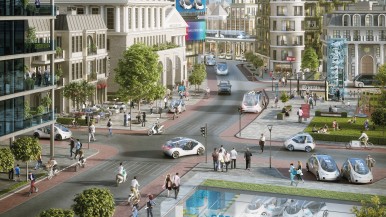
Las Vegas, NV – Urban populations are growing: according to the United Nations, roughly two-thirds of the global population will live in conurbations by 2050. In 2014, this figure was just one-half. Urbanization is increasing, and with it the challenges cities have to solve. Even today, therefore, there is a considerable need for smart solutions. Speaking at CES in Las Vegas, the Bosch management board member Stefan Hartung said: “We need a new conception of the city. One key factor here is technologies that make cities smart and worth living in. In the long run, cities without intelligence will not survive, but succumb to gridlock.” Bosch is working to equip cities and neighborhoods for the future, offering smart mobility, better air quality, more convenience, greater security, and many new services. In short, the aim is significantly better quality of life in cities and neighborhoods. “When it comes to smart cities, few other companies can match Bosch’s comprehensive portfolio, cross-domain knowledge, and outstanding expertise in sensors, software, and services – and all this from a single source,” Hartung said. From January 9 to 12, the supplier of technology and services will be presenting many new solutions that make cities smart at CES 2018, the world’s largest electronics show. These range from a new compact unit that measures and analyzes air quality in real time, to a system that digitally monitors river water levels and gives early warning of flood risks, to a completely automatic parking space service that makes drivers’ lives easier. For more business: the smart-city market is booming Some of the world’s major metropolises are already synonymous with the term “smart,” among them Barcelona, Seoul, and London. Across the globe, cities large and small are investing in smart-city technologies. According to a study on behalf of Bosch, the smart-city market will grow 19 percent each year between now and 2020, reaching a volume of 800 billion dollars (680 billion euros). Bosch believes this is a great business opportunity: “For a long time, the smart city was a vision. We’re helping make it reality. Bosch is in an excellent position to make the connected city a technological and commercial success,” Hartung said. The company is currently involved in 14 extensive smart-city projects in places such as San Francisco, Singapore, Tianjin, Berlin, and Stuttgart. Others are planned to follow. Within the past two years, the company has doubled its sales from cross-domain projects to nearly one billion euros, and this figure is set to rise further. In the Bay Area city of San Leandro, for example, the company has equipped roughly 5,000 streetlights with LEDs and supplied a system for remote management of the city’s street lighting. In this way, the lights are only switched on when they are actually needed. With this solution, San Leandro will be able to save roughly 8 million dollars over the next 15 years. At the Bosch CES press conference, Mike Mansuetti, the president of Bosch North America, said: “Whether cities are big or small, our smart solutions will help them save energy, and money too.” In the case of San Leandro and its 100,000 inhabitants, sensors can be used to measure and analyze air quality, and cameras can automatically re-route traffic in the event of congestion. For more connectivity: IoT and artificial intelligence The internet of things (IoT) has laid one of the main foundations for the connected city. The IoT is finding its way into all walks of life: a Gartner study predicts that some 230 million homes worldwide – roughly 15 percent of all homes – will be intelligently connected by 2020. Here as well, the potential is huge, with market volume estimated to reach 250 billion dollars annually by 2020. By the same year, more than 20 billion devices worldwide will be connected with each other – smoke detectors, burglar alarms, electricity meters, home appliances, and many more. “Bosch recognized this potential early on,” Hartung said. “Even now, more than half our electronic product classes are web-enabled – and the aim is for this to be 100 percent by 2020. Not only that: for each of our products, we want to offer accompanying services.” Another driver of the rapid development of smart cities is artificial intelligence (AI). Bosch intends to further expand its research in this field. Last year, the company opened a research center for artificial intelligence, which now employs some 100 associates in Renningen, Germany, Palo Alto, CA, and Bengaluru, India. By 2021, Bosch will invest some 300 million euros in expanding the center. The company anticipates that, ten years from now, scarcely any product will be conceivable without AI. For better air quality: Climo creates basis for targeted action Air quality is one of the greatest challenges cities face. Thanks to smart technologies, cities can take faster and more targeted action to improve it. However, this depends on accurate measurements. At CES 2018, Bosch is presenting a new solution that it developed together with Intel – the Climo microclimate monitoring system. Climo measures and analyzes 12 parameters that are important for air quality, including carbon dioxide, nitrogen oxide, temperature, and relative humidity. The appliance is one-hundredth the size of conventional systems – and one-tenth the cost. Climo won a CES Honoree Innovation Award in the “smart cities” category. For early warning: digital monitoring of rivers In many regions, climate change is resulting in unpredictable weather. Researchers expect that heavier rainfall will result in more frequent flash flooding. Up to now, mechanical devices have been used to measure river water levels. Hours may pass before these measurements become available for others. However, the flood monitoring system changes all this. In real time, it monitors the water level in rivers and other bodies of water close to cities, and warns of an impending flood. In a pilot project, Bosch is testing the new system on the Neckar river near Ludwigsburg, Germany. Ultrasonic sensor probes and cameras track changes in water level, speed, and throughput. The data is sent to the Bosch IoT Cloud for processing. Should critical thresholds be exceeded, the affected municipalities, residents, and business owners are alerted well in advance by text message. This gives them enough time to take precautions against flooding and flood-related damage. Among those interested in the solution are a number of Indian and South American municipalities that frequently have to combat flooding. For more time: connected parking Urban traffic will increase by roughly one-third by 2050. Bosch is working to make tomorrow’s mobility free of accidents, stress, and emissions. At CES 2018, the company is presenting many solutions that lead toward this goal. Urban traffic plays a role in roughly half the smart-city projects Bosch is involved in. Parking is a particular focal point. U.S. drivers now spend more than 40 hours a year stuck in congestion, wasting some 160 billion dollars in the process. Of this time, roughly one-third is wasted on the search for parking alone. This is where Bosch can help: with its community-based parking, the company simplifies the search for a suitable space. As they drive by, cars automatically recognize and measure the size of the gaps between parked cars, transmitting the data in real time to a digital map. In this way, drivers can have themselves guided directly to free parking spaces. Bosch is already testing this service in German cities, including Stuttgart. This year, as many as 20 U.S. cities will follow, including Los Angeles, Miami, and Boston. In early 2018, moreover, Bosch and Daimler will be launching a new automated valet parking service. Cars in the Mercedes-Benz Museum parking garage in Stuttgart will look for a parking space and park themselves, without a driver. This cuts out stress, and makes more efficient use of parking lots – the same amount of space can accommodate up to 20 percent more vehicles. One factor making fully automated parking a reality is smart parking-garage infrastructure, which connects with the vehicle’s on-board software. Bosch recently won a Frost & Sullivan’s 2017 Technology Innovation Award for this driverless parking solution. For energy and cost savings: Bosch DC microgrids According to the International Panel on Climate Change (IPCC), cities account for roughly 75 percent of total global energy consumption. Forty percent of this is attributable to buildings alone. And the BP Energy Outlook 2035 estimates that global energy consumption will rise 30 percent by 2035. Bosch has many smart energy management solutions that can reduce power consumption. One of these is the Bosch DC (direct current) microgrid, which can be used to supply power to large buildings or building complexes. Since microgrids are generally fed by renewable sources, they are especially eco-friendly. DC microgrids consume up to 10 percent less energy than conventional power plants. Another major advantage is their self-sufficiency, which makes them a reliable source of power when a weather- or security-related outage affects the broader grid. Bosch at CES 2018: PRESS CONFERENCE: In Ballrooms B, C, and D, Mandalay Bay Hotel, Las Vegas South Convention Center, Level 2 , from 8:00 to 8:45 a.m. local time on Monday, Jan 8. BOOTH: Tuesday to Friday, Jan 9–12 , in the Central Hall, booth #14028 FOLLOW the Bosch CES 2018 highlights on Twitter: #BoschCES PANELS WITH BOSCH EXPERTS: PANELS WITH BOSCH EXPERTS: Tuesday, January 9, 1:30 – 3:15 p.m. (local time) “Connect2Car: Next-Gen Automobility” session with Kay Stepper, Vice President of Bosch in North America, head of driver assistance and automated driving, Las Vegas, Convention Center, North Hall, N256 Wednesday, Jan 10, 1:45–2:30 p.m. (local time) “Connected Vehicles in Connected Ecosystems” session with Mike Mansuetti, President Bosch North America, Smart Cities Conference, Westgate. Thursday, Jan 11, 11:30 a.m to 12:30 p.m. (local time) “The Future of Robots at Work and Home” session with Phil Roan, Senior Engineer Robotics, BSH Hausgeräte GmbH, Las Vegas Convention Center, North Hall, N258

CES 2018: Bosch is showing these smart solutions in Las Vegas

22.12.2017

Press release

Internet of Things

CES 2018: Bosch is showing these smart solutions in Las Vegas

At CES 2018, to be held in Las Vegas from January 9 to 12, 2018, Bosch will be demonstrating that the smart, connected city of tomorrow is already a reality. The supplier of technology and services will be presenting innovative solutions and services for urban mobility and a connected working world as well as for smart homes and buildings. You will find Bosch in the Central Hall, Booth #14028 .Solutions for connected cities: safety, energy efficiency, reduced stress Taking the hassle out of parking: Bosch will be presenting various solutions for connected and automated parking. Community-based parking enables drivers to find what has become a rarity in residential areas and city centers: an empty parking space. As they drive by, cars automatically recognize and measure the size of the gaps between parked cars, transmitting the data in real time to a digital parking-space map that enables drivers to locate vacant parking spaces. Automated valet parking from Bosch goes one step further – the car parks itself without any action needed on the driver’s part. Drivers leave their vehicle at the entrance to the parking garage and send a corresponding command from a smartphone app: the car then searches for a vacant spot on its own and parks there without assistance. One factor making fully automated parking a reality is smart parking-garage infrastructure, which connects with the vehicle’s on-board software. Intelligent power supply with DC microgrids: Microgrids are relatively small, independently controlled energy-management systems that can power large buildings. Their ability to run on both traditional and renewable fuels means they have excellent environmental credentials. Another major advantage of microgrids is their self-sufficiency, which makes them a reliable source of power when a weather- or security-related outage affects the broader grid. Unlike conventional systems, Bosch microgrids run on direct current (DC) instead of alternating current (AC), enabling energy savings of up to ten percent. The Bosch DC microgrid was developed in the U.S. as part of a strategic project to develop new business opportunities for the company in a startup environment. As early as 2015, Bosch outfitted an existing facility at Fort Bragg, North Carolina, with a smart-building microgrid solution which supplies less expensive, more eco-friendly electricity. Early warning about flooding: This system offers early warning about potential flooding by digitally monitoring the levels of rivers and other bodies of water close to cities in real time. Up to now, water levels have always been measured by mechanical means. It can take hours until the data is available for third parties. Bosch is currently testing the flood monitoring system in a pilot project on the Neckar river in Ludwigsburg, Germany. There, ultrasonic sensor probes and cameras track changes in water level, water velocity, and rate of discharge. This data is sent to the Bosch IoT Cloud for assessment. When critical thresholds are exceeded, advance alerts are sent by SMS to the affected municipalities, residents, and business owners. This gives them enough time to take precautions against flooding or flood damage. A number of flood-prone municipalities in India and South America have already expressed interest in the solution. Vivatar app – a digital guardian angel: Going jogging in the dark, or heading home on foot after the last bus has already left is enough to make anyone feel uneasy. This is where the Bosch Vivatar app comes in. People can use it to contact friends and family and be digitally “escorted” home via GPS. Users decide for themselves when they should be accompanied and by whom. The Premium version of Vivatar grants users 24/7 access to the Bosch Emergency Assistant, a professionally trained emergency team. Bosch start-ups are developing solutions for smart cities: Bosch wants to tap new fields of business quickly with its in-house start-up platform. At the same time, the innovative start-ups using it benefit from the infrastructure provided and from the long-standing experience of a supplier of technology and services such as Bosch. At CES 2018, two start-ups from the platform will be presenting their connected-city solutions. One of these is the MyScotty app, which allows users to access as well as pay for local shared mobility services from different providers. A single sign-on is enough to gain permanent access to thousands of cars, bicycles, and scooters. This means far fewer apps are needed. MyScotty debuted in Germany mid-2017, and other countries are set to follow. Another solution, the smart mobility center BePart, is still in the development phase. It is designed to enable cities and towns to avoid congestion by diverting traffic during rush hour. Commuters can receive recommendations in real time from the municipal authorities and adjust their routes accordingly. The goal is to improve air quality in conurbations. Initial pilot projects will run in one or two cities in Germany in 2018.