Search & find:
media, releases and events to support your reporting about the Bosch Group.

CES 2022: For better quality of life and more climate action – connected and sma ...

27.01.2022

Press release

Connected Devices and Solutions

CES 2022: For better quality of life and more climate action – connected and sma ...

Las Vegas – At home, on the road, at work, in the hospital, or even in orbit: Bosch is improving the everyday lives of people from all walks of life with smart and connected solutions. At the same time, the company is tapping into new areas of business through software, services, and licenses. “We are systematically digitalizing our core business to increase the benefits for our customers. Going forward, we aim turn the sale of every digital product into services-based revenue as well,” says Tanja Rückert, the Bosch Group’s chief digital officer, at CES in Las Vegas. To achieve this goal, Bosch is focusing on the connection of IoT with AI – in other words, it is linking the internet of things (IoT) with artificial intelligence (AI).This creates a virtuous circle in which connected products deliver information that, in turn, is processed by means of AI and incorporated into software updates for these products. At the core of this approach is the benefit for customers, since it allows users to be an integral part of the development process and enables solutions to be tailored precisely to their needs. Furthermore, neither development nor value creation ends with the sale of the products. “We see the combination of AI and IoT as holding the key to leveraging the most user benefit from both of these technologies,” Rückert says. “Besides enabling us to develop new business models, this approach helps us offer better products and solutions that deliver real added value for individuals and society as a whole.” Expanding software expertise: Bosch is already shaping the future today Bosch laid the foundation for this long ago. As of the new year, all electronics product classes will be connectable. Sales of connected power tools, household appliances, and heating systems alone have grown by 50 percent within one year – from four million units in 2020 to more than six million in 2021. With the Bosch Center for Artificial Intelligence (BCAI), the company has established a strong unit in the field of AI that has already contributed some 300 million euros to result. In addition, the company invests a total of more than four billion euros every year in its software expertise, around three billion of which goes to the mobility business. To shape the software-defined future of mobility, Bosch will also be pooling development activities for application-independent software in one unit as of mid-2022. In the future, under the umbrella of its subsidiary ETAS GmbH, the company will develop and sell basic vehicle software, middleware, cloud services, and development tools for universal application. Bosch is also rapidly advancing connected and automated driving. Over the past five years, Bosch has generated some nine billion euros in sales just with driver assistance systems and the associated sensors. Bosch Tech Compass: a survey conducted in five countries around the world The Bosch Tech Compass – a representative survey conducted in five countries and presented for the first time at CES – shows what people across the globe expect from new technologies. According to the survey, the majority of respondents (72 percent) are convinced that technological progress is making the world a better place, for instance as a key to fighting climate change (76 percent). At the same time, four out of five people think technology should be more focused on tackling the great challenges of our time rather than serving individual needs. “We at Bosch also believe that technology offers a broad range of benefits,” Rückert says. “When we talk about high-tech, we’re not talking only about pushing the envelope on what’s possible. We use technology as a means to improve people’s lives wherever they are.” From space to pediatric medicine: the Bosch SoundSee sensor system One example of the benefit of AI and connectivity is the SoundSee sensor system. Since late 2019, it has been traveling through space to identify unusual sounds on the ISS, using AI algorithms to analyze and indicate when maintenance is required. Now, in collaboration with the non-profit healthcare company Highmark in Pittsburgh (USA), Bosch is pursuing a completely down-to-earth application of this technology: investigating how audio AI can be used as a diagnostic tool in pediatric medicine. Specifically, Bosch and Highmark are working to adapt the sensors in a way that will enable them to detect pulmonary conditions such as asthma at an early stage just by listening to children’s breathing patterns. “Using innovative technology to improve children’s health – that’s exactly what we mean with high tech,” says Mike Mansuetti, president of Bosch in North America. SoundSee’s use in medicine also illustrates Bosch’s understanding of its “Invented for life” strategic imperative. Bosch’s new gas sensor – the first on the market to contain AI – serves to protect both humans and nature. Part of Dryad’s Silvanet Wildfire Sensor, it is essentially a digital nose that helps detect forest fires early on. Dryad’s sensors are attached to trees, where they continuously monitor the local microclimate to detect incipient fires – and to wirelessly notify the local authorities, long before camera- or satellite-based systems can. Not only can this protect against devastation by fire, it can also reduce global carbon emissions from forest fires. “These sensors are going to help save lives, homes, and tons of CO2 from entering the atmosphere – all thanks to AI and connectivity,” Mansuetti says. High-tech #LikeABosch: new campaign for smart solutions A new, lighthearted Bosch campaign shows the solutions the company has developed to improve the little things in people’s everyday lives. Called “High tech #LikeABosch – with many connected, intelligent, and sustainable solutions,” its protagonist takes viewers on a tour through her daily routine and uses several Bosch solutions, from smart glasses to a connected e-bike to a digital access pass for work. This makes her teenage son, who at the start of the clip said his mom was “old school,” look pretty out of touch.

AI code of ethics: Bosch sets company guidelines for the use of artificial intel ...

19.02.2020

Press release

Internet of Things

AI code of ethics: Bosch sets company guidelines for the use of artificial intel ...

Stuttgart and Berlin, Germany – Bosch has established ethical “red lines” for the use of artificial intelligence (AI). The company has now issued guidelines governing the use of AI in its intelligent products. Bosch’s AI code of ethics is based on the following maxim: Humans should be the ultimate arbiter of any AIbased decisions. “Artificial intelligence should serve people. Our AI code of ethics provides our associates with clear guidance regarding the development of intelligent products,” Bosch CEO Volkmar Denner said at the opening of Bosch ConnectedWorld (BCW), the company’s annual IoT conference in Berlin. “Our goal is that people should trust our AI-based products.” AI is a technology of vital importance for Bosch. By 2025, the aim is for all Bosch products to either contain AI or have been developed or manufactured with its help. The company wants its AI-based products to be safe, robust, and explainable. “If AI is a black box, then people won’t trust it. In a connected world, however, trust will be essential,” said Michael Bolle, the Bosch CDO and CTO. Bosch is aiming to produce AI-based products that are trustworthy. The code of ethics is based on Bosch’s “Invented for life” ethos, which combines a quest for innovation with a sense of social responsibility. Over the next two years, Bosch plans to train 20,000 of its associates in the use of AI. Bosch’s AI code of ethics governing the responsible use of this technology will be part of this training program.AI offers major potential Artificial intelligence is a global engine of progress and growth. The management consultants PwC, for example, project that between now and 2030, AI will boost GDP in China by 26 percent, by 14 percent in North America, and by around 10 percent in Europe. This technology can help overcome challenges such as the need for climate action and optimize outcomes in a host of areas such as transportation, medicine, and agriculture. By analyzing huge volumes of data, algorithms are able to reason and make decisions. Well in advance of the introduction of binding EU standards, Bosch has therefore taken the decision to actively engage with the ethical questions that the use of this technology raises. The moral foundation for this process is provided by the values enshrined in the Universal Declaration of Human Rights. Humans should retain control Bosch’s AI code of ethics stipulates that artificial intelligence should not make any decisions about humans without this process being subject to some form of human oversight. Instead, artificial intelligence should serve people as a tool. Three possible approaches are described. All have the following in common: in AI-based products developed by Bosch, humans should retain control over any decisions the technology makes. In the first approach (human-in-command), artificial intelligence is purely an aid – for example, in decision-supporting applications, where AI can help people classify items such as objects or organisms. In the second approach (human-in-the-loop), an intelligent system autonomously makes decisions that humans can, however, override at any time. Examples of this include partially automated driving, where the human driver can directly intervene in the decisions of, say, a parking assistance system. The third approach (human-on-the-loop) concerns intelligent technology such as emergency braking systems. Here, engineers define certain parameters during the development process. Here, there is no scope for human intervention in the decision-making process itself. The parameters provide the basis on which AI decides whether to activate the system or not. Engineers retrospectively test whether the system has remained within the defined parameters. If necessary, these parameters can be adjusted. Building trust together Bosch also hopes its AI code of ethics will contribute to public debate on artificial intelligence. “AI will change every aspect of our lives,” Denner said. “For this reason, such a debate is vital.” It will take more than just technical know-how to establish trust in intelligent systems – there is also a need for close dialogue among policymakers, the scientific community, and the general public. This is why Bosch has signed up to the High-Level Expert Group on Artificial Intelligence, a body appointed by the European Commission to examine issues such as the ethical dimension of AI. In a global network currently comprising seven locations, and in collaboration with the University of Amsterdam and Carnegie Mellon University (Pittsburgh, USA), Bosch is working to develop AI applications that are safer and more trustworthy. Similarly, as a founding member of the Cyber Valley research alliance in Baden-Württemberg, Bosch is investing 100 million euros in the construction of an AI campus, where 700 of its own experts will soon be working side by side with external researchers and startup associates. Last but not least, the Digital Trust Forum, a committee established by Bosch, aims to foster close dialogue among experts from leading international associations and organizations. Its 11 members are meeting up at Bosch ConnectedWorld 2020. “Our shared objective is to make the internet of things safe and trustworthy,” Bolle said. More than 170 speakers and 80 exhibitors Bosch ConnectedWorld (February 19–20, 2020) brings together more than 80 exhibitors showcasing the latest trends and developments in the connected world. Among the more than 170 speakers are Bosch CEO Volkmar Denner and Bosch CDO/CTO Michael Bolle, as well as Roland Busch (the deputy CEO of Siemens), Axel Stepken (the chairman of the board of management of TÜV Süd), and Scott Guthrie (executive vice president of Microsoft’s cloud and AI group). The event’s main features include keynote speeches, a major exhibition, and a hackathon. This year marks the seventh time Bosch ConnectedWorld has taken place. It is one of the world’s largest international conferences devoted to the internet of things. At a glance: The guidelines in Bosch’s AI code of ethics All Bosch AI products should reflect our “Invented for life” ethos, which combines a quest for innovation with a sense of social responsibility. AI decisions that affect people should not be made without a human arbiter. Instead, AI should be a tool for people. We want to develop safe, robust, and explainable AI products. Trust is one of our company’s fundamental values. We want to develop trustworthy AI products. When developing AI products, we observe legal requirements and orient to ethical principles.

Camera-based life-saver: Bosch helps cars keep an eye on their passengers

10.01.2020

Press release

Connected mobility

Camera-based life-saver: Bosch helps cars keep an eye on their passengers

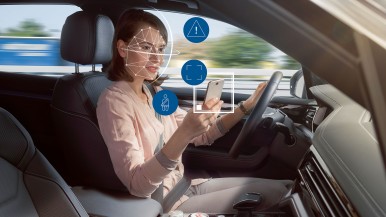
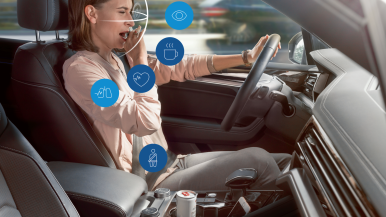
Stuttgart, Germany – Microsleep, distraction, a seatbelt left undone – many things that happen inside a vehicle can have far-reaching consequences. To avert critical driving situations and possibly also accidents, it is planned that cars will in the future use their sensors not simply to monitor the road but also the driver and other passengers. For this purpose, Bosch has developed a new interior monitoring system featuring cameras and artificial intelligence (AI). “If the car knows what its driver and occupants are doing, driving will become safer and more convenient,” says Harald Kroeger, a member of the Robert Bosch GmbH board of management. The Bosch system may go into production in 2022. In that year, the EU will make safety technology that for example warns drivers of drowsiness and distraction a standard feature in new vehicles. The EU Commission expects that, by 2038, their new safety requirements for vehicles will save more than 25,000 lives and help prevent at least 140,000 severe injuries. By keeping an eye on what is happening inside the car, it is hoped that a fundamental problem of self-driving cars will be solved. If responsibility for driving is to be transferred to the driver again following an automated drive on the freeway, say, the car needs to be sure that the driver is neither sleeping, nor reading the newspaper, nor writing e-mails on their smartphone.A smart camera constantly monitors the driver At 50 kph, a vehicle will cover 42 meters completely unsupervised if the driver dozes off or looks at their smartphone for just three seconds. Many people underestimate the associated risk. International studies state that nearly one in ten accidents are caused by distraction or drowsiness. This has prompted Bosch to develop an interior monitoring system that detects and alerts to this danger and provides driving assistance. A camera integrated in the steering wheel detects when drivers’ eyelids are getting heavy, when they are distracted, and when they turn their head toward their passenger or the rear seats. Thanks to AI, the system draws the right conclusions from this information: it warns inattentive drivers, recommends a break if they are getting tired, or even reduces the speed of the vehicles – depending on the automaker’s wishes, and also on legal requirements. “Cameras and AI will turn the vehicle into a life-saver,” Kroeger says. To achieve this, Bosch engineers have used intelligent image-processing algorithms and machine learning to teach the system to understand what the person in the driving seat is actually doing. To take the example of driver drowsiness, the system is trained using recordings of real driving situations and, on the basis of recordings of eyelid position and eye-blink rate, learns how tired the driver really is. This allows it to give an alert that is appropriate to the situation, and to use the driver assistance systems to intervene. Warning systems that sound the alert in the case of distraction and drowsiness will be so important in the future that NCAP, the European New Car Assessment Program, will include them in the roadmap for the Euro NCAP assessment for vehicle safety by 2025. On the subject of monitoring, only the software in the vehicle itself evaluates the information provided by the interior monitoring system – the information is neither saved nor passed on to third parties. Like a relay race: responsibility for steering passes from car to driver and back At the latest when cars start driving automatically, it is obvious how important it is that they understand their drivers. Once driving is automated, cars will drive along freeways without driver intervention. However, they will also have to be able to hand back control to their drivers in tricky situations such as construction zones, or when the exit ramp is drawing near. Drivers have to be able to safely take the wheel again at any time during the automated driving phase, and the camera makes sure they don’t fall asleep. If their eyes remain closed for a prolonged period, an alarm is sounded. The system also interprets camera recordings to establish what drivers are currently doing, and how ready they are to respond. The transfer of driving responsibility is then timed accordingly. “Bosch driver observation will be essential for safe automated driving,” Kroeger says. When the car keeps its camera eyes open But the new Bosch system keeps its eye not only on the driver, but also on all the other passengers, whether next to or behind the driver. For this purpose, a camera mounted above or below the rear-view mirror monitors the entire passenger compartment. It notices whether children on the rear seats have carelessly unfastened their seat belts, and warns the driver. If someone sitting in the back is leaning too far forward, at an angle, or with their feet up on the seat next to them, the airbags and belt tensioner will not be able to protect them properly in an accident. The interior monitoring camera can tell what position they are sitting in and set the airbags and belt tensioner to ensure the best possible protection. The interior monitoring system also prevents the passenger-seat airbag from being deployed if a baby’s carrycot is on the seat. On the subject of children, it is a sad fact that parked vehicles can be a death trap for them. In the United States in 2018, they claimed the lives of more than 50 children (source: KidsAndCars.org), either because they had been left in the car for a short while or had clambered in unnoticed. The new Bosch system can recognizes this danger, and warn parents in a flash by sending a message to their smartphone. In an emergency, it also can alert the emergency services. As the Hot Cars Act currently being debated in the United States shows, legislators are interested in technology solutions to address this challenge. A camera for more convenience The new Bosch system also means more driving convenience. The interior monitoring camera can tell who is about to drive and adjust the rear-view mirror, seating position, steering-wheel height, and infotainment system to preset personal preferences. And the camera can also be used for eye- and handgesture control of the infotainment system. Bosch at CES 2020: • PRESS CONFERENCE: In Ballrooms B, C, and D, Mandalay Bay Hotel, Las Vegas South Convention Center, Level 2, from 9:00 to 10:30 a.m. local time on Monday, January 6, 2020 . • BOOTH: Tuesday to Friday, January 7–10, 2020 , in the Central Hall, booth #12401 • FOLLOW the Bosch CES 2020 highlights on Twitter: #BoschCES • PANELS WITH BOSCH EXPERTS: Wednesday, January 8, 2020, 10:15 to 11:15 (local time) Event on the subject of “Growth of Apprenticeships for ‘New Collar’ Jobs” with Charlie Ackerman, Senior Vice President of Human Resources, Las Vegas, South Convention Center

CES 2020: Bosch raises the bar when it comes to artificial intelligence

06.01.2020

Press release

Artificial Intelligence

CES 2020: Bosch raises the bar when it comes to artificial intelligence

Las Vegas, NV, USA – Whether for automated driving, the smart home, or manufacturing: artificial intelligence (AI) has become an integral part of everyday life. Bosch uses AI and the internet of things (IoT) to make life easier for people and as safe as possible. Here, the slogan “Beneficial AI. Building trust together” sums up the technology and services company’s approach. The focus is on safe and robust AI for the manufacture of smart products, which Bosch will be showcasing at this year’s CES. One of these products is the Virtual Visor: an AI-based digital vehicle sun visor that will be making its debut at the world’s largest trade fair for consumer electronics. The product has also won a CES® Innovation Award, as has Bosch’s 3D display for the car.Other Bosch AI highlights at the show include an application for predictive maintenance of the International Space Station, a system for monitoring vehicle interiors, and a smart platform for medical diagnostics. “The solutions we’re showcasing at CES make it clear that Bosch aims to become an innovation leader in AI as well,” says Bosch management board member Michael Bolle. “As of 2025, every Bosch product will either contain artificial intelligence or will have been developed or manufactured with the help of AI.” The global market volume for AI applications is expected to be around 120 billion dollars over that same period, a twelvefold increase compared to 2018 (source: Tractica). Bosch wants to tap into that potential: the company already invests 3.7 billion euros each yearin software development, currently employs more than 30,000 software engineers, and has 1,000 associates working on AI. In addition, Bosch has established a comprehensive training program. “We plan to make nearly 20,000 associates AI-savvy over the next two years,” Bolle explains. “We must invest not only in artificial intelligence, but in human intelligence as well.” The program includes training formats at three different levels for managers, engineers, and AI developers and includes guidelines for using AI responsibly. To that end, Bosch has drawn up its own set of AI principles that address issues of AI security and ethics. With this in combination with its expertise, the company intends to build trust with customers and partners alike: “Anyone who has internalized technical and ethical principles knows how important data security and sovereignty are,” Bolle says. “In a way, trust is the product quality of the digital world.” Expertise saves lives In the future, Bosch believes one core area of expertise will be the industrial application of artificial intelligence. “We want to harness the power of artificial intelligence not for the purpose of creating models of human behavior, but instead to improve technology to benefit people,” Bolle says. “For this reason, industrial AI has to be safe, robust, and explainable.” According to Bosch, that means people should always remain in control, whether on the street, at home, or in manufacturing. As a pioneer in the development of life-saving driver safety systems such as ABS, ESP, and airbag control units, the company has already proved in the past that people benefit from reliable machines. AI can also make driver assistance systems even more efficient and intelligent: when Bosch’s AI camera for automated driving identifies partially concealed pedestrians, for example, the automatic emergency braking assistant can react even more reliably. Bosch is creating learning technology that is “Invented for life.” Bosch invests 100 million euros in an AI campus Innovations require investment. In addition to spending on software development, Bosch is investing worldwide in people and in competence centers. For example, the company is investing 100 million euros in the construction of a new AI campus in Tübingen, Germany. The move into the new research complex is planned for the end of 2022. It will then offer some 700 AI experts space for creative and productive exchange. These experts come from Bosch, external startups, and public research institutions. The new campus should strengthen exchange among experts in Cyber Valley. “Building trust together” will be a living reality there. Bosch is a founding member of Cyber Valley , which was established in 2016. This joint research venture brings together partners from industry, academia, and government to drive forward AI research and quickly transfer research findings into real-world industrial applications. In addition, the Bosch Center for Artificial Intelligence (BCAI) operates at seven locations worldwide, including two in the U.S.: in Sunnyvale, California and Pittsburgh, Pennsylvania. The BCAI currently has a total of some 250 AI specialists working on more than 150 projects in the domains of mobility, manufacturing, smart homes, and agriculture. World-first Virtual Visor originated in the U.S. Bosch has creative AI minds developing product innovations for mobility, the smart home, and Industry 4.0. Its AI world first for the automotive sector, which is celebrating its world premiere in Las Vegas, originated in the U.S.: the Virtual Visor, which is a transparent digital sun visor. A transparent LCD display connected to the interior monitoring camera detects the position of the driver’s eyes. Using intelligent algorithms, the Virtual Visor analyzes this information and darkens only the portion of the windshield through which the sun would dazzle the driver. The Virtual Visor scored the highest in its category at the CES Best of Innovation Awards. Bosch’s new 3D display won its category as well. Using passive 3D technology, the display generates a realistic three-dimensional effect for images and alerts. This allows visual information to be grasped faster than when displayed on conventional screens, increasing road safety. Additional safety comes from Bosch’s new interior monitoring system for vehicles. It detects when the driver is drowsy or looks at a smartphone based on eyelid movements, direction of gaze, and head position – and alerts the driver to critical situations. It also monitors the vehicle interior to determine how many occupants are present and where and in what position they are sitting. This makes it possible to optimize the operation of safety systems such as the airbags in an emergency. In 2019, Bosch sales of driver assistance systems rose by 12 percent to around 2 billion euros. They are paving the way for automated driving. In the future, when vehicles are in partially automated driving mode for sections of the journey such as on the freeway, the driver monitoring system will become an indispensable partner: In these situations, the camera will ensure that the driver can safely take the wheel again at any time. By 2022, the company will have spent around 4 billion euros on automated driving and will employ more than 5,000 engineers. To round out its sensor portfolio in this domain, Bosch is now working on making lidar sensors production-ready as well. In addition to radar and cameras, lidar is the third essential sensor technology. The Bosch long-range lidar sensor can also detect non-metallic objects at a great distance, such as rocks on the road. Bosch AI used in space and in medicine The company is aiming high with its SoundSee sensor system, which was sent into space at the end of 2019. Riding on NASA’s autonomous flying Astrobee robot, SoundSee will isolate unusual sounds on the ISS, analyze the audio using AI-driven analytics, andindicate when maintenance is necessary. Starting in early 2020, audio data captured by Soundsee will be delivered to a ground control facility configured to meet NASA specifications and built into the Bosch Research Center in Pittsburgh, PA. The system, which is barely bigger than a lunchbox, was developed in the U.S. together with Astrobotic as part of a NASA research collaboration. A completely earthbound but no less innovative product is Vivascope, a smart pathology platform that helps in medical diagnosis. Vivascope magnifies specimens like blood and other bodily fluids, digitizing the microscopic findings, and analyzing them with the help of artificial intelligence-powered algorithms. It is capable of precisely and rapidly identifying cell anomalies and providing physicians with useful support in evaluation and diagnosis. Smartglasses Light Drive make everyday glasses smart Bosch is also showcasing many non-AI innovations at CES. For example, its Light Drive smartglasses module is the world’s first sensor-based solution for making a normal pair of glasses smart. It is more than one-third thinner than other solutions on the market and weighs less than ten grams. The crystal-clear images projected into the wearer’s field of vision, which are clearly discernible even in direct sunlight, range from navigation information and text messages to calendar entries and operating instructions – depending on the information received from a smartphone or smartwatch. At CES, Bosch is using its IoT shuttle technology showpiece to present the solutions that the company offers automakers and mobility service providers for the electrification, automation, connectivity, and personalization of ridesharing vehicles. Its portfolio goes beyond components to include seamlessly connected mobility services that give users flexibility in how they operate, manage, charge, and maintain their fleet vehicles, as well as making each journey safe. At the Bosch booth, visitors can also see improved drive and sensor technologies for the connected and emissions-free mobility of the future. Solutions for the entire house: expanded portfolio for residential IoT Bosch is expanding the scope of its services for the residential internet of things (IoT). The highlight here is the open Home Connect platform, which is being showcased at CES. Starting in mid-2020, the platform’s app will also offer control of lighting and shade, entertainment, and smart gardening equipment from different manufacturers. The number of partner companies, which is currently at 40, is set to more than double, making life at home even more convenient and efficient. Smart technology protects the environment Underlying all these innovative products is Bosch’s entrepreneurial mindset. “We want to harmonize commercial, environmental, and social responsibility,” Bolle says. Climate protection is also a major concern here. According to Bolle, “Bosch not only developsPage 5 of 6environmentally friendly solutions, but also acts as a role model. By the end of 2020, all our 400 locations worldwide will be climate neutral and from development to manufacturing to administration no longer leave a carbon footprint. We’ve already achieved this for our German locations.” Artificial intelligence plays a role here, too: at individual locations, for example, an in-house energy platform uses intelligent algorithms to identify deviations in energy consumption. This alone has enabled some plants to reduce their CO2 emissions by more than 10 percent over the past two years. Considering that Bosch operates a total of 270 such plants, the savings potential is enormous. As Bolle explains, “That’s how we sum up our message at CES: Bosch has big plans for AI in many respects.”

Bosch is showcasing the following highlights at Bosch ConnectedWorld in Berlin

26.02.2018

Press release

Internet of Things

Bosch is showcasing the following highlights at Bosch ConnectedWorld in Berlin

Berlin and Stuttgart, Germany – An intelligent glove in the factory, a digital guardian angel for people on the go, and connected kitchens: Bosch is showcasing these and other solutions at Bosch ConnectedWorld in Berlin, where the IoT sector meets to discuss tomorrow’s world. Innovative products and services are making everyday life not only more convenient, but also safer and more efficient – at home, at work, and on the move.Products and solutions for all aspects of connected manufacturing ActiveAssist – the assembly assistant: The assembly assistance system guides users step by step through each individual stage in the manufacturing process. It identifies the next workpiece using RFID (radio frequency identification) and provides information about the required processing steps. For instance, the system uses light signals to mark those grab containers that hold the screws or other parts required to complete the next step. A 3D camera tracks the user’s movements. All in all, the system makes it possible to correct errors and prevents the wrong parts from being used. The benefits are a reduction in user strain and an increase in product quality. Intelligent glove: The iGlove features highly sensitive sensors and is designed for use in connected manufacturing. It maps hand movements and can greatly reduce workforce training times. Furthermore, it helps users learn the correct assembly steps and can document production steps such as the removal of parts. Without any need for physical contact, the data is sent via Bluetooth to a computer or smartphone, where it is compared to previously stored movement patterns. ActiveCockpit – the manufacturing assistant: A gigantic screen informs associates in the factory about the current status of production. The benefits are faster information processing, clear analysis, and subsequent definition of tasks for more efficient processes. As a result, manufacturing becomes transparent. Users and companies benefit thanks to the immediate identification of problems, such as screws that are slightly too small or too large. This reduces downtimes, increases the level of product quality, and avoids any recall costs. Connected solutions and products for better living: Vivatar app – a digital guardian angel: Going jogging in the dark or heading home on foot after the last bus has left is enough to make anyone feel uneasy. This is where the Bosch Vivatar app comes in; it acts as a digital guardian angel for people on the go. It enables users to contact friends and family and be digitally “escorted” home via GPS, and decide for themselves when they should be accompanied and by whom. Vivatar Premium grants users 24/7 access to the Bosch Emergency Assistant, a professionally trained emergency team. Climo – a small box for better air quality: It’s the size of a shoebox and measures air quality in real time. Developed by Bosch in collaboration with Intel, Climo is a hundredth of the size and a tenth of the cost of conventional systems. It measures and analyzes a total of 12 parameters, including temperature and humidity as well as carbon dioxide, nitrogen oxide, and even pollen count. Using the information gathered, cities can swiftly take action to improve air quality. They can also use it to help with traffic management, for instance. And by using the app, people suffering from asthma or allergies can find out if they should stay indoors or avoid certain areas of the city. Home Connect – a platform for the connected kitchen: The platform for the connected kitchen from Bosch subsidiary BSH is called Home Connect. No matter where users are, they can use devices such as smartphones to control and monitor Bosch household appliances and those of other manufacturers. With some 30 partners around the world, Home Connect already has the largest digital ecosystem in the connected kitchen, and the company is continuously entering into new partnerships and adding helpful functions and services. At the end of last year, BSH acquired a 65 percent stake in Berlin-based start-up Kitchen Stories. The plan now is to integrate the cooking app into Home Connect. Voice control is also among the services provided. In this way, Bosch products can be controlled by the likes of Amazon Alexa (Germany), Google Home (UK), or Ding Dong (China). Predictive maintenance – remote diagnostics for elevators: Bosch has already spent over 30 years working on emergency call systems in order to quickly free people trapped in broken-down elevators. Now the company is going a step further by preventing elevators from failing in the first place. The key is predictive maintenance. Connected sensors and cameras are integrated into the elevator system and wirelessly notify the service team when a breakdown is imminent. Maintenance and repair work can thus be carried out before the elevator stops working. Connected building platform – a smart building solution: The sensor- and cloud-based solution analyzes data from a building, for instance regarding occupancy or air quality. In this way, the platform provides a solid foundation for efficient building management. Windows and doors open and close as required, which reduces energy consumption. The platform also provides information about room use and whether workspaces are occupied. In offices that offer flexible workspaces, for example, this allows people to quickly find the nearest free desk, lights can be efficiently controlled, and cleaning services can be utilized to maximum effect. Knowing where people and equipment are helps optimize building processes, for instance in commercial buildings or hospitals. The solution is based on the Bosch IoT Suite, the company’s own IoT software platform.

Bosch acquires U.S. carpooling start-up SPLT

26.02.2018

Press release

Automated mobility

Bosch acquires U.S. carpooling start-up SPLT

Berlin and Stuttgart, Germany – Bosch is entering the ridesharing business. The supplier of technology and services has acquired Splitting Fares Inc. (SPLT), a U.S. start-up based in Detroit. SPLT operates a platform that allows companies, universities, and municipal authorities to offer their workforces ridesharing services. The B2B approach is designed especially for commuters. SPLT uses an app to connect people who share the same route to their place of work or study. An algorithm finds the best composition for the ride-share, and computes the fastest route. The aim is to reduce congestion and make the daily commute more relaxed. SPLT was founded in 2015. Some 140,000 users in the United States, Mexico, and Germany currently take advantage of the service. It has been agreed that the purchase price will not be disclosed. “With SPLT, we are extending our portfolio in the growth area of mobility services,” said Dr. Markus Heyn, member of the Bosch board of management. With connected mobility services, Bosch aims for growth well into double digits.“Increasingly, smartphones are becoming the most important means of travel,” Heyn added. Connecting road users and modes of transportation is making flexible, multimodal mobility possible: in a matter of seconds, everyone can decide how they want to travel, and make the necessary bookings. “With this sustainable and affordable mobility service, we want to fundamentally change the way people get from A to B,” said Anya Babbitt, the co-founder and CEO of SPLT.Increasing numbers of commuters Ridesharing, in which digital services and apps are used to form carpools and to organize vehicle sharing and taxis, is a growth market in the connected mobility sector. By 2020, the number of people worldwide using rideshares is expected to rise 60 percent to 685 million (source: Statista). Up to now, the services available have usually directly targeted people who happen to be traveling in the same direction, and who want to book a ride on the spur of the moment. They have not focused so much on companies and commuters. But it is precisely here that there is huge potential. According to the German Federal Motor Transport Authority, there are more than 45 million cars on Germany’s roads alone. And the number of commuters is rising: according to the German Federal Institute for Research on Building, Urban Affairs, and Spatial Development, three out of five workers do not work in their home cities. And for roughly two-thirds of the working population, the car is the first choice of transport for the daily commute, according to the German Federal Statistical Office. Worldwide, the result is the same: rush-hour traffic is frequently gridlocked. Millions of commuters find themselves stuck in traffic every day. A further problem is that drivers usually sit alone in their cars. Carpooling is still the exception. This is where SPLT’s solution comes in. Commuting without stress, at low cost, and with little environmental impact SPLT is about sharing – and it couldn’t be simpler to use. Companies, universities, or municipal authorities enable access to the SPLT platform for their employees, who then download the SPLT app, register, and look for or offer a rideshare. Bookings can be made on the spur of the moment or in advance. Arrival times are displayed in real time, and costs are shared among colleagues and charged online. The B2B service is intended for users who travel the same route each day. One advantage of this is that rides are shared by colleagues, which means users never have to get in the car with complete strangers. As a side benefit, such rideshares encourage communication and offer a chance to network. Company buses can also be integrated into the app, and in this way be used more flexibly and efficiently. The result is a journey to work and back without stress, at low cost, and with little environmental impact. Companies can also play a role in reducing traffic volume. In the years ahead, the number of SPLT users is expected to rise many times over – with new regions also being included. Within Bosch itself, associates in Mexico are already using the app, and it is planned to extend its use to the entire company. “We believe we have a good chance of global growth together with Bosch,” Babbitt said. SPLT will remain an independent entity within the Bosch Group and be run as a wholly owned subsidiary. 4,000 participants, 70 exhibitors, and 140 speakers Bosch’s IoT activities are broadly diversified, encompassing solutions for connected mobility, connected manufacturing, as well as for connected energy systems and buildings. At the Bosch ConnectedWorld forum for the IoT industry in Berlin, more than 70 exhibitors will demonstrate what is already possible with the internet of things, and how it will improve people’s everyday lives in the future. On a 10,000 square-meter exhibition space at “Station” in Berlin, some 4,000 delegates will meet from February 21 to 22. In addition to the Bosch CEO Dr. Volkmar Denner, the roughly 140 speakers will include Dr. Dieter Zetsche (CEO Daimler), Dr. Frank Appel (CEO Deutsche Post DHL), and Johann Jungwirth (CDO Volkswagen). At a hackathon, some 700 programmers, start-up associates, and designers will develop new ideas for connected mobility services, automated driving, connected manufacturing and logistics, and connected living. The 2018 Bosch ConnectedWorld will be the fifth event of its kind. It is one of the world’s largest conferences on the internet of things.