Search & find:
media, releases and events to support your reporting about the Bosch Group.

Bosch Tech Compass: 72 percent believe that technology makes the world a better place

04.01.2022

Press release

Energy and Building Technology

Bosch Tech Compass: 72 percent believe that technology makes the world a better place

Stuttgart, Germany / Las Vegas, USA – The vast majority of people surveyed worldwide believe that technological progress is making the world a better place (72 percent). This is a finding of the Bosch Tech Compass , a representative survey of the general public in China, India, Germany, the United Kingdom, and the United States. The survey is having its global debut at CES 2022. In view of the rapid and profound changes technology is driving in many spheres of life, the Bosch Tech Compass aims to encourage people to take a closer look at the positive impact of technological progress on a globalized world.Technological progress as key to combating climate change Although technology has the potential to make almost anything possible, such as creating a pizza with a 3D printer, global respondents strongly agree that technology should be more focused on tackling the major challenges of our time rather than serving individual needs (83 percent). For example, the survey shows that more than three out of four respondents worldwide see technological progress as the key to combating climate change. “The Bosch Tech Compass shows that people want technology that addresses the problems of our time,” says Bosch CEO Stefan Hartung. “Technology should support us, make life easier overall, and make the world a better place. This is why we at Bosch are committed to technology that is ‘Invented for life’ and serves people.” Despite global confidence in technological progress, there are regional differences in the perception of how technology is currently being used. While most Chinese (83 percent) and Indian respondents (77 percent) are more confident that technology is currently being used sufficiently to tackle the major problems of our time, only a minority of people in the U.S. (47 percent), the U.K. (37 percent), and Germany (29 percent) believe this. Western countries have high hopes for green tech, Asia for AI In the assessment of individual technologies and their impact, there are significant regional differences. While Germany, the U.K., and the U.S. see green technologies like climate engineering, biotechnology, and hydrogen as having a particularly positive impact on society, China and India have high hopes for intelligent and connected technologies like AI and 5G. Around a third of all respondents in the U.S. and Europe, however, say they see AI as the biggest technological threat. “Easing such concerns is yet another reason why building trust in digital technology will be crucial, and it will have a direct impact on consumer behavior as well,” Hartung says. Four out of five people worldwide believe that a company’s success will depend on building digital trust with its customers in the future. Trust is also becoming increasingly important: for 43 percent of global respondents, trust plays a greater role in the digital world than in the analog world, as opposed to only 20 percent who see it the other way around. “This is also why Bosch has introduced its AI code of ethics , which is contributing to the important public debate around AI and trust in AI,” Hartung adds. Driving or beaming? When asked how they would prefer to move around in the future – regardless of technical feasibility – German respondents displayed fewer reservations. Nearly four in ten (39 percent) would choose beaming as their preferred mode of transportation, which makes them more adventurous than the Chinese with 34 percent. Teleportation also has a few fans in the U.K. (27 percent), the U.S. (20 percent), and India (10 percent). Despite respondents being given free rein to daydream, teleportation was not at the top of anyone’s wish list. In first place with 56 percent was the considerably more mundane human-controlled car, followed by planes (40 percent) and trains (32 percent). About the survey: For this study, people aged 18 and over were surveyed online in five countries (China, Germany, India, the U.K., and the U.S.) in August 2021 by Gesellschaft für Innovative Marktforschung mbH (GIM) on behalf of Robert Bosch GmbH. In Germany and the United Kingdom, 1,000 people were surveyed, in China, India, and the United States, 2,000 people were surveyed. The samples are representative for the respective country in terms of region, gender, and age (DE, UK, USA: 18–69 years / CN, IN: 18–59 years). Additional information: www.bosch.com/techcompass

Sustainable washing and drying in communal laundry rooms

03.06.2021

Press release

Energy and Building Technology

Sustainable washing and drying in communal laundry rooms

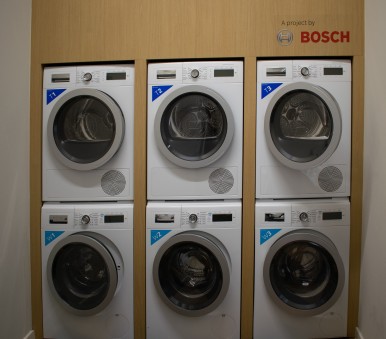
Brussels/Antwerp – Communal laundry areas in apartment buildings, student accommodations, vacation houses or campgrounds are on the rise. Due to the housing shortage in large cities, rising real estate prices and a growing interest in the sharing economy, more and more people are looking for new ways to do their laundry sustainable and cheaply. WeWash makes washing and drying sustainable, digital and user-friendly, for both the property manager and the user.WeWash has been present in Belgium since March 2021 and responds to the trend of a sustainable sharing economy that is today conquering cities such as Brussels and Antwerp. “Sustainability is becoming increasingly important in new building and renovation projects. In the design of the communal laundry room as well, a conscious choice is being made for energy-efficient appliances and a solution that guarantees a smooth, convenient, and ecological use. WeWash is the perfect solution for this,” says Georges Van der Meulen, Managing director of BSH Home Appliances N.V. BSH Home Appliances N.V. supplies the energy-efficient and high-tech appliances for the laundry rooms. For BSH, this is a next step – after the Papillon project – in its pursuit for sustainable economic models. From Box to full-service Care The heart of the solution is the WeWash Box, a maintenance-free device for digital booking and billing for communal washing and drying. The WeWash Box is compatible with all commonly used washing machines and dryers, regardless of the make, model and age of the machine. There is no need for a Wi-Fi or LAN connection as the Box is supplied with its own data connection using an integrated SIM-card. The free WeWash app allows users to easily check the status of the machines, make a reservation and handle the payment. Payment is cashless and users pay-per-use. In addition to the WeWash Box, BSH Belgium also offers WeWash Care, a full-service solution that sets up the entire laundry room. In doing so, it leverages its modern, energy- and water-efficient Bosch appliances equipped with a WeWash Box. The exclusive WeWash Care machines are approved for commercial use, are highly user-friendly and have a short program duration. BSH takes care of the installation, service and maintenance of the machines. In addition, the laundry room is continuously monitored by the Network Operation Center (NOC). Defective machines are identified at an early stage and are immediately deactivated. They can no longer be reserved and the repair service is notified instantly. This prevents inconvenient user experiences. First projects in Belgium At the beginning of March 2021, WeWash set foot in Belgium. The first projects with WeWash Care have been launched in the vibrant city centers in Brussels and Antwerp. This is no coincidence as many students, singles and young families are living in these cities and the demand for modern, communal laundry rooms has been increasing. In Stadswaag in Antwerp, real estate company Quares also uses WeWash Care for the communal laundry room. “Quares is a real estate company fully committed to quality innovation and sustainability. For our latest development, the Stadswaag, a site with 32 apartments for young professionals, including co-working and community-building spaces, we opted for WeWash because of its sustainable, qualitative and innovative offer. Recent graduates do not have the financial means to make large investment in home appliances. Thanks to the app and the cashless payment, the devices are used smoothly. And because WeWash works with the most energy-efficient appliances, we as owner-manager can keep energy and water consumption within limits”, Siham Rahmuni, CEO of Quares says. In the beautifully renovated The Soap Factory , a housing project in the heart of Brussels, offering large rooms and an array of shared communal spaces, the communal laundry room is also equipped with a WeWash Care service. “We had several criteria for the laundry room in our co-housing and WeWash offered the perfect answer. The machines are high-quality and easy to use and no expensive installation was required to install the machines. In addition, the app ensures a proper organization of the use of the machines. Moreover, the app fits completely into the lifestyle of our tech-savvy young tenants. We only had positive feedback”, says Isaline Van den Abeele, Manager of The Soap Factory. Discussions are currently ongoing for further projects in Ghent, Liège and Brussels. “We are excited that WeWash is now available for customers in Belgium and I am personally thrilled about the positive market response that we got so far. New living concepts are on the rise across Europe and with our WeWash concept we offer a space-efficient, convenient and sustainable way of doing laundry without owning appliances.” Philip Laukart, Managing Director WeWash GmbH. About WeWash WeWash was founded in 2016 as part of the Bosch Group. A team of 20 people ensures that communal washing is attractive for everyone involved. As the market leader in Germany for digital booking and billing systems in communal laundry rooms, WeWash offers a digital solution with a comprehensive service concept. Thanks to a cashless billing and maintenance-free system, WeWash demonstrably and sustainably reduces expenses. With over 63.000 users, WeWash currently has over 3.000 installations in Europe. WeWash is already working successfully with many providers of student accommodations, serviced apartments, micro-apartments, property managers and the private and social housing sector. More information: we-wash. be

CES 2018: Bosch sees future in smart-city business

09.01.2018

Press release

Internet of Things

CES 2018: Bosch sees future in smart-city business

Las Vegas, NV – Urban populations are growing: according to the United Nations, roughly two-thirds of the global population will live in conurbations by 2050. In 2014, this figure was just one-half. Urbanization is increasing, and with it the challenges cities have to solve. Even today, therefore, there is a considerable need for smart solutions. Speaking at CES in Las Vegas, the Bosch management board member Stefan Hartung said: “We need a new conception of the city. One key factor here is technologies that make cities smart and worth living in. In the long run, cities without intelligence will not survive, but succumb to gridlock.” Bosch is working to equip cities and neighborhoods for the future, offering smart mobility, better air quality, more convenience, greater security, and many new services. In short, the aim is significantly better quality of life in cities and neighborhoods. “When it comes to smart cities, few other companies can match Bosch’s comprehensive portfolio, cross-domain knowledge, and outstanding expertise in sensors, software, and services – and all this from a single source,” Hartung said. From January 9 to 12, the supplier of technology and services will be presenting many new solutions that make cities smart at CES 2018, the world’s largest electronics show. These range from a new compact unit that measures and analyzes air quality in real time, to a system that digitally monitors river water levels and gives early warning of flood risks, to a completely automatic parking space service that makes drivers’ lives easier. For more business: the smart-city market is booming Some of the world’s major metropolises are already synonymous with the term “smart,” among them Barcelona, Seoul, and London. Across the globe, cities large and small are investing in smart-city technologies. According to a study on behalf of Bosch, the smart-city market will grow 19 percent each year between now and 2020, reaching a volume of 800 billion dollars (680 billion euros). Bosch believes this is a great business opportunity: “For a long time, the smart city was a vision. We’re helping make it reality. Bosch is in an excellent position to make the connected city a technological and commercial success,” Hartung said. The company is currently involved in 14 extensive smart-city projects in places such as San Francisco, Singapore, Tianjin, Berlin, and Stuttgart. Others are planned to follow. Within the past two years, the company has doubled its sales from cross-domain projects to nearly one billion euros, and this figure is set to rise further. In the Bay Area city of San Leandro, for example, the company has equipped roughly 5,000 streetlights with LEDs and supplied a system for remote management of the city’s street lighting. In this way, the lights are only switched on when they are actually needed. With this solution, San Leandro will be able to save roughly 8 million dollars over the next 15 years. At the Bosch CES press conference, Mike Mansuetti, the president of Bosch North America, said: “Whether cities are big or small, our smart solutions will help them save energy, and money too.” In the case of San Leandro and its 100,000 inhabitants, sensors can be used to measure and analyze air quality, and cameras can automatically re-route traffic in the event of congestion. For more connectivity: IoT and artificial intelligence The internet of things (IoT) has laid one of the main foundations for the connected city. The IoT is finding its way into all walks of life: a Gartner study predicts that some 230 million homes worldwide – roughly 15 percent of all homes – will be intelligently connected by 2020. Here as well, the potential is huge, with market volume estimated to reach 250 billion dollars annually by 2020. By the same year, more than 20 billion devices worldwide will be connected with each other – smoke detectors, burglar alarms, electricity meters, home appliances, and many more. “Bosch recognized this potential early on,” Hartung said. “Even now, more than half our electronic product classes are web-enabled – and the aim is for this to be 100 percent by 2020. Not only that: for each of our products, we want to offer accompanying services.” Another driver of the rapid development of smart cities is artificial intelligence (AI). Bosch intends to further expand its research in this field. Last year, the company opened a research center for artificial intelligence, which now employs some 100 associates in Renningen, Germany, Palo Alto, CA, and Bengaluru, India. By 2021, Bosch will invest some 300 million euros in expanding the center. The company anticipates that, ten years from now, scarcely any product will be conceivable without AI. For better air quality: Climo creates basis for targeted action Air quality is one of the greatest challenges cities face. Thanks to smart technologies, cities can take faster and more targeted action to improve it. However, this depends on accurate measurements. At CES 2018, Bosch is presenting a new solution that it developed together with Intel – the Climo microclimate monitoring system. Climo measures and analyzes 12 parameters that are important for air quality, including carbon dioxide, nitrogen oxide, temperature, and relative humidity. The appliance is one-hundredth the size of conventional systems – and one-tenth the cost. Climo won a CES Honoree Innovation Award in the “smart cities” category. For early warning: digital monitoring of rivers In many regions, climate change is resulting in unpredictable weather. Researchers expect that heavier rainfall will result in more frequent flash flooding. Up to now, mechanical devices have been used to measure river water levels. Hours may pass before these measurements become available for others. However, the flood monitoring system changes all this. In real time, it monitors the water level in rivers and other bodies of water close to cities, and warns of an impending flood. In a pilot project, Bosch is testing the new system on the Neckar river near Ludwigsburg, Germany. Ultrasonic sensor probes and cameras track changes in water level, speed, and throughput. The data is sent to the Bosch IoT Cloud for processing. Should critical thresholds be exceeded, the affected municipalities, residents, and business owners are alerted well in advance by text message. This gives them enough time to take precautions against flooding and flood-related damage. Among those interested in the solution are a number of Indian and South American municipalities that frequently have to combat flooding. For more time: connected parking Urban traffic will increase by roughly one-third by 2050. Bosch is working to make tomorrow’s mobility free of accidents, stress, and emissions. At CES 2018, the company is presenting many solutions that lead toward this goal. Urban traffic plays a role in roughly half the smart-city projects Bosch is involved in. Parking is a particular focal point. U.S. drivers now spend more than 40 hours a year stuck in congestion, wasting some 160 billion dollars in the process. Of this time, roughly one-third is wasted on the search for parking alone. This is where Bosch can help: with its community-based parking, the company simplifies the search for a suitable space. As they drive by, cars automatically recognize and measure the size of the gaps between parked cars, transmitting the data in real time to a digital map. In this way, drivers can have themselves guided directly to free parking spaces. Bosch is already testing this service in German cities, including Stuttgart. This year, as many as 20 U.S. cities will follow, including Los Angeles, Miami, and Boston. In early 2018, moreover, Bosch and Daimler will be launching a new automated valet parking service. Cars in the Mercedes-Benz Museum parking garage in Stuttgart will look for a parking space and park themselves, without a driver. This cuts out stress, and makes more efficient use of parking lots – the same amount of space can accommodate up to 20 percent more vehicles. One factor making fully automated parking a reality is smart parking-garage infrastructure, which connects with the vehicle’s on-board software. Bosch recently won a Frost & Sullivan’s 2017 Technology Innovation Award for this driverless parking solution. For energy and cost savings: Bosch DC microgrids According to the International Panel on Climate Change (IPCC), cities account for roughly 75 percent of total global energy consumption. Forty percent of this is attributable to buildings alone. And the BP Energy Outlook 2035 estimates that global energy consumption will rise 30 percent by 2035. Bosch has many smart energy management solutions that can reduce power consumption. One of these is the Bosch DC (direct current) microgrid, which can be used to supply power to large buildings or building complexes. Since microgrids are generally fed by renewable sources, they are especially eco-friendly. DC microgrids consume up to 10 percent less energy than conventional power plants. Another major advantage is their self-sufficiency, which makes them a reliable source of power when a weather- or security-related outage affects the broader grid. Bosch at CES 2018: PRESS CONFERENCE: In Ballrooms B, C, and D, Mandalay Bay Hotel, Las Vegas South Convention Center, Level 2 , from 8:00 to 8:45 a.m. local time on Monday, Jan 8. BOOTH: Tuesday to Friday, Jan 9–12 , in the Central Hall, booth #14028 FOLLOW the Bosch CES 2018 highlights on Twitter: #BoschCES PANELS WITH BOSCH EXPERTS: PANELS WITH BOSCH EXPERTS: Tuesday, January 9, 1:30 – 3:15 p.m. (local time) “Connect2Car: Next-Gen Automobility” session with Kay Stepper, Vice President of Bosch in North America, head of driver assistance and automated driving, Las Vegas, Convention Center, North Hall, N256 Wednesday, Jan 10, 1:45–2:30 p.m. (local time) “Connected Vehicles in Connected Ecosystems” session with Mike Mansuetti, President Bosch North America, Smart Cities Conference, Westgate. Thursday, Jan 11, 11:30 a.m to 12:30 p.m. (local time) “The Future of Robots at Work and Home” session with Phil Roan, Senior Engineer Robotics, BSH Hausgeräte GmbH, Las Vegas Convention Center, North Hall, N258