Search & find:
media, releases and events to support your reporting about the Bosch Group.

Camera-based life-saver: Bosch helps cars keep an eye on their passengers

10.01.2020

Press release

Connected mobility

Camera-based life-saver: Bosch helps cars keep an eye on their passengers

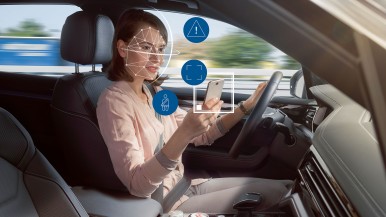
Stuttgart, Germany – Microsleep, distraction, a seatbelt left undone – many things that happen inside a vehicle can have far-reaching consequences. To avert critical driving situations and possibly also accidents, it is planned that cars will in the future use their sensors not simply to monitor the road but also the driver and other passengers. For this purpose, Bosch has developed a new interior monitoring system featuring cameras and artificial intelligence (AI). “If the car knows what its driver and occupants are doing, driving will become safer and more convenient,” says Harald Kroeger, a member of the Robert Bosch GmbH board of management. The Bosch system may go into production in 2022. In that year, the EU will make safety technology that for example warns drivers of drowsiness and distraction a standard feature in new vehicles. The EU Commission expects that, by 2038, their new safety requirements for vehicles will save more than 25,000 lives and help prevent at least 140,000 severe injuries. By keeping an eye on what is happening inside the car, it is hoped that a fundamental problem of self-driving cars will be solved. If responsibility for driving is to be transferred to the driver again following an automated drive on the freeway, say, the car needs to be sure that the driver is neither sleeping, nor reading the newspaper, nor writing e-mails on their smartphone.A smart camera constantly monitors the driver At 50 kph, a vehicle will cover 42 meters completely unsupervised if the driver dozes off or looks at their smartphone for just three seconds. Many people underestimate the associated risk. International studies state that nearly one in ten accidents are caused by distraction or drowsiness. This has prompted Bosch to develop an interior monitoring system that detects and alerts to this danger and provides driving assistance. A camera integrated in the steering wheel detects when drivers’ eyelids are getting heavy, when they are distracted, and when they turn their head toward their passenger or the rear seats. Thanks to AI, the system draws the right conclusions from this information: it warns inattentive drivers, recommends a break if they are getting tired, or even reduces the speed of the vehicles – depending on the automaker’s wishes, and also on legal requirements. “Cameras and AI will turn the vehicle into a life-saver,” Kroeger says. To achieve this, Bosch engineers have used intelligent image-processing algorithms and machine learning to teach the system to understand what the person in the driving seat is actually doing. To take the example of driver drowsiness, the system is trained using recordings of real driving situations and, on the basis of recordings of eyelid position and eye-blink rate, learns how tired the driver really is. This allows it to give an alert that is appropriate to the situation, and to use the driver assistance systems to intervene. Warning systems that sound the alert in the case of distraction and drowsiness will be so important in the future that NCAP, the European New Car Assessment Program, will include them in the roadmap for the Euro NCAP assessment for vehicle safety by 2025. On the subject of monitoring, only the software in the vehicle itself evaluates the information provided by the interior monitoring system – the information is neither saved nor passed on to third parties. Like a relay race: responsibility for steering passes from car to driver and back At the latest when cars start driving automatically, it is obvious how important it is that they understand their drivers. Once driving is automated, cars will drive along freeways without driver intervention. However, they will also have to be able to hand back control to their drivers in tricky situations such as construction zones, or when the exit ramp is drawing near. Drivers have to be able to safely take the wheel again at any time during the automated driving phase, and the camera makes sure they don’t fall asleep. If their eyes remain closed for a prolonged period, an alarm is sounded. The system also interprets camera recordings to establish what drivers are currently doing, and how ready they are to respond. The transfer of driving responsibility is then timed accordingly. “Bosch driver observation will be essential for safe automated driving,” Kroeger says. When the car keeps its camera eyes open But the new Bosch system keeps its eye not only on the driver, but also on all the other passengers, whether next to or behind the driver. For this purpose, a camera mounted above or below the rear-view mirror monitors the entire passenger compartment. It notices whether children on the rear seats have carelessly unfastened their seat belts, and warns the driver. If someone sitting in the back is leaning too far forward, at an angle, or with their feet up on the seat next to them, the airbags and belt tensioner will not be able to protect them properly in an accident. The interior monitoring camera can tell what position they are sitting in and set the airbags and belt tensioner to ensure the best possible protection. The interior monitoring system also prevents the passenger-seat airbag from being deployed if a baby’s carrycot is on the seat. On the subject of children, it is a sad fact that parked vehicles can be a death trap for them. In the United States in 2018, they claimed the lives of more than 50 children (source: KidsAndCars.org), either because they had been left in the car for a short while or had clambered in unnoticed. The new Bosch system can recognizes this danger, and warn parents in a flash by sending a message to their smartphone. In an emergency, it also can alert the emergency services. As the Hot Cars Act currently being debated in the United States shows, legislators are interested in technology solutions to address this challenge. A camera for more convenience The new Bosch system also means more driving convenience. The interior monitoring camera can tell who is about to drive and adjust the rear-view mirror, seating position, steering-wheel height, and infotainment system to preset personal preferences. And the camera can also be used for eye- and handgesture control of the infotainment system. Bosch at CES 2020: • PRESS CONFERENCE: In Ballrooms B, C, and D, Mandalay Bay Hotel, Las Vegas South Convention Center, Level 2, from 9:00 to 10:30 a.m. local time on Monday, January 6, 2020 . • BOOTH: Tuesday to Friday, January 7–10, 2020 , in the Central Hall, booth #12401 • FOLLOW the Bosch CES 2020 highlights on Twitter: #BoschCES • PANELS WITH BOSCH EXPERTS: Wednesday, January 8, 2020, 10:15 to 11:15 (local time) Event on the subject of “Growth of Apprenticeships for ‘New Collar’ Jobs” with Charlie Ackerman, Senior Vice President of Human Resources, Las Vegas, South Convention Center

Bosch is showcasing the following highlights at Bosch ConnectedWorld in Berlin

26.02.2018

Press release

Internet of Things

Bosch is showcasing the following highlights at Bosch ConnectedWorld in Berlin

Berlin and Stuttgart, Germany – An intelligent glove in the factory, a digital guardian angel for people on the go, and connected kitchens: Bosch is showcasing these and other solutions at Bosch ConnectedWorld in Berlin, where the IoT sector meets to discuss tomorrow’s world. Innovative products and services are making everyday life not only more convenient, but also safer and more efficient – at home, at work, and on the move.Products and solutions for all aspects of connected manufacturing ActiveAssist – the assembly assistant: The assembly assistance system guides users step by step through each individual stage in the manufacturing process. It identifies the next workpiece using RFID (radio frequency identification) and provides information about the required processing steps. For instance, the system uses light signals to mark those grab containers that hold the screws or other parts required to complete the next step. A 3D camera tracks the user’s movements. All in all, the system makes it possible to correct errors and prevents the wrong parts from being used. The benefits are a reduction in user strain and an increase in product quality. Intelligent glove: The iGlove features highly sensitive sensors and is designed for use in connected manufacturing. It maps hand movements and can greatly reduce workforce training times. Furthermore, it helps users learn the correct assembly steps and can document production steps such as the removal of parts. Without any need for physical contact, the data is sent via Bluetooth to a computer or smartphone, where it is compared to previously stored movement patterns. ActiveCockpit – the manufacturing assistant: A gigantic screen informs associates in the factory about the current status of production. The benefits are faster information processing, clear analysis, and subsequent definition of tasks for more efficient processes. As a result, manufacturing becomes transparent. Users and companies benefit thanks to the immediate identification of problems, such as screws that are slightly too small or too large. This reduces downtimes, increases the level of product quality, and avoids any recall costs. Connected solutions and products for better living: Vivatar app – a digital guardian angel: Going jogging in the dark or heading home on foot after the last bus has left is enough to make anyone feel uneasy. This is where the Bosch Vivatar app comes in; it acts as a digital guardian angel for people on the go. It enables users to contact friends and family and be digitally “escorted” home via GPS, and decide for themselves when they should be accompanied and by whom. Vivatar Premium grants users 24/7 access to the Bosch Emergency Assistant, a professionally trained emergency team. Climo – a small box for better air quality: It’s the size of a shoebox and measures air quality in real time. Developed by Bosch in collaboration with Intel, Climo is a hundredth of the size and a tenth of the cost of conventional systems. It measures and analyzes a total of 12 parameters, including temperature and humidity as well as carbon dioxide, nitrogen oxide, and even pollen count. Using the information gathered, cities can swiftly take action to improve air quality. They can also use it to help with traffic management, for instance. And by using the app, people suffering from asthma or allergies can find out if they should stay indoors or avoid certain areas of the city. Home Connect – a platform for the connected kitchen: The platform for the connected kitchen from Bosch subsidiary BSH is called Home Connect. No matter where users are, they can use devices such as smartphones to control and monitor Bosch household appliances and those of other manufacturers. With some 30 partners around the world, Home Connect already has the largest digital ecosystem in the connected kitchen, and the company is continuously entering into new partnerships and adding helpful functions and services. At the end of last year, BSH acquired a 65 percent stake in Berlin-based start-up Kitchen Stories. The plan now is to integrate the cooking app into Home Connect. Voice control is also among the services provided. In this way, Bosch products can be controlled by the likes of Amazon Alexa (Germany), Google Home (UK), or Ding Dong (China). Predictive maintenance – remote diagnostics for elevators: Bosch has already spent over 30 years working on emergency call systems in order to quickly free people trapped in broken-down elevators. Now the company is going a step further by preventing elevators from failing in the first place. The key is predictive maintenance. Connected sensors and cameras are integrated into the elevator system and wirelessly notify the service team when a breakdown is imminent. Maintenance and repair work can thus be carried out before the elevator stops working. Connected building platform – a smart building solution: The sensor- and cloud-based solution analyzes data from a building, for instance regarding occupancy or air quality. In this way, the platform provides a solid foundation for efficient building management. Windows and doors open and close as required, which reduces energy consumption. The platform also provides information about room use and whether workspaces are occupied. In offices that offer flexible workspaces, for example, this allows people to quickly find the nearest free desk, lights can be efficiently controlled, and cleaning services can be utilized to maximum effect. Knowing where people and equipment are helps optimize building processes, for instance in commercial buildings or hospitals. The solution is based on the Bosch IoT Suite, the company’s own IoT software platform.

Bosch acquires U.S. carpooling start-up SPLT

26.02.2018

Press release

Automated mobility

Bosch acquires U.S. carpooling start-up SPLT

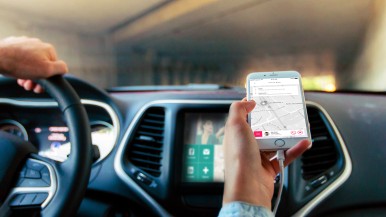
Berlin and Stuttgart, Germany – Bosch is entering the ridesharing business. The supplier of technology and services has acquired Splitting Fares Inc. (SPLT), a U.S. start-up based in Detroit. SPLT operates a platform that allows companies, universities, and municipal authorities to offer their workforces ridesharing services. The B2B approach is designed especially for commuters. SPLT uses an app to connect people who share the same route to their place of work or study. An algorithm finds the best composition for the ride-share, and computes the fastest route. The aim is to reduce congestion and make the daily commute more relaxed. SPLT was founded in 2015. Some 140,000 users in the United States, Mexico, and Germany currently take advantage of the service. It has been agreed that the purchase price will not be disclosed. “With SPLT, we are extending our portfolio in the growth area of mobility services,” said Dr. Markus Heyn, member of the Bosch board of management. With connected mobility services, Bosch aims for growth well into double digits.“Increasingly, smartphones are becoming the most important means of travel,” Heyn added. Connecting road users and modes of transportation is making flexible, multimodal mobility possible: in a matter of seconds, everyone can decide how they want to travel, and make the necessary bookings. “With this sustainable and affordable mobility service, we want to fundamentally change the way people get from A to B,” said Anya Babbitt, the co-founder and CEO of SPLT.Increasing numbers of commuters Ridesharing, in which digital services and apps are used to form carpools and to organize vehicle sharing and taxis, is a growth market in the connected mobility sector. By 2020, the number of people worldwide using rideshares is expected to rise 60 percent to 685 million (source: Statista). Up to now, the services available have usually directly targeted people who happen to be traveling in the same direction, and who want to book a ride on the spur of the moment. They have not focused so much on companies and commuters. But it is precisely here that there is huge potential. According to the German Federal Motor Transport Authority, there are more than 45 million cars on Germany’s roads alone. And the number of commuters is rising: according to the German Federal Institute for Research on Building, Urban Affairs, and Spatial Development, three out of five workers do not work in their home cities. And for roughly two-thirds of the working population, the car is the first choice of transport for the daily commute, according to the German Federal Statistical Office. Worldwide, the result is the same: rush-hour traffic is frequently gridlocked. Millions of commuters find themselves stuck in traffic every day. A further problem is that drivers usually sit alone in their cars. Carpooling is still the exception. This is where SPLT’s solution comes in. Commuting without stress, at low cost, and with little environmental impact SPLT is about sharing – and it couldn’t be simpler to use. Companies, universities, or municipal authorities enable access to the SPLT platform for their employees, who then download the SPLT app, register, and look for or offer a rideshare. Bookings can be made on the spur of the moment or in advance. Arrival times are displayed in real time, and costs are shared among colleagues and charged online. The B2B service is intended for users who travel the same route each day. One advantage of this is that rides are shared by colleagues, which means users never have to get in the car with complete strangers. As a side benefit, such rideshares encourage communication and offer a chance to network. Company buses can also be integrated into the app, and in this way be used more flexibly and efficiently. The result is a journey to work and back without stress, at low cost, and with little environmental impact. Companies can also play a role in reducing traffic volume. In the years ahead, the number of SPLT users is expected to rise many times over – with new regions also being included. Within Bosch itself, associates in Mexico are already using the app, and it is planned to extend its use to the entire company. “We believe we have a good chance of global growth together with Bosch,” Babbitt said. SPLT will remain an independent entity within the Bosch Group and be run as a wholly owned subsidiary. 4,000 participants, 70 exhibitors, and 140 speakers Bosch’s IoT activities are broadly diversified, encompassing solutions for connected mobility, connected manufacturing, as well as for connected energy systems and buildings. At the Bosch ConnectedWorld forum for the IoT industry in Berlin, more than 70 exhibitors will demonstrate what is already possible with the internet of things, and how it will improve people’s everyday lives in the future. On a 10,000 square-meter exhibition space at “Station” in Berlin, some 4,000 delegates will meet from February 21 to 22. In addition to the Bosch CEO Dr. Volkmar Denner, the roughly 140 speakers will include Dr. Dieter Zetsche (CEO Daimler), Dr. Frank Appel (CEO Deutsche Post DHL), and Johann Jungwirth (CDO Volkswagen). At a hackathon, some 700 programmers, start-up associates, and designers will develop new ideas for connected mobility services, automated driving, connected manufacturing and logistics, and connected living. The 2018 Bosch ConnectedWorld will be the fifth event of its kind. It is one of the world’s largest conferences on the internet of things.