#Connected Devices and Solutions

CES 2022: For better quality of life and more climate action – connected and sma ...

27.01.2022

Press release

Connected Devices and Solutions

CES 2022: For better quality of life and more climate action – connected and sma ...

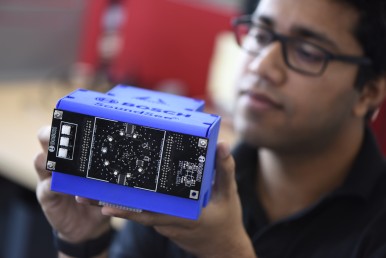
Las Vegas – At home, on the road, at work, in the hospital, or even in orbit: Bosch is improving the everyday lives of people from all walks of life with smart and connected solutions. At the same time, the company is tapping into new areas of business through software, services, and licenses. “We are systematically digitalizing our core business to increase the benefits for our customers. Going forward, we aim turn the sale of every digital product into services-based revenue as well,” says Tanja Rückert, the Bosch Group’s chief digital officer, at CES in Las Vegas. To achieve this goal, Bosch is focusing on the connection of IoT with AI – in other words, it is linking the internet of things (IoT) with artificial intelligence (AI).This creates a virtuous circle in which connected products deliver information that, in turn, is processed by means of AI and incorporated into software updates for these products. At the core of this approach is the benefit for customers, since it allows users to be an integral part of the development process and enables solutions to be tailored precisely to their needs. Furthermore, neither development nor value creation ends with the sale of the products. “We see the combination of AI and IoT as holding the key to leveraging the most user benefit from both of these technologies,” Rückert says. “Besides enabling us to develop new business models, this approach helps us offer better products and solutions that deliver real added value for individuals and society as a whole.” Expanding software expertise: Bosch is already shaping the future today Bosch laid the foundation for this long ago. As of the new year, all electronics product classes will be connectable. Sales of connected power tools, household appliances, and heating systems alone have grown by 50 percent within one year – from four million units in 2020 to more than six million in 2021. With the Bosch Center for Artificial Intelligence (BCAI), the company has established a strong unit in the field of AI that has already contributed some 300 million euros to result. In addition, the company invests a total of more than four billion euros every year in its software expertise, around three billion of which goes to the mobility business. To shape the software-defined future of mobility, Bosch will also be pooling development activities for application-independent software in one unit as of mid-2022. In the future, under the umbrella of its subsidiary ETAS GmbH, the company will develop and sell basic vehicle software, middleware, cloud services, and development tools for universal application. Bosch is also rapidly advancing connected and automated driving. Over the past five years, Bosch has generated some nine billion euros in sales just with driver assistance systems and the associated sensors. Bosch Tech Compass: a survey conducted in five countries around the world The Bosch Tech Compass – a representative survey conducted in five countries and presented for the first time at CES – shows what people across the globe expect from new technologies. According to the survey, the majority of respondents (72 percent) are convinced that technological progress is making the world a better place, for instance as a key to fighting climate change (76 percent). At the same time, four out of five people think technology should be more focused on tackling the great challenges of our time rather than serving individual needs. “We at Bosch also believe that technology offers a broad range of benefits,” Rückert says. “When we talk about high-tech, we’re not talking only about pushing the envelope on what’s possible. We use technology as a means to improve people’s lives wherever they are.” From space to pediatric medicine: the Bosch SoundSee sensor system One example of the benefit of AI and connectivity is the SoundSee sensor system. Since late 2019, it has been traveling through space to identify unusual sounds on the ISS, using AI algorithms to analyze and indicate when maintenance is required. Now, in collaboration with the non-profit healthcare company Highmark in Pittsburgh (USA), Bosch is pursuing a completely down-to-earth application of this technology: investigating how audio AI can be used as a diagnostic tool in pediatric medicine. Specifically, Bosch and Highmark are working to adapt the sensors in a way that will enable them to detect pulmonary conditions such as asthma at an early stage just by listening to children’s breathing patterns. “Using innovative technology to improve children’s health – that’s exactly what we mean with high tech,” says Mike Mansuetti, president of Bosch in North America. SoundSee’s use in medicine also illustrates Bosch’s understanding of its “Invented for life” strategic imperative. Bosch’s new gas sensor – the first on the market to contain AI – serves to protect both humans and nature. Part of Dryad’s Silvanet Wildfire Sensor, it is essentially a digital nose that helps detect forest fires early on. Dryad’s sensors are attached to trees, where they continuously monitor the local microclimate to detect incipient fires – and to wirelessly notify the local authorities, long before camera- or satellite-based systems can. Not only can this protect against devastation by fire, it can also reduce global carbon emissions from forest fires. “These sensors are going to help save lives, homes, and tons of CO2 from entering the atmosphere – all thanks to AI and connectivity,” Mansuetti says. High-tech #LikeABosch: new campaign for smart solutions A new, lighthearted Bosch campaign shows the solutions the company has developed to improve the little things in people’s everyday lives. Called “High tech #LikeABosch – with many connected, intelligent, and sustainable solutions,” its protagonist takes viewers on a tour through her daily routine and uses several Bosch solutions, from smart glasses to a connected e-bike to a digital access pass for work. This makes her teenage son, who at the start of the clip said his mom was “old school,” look pretty out of touch.
AI code of ethics: Bosch sets company guidelines for the use of artificial intel ...

19.02.2020

Press release

Internet of Things

AI code of ethics: Bosch sets company guidelines for the use of artificial intel ...

Stuttgart and Berlin, Germany – Bosch has established ethical “red lines” for the use of artificial intelligence (AI). The company has now issued guidelines governing the use of AI in its intelligent products. Bosch’s AI code of ethics is based on the following maxim: Humans should be the ultimate arbiter of any AIbased decisions. “Artificial intelligence should serve people. Our AI code of ethics provides our associates with clear guidance regarding the development of intelligent products,” Bosch CEO Volkmar Denner said at the opening of Bosch ConnectedWorld (BCW), the company’s annual IoT conference in Berlin. “Our goal is that people should trust our AI-based products.” AI is a technology of vital importance for Bosch. By 2025, the aim is for all Bosch products to either contain AI or have been developed or manufactured with its help. The company wants its AI-based products to be safe, robust, and explainable. “If AI is a black box, then people won’t trust it. In a connected world, however, trust will be essential,” said Michael Bolle, the Bosch CDO and CTO. Bosch is aiming to produce AI-based products that are trustworthy. The code of ethics is based on Bosch’s “Invented for life” ethos, which combines a quest for innovation with a sense of social responsibility. Over the next two years, Bosch plans to train 20,000 of its associates in the use of AI. Bosch’s AI code of ethics governing the responsible use of this technology will be part of this training program.AI offers major potential Artificial intelligence is a global engine of progress and growth. The management consultants PwC, for example, project that between now and 2030, AI will boost GDP in China by 26 percent, by 14 percent in North America, and by around 10 percent in Europe. This technology can help overcome challenges such as the need for climate action and optimize outcomes in a host of areas such as transportation, medicine, and agriculture. By analyzing huge volumes of data, algorithms are able to reason and make decisions. Well in advance of the introduction of binding EU standards, Bosch has therefore taken the decision to actively engage with the ethical questions that the use of this technology raises. The moral foundation for this process is provided by the values enshrined in the Universal Declaration of Human Rights. Humans should retain control Bosch’s AI code of ethics stipulates that artificial intelligence should not make any decisions about humans without this process being subject to some form of human oversight. Instead, artificial intelligence should serve people as a tool. Three possible approaches are described. All have the following in common: in AI-based products developed by Bosch, humans should retain control over any decisions the technology makes. In the first approach (human-in-command), artificial intelligence is purely an aid – for example, in decision-supporting applications, where AI can help people classify items such as objects or organisms. In the second approach (human-in-the-loop), an intelligent system autonomously makes decisions that humans can, however, override at any time. Examples of this include partially automated driving, where the human driver can directly intervene in the decisions of, say, a parking assistance system. The third approach (human-on-the-loop) concerns intelligent technology such as emergency braking systems. Here, engineers define certain parameters during the development process. Here, there is no scope for human intervention in the decision-making process itself. The parameters provide the basis on which AI decides whether to activate the system or not. Engineers retrospectively test whether the system has remained within the defined parameters. If necessary, these parameters can be adjusted. Building trust together Bosch also hopes its AI code of ethics will contribute to public debate on artificial intelligence. “AI will change every aspect of our lives,” Denner said. “For this reason, such a debate is vital.” It will take more than just technical know-how to establish trust in intelligent systems – there is also a need for close dialogue among policymakers, the scientific community, and the general public. This is why Bosch has signed up to the High-Level Expert Group on Artificial Intelligence, a body appointed by the European Commission to examine issues such as the ethical dimension of AI. In a global network currently comprising seven locations, and in collaboration with the University of Amsterdam and Carnegie Mellon University (Pittsburgh, USA), Bosch is working to develop AI applications that are safer and more trustworthy. Similarly, as a founding member of the Cyber Valley research alliance in Baden-Württemberg, Bosch is investing 100 million euros in the construction of an AI campus, where 700 of its own experts will soon be working side by side with external researchers and startup associates. Last but not least, the Digital Trust Forum, a committee established by Bosch, aims to foster close dialogue among experts from leading international associations and organizations. Its 11 members are meeting up at Bosch ConnectedWorld 2020. “Our shared objective is to make the internet of things safe and trustworthy,” Bolle said. More than 170 speakers and 80 exhibitors Bosch ConnectedWorld (February 19–20, 2020) brings together more than 80 exhibitors showcasing the latest trends and developments in the connected world. Among the more than 170 speakers are Bosch CEO Volkmar Denner and Bosch CDO/CTO Michael Bolle, as well as Roland Busch (the deputy CEO of Siemens), Axel Stepken (the chairman of the board of management of TÜV Süd), and Scott Guthrie (executive vice president of Microsoft’s cloud and AI group). The event’s main features include keynote speeches, a major exhibition, and a hackathon. This year marks the seventh time Bosch ConnectedWorld has taken place. It is one of the world’s largest international conferences devoted to the internet of things. At a glance: The guidelines in Bosch’s AI code of ethics All Bosch AI products should reflect our “Invented for life” ethos, which combines a quest for innovation with a sense of social responsibility. AI decisions that affect people should not be made without a human arbiter. Instead, AI should be a tool for people. We want to develop safe, robust, and explainable AI products. Trust is one of our company’s fundamental values. We want to develop trustworthy AI products. When developing AI products, we observe legal requirements and orient to ethical principles.

Camera-based life-saver: Bosch helps cars keep an eye on their passengers

10.01.2020

Press release

Connected mobility

Camera-based life-saver: Bosch helps cars keep an eye on their passengers

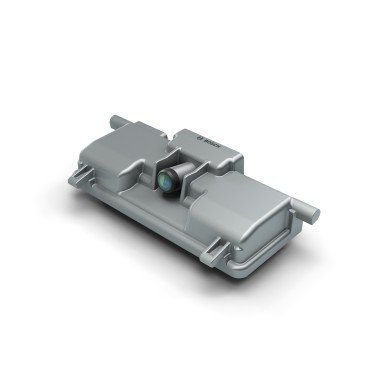
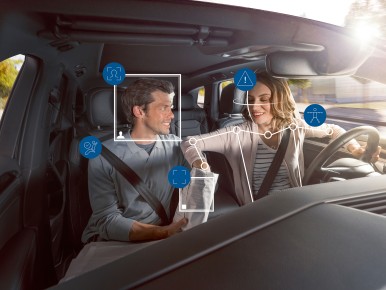
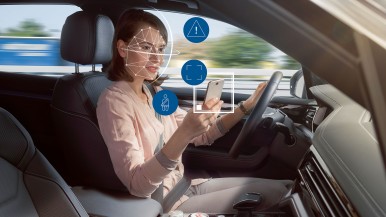
Stuttgart, Germany – Microsleep, distraction, a seatbelt left undone – many things that happen inside a vehicle can have far-reaching consequences. To avert critical driving situations and possibly also accidents, it is planned that cars will in the future use their sensors not simply to monitor the road but also the driver and other passengers. For this purpose, Bosch has developed a new interior monitoring system featuring cameras and artificial intelligence (AI). “If the car knows what its driver and occupants are doing, driving will become safer and more convenient,” says Harald Kroeger, a member of the Robert Bosch GmbH board of management. The Bosch system may go into production in 2022. In that year, the EU will make safety technology that for example warns drivers of drowsiness and distraction a standard feature in new vehicles. The EU Commission expects that, by 2038, their new safety requirements for vehicles will save more than 25,000 lives and help prevent at least 140,000 severe injuries. By keeping an eye on what is happening inside the car, it is hoped that a fundamental problem of self-driving cars will be solved. If responsibility for driving is to be transferred to the driver again following an automated drive on the freeway, say, the car needs to be sure that the driver is neither sleeping, nor reading the newspaper, nor writing e-mails on their smartphone.A smart camera constantly monitors the driver At 50 kph, a vehicle will cover 42 meters completely unsupervised if the driver dozes off or looks at their smartphone for just three seconds. Many people underestimate the associated risk. International studies state that nearly one in ten accidents are caused by distraction or drowsiness. This has prompted Bosch to develop an interior monitoring system that detects and alerts to this danger and provides driving assistance. A camera integrated in the steering wheel detects when drivers’ eyelids are getting heavy, when they are distracted, and when they turn their head toward their passenger or the rear seats. Thanks to AI, the system draws the right conclusions from this information: it warns inattentive drivers, recommends a break if they are getting tired, or even reduces the speed of the vehicles – depending on the automaker’s wishes, and also on legal requirements. “Cameras and AI will turn the vehicle into a life-saver,” Kroeger says. To achieve this, Bosch engineers have used intelligent image-processing algorithms and machine learning to teach the system to understand what the person in the driving seat is actually doing. To take the example of driver drowsiness, the system is trained using recordings of real driving situations and, on the basis of recordings of eyelid position and eye-blink rate, learns how tired the driver really is. This allows it to give an alert that is appropriate to the situation, and to use the driver assistance systems to intervene. Warning systems that sound the alert in the case of distraction and drowsiness will be so important in the future that NCAP, the European New Car Assessment Program, will include them in the roadmap for the Euro NCAP assessment for vehicle safety by 2025. On the subject of monitoring, only the software in the vehicle itself evaluates the information provided by the interior monitoring system – the information is neither saved nor passed on to third parties. Like a relay race: responsibility for steering passes from car to driver and back At the latest when cars start driving automatically, it is obvious how important it is that they understand their drivers. Once driving is automated, cars will drive along freeways without driver intervention. However, they will also have to be able to hand back control to their drivers in tricky situations such as construction zones, or when the exit ramp is drawing near. Drivers have to be able to safely take the wheel again at any time during the automated driving phase, and the camera makes sure they don’t fall asleep. If their eyes remain closed for a prolonged period, an alarm is sounded. The system also interprets camera recordings to establish what drivers are currently doing, and how ready they are to respond. The transfer of driving responsibility is then timed accordingly. “Bosch driver observation will be essential for safe automated driving,” Kroeger says. When the car keeps its camera eyes open But the new Bosch system keeps its eye not only on the driver, but also on all the other passengers, whether next to or behind the driver. For this purpose, a camera mounted above or below the rear-view mirror monitors the entire passenger compartment. It notices whether children on the rear seats have carelessly unfastened their seat belts, and warns the driver. If someone sitting in the back is leaning too far forward, at an angle, or with their feet up on the seat next to them, the airbags and belt tensioner will not be able to protect them properly in an accident. The interior monitoring camera can tell what position they are sitting in and set the airbags and belt tensioner to ensure the best possible protection. The interior monitoring system also prevents the passenger-seat airbag from being deployed if a baby’s carrycot is on the seat. On the subject of children, it is a sad fact that parked vehicles can be a death trap for them. In the United States in 2018, they claimed the lives of more than 50 children (source: KidsAndCars.org), either because they had been left in the car for a short while or had clambered in unnoticed. The new Bosch system can recognizes this danger, and warn parents in a flash by sending a message to their smartphone. In an emergency, it also can alert the emergency services. As the Hot Cars Act currently being debated in the United States shows, legislators are interested in technology solutions to address this challenge. A camera for more convenience The new Bosch system also means more driving convenience. The interior monitoring camera can tell who is about to drive and adjust the rear-view mirror, seating position, steering-wheel height, and infotainment system to preset personal preferences. And the camera can also be used for eye- and handgesture control of the infotainment system. Bosch at CES 2020: • PRESS CONFERENCE: In Ballrooms B, C, and D, Mandalay Bay Hotel, Las Vegas South Convention Center, Level 2, from 9:00 to 10:30 a.m. local time on Monday, January 6, 2020 . • BOOTH: Tuesday to Friday, January 7–10, 2020 , in the Central Hall, booth #12401 • FOLLOW the Bosch CES 2020 highlights on Twitter: #BoschCES • PANELS WITH BOSCH EXPERTS: Wednesday, January 8, 2020, 10:15 to 11:15 (local time) Event on the subject of “Growth of Apprenticeships for ‘New Collar’ Jobs” with Charlie Ackerman, Senior Vice President of Human Resources, Las Vegas, South Convention Center