#Research

Quantum technologies: Bosch aims to use sensors to take a leading position

05.10.2023

Press release

Research

Quantum technologies: Bosch aims to use sensors to take a leading position

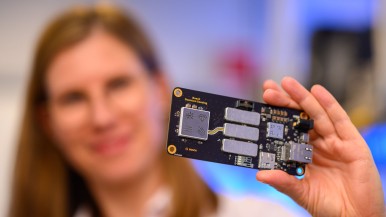
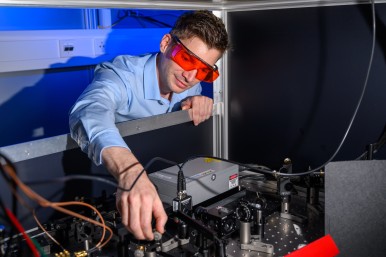
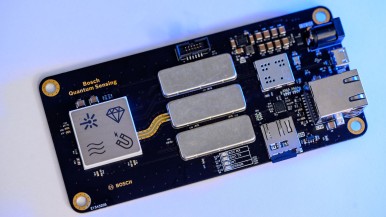
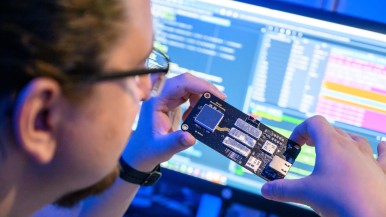
Stuttgart, Germany – Quantum technologies have great potential, but most of this potential is still a distant dream at present. Following ten years of research in this field, Bosch is now planning to work with the first pilot customers in the medical and mobility industries on specific applications over the next two years. At the startup Bosch Quantum Sensing, established at the beginning of 2022, some 30 associates are currently focusing on this. Bosch estimates the annual global market potential of applications for medicine and mobility will reach the mid-single-digit billions by the middle of the next decade. One potential area of application for quantum sensors, the brain-computer interface (BCI), will on its own be worth more than five billion dollars annually in the long term, according to the company’s calculations. One example of its future use is sensors that record nerve impulses in order to control artificial limbs and thus improve patients’ quality of life. “The quantum sensors we are creating in medical technology are a perfect fit for our ‘Invented for life’ ethos. By the end of the decade, we want to take a leading position with our technology,” says Dr. Stefan Hartung, chairman of the Bosch board of management.Small is beautiful: Bosch is a leader in miniaturization When it comes to size, the technology company is already a frontrunner: in terms of its measurement accuracy, the Bosch sensor prototype is the smallest currently available – about the size of a cell phone. Its compact design offers considerable advantages wherever space is at a premium – for example, in industrial applications, in vehicles, in aircraft, or even in hospital emergency rooms. The smaller the sensor, the greater the benefits: smaller sensors are portable, cheaper to produce, and more scalable as a result. “Our goal is to miniaturize quantum sensors to the point where they can be integrated onto a chip,” says Dr. Katrin Kobe, who is responsible for sensor commercialization at Bosch Quantum Sensing. This could lead the way to additional sensor applications. Quantum sensors as potential lifesavers In medicine, Bosch quantum sensors could help save lives in the future: by measuring the heart’s natural magnetic field and enabling simple measurements over a longer period of time, they can provide far more data than today’s electrocardiography (ECG). An ECG machine is applied directly to the skin by means of electrodes; if they slip, measurements are inaccurate. Moreover, in an emergency, attaching the ECG machine uses up precious time. Quantum sensors, by contrast, can be incorporated into things like items of clothing or mattresses. This not only speeds up diagnosis in the emergency room, but also makes monitoring at home easy and precise. The prospect of contactless early detection of atrial fibrillation – one of the causes of life-threatening strokes, heart failure, and dementia – is thus within reach for the first time. In other words, early diagnosis with the help of quantum sensors could, in the best case, lead to the prevention of fatal strokes. Ultra-precise navigation in the air, on the road, and on water In addition to medical technology, quantum sensors could also be used in mobility. One example is navigation. A global positioning system (GPS) is susceptible to interference, whereas quantum sensors are resistant to external influences, since they work by measuring the earth’s unchanging magnetic field. This paves the way for ultra-precise navigation in the air, on the road, and on water. There may also be scope for considerable additional benefits in electromobility. In the future, quantum sensors could be used there to precisely measure the magnetic field of the electric current and thus determine the exact charge level of the battery. The result would be more reliable determination of the remaining range, allowing trips to be planned better.


Carnegie Mellon University and Bosch further commitment to Carnegie Bosch Institute

24.02.2022

Press release

Research

Carnegie Mellon University and Bosch further commitment to Carnegie Bosch Institute

PITTSBURGH – For more than 30 years, the Carnegie Bosch Institute (CBI) has brought together industry and academia for research, education and collaboration in the areas of international management as well as technology innovation. Today, Bosch and Carnegie Mellon University (CMU) announced new leadership for the CBI as Christopher Martin, CMU alumnus and 21-year Bosch associate who currently serves as director of engineering, research and development for the Bosch Research and Technology Center in Pittsburgh, steps into the role of president of CBI. Additionally, the organizations announced a new $3 million gift from Bosch to CBI as the organization continues to stimulate relevant research in areas such as artificial intelligence (AI) and cybersecurity. The gift builds on the long-standing collaboration dating back to 1990 when the CBI was established. “The Carnegie Bosch Institute showcases how Bosch Research places a priority on collaboration with academia to pursue research that helps to accelerate technological development,” said Thomas Kropf, president, Bosch Research and Advance Engineering. “Under the leadership of Chris, we will continue to explore the intersection of shared interest with CMU that enables technological advancement in these areas.” Since 2019, CBI has funded 12 CMU research projects in fields such as AI, cybersecurity and sustainability. Examples include crowd-centric computing and interaction; connected and intelligent systems and services; disruptive materials and sustainable manufacturing; and ethics and AI. Most recently in 2021, CBI focused its awards on the topic of research at the intersection of modern data-driven AI and classical scientific or engineering approaches. “Through the Carnegie Bosch Institute as well as other collaborations, CMU and Bosch have been able to explore many research areas that have provided benefit to both organizations as well as to academia and business at-large,” said William Sanders, dean of the College of Engineering at Carnegie Mellon University. Beyond the scope of CBI, Bosch Research and Carnegie Mellon University have collaborated in areas like AI and spatial computing . In 2018, Zico Kolter, associate professor in the Computer Science Department with the School of Computer Science, joined Bosch as the chief scientist for AI which coincided with the launch of the Bosch Center for Artificial Intelligence (BCAI) Research Lab in Pittsburgh. In 2021, Anthony Rowe, Siewiorek and Walker Family Professor in CMU’s Electrical and Computer Engineering Department, joined Bosch as chief scientist focused on spatial computing . “This latest round of investment in CBI not only deepens the relationship with Bosch and CMU, it enhances our ability to support the incredible faculty, students, and staff that are the heart of the university’s excellence,” Martin said. “We look forward to enabling more cutting-edge research in areas of shared interest, and seeing the positive impact from that work on the world.” In addition to his role with CBI, Martin will continue to manage the Bosch Research and Technology Center (RTC) in Pittsburgh. As the leader for Bosch’s presence in Pittsburgh, he also guides operations for the Bosch Center for Artificial Intelligence in Pittsburgh. Martin holds undergraduate and graduate degrees from Carnegie Mellon University's Department of Electrical and Computer Engineering and has been responsible for global research teams in the U.S. and Europe during his time at Bosch. He holds multiple patents and continues to act as an Expert in Information and Communication Technology (ICT) for the European Commission. Martin also actively serves in the Pittsburgh community to champion the non-profit community, especially organizations related to STEM education. He is a member of the Board of Directors of the Allegheny Conference, Carnegie Science Center and the Pittsburgh German American Chamber of Commerce and serves on the Advisory Board for the Department of Electrical and Computer Engineering and the Manufacturing Futures Institute at CMU. Preceding Martin in the role of president of the CBI was Sylvia B. Vogt, who retired at the end of January 2022. In her time leading CBI from 2009 until the end of 2021, Vogt oversaw a shift at the organization from an emphasis on international management to a more research-oriented focus in technology fields relevant to international business. She continues to serve as an adjunct professor of management at Carnegie Mellon.