Search and find:
Photos, videos, releases, events to support your reporting about the Bosch Group

Connect favorite devices for an enhanced eBike riding experience

15.05.2026

Press release

Business/economy

Connect favorite devices for an enhanced eBike riding experience

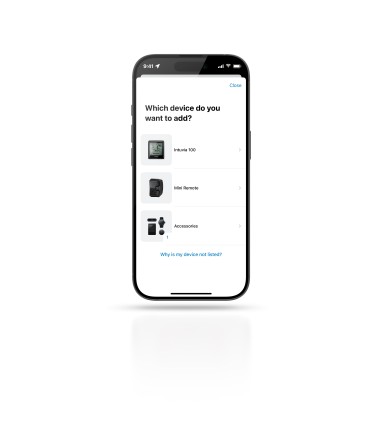
Stuttgart/Reutlingen – Want to check your current speed, ride in your ideal training zone with precise performance values, navigate with confidence or just keep an eye on your eBike battery level? With Bosch Live Data Interface, eBike riders can personalize their riding experience even more: It allows riders to connect their own GPS bike computers, or in the future, fitness watches, smart glasses and helmets to the eBike. With this new functionality, eBikes equipped with the Bosch smart system can connect directly with select Garmin Edge cycling computers to bring ride data together in real time. Bosch collaborates with Garmin as the first company to integrate this functionality, and the Live Data Interface presents an opportunity for further integrations with third-party products and apps. “Ambitious eBikers ride with a highly personalized setup. The eBike should adapt seamlessly to their preferences. That is why we are making our system accessible to third-party companies. We are taking the first step with Garmin and are excited to provide riders with relevant live data from their eBike directly on their Edge cycling computer,” says Claus Fleischer, CEO of Bosch eBike Systems. Live Data Interface: more options for displaying ride data Until now, eBike riders had two ways to display live ride data from the smart system: through Bosch displays or using a smartphone with the Bosch eBike Flow app. With Live Data Interface, the smart system now makes live ride data available for third-party devices and apps via Bluetooth Low Energy (BLE). Whether on a trail, completing a trekking tour, or on their daily ride through the city, eBike riders can now show their ride data on compatible third-party devices. Available information includes performance-related values like speed, total distance, and cadence, as well as important system data like battery charge level percentage, remaining range, and the status of the theft protection feature eBike Lock. This makes the eBike an even bigger part of each rider’s personal digital ecosystem. Next Level Training: Bosch smart system eBikes and Garmin Edge cycling computers Riders will be able to connect compatible Garmin Edge cycling computers* to the Bosch smart system, bringing all their ride data together on the Edge display. At launch, this includes the Garmin Edge 550/850/1050 and Edge 540/840/1040 – advanced GPS bike computers loaded with performance features – and the rugged Garmin Edge MTB, purposefully built for mountain bikers and those long days on the trail. The integration is available now in the Garmin Public Beta program. “We are excited to be the first brand to collaborate with Bosch on their innovative Live Data integration. Garmin proudly makes cycling computers for riders of all abilities and by displaying important information like rider power and battery status in real time right on their Edge display, we believe our eBike customers will get even more from their adventures,” says Susan Lyman, Garmin Vice President of Consumer Sales and Marketing. eBike riders can use the live data integration to manage effort and train more efficiently. With the live data integration, the rider’s power output – measured by the smart system – can be shown directly on the Garmin Edge without the need to install a separate power meter on the eBike. Combining this functionality with other metrics like cadence and speed means riders can optimize their training for targeted performance zones. Other important eBike data is also communicated to the Garmin Edge cycling computer, enhancing the experience for all types of riding. Riders will see real-time battery levels, and the Garmin Edge eBike Smart Range feature will display estimated remaining distance directly based on their planned course. Full control: Data protection is a top priority Protecting privacy is a top priority for Bosch eBike Systems. eBike riders can decide for themselves at any time whether and which device or app they want to connect to their eBike. This allows them to retain full control over their data. *Coming soon to compatible Edge devices and available now in the Garmin Public Beta program. Not all Garmin devices are supported. A detailed overview of compatibility is available in the Bosch eBike Systems Help Center.

More power when it counts: intelligent performance upgrade 2.0 for dynamic eBike ...

15.05.2026

Press release

Business/economy

More power when it counts: intelligent performance upgrade 2.0 for dynamic eBike ...

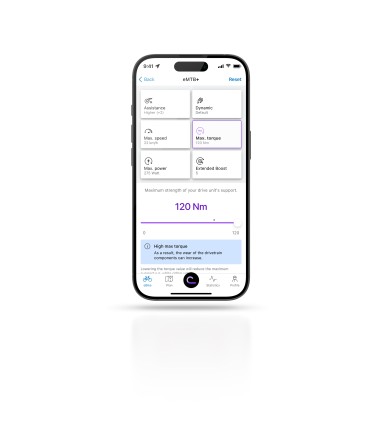
Stuttgart/Reutlingen – Master even the steepest ascents with ease, ride technical uphills with full control, and overcome challenging trail sections: From May 2026, Bosch eBike Systems is offering ambitious riders the free performance upgrade 2.0 for the Performance Line CX and Performance Line CX-R, which consistently expands the dynamic ecosystem. The eBike Flow app can be used to increase the maximum torque and maximum support – the intelligent riding software recognizes technically challenging situations and automatically delivers full power precisely when it is needed. Together with the now customizable Extended Boost, the Drivetrain Tensioner, the new Trick Check feature, and the 12A Charger, which will be available from the end of 2026, the result is an enhanced overall package for performance riders. “eMTB riding means constantly challenging yourself on the trail – and mastering new situations. This requires not only more power, but also intelligent power delivery at crucial moments. This is exactly what drives us in the further development of our dynamic ecosystem. We want every update to feel noticeably better on the trail – not just on the data sheet,“ says Claus Fleischer, CEO of Bosch eBike Systems. Performance upgrade 2.0: situation-specific peak power for key technical sections With the performance upgrade 2.0, the smart system from Bosch provides even more torque and support for powerful riding on steep trails, when negotiating high steps, or when cranking through tight curves. Using the eBike Flow app, performance riders can increase the torque of the Performance Line CX and the Performance Line CX-R to up to 120 Nm in any riding mode, with the maximum setting value being defined by the respective bicycle manufacturer. Starting from the basic setting of 85 Nm, there is a wide adjustment range for personalized tuning. In addition, the maximum support can be increased: Up to a speed of 15 kph, up to 600% support is now provided in certain riding situations.1 What this means on the trail: The long section of exposed roots, the challenging exit from the hairpin curves, the sudden steep section after crossing a stream – it is precisely in these key areas that the intelligent riding software delivers full power – tailored to the specific situation and precisely regulated. This requires dynamic rider power on the pedals: For riders who provide more input in the short term, the system delivers the decisive power boost and rewards them with a new sense of achievement. Immediately afterward, the system adjusts back to an efficient level. This intelligent, short-term power peak reduces material wear, particularly on the chain, cassette, and freewheel, and maximizes the range. Riders decide for themselves whether and to what extent they want to use this short-term peak support via the eBike Flow app – for a natural riding experience with full control. The performance upgrade 2.0 will be available from May 4, 2026 as a free over-the-air update. Adjustable Extended Boost: more control and more personalization Extended Boost gives eMTB riders the decisive boost they need to overcome obstacles such as roots, steps, or rocks with ease – even if a full pedal stroke is not possible. The system delivers an intuitive, residual boost of up to 2.2 yards. From mid-2026, a new slider in the Bosch eBike Flow app will make it possible to set the length of the overrun for each riding mode. Some modes, such as eMTB, eMTB+, or Race, already have a predefined boost length by default that matches the characteristic of the respective mode. The system reacts intelligently to the current situation on the trail: shorter and smoother for low drops, longer and more dynamic for high, angular steps. The final amount of overrun is determined by the interplay between app setting, riding mode, and pedal pressure. The result: smooth riding on the trail and full control when negotiating technical sections – making pedal jams a thing of the past. This allows performance riders to customize their setup according to their own preferences – for a precisely tuned riding experience. Drivetrain Tensioner for maximum control For an even more direct response and maximum control in technical riding situations, Bosch eBike Systems is introducing the Drivetrain Tensioner for the Performance Line CX and Performance Line CX-R. A software optimization closes the freewheel between the motor and rear wheel. This reduces the free travel on the pedal to a minimum and eliminates the usual delay when pedaling. The result is almost instantaneous traction with an even quieter freewheel, with the rider's input converted directly into precise propulsion. This direct power transmission enables superior control and noticeably more agile riding behavior, particularly on demanding sections, such as when starting off on a step or accelerating out of tight curves. Especially in combination with the performance upgrade 2.0, the Drivetrain Tensioner can protect the freewheel and thus ensure a longer service life and lower repair costs. Available from mid-2026 in eMTB+ and Race riding modes via an update through the eBike Flow app. Trick Check: a fun way to measure trail skills Flow smoothly through a curve on the rear wheel or take the next jump a little further – with the new Trick Check function, every successful move becomes an achievement. The sensor technology automatically recognizes Jumps, Wheelies, Manuals, or Stoppies, records duration, height, distance, or angle and confirms success with an audible signal. In addition, the last trick is shown on the display for eight seconds – a moment that visualizes the rider's personal achievements and motivates them in a fun way. Once the ride is over, the eBike Flow app shows all personal best performances at a glance. Riders can track progress, compare attempts – and generate additional motivation for the next ride.2 12A Charger: faster charging, more time on the trail True performance on the trail means maximum time on the eBike. That's why the new 12A Charger now significantly shortens charging breaks. With a charging power of around 500 W, it charges around three times faster than the familiar 4A Charger; a PowerTube 800 thus reaches a battery level of around 50 percent in around one hour. This is made possible by modern GaN technology. Since it generates significantly less waste heat than conventional semiconductors, it enables efficient and intelligent thermal management. Despite its high performance, the charger is compact, weighs just over 2 lbs, and therefore fits in a backpack or small bike bag. For performance riders, this means spontaneous recharging, a range buffer before their after-work ride, and more time on the trail instead of at the power outlet. The 12A Charger is compatible with all Bosch smart system batteries and will be available from the end of 2026. With the performance upgrade 2.0 and the new 12A Charger, Bosch eBike Systems brings together important facets of performance eBiking: The Drivetrain Tensioner and Extended Boost ensure unparalleled direct control and confidence, while personalized tuning, fun skill tracking, and fast charging round off the experience in the connected dynamic ecosystem. The result: a riding experience that can be felt on the trail at every moment. 1 600% support only applies to the modes: Race, Turbo, eMTB+, Cargo, Auto 2 Trick Check is shown on the following displays: Kiox 300, Kiox 400C, Kiox 500, Purion 200, Purion 400

CES 2026: Bosch eBike Systems extends its digital theft protection for eBikes

05.01.2026

Press release

Business/economy

CES 2026: Bosch eBike Systems extends its digital theft protection for eBikes

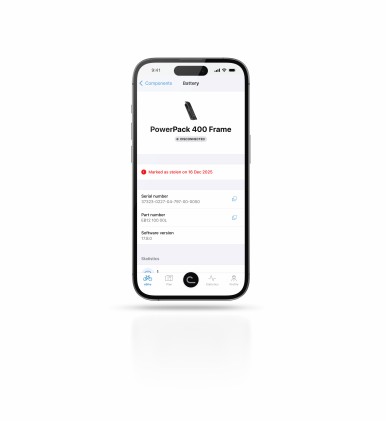
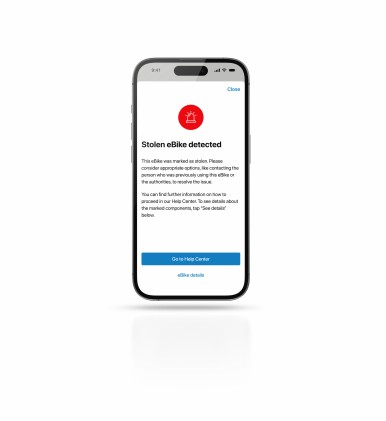
Your eBike has been stolen. What remains is a mix of anger, frustration, and a financial loss. For thieves, however, this is a profitable business, depending on their ability to resell eBikes undetected. This is precisely where Bosch eBike Systems steps in. At CES 2026 in Las Vegas, it is presenting a solution that adds another layer of digital theft protection to its smart system. In the future, stolen eBikes and batteries can be marked as stolen in the eBike Flow app. This feature is available free of charge in the eBike Flow app from the end of January 2026. If an eBike or a battery is marked as stolen, it can be identified as such throughout the entire digital ecosystem of Bosch eBike Systems. This makes reselling the eBike difficult and increases the chances of the owner getting the eBike back. Buyers of used eBikes, dealers and public authorities are sent a warning when they attempt to connect to the eBike via the eBike Flow app. This includes the serial numbers of the components that are marked as stolen. In addition, the connection with the eBike Flow app is permanently blocked. It is no longer possible for the eBike to receive over-the-air updates or for custom riding modes to be selected. Dealers also receive a warning in the DiagnosticTool, the diagnostic software from Bosch eBike Systems, when they connect the eBike for servicing. Centralized storage, system-wide impact This is made possible by the digital allocation principle used by the smart system. All the components of an eBike – the motor, the battery, and the display – have a unique registration in the system and are linked to a specific user profile. If the user marks their eBike or battery as stolen, this information is stored centrally and can be accessed from anywhere in the digital ecosystem of Bosch eBike Systems. The eBike Flow app, the DiagnosticTool, and Bosch eBike Support all use the same data. The digital marking can only be removed via the registered user profile. This function is a valuable addition to the theft protection portfolio of Bosch eBike Systems. The first theft protection functions were introduced in 2018 and the portfolio, which includes eBike Lock , eBike Alarm , and Battery Lock , now offers an additional layer of protection. This makes stealing eBikes an even less attractive proposition and represents a further step toward the Bosch mission of preventing all thefts of eBikes with the help of its smart system. Extended control functions for commercial users In addition to its theft protection solutions for private use, Bosch eBike Systems is also expanding its range for commercial users. This is because eBike sharing providers, rental firms, and company fleets need active control options, for example if eBikes are not returned. The Bosch ConnectModule from Bosch eBike Systems allows motor support to be deactivated remotely. Commercial users also have direct access to operating data via a cloud interface, including battery level, range forecast, service intervals, maintenance requirements, GPS position (if tracking is activated), and usage statistics. This can be integrated into existing fleet management systems and will play a key role in the growing market of professional eBike fleets. The extended control functions are available immediately to commercial users.

Comprehensive Bosch portfolio for software-driven mobility is a crowd-puller

03.09.2025

Press release

Business/economy

Comprehensive Bosch portfolio for software-driven mobility is a crowd-puller

Farmington Hills, Mich. – The automotive industry is changing. Software and artificial intelligence are making cars even more digital, while codes and algorithms are turning driving into a customized experience. To develop its full potential, software needs the right hardware. After all, even the most modern car won’t move an inch without physical components. Bosch operates in all relevant areas of software-driven mobility, and is a partner for automakers across the globe – regardless of how much progress they have made in the transformation to the software-defined vehicle. With its profound automotive expertise, Bosch interconnects the various vehicle domains. From brakes, steering systems, and electric powertrains to sensors, vehicle computers, and software, the supplier of technology and services develops and manufactures the key components of modern vehicles under one roof. At booth D01 in hall B3, Bosch is showcasing its latest solutions for connected and intelligent transportation systems at IAA Mobility 2025 in Munich. Bosch driving assistance for more safety and convenience Automated driving is an essential feature of software-defined vehicles. Bosch is actively pressing ahead with its development, and systematically taking driver assistance systems to new levels – for greater safety and convenience. The company uses an End-to-End AI architecture: The use of AI along the entire technology chain accelerates development cycles and increases the performance of the software stack. For assisted driving and parking up to SAE Level 2, Bosch offers its ADAS (advanced driver assistance system) product family in three variants: entry-level, mid-range, and premium. These variants differ in scope of software function, the number and combination of sensors, and required computing power. Automakers can purchase the hardware and software as integrated or stand-alone packages. The number of automakers who have opted for various constellations of the Bosch ADAS product family now runs into double figures. Both the mid-range and luxury variants are already in series production in China. Also available to end customers on the market are connected map services that extend the vehicle's field of vision like an additional sensor. The crowd-based solution provides information on difficult weather and road conditions, accidents, or wrong-way drivers, for example. Sensors for precise surround sensing: More and more vehicles, including less expensive ones, are being equipped with comprehensive driver assistance systems. This explains why high-performance and cost-effective camera solutions are becoming increasingly important. The Bosch multi purpose camera is available as a camera-only solution, or alternatively as a new two-part system variant comprising camera head and control unit. In the camera-only solution, the entire ADAS function is installed in the camera itself, and computation is done there. This is particularly suitable for vehicles with decentralized architectures. The two-part system variant, on the other hand, is a step on the way to centralized architectures. It is particularly attractive for automakers who want to take advantage of advanced driver assistance functions in their existing architectures. In software-defined vehicles with centralized architectures, the camera’s safety-relevant computation is done in powerful computers. For its new radar sensor , Bosch has developed and manufactured all the key elements itself, including the system on a chip (SoC). Thanks to advanced semiconductor technology, the SX600 and SX601 radar sensors’ range is roughly 30 percent greater than that of comparable models. This technology also allows driving functions to be fully and cost-effectively integrated into the radar sensor. Both sensor types support AI-assisted signal processing. The SX601 offers significantly greater computing power than usual on the market, as well as even better detection properties. For improved system performance and maximum precision, two SX601s can be connected in series to use eight transmitting and eight receiving antennas. In software-driven mobility, centralized semiconductor architectures are taking on increasing importance. They govern many sensor-based functions, including ESP ® , navigation, and driver assistance systems. To reduce complexity, Bosch has developed the latest generation of especially powerful MEMS inertial sensors . They can provide several systems at once with the data they need. This “one-sensor-fits-all” approach features in Bosch sensors such as the SMU300 and SMI980 , which are already in use in inertial measurement units and in airbag control units. At the IAA, Bosch will also be presenting its new TB293 and TB193 chips for ultrasonic sensors , which offer the highest data transmission rate in the ultrasonic market. For even greater sensor performance, Bosch is also turning to raw data, with the signal being recorded directly at the ultrasonic sensor (at the transducer), which means that the full range of data is retained. This is a great advantage, especially for AI-based functions. As a result, the sensors allow much better object detection. Now, for the first time, these chips are freely available in the market, independent of any sensors. With this step, Bosch is also making its new VASI bus interface (versatile automotive sensor interface) available, thus setting a new standard in the market. This means that automakers have a wider choice of sensor supplier, benefit from state-of-the-art ultrasonic technology, and can avoid lock-in effects. New standards for Bluetooth-based tire pressure sensors: In the Bosch SMP290 , safety and energy efficiency go hand in hand. With its compact design, low power consumption, long life, and one-of-a-kind integration of acceleration and pressure sensor as well as ASIC including Bluetooth on one chip, it truly stands out. Not only that: it helps simplify vehicle architecture. Thanks to the standardized Bluetooth interface, the SMP290 also enables new applications such as direct interaction with a smartphone. Bosch solution for damage detection: With its small damage detection , Bosch demonstrates how to cleverly combine software and hardware. This solution uses existing vehicle components such as the airbag ECU and sensors, obviating the need for any additional hardware. And in software-defined vehicles, small damage detection can even be updated over the air, after the vehicle has been purchased. It accurately detects even minor damage to the vehicle – both while driving and when parked. Small damage detection registers shocks that are below the threshold for airbag deployment, storing the relevant data. The system thus enables fast, automated, and objective damage detection. Act-by-wire technology: the future of vehicle control Act-by-wire systems transmit the driver’s steering and braking commands purely electronically. They are highly relevant for software-driven mobility, especially for the personalization of vehicle dynamics and handling, and for higher-level modes of automated driving. New brakes and steering for greater flexibility: Braking and steering via electrical cables (act-by-wire) opens up the possibility of new concepts for the steering wheel and brake pedal, crash-optimized design, and the more flexible positioning of components and the design of the interior. Bosch is one of the pioneers in the development of this technology, and soon one of the first to market it. Its brake-by-wire solution , comprising a by-wire actuator and ESP®, will feature in a production vehicle of a major Asian automaker. What is special about the hydraulic Bosch by-wire braking system is that it requires absolutely no mechanical connection between the brake pedal and the braking system. Software systems solution for vehicle dynamics: Bosch Vehicle Motion Management assumes the task of intelligently controlling actuators. This systems solution perfectly synchronizes the brakes, steering, chassis, and powertrain. Vehicle Motion Management is suitable for all vehicles and marques in the passenger-car segment. It takes the driving experience to a new level. Thanks to a special software function, the vehicle can be transformed into a super-maneuverable urban vehicle, a powerful speedster, or a limousine with chauffeur-driven comfort – depending on the individual driver’s mood. It can be activated either at the push of a button or by AI, which works in the background to customize the vehicle. Software function against travel sickness: Vehicle Motion Management’s “Comfort Stop” function increases comfort and counters travel sickness. The interaction of the brakes and the electric motor can reduce the jerk resulting from braking by 70 to 90 percent and gently bring the vehicle to a standstill. The shift from decentralized to centralized vehicle architectures Software-defined functions require a completely different setup for the electronic components and systems. Intelligence in the vehicle will be centralized in a few high-performance computers, instead of being distributed among currently sometimes more than 100 individual control units. This reduces the need for wiring, and makes both centralized processing and over-the-air updates possible. Bosch can supply the basic framework for any vehicle. Powerful computers for the software-defined vehicle: The Bosch portfolio not only includes centralized, powerful computers and state-of-the-art software , but also scalable and adaptable vehicle infrastructure. Bosch’s centralized high-performance computers and all its other components feature state-of-the-art communication interfaces. Depending on requirements, the resulting communication infrastructure can either be fast and broadband or lean and especially cost-efficient. Here, a key role is played by zone-level control units, which aggregate and translate the various communication channels and media. Robust on-board networks with zone-based architecture and 48-volt technology create the basis for a stable power supply that satisfies the growing requirements of modern vehicles. On the level of power-supply infrastructure, the key components supplied by Bosch include its 48-volt Powernet Master, which ensures that the vehicle’s safety-relevant functions are supplied with power at all times. The portfolio also includes combined communication and power-supply solutions, and well as zone-level control units. The range is rounded out by intelligent solutions for power distribution. These not only open up new diagnostic and maintenance options, but also meet the most stringent functional safety requirements. Faster data transmission in modern vehicles: It takes automotive ECUs just milliseconds to exchange data. The invisible backbone of this communication is the controller area network, or CAN. In vehicle architectures, such networks ensure a high level of stability, simplicity, flexibility, and cost efficiency. And with the new Bosch CAN SIC XL transceiver , they work especially fast – up to 20 Mbit/s in the case of CAN XL networks. In addition to the customary CAN commands, the new CAN XL standard can transmit internet protocol (IP), and thus complies with the requirements of modern E/E architectures. ETAS software: The Bosch subsidiary ETAS offers a Vehicle Software Platform Suite , which provides a stable and secure basis for the efficient development and management of scalable vehicle architecture. It supports all modern vehicle architectures – from classic control units to powerful computers and platforms for assisted and automated driving. Customers can use it to efficiently create state-of-the-art vehicle platforms and market them more quickly. As a founding member of Eclipse S-Core, ETAS uses a code-first approach as an integral part of the platforms it offers, and in this way plays a major part in shaping the open-source initiative. Using the ETAS Comprehensive Measurement Solution , vehicle functions can be validated quickly and cost-effectively, and system behavior optimized efficiently. The platform software records data in real time, and perfectly synchronizes internal data from microprocessor-based control units. This scalable and flexible solution can be adapted to various E/E architectures and to vehicle domains such as assisted and automated driving (ADAS/AD), infotainment, and motion. Bosch powertrain solutions: powerful and efficient In the powertrain domain, too, Bosch is responding to the growing requirements of software-driven mobility, and is developing sophisticated solutions. Following a technology-neutral approach, Bosch offers concepts for powertrains ranging from combustion engines to electric motors. Silicon-carbide semiconductors for electromobility: Automakers, automotive suppliers, and distributors can draw on a wide range of Bosch silicon-carbide (SiC) power semiconductors for diverse automotive applications. Silicon carbide is seen as a key technology for electromobility. Bosch offers its dual-channel trench MOSFETs as 750 and 1200 volt versions – unpackaged for inverter modules or packaged for on-board chargers, DC/DC converters, and inverters. By 2030, Bosch predicts that one in three newly registered cars and light trucks will be battery-electric. In electromobility, the Chinese market is setting the pace. Bosch is playing an active part in its development. Here, scalable and standardized platforms are crucial in making innovations universally available and affordable. They are also the basis of the broad Bosch portfolio for electric and hybrid vehicles of all types (Mild Hybrid, Strong Hybrid, Plug-in Hybrid, Range-extended electric vehicle). A global platform for a wealth of variants: Oil-cooled Bosch e-axles can be used as primary or secondary powertrains. They are globally available and locally adaptable. The 3-in-1 e-axle combines an electric motor, power electronics, and transmission. Bosch is adding further energy management components to its e-axle, such as an on-board charger, a DC/DC converter, and a power distribution unit. This combination of several functions in one unit offers a number of benefits, including a more compact design, lighter weight, and optimized costs, while increasing efficiency at the same time. From electric vehicle to mobile energy storage unit: Although they take up 30 percent less space, the latest generation of bidirectional charger converters , which combine an on-board charger with a DC/DC converter, are even more efficient. This systems solution is much easier to integrate, whether close to the powertrain in the e-axle or close to the battery. With bidirectional flows of energy, an electric vehicle can also function as a mobile energy storage unit. Inverters with greater power density: A new generation of inverters featuring power modules and semiconductors as well as innovative inverter topologies is paving the way for significant progress in power density and efficiency. And in electric motors as well, Bosch is moving ahead. Automakers can benefit from a globally standardized technology platform comprising various electric motors and active components such as rotors and stators. Shorter winding heads, innovative cooling designs including a direct copper conductor and magnet solution, and innovative materials are having a positive effect on electric motors’ size, efficiency, and use of materials. Increased range, reduced charging time: Standardized hardware means that intelligent software is gaining in significance. It can be used to extend range and curtail recharging time. Synchronous control (voltage modulation) allows efficiency to be increased by 1.5 percent, and an electric vehicle’s peak power and continuous output by 10 percent. Solely by using software, switching behavior can be synchronized with the rotation of the electric motor, without modifying the hardware. This extends the vehicle's range and simultaneously enhances the driving experience. Through the software feature eAxle Heating , the electric vehicle's battery is optimally preconditioned prior to charging. This facilitates higher charging capacities and consequently reduces vehicle downtimes. Digital proof of renewable fuels: In addition to electric vehicles, hybrid vehicles can also reduce carbon emissions from road traffic. This is why Bosch is continuing to develop injection and exhaust-gas treatment technology for combustion engines. Apart from strong and plug-in hybrids, electric vehicles with range extenders are becoming increasingly common, especially in China. Using renewable fuels in hybrid vehicles makes them much more climate-friendly. Proof that such fuels are in the tank can be provided by a Bosch cloud solution, the Digital Fuel Twin . This also shows how much less CO2 has been emitted. Optimum battery temperature: Thermal management systems can further increase the efficiency of hybrid and electric vehicles. By deliberately controlling flows of cold and heat, they ensure that the high-voltage battery remains within the optimum temperature window at all times, that the electric motor does not overheat under heavier loads, and that as little electricity as possible is used for cooling and heating. For this, Bosch is developing pre-integrated modules that combine essential elements such as electric cooling compressors and coolant pumps. This considerably reduces complexity and installation effort. In new systems, the coolant used is propane (R290), which is already used in heat pumps and tumble dryers. Intelligent coordination of energy management: The modular software solutions used in Bosch Vehicle Energy Management distribute energy in the vehicle in an especially intelligent way. An integrated approach coordinates and optimizes energy management and its component subsystems such as thermal management, powertrain, on-board network, and charging system. This connected system also takes account of current and forecast vehicle parameters, as well as of road conditions and driver behavior. In this way, electric vehicles’ efficiency, convenience, and service life can be further improved. Bosch Vehicle Energy Management is also offered as a hardware-agnostic solution. Safety in critical operating states: Together with its electronic disconnect unit , the Bosch battery management system monitors and controls the high-voltage battery’s cells – in both electric cars and plug-in hybrids. In critical operating states, it provides the necessary safety mechanisms. It also optimizes power output and battery life. It comprises a control unit as well as elements that are attached to the individual battery modules and that monitor each individual cell. Software functions, such as the battery passport that will be required in the EU from 2027, can also be integrated. In the event of an accident, the electronic disconnect unit disconnects the battery from the vehicle electronics. The battery management system, the cell monitoring units, and the charger-converter can be brought together in this disconnect unit, thereby reducing complexity. New battery for the on-board network: To meet ever greater demands for power, more and more electric vehicles will feature a 48-volt on-board network in the future. To satisfy this need, Bosch is developing a 48-volt lithium-ion battery – in addition to the 48-volt battery for mild hybrids it has already manufactured millions of times. The new variant will consistently provide the power needed for safety-critical features and for highly automated driving, but also when the vehicle is stationary for a protracted period. The battery can be flexibly integrated into the vehicle. Unlike conventional 12-volt batteries, it is lead-free. Bosch ESI[tronic] adds Tesla to its diagnostic program: The range of vehicles covered by Bosch’s tried and tested ESI[tronic] diagnostic software now also includes Tesla models. For the first time, therefore, independent workshops will now be able to use their everyday multibrand solution to perform extensive diagnostic work on Tesla models . Accessing diagnostic data was a special challenge when integrating Tesla. In contrast to many other automakers whose data Bosch receives in advance and translates into [ESI]tronic languages, the original Tesla diagnosis interacts in English only. And while other documentation is available in several languages, it is not available in all 23 of the languages supported by [ESI]tronic. To deal with this language barrier, Bosch has now come up with a technical solution that works with artificial intelligence, and has integrated this automatic translation functionality directly into the diagnostic process. As soon as a mechatronics engineer hooks up to a Tesla, the English diagnostic information is translated in real time into the user’s selected [ESI]tronic system language. This innovative approach ensures that independent workshops can work on Tesla vehicles efficiently and precisely, without language difficulties. This addition is an important step toward providing independent workshops with a future-proof, comprehensive diagnostic solution for the growing electric-vehicle segment. Bosch press conference: Monday, September 8, 2025, 11:00–11:20 CEST: with Dr. Stefan Hartung, chairman of the board of management of Robert Bosch GmbH, and Dr. Markus Heyn, member of the Bosch board of management and chairman of Bosch Mobility, at the Bosch booth D01 in Hall B3 and via Livestream on the Bosch Media Service . Bosch eBike Systems at IAA Mobility | Open Space: The IAA Open Space in downtown Munich will be open from 11:00 to 21:00 CEST from September 9 to 13, 2025. On Sunday, September 14, 2025, the IAA Open Space will be open for guests from 10:00 until 17:00 CEST. During the IAA, visitors can take the Cargo Line and other innovations, as well as many digital features offered by Bosch eBike Systems, for a test ride on the cycling test track in Munich’s Englischer Garten park. In addition, Bosch eBike product experts will be on hand to answer questions in the Open Space at Odeonsplatz.

Level up your day and start an adventure – with the Performance Line PX from Bos ...

27.06.2025

Press release

eBike

Level up your day and start an adventure – with the Performance Line PX from Bos ...

Stuttgart/Reutlingen – Peaceful forest paths, sweeping river valleys, or spectacular coastal routes – eBike rides offer countless adventures. With the Performance Line PX , Bosch eBike Systems is launching a premium system that has been specially developed for demanding bike rides, weekend trips, and extended bike-packing rides. "Whether on multi-day adventures with heavy bags or on spontaneous discovery rides in nature: We have developed the Performance Line PX specifically for the needs of touring riders. It was important to us that they receive powerful yet finely tuned support that adapts intuitively to their riding situation. With the robust and versatile system, eBike riders level up their everyday and discover new paths," says Claus Fleischer, CEO at Bosch eBike Systems. Feel the power – and adjust it to suit you With up to 90 Newton meters of torque, 700 watts of power and assistance of up to 400 percent, the Performance Line PX weighs approximately 6.4 pounds and promises a powerful yet balanced riding experience.1 The smart sensor technology responds precisely to pedal input and provides natural support for touring eBike riders on their tours. It also recognizes start-up situations and gives them a powerful boost when required. Smart functions such as the familiar walk assistance or hill start assist make handling easier when starting uphill or on steeper terrain – an absolute bonus, especially when touring with heavy bags. Another positive point: eBike riders can customize the performance values of the Performance Line PX to their personal requirements in the eBike Flow app . 1 Higher performance values also mean higher wear and lower range – Bosch eBike Systems leaves this decision up to eBike riders. For example, the maximum torque can be increased on tours with many inclines and heavy bags. If you are riding on long flat stages, you can reduce the motor support and thus optimize your range. Naturally quiet – and comfortable The Performance Line PX makes it possible for eBike riders to enjoy nature and explore new surroundings thanks to the optimized gearbox concept: The drive unit provides particularly quiet support and remains smooth even when cruising. As usual, eBike riders receive support up to 20 mph, above which the gearbox decouples the motor and the eBike can be pedaled with hardly any noticeable resistance. With Auto mode, adventurous riders can simply keep pedaling, even on ascents and into headwinds, as the riding mode automatically provides optimum support. This means you don't have to switch between riding modes and can simply enjoy the ride. Don't waste a thought on the gear shifting operation If you want even more comfort on your touring ride, you should not miss out on the eShift electric gear shifting solution With this automatic solution, eBikes with the Performance Line PX automatically shift to the appropriate gear – according to the individually selected cadence. This allows eBike riders to ride more evenly and focus fully on the route. A positive side effect: Material wear on the system is also reduced. eShift with automatic shifting is already available with the shifting systems from enviolo and TRP. New: eShift is now also available with shifting systems from Shimano. Smart tour helpers: 3D map display, annual overview of ride data, and optimized eBike ABS For an even better overview, the ride screen in the eBike Flow app now offers eBike riders a 3D map display of the terrain and visualizes the elevation graph of the immediate surroundings. This way, adventurous travelers always know what to expect on the next leg of their journey. Also new: In the statistics, eBike riders can see an annual overview of the number of all rides, the distance traveled, the trip time, and the elevation. These valuable statistics apply to all eBikes registered in the eBike Flow app. The two new functions require a Flow+ subscription. If you are traveling downhill with fully loaded panniers or the route leads over slippery gravel or wet forest paths, the Bosch eBike ABS in ABS Allroad mode is your reliable partner. Precise sensors in the Performance Line PX measure the inclination and speed of the eBike very accurately and ensure optimum brake support. This allows eBike riders to brake more safely in the event of sudden obstacles and enjoy a smoother ride overall. The Performance Line PX is available in conjunction with Bosch eBike ABS with brakes from Magura, TRP, and Shimano. Enjoy nature responsibly The Performance Line PX lets you experience maximum support on adventure tours, while also enjoying nature at the same time. To achieve this, Bosch eBike Systems has taken various measures to reduce its Product Carbon Footprint 2 . Firstly, around 40 percent recycled aluminum is used in the housing of the drive unit. This has enabled almost half of the CO₂ emissions from the housing to be cut 3 . Secondly, Bosch eBike Systems uses recycled plastic 4 for some components in the drive unit – thereby supporting the circular economy. 1 On delivery: 85 Nm, 600 W, 340% support. eBike riders can adjust the performance values of the drive unit via the eBike Flow app. Note: Higher performance values can have a negative effect on range and wear. This allows the eBike manufacturer to limit the maximum performance values by means of a factory setting. In the eBike Flow app, only the maximum values specified by the manufacturer can be set. 2 The Product Carbon Footprint can be used to record the emissions generated during the production and manufacture of a product. We have considered the effects of CO₂ as well as other greenhouse gases and climate-relevant substances, insofar as these are relevant to the analysis. For ease of reading, we use CO₂ synonymously with CO₂ equivalents. 3 Savings compared to the use of conventional aluminum. These savings are partially attributable to the use of green electricity in the production of recycled aluminum. The calculation is based on supplier data. 4 The grease guide plate, torque sensor housing, and wire feeder are among the largest plastic parts in the drive unit. The grease guide plate and torque sensor housing are manufactured using more than 50% recycled material, while the wire feeder has a recycled content of approx. 35% (source: supplier data).

More flow for the city – and beyond

27.06.2025

Press release

eBike

More flow for the city – and beyond

Stuttgart/Reutlingen – Bosch eBike Systems is expanding its smart system with four new drive units for urban use. The Cargo Line, Performance Line Speed, Performance Line Sport and Performance Line make eBiking even more comfortable and flexible in everyday life. Highlight: The Cargo Line, Performance Line Speed and Performance Line Sport have received higher performance values (torque, power, and support factor), which eBike riders can adjust according to their needs in the eBike Flow app. With even more support, the new systems are quieter and lighter than ever before, yet reliable and efficient in the familiar Bosch quality. The Performance Line SX and Performance Line Sprint from the smart system is also even more powerful. The new product package is complemented by the new PowerTube 540 battery and other features in the eBike Flow app. Maximum support for Cargo eBikes: the new Cargo Line Bringing the kids to daycare in the morning, quickly taking packages to the post office, and weekly grocery shopping – with the new Cargo Line even heavy loads can be easily transported during daily life. This popular drive unit now delivers even more power: With up to 100 Newton meters of torque (previously up to 85) and 750 watts of maximum power (previously 600), eBike riders can transport their kids or groceries, even up steep climbs, with greater ease. They decide for themselves whether or not they want to set the new performance values in the eBike Flow app (under "Custom riding modes"). 1 Higher performance values also mean greater wear and a shorter range – Bosch eBike Systems leaves this decision up to eBike riders. The tried-and-tested Cargo mode provides support of up to 400 percent – automatically and precisely when it’s needed. The walk assistance and hill start assist, both featuring Hill Hold, also make handling easier. The new Cargo Line is not only more powerful, but also more lightweight and quieter. It now weighs only 6.2 pounds, which is approximately 0.2 pounds lighter than its predecessor. The optimized gearbox reduces riding noise and pedal resistance to a minimum. At the same time, the improved sensor technology ensures smooth acceleration and precise handling – regardless of the load on the Cargo eBike. The sensitive response to the rider’s pedal input enables greater control and an even more intuitive riding experience. Get there faster – with the new Performance Line Speed Anyone traveling long distances every day by eBike will find a reliable partner in the new Performance Line Speed . With maximum support of up to 400 percent and up to 28 mph, 100 Newton meters of torque, and 750 watts of maximum power, the drive unit for speed eBikes is the ideal system for commuters who want to ride at higher speeds and get there faster. As with the Cargo Line, the performance parameters can now be adjusted via the eBike Flow app. 2 The advantages: eBike riders can accelerate faster at traffic lights, for example, and receive maximum support on steep climbs. Thanks to the improved software, the Performance Line Speed now responds even more precisely to pedal input. eBike riders also benefit from the significantly reduced pedal resistance, meaning that they have greater rider power and reach their destination quickly and efficiently. The Performance Line Speed is also approximately 0.2 pounds lighter than its predecessor and impresses with its quiet sound. It offers great reliability thanks to its sturdy design – even when subjected to heavy use. The housing is robust thanks to the sealing concept, making it dust and splash-water protected. The Limit mode limits the power of the speed eBike to a maximum speed of 20 mph on request, bringing it up to the level of a conventional eBike – practical for anyone who wants to go on relaxed rides at the weekend or deliberately avoid traveling faster in the city. 3 For athletic, commuters and beyond – the new Performance Line Sport The new Performance Line Sport is perfect for those who love longer rides at a faster pace. This powerful drive unit, with a torque of up to 90 Nm, maximum power of 700 W and a maximum support of 400 % provides an extra boost at speeds over 20 mph, reaching a maximum of 28 mph. 4 As with the previous drive units, the performance parameters can now be adjusted via the eBike Flow app. Its powerful acceleration and high speed make it perfect for reaching your destination quickly and efficiently. And it’s lighter than ever before. In fact, more than 0.7 lbs – and it stands out with its optimized design for easy integration. Being quiet as usual, it allows you to concentrate on your surroundings and relax as you enjoy the ride. The Performance Line Sport pairs perfectly with the Auto mode, which regulates support without the need to change pedal power, enhancing comfort in any situation. This drive unit is robust, reliable, and designed for long-term use, making it the ideal choice for long commutes or weekend rides. Reliable all-rounder: the new Performance Line Comfortable and reliable eBiking in everyday life and on excursions – that's the new Performance Line from Bosch. This versatile all-rounder offers up to 340 percent support, 75 Newton meters of torque, and 600 watts of power. Weighing only 6.2 pounds, the new drive unit is approximately 0.2 pounds lighter than its predecessor. It supports eBike riders with a powerful and even boost when starting off and ensures a particularly comfortable and natural riding experience. More powerful Performance Line SX and Performance Line Sprint The Performance Line SX and Performance Line Sprint have new maximum values: 60 Newton meters of torque (previously 55), 600 watts of power, and 400 percent support (previously 340). Here, eBike riders can decide for themselves whether they want to retain the default values or if they prefer to customize them to meet their individual needs in the eBike Flow app. The performance upgrade will be available to riders of the Performance Line SX and Performance Line Sprint via an update in the eBike Flow app in fall 2025. 5 The eMTB+ mode, introduced in spring 2025, will also be available for Performance Line SX as a free update. It provides more support than the existing eMTB mode and offers maximum dynamics and control. More range for every day: the new PowerTube 540 The new PowerTube 540 battery is available now. Compared to the PowerTube 500 battery, the new battery now offers 540 watt hours of energy at the same weight – more range for daily commutes in the city or a relaxed weekend ride. The integrated battery meets high safety standards and can be combined with the PowerMore 250 Range Extender if required, providing almost 800 watt hours. New eBike Flow app features: Share eBikes and Battery Lock Bosch eBike Systems adds two more functions to the smart system. The use of an eBike by several people is now even easier: In the future, eBike riders can invite up to five friends or family members to use their eBike via the eBike Flow app. Each invited user can create and save a personal profile on their own smartphone. To use the new function, only the person making the invitation needs a Flow+ subscription. Another new feature, the Battery Lock function, will be available from summer 2025. This additional digital theft protection for the battery ensures that the eBike battery can no longer be used if it is stolen – and is therefore worthless to thieves. As soon as the function is active, the battery locks automatically when the eBike is switched off. If a locked battery is stolen and inserted into another eBike with a smart system, it automatically disables motor support. This also makes reselling the battery pointless, which reduces the risk of theft. 1 Delivered from the factory: 85 Newton meters, 600 watts, 340 percent support. eBike riders can adjust the performance values of the drive unit via the eBike Flow app. Note: Higher performance values can have a negative effect on range and wear. The eBike manufacturer can therefore limit the maximum performance values by means of a factory setting. In the eBike Flow app, only the maximum values specified by the manufacturer can be set. 2 Delivered from the factory: 100 Newton meters, 750 watts, 340 percent support. eBike riders can adjust the performance values of the drive unit via the eBike Flow app. Note: Higher performance values can have a negative effect on range and wear. The eBike manufacturer can therefore limit the maximum performance values by means of a factory setting. In the eBike Flow app, only the maximum values specified by the manufacturer can be set. 3 Only available for speed eBikes in Europe. Activating Limit mode does not change the vehicle status. 4 Higher performance values also mean higher wear and lower range – we leave this individual decision up to you. The eBike manufacturer can limit the maximum performance values by means of a factory setting. In the eBike Flow app, you can then only set the maximum values specified by the manufacturer. 5 Delivered from the factory: 55 Newton meters, 600 watts, 340 percent support. eBike riders can adjust the performance values of the drive unit via the eBike Flow app. Note: Higher performance values can have a negative effect on range and wear. The eBike manufacturer can therefore limit the maximum performance values by means of a factory setting. In the eBike Flow app, only the maximum values specified by the manufacturer can be set. The upgrade over-the-air is only available for eBikes with derailleur system.