Search and find:
Photos, videos, releases, events to support your reporting about the Bosch Group

AI-enabled sensors deliver life-changing use cases

06.01.2025

Press release

Artificial Intelligence

AI-enabled sensors deliver life-changing use cases

Las Vegas, NV - Sensor technology is transforming our lives: tracking our fitness, making our gadgets easy to use, and monitoring air quality, to mention just a few examples. To provide all these sophisticated functions to consumers, Bosch Sensortec’s sensors are evolving to be smarter – by integrating MEMS technology with embedded microcontrollers, software, and AI runs inside the sensor itself. At CES®, Bosch Sensortec is showcasing its latest AI-enabled sensors, and highlighting how software adds value not only to the sensor but to the entire system. Stefan Finkbeiner, CEO at Bosch Sensortec, said: “Bosch’s innovative cutting-edge sensor solutions are making an impact in diverse areas such as consumer health, smart homes and smart cities. AI and intelligent software are the key enabling technologies that make this possible.” Vision 2030: Bosch aims for more than 10 billion intelligent sensors According to market research and strategy consulting company Yole Group, Bosch is the market leader for MEMS for the fourth year in a row. In 2024 alone, Bosch Sensortec surpassed the milestone of delivering over 1 billion MEMS sensors featuring integrated microcontrollers and software. From 2027 onwards, 90 % of the products will include these integrated features. By 2030, the company aims to achieve a remarkable total of more than 10 billion MEMS sensors sold with this advanced integration. AI on the edge With AI running on the edge (meaning directly in the sensor), there’s no need for constant cloud connectivity. This ensures data remains private, dramatically reduces latency, and cuts power consumption, all while delivering accurate real-time feedback to users. State-of-the-art software solutions add value not only to the sensor but to the entire system, enabling new applications and forming the basis for AI inside the sensor itself. Always-on and ready to go Always-on technology is essential in consumer electronics, enabling continuous access to features without the need to activate the device and wake up the main processor. This significantly extends battery life, and creates a more intuitive and effortless experience for users, especially in smartphones and hearables. This is achieved with intelligent sensors combined with smart software, enabling quick access to voice assistants, health monitoring, and more, empowered by MEMS sensors with integrated microcontrollers. Examples of always-on use cases include voice activity detection and keyword triggering to activate voice assistants in hearables, fall detection in smartwatches for faster emergency assistance, and automatic orientation sensing in smartphones to adjust modes and enter sleep mode when inactive. Smart Connected Sensors (SCS): the personal AI feedback coach Can you imagine having unlimited access to a professional fitness trainer, with feedback at any time? This is the future of exercising – made possible by the Smart Connected Sensors platform from Bosch Sensortec. The platform gives users qualitative feedback on the movement execution, as well as measuring movements and repetitions. Specifically designed for full-body motion tracking, the SCS platform provides a fully integrated hardware and software solution (based on the BHI380, a programmable IMU-based sensor system with AI) that dramatically cuts development costs and time to market. A sound move for software-enabled voice control Wireless headsets have transformed how we listen to music, podcasts and audiobooks, providing free, unhindered movement – as well as new features enabled by sensors, such as activity recognition and indoor navigation. But shifting to voice control can cause problems, when the system is triggered unintentionally because it reacts to ambient noise. To fix this issue, Bosch Sensortec has come up with a software-based innovation: a new type of acceleration sensor, the BMA550, detects sound through bone vibrations. Intelligent algorithms then ensure voice control activates only when the wearer of the headset is actually speaking. Take a breath: air quality sensing Poor indoor air quality is a problem: the concentration of PM2.5 particulates from domestic cooking can reach levels 100 times higher than acceptable limits. Localized, actionable data from Bosch's particulate matter sensor for PM2.5 and PM1 enables effective responses to poor air quality. A software update coming soon will activate PM10 measurement in addition. Almost the entire global population (99 %) breathes air that exceeds WHO air quality limits, and threatens their health. Bosch’s BMV080 sensor uses software and intelligent algorithms, in a tiny, fanless design which is more than 450 times smaller than any comparable device on the market. Open platform and strong collaboration Bosch can’t do all this alone and offers a framework that supports customers in creating movement classification algorithms specific for their own application. These models can then run on a smart motion sensor, such as the BHI360. For example, Bosch Sensortec and Doublepoint have partnered to develop a powerful microgesture control solution for smartwatches, using the BHI360. This enables always-available, reliable control, such as allowing users to adjust light brightness with an intuitive pinch gesture. Doublepoint's advanced algorithms are seamlessly integrated into Bosch’s compact, low-power IMUs via a new software tool. Compared to camera-based solutions, this IMU-based approach enables obstruction-free gesture detection, offering greater reliability and efficiency. “This collaboration exemplifies Bosch Sensortec's commitment to innovation in the IoT and wearable markets, empowering manufacturers to bring advanced, user-friendly products to market more quickly,” said Lucas Ginzinger, Vice President Marketing and Business Strategy at Bosch Sensortec.

Bosch uses software and AI to make its products smarter and make people’s lives safer

06.01.2025

Press release

Artificial Intelligence

Bosch uses software and AI to make its products smarter and make people’s lives safer

Las Vegas, NV, USA – Software and artificial intelligence (AI) are already shaping our present. For the future, however, they will be crucial. Bosch was quick to recognize the opportunities offered by intelligent software and services, and focused on them at an early stage: AI now features in every one of the technology company’s products – or was involved in their production. “Intelligent software and digital services have become cornerstones of our core business,” says Tanja Rueckert, member of the board of management of Robert Bosch GmbH, at the CES 2025 electronics trade fair in Las Vegas, Nevada. And the AI and software business is continuing to gain speed: Bosch expects to achieve sales of software and services of over 6 billion euros by the beginning of the next decade. The Mobility business sector will generate around two-thirds of this sales revenue. AI is playing a particularly significant role in this development. “With over 1,500 patents in just five years, Bosch leads the way in Germany and Europe,” Rueckert says. Almost 5,000 Bosch AI specialists are now working on intelligent solutions. Bosch is offering tailored courses to consistently drive forward the training of its entire workforce in the field of AI. To date, the company’s own AI Academy has trained more than 65,000 associates. This also dovetails with the results of the latest Bosch Tech Compass, an annual survey of people’s expectations of new technologies. According to the survey, four out of five of those surveyed worldwide are planning AI-related further training this year. And two-thirds believe that schools should teach AI as an independent subject. The message is clear: AI skills are fundamental to the future of the working environment. At CES 2025 in Las Vegas, Bosch is presenting products and solutions that are already making people’s lives safer, more efficient, and more convenient thanks to software and AI. Or to put it another way: with software and AI, Bosch is improving the everyday lives of people from all walks of life. Mobility, the home, health – Bosch software in all life situations Take roads, for example: Bosch has long seen itself as a company providing software for mobility. It recently programmed a new function for vehicles that allows cars to brake smoothly and without jerking. This is a boon for drivers in slow-moving traffic, as well as for passengers with motion sickness. “No one understands the requirements and needs of the automotive industry as comprehensively as Bosch,” says Paul Thomas, president of Bosch in North America, at CES 2025. “With our mobility-specific software expertise, we’re the ideal partner for the world’s major tech players.” After all, software will change not only how we use and experience cars, but how we develop them as well. In the age of software-defined mobility, Bosch programmers approach cars from a software perspective. They are developing technologies and solutions for new centralized architectures that effortlessly manage all interactions between automotive electronics and the cloud. This will be essential in the future if cars are to be able to download new functions for areas such as infotainment or driver assistance easily and conveniently over the air. At Bosch, AI has been playing an important role in assisted and automated driving for years now. For example, the MPC3 multifunctional camera has been in volume production since 2019 and is setting new standards. This camera is able to reliably recognize objects and people as well as to distinguish between the road and the edge of the road, thereby keeping the car safely in its lane. The camera combines conventional image-processing algorithms with AI methods for a complete understanding of what it is recording. “Our AI-based multifunction camera not only makes driving more relaxed, but also makes the roads safer for all users,” Thomas says. To achieve this, Bosch is combining its profound automotive engineering knowledge and its AI expertise with a vast pool of in-house sensor data. “We’re using AI to increase the efficiency of our assistance systems,” Thomas says. What’s more, Bosch is investigating how generative AI can be used to further improve automated driving functions. The expectation is that it will enable vehicles to assess situations and react accordingly, and in this way keep road users even safer. In the future, generative AI will train automated driving functions more quickly, thus reducing the number of test miles required to validate them. And by adding conditions such as snow to the road, generative AI will quickly be in a position to alter the context of a driving sequence recorded by cameras or radar sensors. In other words, systems can be trained for snow without having to wait until snow actually falls – the AI will do it itself. AI to combat worries about range and new theft protection for eBikes By merging the physical and digital worlds, software also enhances the e-bike experience. Bosch is debuting its new Battery Lock theft protection system in Las Vegas. This provides additional protection for the e-bike battery: locking it digitally by using the rider’s smartphone as a key. AI also helps allay worries about range: with the AI-based Range Control feature, e-bike riders who are about to set out on a journey can determine the battery charge level with which they would like to arrive at their destination. And in the kitchen as well, people also have their own personal preferences. The intelligent Bosch Series 8 oven will also be on show at CES 2025. It is equipped with sensors, cameras, and AI. With their help, the oven can recognize around 80 dishes and automatically set the optimum cooking method and temperature. And for many dishes, even the degree of browning can be individually selected. Intelligent Bosch crib – a helping hand for child carers Sensors, cameras, and AI can also give parents a helping hand when caring for newborn babies. The new, intelligent Bosch Revol crib can monitor a baby’s vital signs such as heart rate and respiratory rate. The software also signals in good time if a soft toy or blanket is covering the child’s airway or if crying is detected. And should the baby have trouble falling asleep, the crib can automatically engage a gentle rocking function. Users can decide for themselves whether the data the crib records is ultimately stored in encrypted form on Bosch servers or remains offline within their own four walls. The CTA, organizer of CES 2025, has designated the intelligent Bosch crib a CES Innovation Award Honoree. Smart Bosch sensors have become an integral part of our daily lives Another example of how the rapid acceleration of AI-based innovations is changing the way people use new technologies is smart sensors. These tiny components have a big impact. Microelectromechanical sensors (MEMS), packed with Bosch software and AI, can be found in all areas of our daily lives: whether smartphones, e-bikes, fitness trackers, or cars. What do they do? They can tilt displays from vertical to horizontal, count steps, and control airbags. Modern MEMS sensors even have an integrated microprocessor and run with independent software. Without these sensors, everyday functions that we have all become accustomed to wouldn’t be possible at all – functions such as “waking up” a smartphone display or activating a voice assistant with wireless headphones. Smart sensors record data such as acceleration, rotation, and temperature and use Bosch software to process it directly in the integrated microprocessor. This means their entire functionality is contained in a compact housing – Bosch produces the world’s smallest sensor, which measures just 0.8 x 1.2 millimeters, making it barely larger than a grain of sand. Another advantage is that sensors with an integrated microprocessor draw noticeably less power from the battery of a smartphone or smartwatch. For the “wake-up” function, for example, the sensor system needs only its own microprocessor. Since it can do without the device’s central computer, this prolongs the battery’s runtime. Bosch grows with billions of units in the sensor market AI takes smart MEMS sensors to the next level: Bosch offers sensors with integrated self-learning AI software, for devices such as fitness trackers. The AI recognizes a variety of different movements and learns every repetitive fitness activity. If required, it can also provide users with qualitative feedback about how well they have done their exercises. The AI runs on the sensor itself; no connection to a cloud or smart device is needed. All data remains private and activities can be continuously recorded and analyzed without an internet connection. According to the market research institute Yole Group*, this is now the fourth year in a row that Bosch is the market leader in the MEMS sector. More than one in every two new smartphones worldwide is equipped with Bosch sensors. And the potential is still huge: according to the Yole study, the annual global demand for MEMS in the automotive and consumer electronics sectors alone is expected to grow from today’s 33 billion to over 40 billion units by 2029. Bosch wants to share in this growth and is planning to produce ten billion smart MEMS sensors with integrated microprocessors and independent software for consumer electronics by the end of 2030. Billions invested in the strategically important U.S. market CES 2025 in Las Vegas is one of the world’s biggest electronics trade fairs in a strategic growth market for Bosch. The company is making targeted investments in the U.S. to further expand its global presence. Bosch recently announced plans to acquire Johnson Controls’ global heating, ventilation, and air conditioning solutions business for residential and small commercial buildings – continuing its growth trajectory in the country. At a total of around 8 billion dollars (7.4 billion euros), this is the largest transaction in the company’s history. In Roseville, California, Bosch is currently equipping a chip factory with modern manufacturing facilities to produce silicon carbide chips, thereby expanding its manufacturing capacity in an important sales market. These special semiconductors are a key component for electrified mobility. Over the next few years, Bosch wants to invest more than 1.9 billion dollars (some 1.8 billion euros) in the Roseville location and start delivering silicon carbide chips from California in 2026. “The enormous investments in the heating and chip businesses underline the strategic importance of the U.S. market for Bosch,” Thomas says. *Source: Status of the MEMS Industry 2024, Yole Intelligence

From windshield wiper to e-bike ABS

19.05.2020

Press release

Artificial Intelligence

From windshield wiper to e-bike ABS

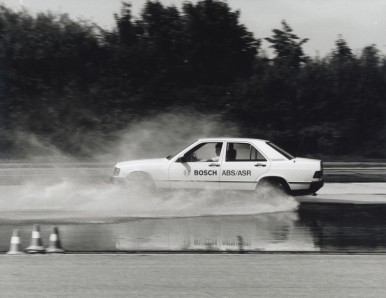
1926: Windshield wiper Goodbye to poor visibility: comprising an electric motor that drove a rubber-coated arm via a worm screw and gear, the Bosch electric windshield wiper finally gave drivers a clear view of the road ahead. It was followed in 1959 by an electric windshield washer system. Activated at the push of a button, an electric pump precisely sprayed water on to the windshield through one or several nozzles that were mounted on the hood. 1927: Power-assisted brake for commercial vehicles In the years after 1900, vehicles became increasingly fast and powerful, but braking force was unable to keep up. This prompted Bosch to develop a pneumatic brake booster for heavy trucks, whose heavy loads meant especially long braking distances. The system used the vacuum that arises in the induction tract of the engine, so that only one-third as much pressure now had to be applied to the brakes. 1928: Bosch brake assistant Bosch also used this innovative brake technology, premiered in 1927, in passenger cars. There were two challenges: to achieve a compact design that would allow it to be installed in the tight space available in the engine compartment, and to make it more affordable. The technology became established as standard equipment. As in the case of the Bosch brake for trucks, drivers now only had to apply one-third of the pedal pressure, and braking distance was also reduced by one-third. 1957: Asymmetric low-beam headlights In 1913, Bosch started production of a new automotive lighting system. The system comprised a generator, headlights, a battery, and a regulator. And while these lighting systems were continuously improved, they still had one disadvantage: they dazzled oncoming vehicles. The more cars there were on the roads, the more inconvenient and dangerous the situation became. In 1957, Bosch premiered asymmetric low-beam headlights. This system causes less dazzle for oncoming traffic and illuminates the driver’s own side of the road better. 1978: ABS antilock braking system Following nine years of development work, 1978 marked the start of the success story of ABS, the electronically controlled antilock braking system for four-wheeler passenger cars. If the wheels lock up, ABS reduces brake pressure then increases it again – up to 40 times a second. This keeps braking distances short, even on slippery surfaces, and the vehicle remains steerable. For motorcycles, the EU mandated the system for all new type approvals from 2016. 1926: Windshield wiper Goodbye to poor visibility: comprising an electric motor that drove a rubber-coated arm via a worm screw and gear, the Bosch electric windshield wiper finally gave drivers a clear view of the road ahead. It was followed in 1959 by an electric windshield washer system. Activated at the push of a button, an electric pump precisely sprayed water on to the windshield through one or several nozzles that were mounted on the hood. 1927: Power-assisted brake for commercial vehicles In the years after 1900, vehicles became increasingly fast and powerful, but braking force was unable to keep up. This prompted Bosch to develop a pneumatic brake booster for heavy trucks, whose heavy loads meant especially long braking distances. The system used the vacuum that arises in the induction tract of the engine, so that only one-third as much pressure now had to be applied to the brakes. 1928: Bosch brake assistant Bosch also used this innovative brake technology, premiered in 1927, in passenger cars. There were two challenges: to achieve a compact design that would allow it to be installed in the tight space available in the engine compartment, and to make it more affordable. The technology became established as standard equipment. As in the case of the Bosch brake for trucks, drivers now only had to apply one-third of the pedal pressure, and braking distance was also reduced by one-third. 1957: Asymmetric low-beam headlights In 1913, Bosch started production of a new automotive lighting system. The system comprised a generator, headlights, a battery, and a regulator. And while these lighting systems were continuously improved, they still had one disadvantage: they dazzled oncoming vehicles. The more cars there were on the roads, the more inconvenient and dangerous the situation became. In 1957, Bosch premiered asymmetric low-beam headlights. This system causes less dazzle for oncoming traffic and illuminates the driver’s own side of the road better. 1978: ABS antilock braking system Following nine years of development work, 1978 marked the start of the success story of ABS, the electronically controlled antilock braking system for four-wheeler passenger cars. If the wheels lock up, ABS reduces brake pressure then increases it again – up to 40 times a second. This keeps braking distances short, even on slippery surfaces, and the vehicle remains steerable. For motorcycles, the EU mandated the system for all new type approvals from 2016. 1980: Electronic airbag control In 1980, Bosch was the first European company to manufacture electronic triggering units for passive safety systems. This set the standard in road safety. The triggering unit comprised three components made up of some 170 individual parts, and controlled the driver airbag. It was first installed in the Mercedes-Benz S-class. Up to nine airbags are installed in today’s vehicles. They are deployed individually, depending on the accident scenario. 1986: TCS traction control system The TCS traction control system prevents the driven wheels from spinning. The electronic control unit reduces the speed of the spinning wheels until they recover their grip. TCS is an early example of networking diverse automotive electronic systems. When traction control is activated, it intervenes in the engine management or brake control system. Despite actuation of the accelerator, engine power is continuously lowered, or the brake is actuated, until the wheels recover their grip. Traction control can also brake a wheel individually in order to divert engine power to another drive wheel if the latter offers better traction. 1995: MEMS in mass production In the 1980s, Bosch worked on making sensors smaller, more reliable, and more energy efficient, as a way of providing ever more sensor data in cars. Following the start of mass production in 1995, these miniature helpers became ever more prevalent, furnishing control units with data about when the car brakes or accelerates, as well as about the direction the car is traveling. Information such as this is important for safety systems such as ESP®. 1995: ESP® electronic stability program Using smart sensors, ESP® compares 25 times per second whether the car is actually moving in the direction that the driver is steering it in. If it is not, the system intervenes. By reducing engine torque and deliberately braking each wheel individually, the system helps the driver stabilize the vehicle and prevent skidding accidents. Since its market launch in 1995, ESP® has prevented just under half a million accidents and saved more than 15,000 lives in the EU alone. Bosch celebrates a milestone this year: it has sold 250 million ESP® systems since production began 25 years ago. 2010: Predictive emergency braking system Ever more sensors in cars, sharing information with each other, make completely new applications possible: the emergency braking system that went into production in 2010 makes use of the information radar and video sensors share with the ESP®. If there is a threat of collision, it offers drivers multi-stage support. First, it alerts to the need to brake hard. If this alert is not heeded, the system initiates partial braking, and if the driver still does not react, it triggers emergency braking. 2013: MSC motorcycle stability control In 2013, Bosch took its ESP® success story, which began in 1995, and applied it to two-wheelers. In all riding situations, MSC motorcycle stability control ensures maximum stability: when braking and accelerating, on straight stretches and in bends. Wheel sensors measure wheel speed, and a further sensor measures lean and pitch angles. If the system detects a wheel on the verge of locking up, braking pressure is lowered and built up again within a fraction of a second, ensuring that the correct amount of pressure is constantly applied to prevent each wheel from locking up. This can save motorcyclists’ lives. 2018: eBike ABS Bosch has been manufacturing antilock braking systems for cars since 1978, and for motorcycles since 1995. They were joined in 2018 by an ABS for eBikes, which Bosch developed in collaboration with the brake manufacturer Magura. The world’s first production antilock braking system for pedelecs reduces the risk of becoming unseated in critical situations. In this front-wheel ABS, the hydraulic brakes and electronic brake system are perfectly tuned to each other. Wheel-speed sensors monitor the speed of both wheels. As soon as the front wheel threatens to lock up, the system regulates brake pressure to optimize riding stability. This is a huge added boost to rider safety. In addition, the rear wheel lift control function reduces the risk of a head-over-heels accident. If far too much brake force is applied, the ABS regulates the pressure applied to the front wheel, so that the rear wheel can quickly regain traction. In 1980, Bosch was the first European company to manufacture electronic triggering units for passive safety systems. This set the standard in road safety. The triggering unit comprised three components made up of some 170 individual parts, and controlled the driver airbag. It was first installed in the Mercedes-Benz S-class. Up to nine airbags are installed in today’s vehicles. They are deployed individually, depending on the accident scenario. 1986: TCS traction control system The TCS traction control system prevents the driven wheels from spinning. The electronic control unit reduces the speed of the spinning wheels until they recover their grip. TCS is an early example of networking diverse automotive electronic systems. When traction control is activated, it intervenes in the engine management or brake control system. Despite actuation of the accelerator, engine power is continuously lowered, or the brake is actuated, until the wheels recover their grip. Traction control can also brake a wheel individually in order to divert engine power to another drive wheel if the latter offers better traction. 1995: MEMS in mass production In the 1980s, Bosch worked on making sensors smaller, more reliable, and more energy efficient, as a way of providing ever more sensor data in cars. Following the start of mass production in 1995, these miniature helpers became ever more prevalent, furnishing control units with data about when the car brakes or accelerates, as well as about the direction the car is traveling. Information such as this is important for safety systems such as ESP®. 1995: ESP® electronic stability program Using smart sensors, ESP® compares 25 times per second whether the car is actually moving in the direction that the driver is steering it in. If it is not, the system intervenes. By reducing engine torque and deliberately braking each wheel individually, the system helps the driver stabilize the vehicle and prevent skidding accidents. Since its market launch in 1995, ESP® has prevented just under half a million accidents and saved more than 15,000 lives in the EU alone. Bosch celebrates a milestone this year: it has sold 250 million ESP® systems since production began 25 years ago. 2010: Predictive emergency braking system Ever more sensors in cars, sharing information with each other, make completely new applications possible: the emergency braking system that went into production in 2010 makes use of the information radar and video sensors share with the ESP®. If there is a threat of collision, it offers drivers multi-stage support. First, it alerts to the need to brake hard. If this alert is not heeded, the system initiates partial braking, and if the driver still does not react, it triggers emergency braking. 2013: MSC motorcycle stability control In 2013, Bosch took its ESP® success story, which began in 1995, and applied it to two-wheelers. In all riding situations, MSC motorcycle stability control ensures maximum stability: when braking and accelerating, on straight stretches and in bends. Wheel sensors measure wheel speed, and a further sensor measures lean and pitch angles. If the system detects a wheel on the verge of locking up, braking pressure is lowered and built up again within a fraction of a second, ensuring that the correct amount of pressure is constantly applied to prevent each wheel from locking up. This can save motorcyclists’ lives. 2018: eBike ABS Bosch has been manufacturing antilock braking systems for cars since 1978, and for motorcycles since 1995. They were joined in 2018 by an ABS for eBikes, which Bosch developed in collaboration with the brake manufacturer Magura. The world’s first production antilock braking system for pedelecs reduces the risk of becoming unseated in critical situations. In this front-wheel ABS, the hydraulic brakes and electronic brake system are perfectly tuned to each other. Wheel-speed sensors monitor the speed of both wheels. As soon as the front wheel threatens to lock up, the system regulates brake pressure to optimize riding stability. This is a huge added boost to rider safety. In addition, the rear wheel lift control function reduces the risk of a head-over-heels accident. If far too much brake force is applied, the ABS regulates the pressure applied to the front wheel, so that the rear wheel can quickly regain traction.

In brief: Bosch code of ethics for AI

25.02.2020

Press release

Internet of Things

In brief: Bosch code of ethics for AI

Our objective is to create AI products our customers can trust. To achieve this, we combine values-based action and methodological and technological excellence. There are “red lines” we will not cross. For example, we will not allow any AI to subject the lives of individuals or of groups of people to some kind of trade-off.Our objective is to create AI products our customers can trust. To achieve this, we combine values-based action and methodological and technological excellence. There are “red lines” we will not cross. For example, we will not allow any AI to subject the lives of individuals or of groups of people to some kind of trade-off. We are guided by the following principles: All Bosch AI products should reflect our “Invented for life” ethos, which combines a quest for innovation with a sense of social responsibility. AI decisions that affect people should not be made without a human arbiter. Instead, AI should be a tool for people. We want to develop safe, robust, and explainable AI products. Trust is one of our company’s fundamental values. We want to develop trustworthy AI products. When developing AI products, we observe legal requirements and orient to ethical principles. Concerning the use of AI, we observe the following criteria: An AI product, and/or the use to which it is put, should not violate the articles of the Universal Declaration of Human Rights. Its use must comply with the laws of the countries for which the AI product was made. Our use of the AI product should conform with the Bosch values formulated in “We are Bosch.” AI products should be guided by our “Invented for life” ethos: they must kindle people’s enthusiasm, improve quality of life, and conserve natural resources. Three approaches to the role of AI in decision making: “Human-in-command” (HIC): In this approach, the AI product is used purely as a tool. At all times, people decide when and how to use the results presented by the tool. An example is when a machine helps people with classification tasks. “Human-in-the-loop” (HITL): In this approach, people can directly influence or change decisions made by an AI product. “Human-on-the-loop” (HOTL): This approach concerns those cases in which the parameters relevant for decisions are defined by people during the design process, but the decisions themselves are delegated to the AI product. The application allows those affected by the decision to appeal for review. This ensures that people not only define the parameters for decision making beforehand, but also check retrospectively whether the decision was carried out in the intended sense.