Search & find:
Media, press releases, events for your editorial coverage

Connected sensors and smart algorithms

29.11.2019

Press release

Internet of Things

Connected sensors and smart algorithms

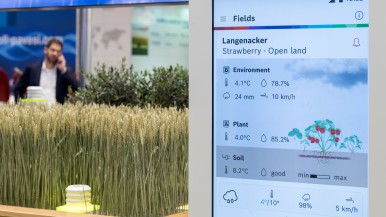
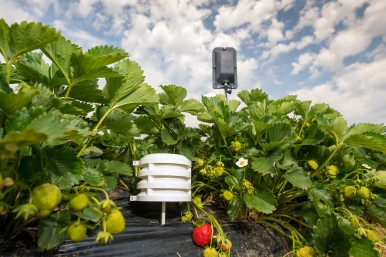
Stuttgart. While the world’s population continues to grow, the per capita area of arable land is shrinking. “Our aim is to maximize yields and use resources more purposefully and thus more efficiently,” says Dr.Bojan Ferhadbegović, head of the Deepfield Connect product family at Bosch Software Innovations. In keeping with the idea behind agriculture 4.0, he and his team are working on connected sensor systems and smart algorithms to make life easier for hardworking farmers.No unwelcome surprises with smartphone fruit-and-veg monitoring The Deepfield Connect Field Monitoring system transmits temperature and humidity data directly from the field to the farmer’s smartphone, at any time and to any place. The app is available for iOS version 11 or later and for Android version 5 or later. A customizable alert gives farmers a heads-up when readings reach critical levels. Featuring temperature, air humidity, and soil moisture sensors, the system comes in four versions that provide a conventional weather station’s key climate data. This information keeps users up to date on how their crops are faring in the field, the warehouse, or the seed-priming room. It also clues them in on how to improve their storage, foil management, and irrigation practices. “What’s more, the Deepfield Connect product family is very easy to install and use. Anyone can set up the systems on their own in five minutes and start using them straightaway,” says Ferhadbegović.Black or white side up? Asparagus bed sensors answer that and more Another option alongside the Field Monitoring system features special sensors for growing asparagus. Improper foil management can compromise quality and cost farmers up to 30 percent of their crop. The Deepfield Connect Asparagus Monitoring system minimizes this risk with sensors measuring at four depths in the asparagus bed to gauge temperature. The app’s customizable alert warns farmers before it gets too hot or cold, while a weather forecast specific to that field helps the farmer decide when to turn the foil. The temperature sum helps farmers predict the best time to start harvesting.Always take the weather with you – in the app “One of the great risk factors in farming is the weather. We can’t influence it, but our sensor systems and the Deepfield Connect app help farmers work with the weather to best support their crops’ growth,” says Ferhadbegović. The Deepfield Connect app comes with plant growth models for selected standard and specialty crops. The Bosch IoT Suite’s smart algorithms combine weather data with the science behind the growth models to keep farmers informed. They can consult the app at any time to gain insight into their plants’ current growth phase and in future get the right recommendations for each development stage. “For example, we can use our models to calculate which nutrients the plant has theoretically absorbed from the soil by the time it completes a given development stage. We can also use the weather forecast to recommend the best time to apply fertilizer, so this isn’t done when the soil is too dry or when rain would wash it right back out again,” says Ferhadbegović, pointing out another of the algorithms’ advantages. In near future, the app will also help farmers comply with documentation regulations, for example by providing an audit trail tracking fertilizer use.Accurate forecasting with the right data from the right spot “The Internet of Things (IoT) offers great potential for agriculture. Bosch can draw on its extensive expertise in software, sensor technology, and services to tap that potential. The bigger the database, the better the outcomes achieved with algorithms and artificial intelligence,” says Ferhadbegović. Even without the Deepfield Connect sensors, every app user enjoys free access to the weather data calculated for a given field. It is based on information from independent weather services and other sources. Users can order sensors right there in the app to obtain even better data and recommendations that are even more in tune with local conditions. “Then the exact readings taken in the user’s fieldwill be factored into the calculations. Particularly frost and soil moisture vary in intensity from one location to the next and can never be calculated accurately from general weather data. And if farmers grow the crop in tunnels, external sources won’t yield reliable calculations anyway,” explains Ferhadbegović.Keeping tabs on the tank via an app to maximize milk quality The Deepfield Connect Milk Monitoring system is the latest product to join this family. Asensor measures the temperature directly in the milk and takes other readings to track the tank’s functionality. This data is sent to the app on the smartphone. An alert warns the dairy farmer or tank truck driver when readings take a critical turn. “For example, the cooling system may be tailored precisely to the dairy’s specifications and thereby save energy,” says Ferhadbegović. Installation is an exercise in plug-and-play convenience: simply lower the sensor chain into the milk tank and attach the transmitter and warning lamp to the agitator respectively the tank. Independent bodies such as the Fraunhofer Institute for Manufacturing Engineering and Automation IPA have verified that the system is safe for food.Farm #LikeABosch – everything for the farmer in one app Ferhadbegović and his team are already thinking ahead. They want to add interfaces for manufacturing partners so that farmers have access to many important topics at one singlepoint. “What we have in mind are interfaces to irrigation and other control systems, but also for suppliers.” The team at Bosch Software Innovations also wants to offer special sensors as modular add-ons – for example to measure hydrostatic leaf pressure – alongside the model already available for asparagus beds. With its digital solutions for agriculture, Bosch Software Innovations is carrying on a tradition that started with founder Robert Bosch, who was a farmer himself in the 1920s. His old farmstead at Mooseurach near Munich still stands today. “We are perpetuating this legacy by making life a little easier for the hardworking farming community by delivering smart solutions that achieve higher quality with more efficient, resource-friendlier practices. That’s what Farm #LikeABosch is all about,” says Ferhadbegović. To learn all about the products and the app, visit www.deepfield-connect.com

A smart, pocket-sized operations assistant

29.10.2019

Press release

Internet of Things

A smart, pocket-sized operations assistant

Stuttgart/Hanover – Frost or excessive heat, too wet or too dry? “The weather is one of the biggest risk factors in agriculture,” says Dr. Bojan Ferhadbegovic, head of the Deepfield Connect product family at Bosch Software Innovations. “We can’t influence it, but our sensor systems and the Deepfield Connect app help farmers work hand in hand with the weather to provide optimum support for the growth of their crops.” Farmers who use the Deepfield Connect systems already get current weather data straight from their field on their smartphones, thanks to the Bosch IoT Suite – and they can set customized alerts to notify them when certain temperature or moisture levels are reached. The app is available for iOS (version 11 or later) and for Android (version 5 or later).There are also plans to expand the Deepfield Connect app in the near future to include plant growth models of all plants common in traditional agriculture and specialty crop production. The Bosch IoT Suite uses algorithms to combine weather data and scientific findings to model plant growth. The aim is to let users know which growth phase their crops are in at any given time and to provide appropriate recommendations for each development stage. “For example, we can use our models to calculate which nutrients the plant has absorbed from the soil by the time it completes a given development stage. We can also use the weather forecast to recommend the best time to spread fertilizer, so as to avoid fertilizing when the soil is too dry or when rain would wash it right back out again,” says Ferhadbegovic, citing one of the advantages of the algorithms. Precise forecast: the right data from the right location “The Internet of Things (IoT) offers great potential for agriculture, and Bosch can draw on its extensive expertise in software, sensor technology, and services,” says Ferhadbegovic, adding: “The more data there is available, the better the results of the algorithms and artificial intelligence will be.” Even without the Deepfield Connect sensors, anyone using the app can immediately access the weather data calculated for a given field, free of charge. It is based on data from independent weather services and other sources. To get even better data – and soon even more finely tuned recommendations – the sensors can also be ordered right in the app. “Then the calculations will incorporate precise values from the user’s own field. Particularly frost and soil moisture vary in intensity from one location to the next and can never be calculated accurately from general weather data. And if farmers use a tunnel, external sources won’t yield reliable calculations anyway,” explains Ferhadbegovic. Flexible and easy: installs in just minutes The Deepfield Connect system is available in several versions, allowing farmers to configure the scope of temperature, air humidity, and soil moisture sensors to fit their needs. In this way, users always know how their crops are doing in the field, the warehouse, or the seed-priming room – and what they need in order to optimize storage, foil management, or irrigation. In addition, a customizable alert enables farmers to respond promptly when critical values are recorded. The app allows farmers to document when they fertilize and when ground frost occurs. Only users themselves can access the data from their own fields; this data is not disclosed to third parties. “The Deepfield Connect product family is also very easy to install and use. Anyone can install the systems themselves in five minutes and start using them right away,” says Ferhadbegovic. And it’s just as easy to install the other Deepfield Connect systems for Asparagus Monitoring and Milk Monitoring as it is to install the Deepfield Connect system for Field Monitoring. These systems can be ordered online at www.deepfield-connect.de. The right amount at the right time: using resources efficiently A long-term study by the University of Bari in Italy on an olive plantation in southern Italy showed that the Deepfield Connect products reduced water usage by as much as 40 percent, for savings of up to 700 euros per hectare on this plantation. “Going forward, we also want to display the disease pressure on crops based on moisture levels at each plant. This will enable farmers to apply plant protection agents more sparingly and with even greater precision and to adjust irrigation for optimum crop health,” says Ferhadbegovic. Farm #LikeABosch: everything you need to know about plants in an App Ferhadbegovic and his team are already thinking ahead. For instance, they want to add interfaces for industry partners in order to give farmers access to as many important topics as possible in one convenient location. “We are thinking of interfaces for control systems, such as for irrigation, but also for suppliers. The required fertilizer, for example, could then be ordered directly in the app.” They also want to offer additional special sensors, such as the sensor that is already available for asparagus ridges, as modular add-ons. Bosch Software Innovations solutions for digital agriculture follow in the tradition of Robert Bosch: the company’s founder himself engaged in agriculture in the 1920s. His farm in Mooseurach, near Munich, still exists today. “We are continuing this legacy: we make life a little easier for hardworking farmers with smart solutions that help them work more efficiently, using fewer resources, while simultaneously improving quality – in other words, we help them to “Farm #LikeABosch”,” says Ferhadbegovic.

CES® 2018 Innovation Award: Bosch smart city solution Climo helps to manage air  ...

08.01.2018

Press release

Internet of Things

CES® 2018 Innovation Award: Bosch smart city solution Climo helps to manage air ...

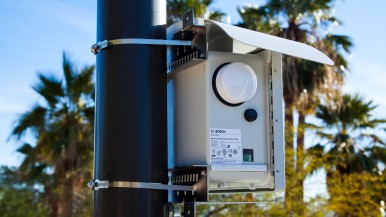
LAS VEGAS – Thanks to smart city technology, cities can now take action on the topic of air pollution. A first step towards improving air quality is the provision and management of data. At CES 2018, Bosch is presenting its micro-climate monitoring system Climo – a new solution, which helps cities around the world manage air-quality parameters in real time and at a much lower cost than existing technologies. The tiny box enables rapid and accurate measurement of data. It has been honored with a CES 2018 Innovation Award in the Smart Cities category. During CES 2018, Climo is monitoring air quality in the city of Las Vegas.“Sensors throughout the city provide a variety of valuable data. Climo gives cities quicker and easier access to this data, allowing them to take action on air quality,” said Mike Mansuetti, president of Bosch in North America at CES 2018. “The Bosch portfolio of sensors, software and services – combined with a wealth of cross-domain expertise – position us to be a partner for cities to solve challenges and positively impact quality of life of its inhabitants.” The Climo system, developed by Bosch in collaboration with Intel , enables the rapid and accurate measurement of air-quality parameters. It combines sensors and software to deliver a range of air-quality data, covering key air pollutants including: particulate matter, carbon monoxide, nitric oxide, nitrogen dioxide, sulphur dioxide and ozone. It also provides data from environmental parameters such as temperature, relative humidity, light, sound, pressure – and even pollen. Benefits for citizens in real time Ambient air quality is a key objective for urban environmental planning. The data provided by the Climo system can be utilized by cities in a variety of proactive approaches such as traffic-flow management. It can also serve to proactively message the local population with tips and information. For example, citizens who are asthmatic or suffer from allergies can instantly know whether it is better to stay indoors or avoid a certain part of the city. It is also a source of data generation for cities to make other decisions, such as future policy and planning. In rural or park areas, the system can also provide an early warning for fires. Wireless sensors that can connect over Wi-Fi and cellular networks The ability to enable micro-climate data collection comes via the connection of compact wireless sensors. Secure remote calibration and monitoring is enabled through both wireless (Wi-Fi and 3G) as well as a wired connection. The Climo system is powered with Intel IoT technologies and features cloud-based analytics, data management and visualization software. Units are pre-configured by location and can be further configured using over-the-air updates. The easy update capabilities are part of the Climo design to scale with future technologies, such as 5G, as they become available. Hundred times smaller, ten times more cost-effective While air-quality monitoring systems can often require large infrastructure investments and are complex to operate, the Climo system was designed for simple deployment and management. It measures 1/100th the size and 1/10th the cost of a traditional air quality monitoring system. Climo was designed to withstand a variety of weather conditions. Climo units feature options for power via either 110/220 V or 12V DC. This makes it an interesting solution for cities and countries around the globe – in different weather zones and with different economic environment. Originally, it was developed by Bosch engineers in India. Real time data of air quality in Las Vegas during CES 2018 At CES Unveiled in Las Vegas, Bosch will present a live demonstration utilizing Climo that shows air-quality measurements from cities around the world – including Las Vegas. It will also show an updated management interface for Climo that provides an even more comprehensive view for city officials. Bosch at CES 2018: PRESS CONFERENCE: In Ballrooms B, C, and D, Mandalay Bay Hotel, Las Vegas South Convention Center, Level 2 , from 8:00 to 8:45 a.m. local time on Monday, January 8, 2018. BOOTH: Tuesday to Friday, January 9–12, 2018 , in the Central Hall, booth #14028 FOLLOW the Bosch CES 2018 highlights on Twitter: #BoschCES PANELS WITH BOSCH EXPERTS: Tuesday, January 9, 1:30 – 3:15 p.m. (local time) “ Connect2Car: Next-Gen Automobility ” session with Kay Stepper, Vice President of Bosch in North America, head of driver assistance and automated driving, Las Vegas, Convention Center, North Hall, N256 Wednesday, January 10, 2018, 1:45–2:30 p.m. (local time) “ Connected Vehicles in Connected Ecosystems ” session with Mike Mansuetti, President Bosch North America, Smart Cities Conference, Westgate. Thursday, January 11, 2018, 11:30 a.m to 12:30 p.m. (local time) “ The Future of Robots at Work and Home ” session with Phil Roan, Senior Engineer Robotics, BSH Hausgeräte GmbH, Las Vegas Convention Center, North Hall, N258