Search & find:
media, releases and events to support your reporting about the Bosch Group.

12.10.2020

Press release

Automated mobility

Stuttgart airport set to welcome fully automated and driverless parking

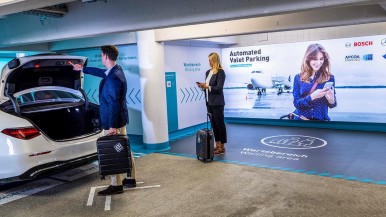
Stuttgart, Germany – Automated parking to drive down the airport stress: Bosch, Mercedes-Benz, and the parking garage operator Apcoa want to introduce driverless and fully automated parking at Stuttgart airport in the future. To this end, the automated valet parking (AVP) system co-developed by Bosch and Mercedes-Benz is to be made ready for commercial operation. The new Mercedes-Benz S-Class is already geared up to accommodate it as the world’s first production vehicle to feature the technology required for future infrastructure-based AVP. As an option, customers can buy the appropriate pre-installation for what the company calls the INTELLIGENT PARK PILOT, which makes the S-Class capable of receiving a smartphone command to drive itself to a reserved parking space. “With the new S-Class, it’s not just driving that’s a luxury, but parking as well,” says Dr. Michael Hafner, head of automated driving at Mercedes-Benz AG. The P6 parking garage at Stuttgart airport will serve as the pilot for the planned commercial automated parking service. Here, the companies will test how the vehicle technology onboard the S-Class interacts with the intelligent Bosch infrastructure and APCOA FLOW, the digital platform provided by the parking garage operator Apcoa. This platform makes the whole parking process ticketless and cashless. “Apcoa, Bosch, Mercedes-Benz, and Stuttgart airport want to work together to make parking fully automatic,” says Christoph Hartung, member of the executive management of Connected Mobility Solutions at Bosch. In the airport parking garage, preparations are currently underway to begin piloting the planned automated valet parking service. The aim of this trial with new S-Class vehicles at Stuttgart airport is to ensure that interactions between the vehicle, infrastructure technology, and parking garage operator run smoothly and are optimized for the customer.World’s first Level 4 park function in a production vehicle In July 2019, Bosch and Mercedes-Benz received the world’s first special permit to operate AVP for selected E-Class vehicles without a safety driver in real-life, mixed parking garage traffic at the Mercedes-Benz Museum in Stuttgart. Equipped with the appropriate pre-installation for the INTELLIGENT PARK PILOT, the new Mercedes-Benz S-Class is now the first production vehicle to feature AVP technology, which enables it to park without a driver. However, this is conditional on the future availability of parking garages with the appropriate infrastructure, as well as on national legislators giving AVP the green light. This makes the Mercedes-Benz S-Class the world’s first vehicle to feature a pre-installation for an SAE Level 4 automated driving function, the second-highest level of automation. “With automated valet parking, Mercedes-Benz is demonstrating that driverless parking will soon be possible,” Hafner says. To facilitate this new one-touch parking function, a spacious drop-off and pick-up area will be set up directly behind the entrance to the P6 parking garage, giving AVP users a convenient place to leave their vehicles. As they comfortably make their way to the terminal and check in, their S-Class will park itself in the basement, guided by information from the infrastructure technology. In other words, users no longer need to worry about maneuvering or having to squeeze out of their cars when the space they have finally found proves to be too narrow. “Automated valet parking really enhances our passengers’ comfort and convenience and saves them time, especially when they’re in a hurry and just want to drop their car off quickly at the airport”, says Walter Schoefer, management spokesman for Flughafen Stuttgart GmbH. For the test phase that is about to start, P6 will initially have two spaces available for self-parking vehicles. More spaces will be added when driverless parking becomes standard as planned in the future and as demand increases. Intelligent infrastructure and digital platforms The pilot parking garage at Stuttgart airport will be a premiere for new Bosch video cameras that can identify vacant parking spaces, monitor the driving aisle and its surroundings, and detect obstacles or people in the aisle. Until now, lidar sensors have been used for this purpose. A dedicated control center in the parking garage then calculates the route the vehicles need to take to reach an available space. “Our intelligent parking garage infrastructure forms the basis for the future of driverless parking,” Hartung says. Thanks to the information that the cameras provide, it is also possible for cars to drive themselves around the parking garage – even on narrow ramps, enabling them to move between different stories. The in-vehicle technology autonomously converts the information from the infrastructure into driving maneuvers. If the cameras detect an unexpected obstacle, for example, the vehicle safely performs an emergency stop. APCOA FLOW, the parking garage operator Apcoa’s digital platform, will also play a key role in driverless parking at Stuttgart airport. Drivers are already using the platform to help lighten the burden of parking. This ranges from making firm reservations for a parking space, to contactless entry into the parking garage, and to fully automated payment, invoicing, and contactless exit. The system recognizes the customer’s vehicle and the barriers open automatically, making a ticket and trip to the ticket machine redundant. “We want to be the first parking garage operator to fully support and enable automated parking services based on AVP technology in one of our parking garages,” says Frank van der Sant, chief commercial officer at Apcoa Parking Holdings GmbH. More vehicles, more parking garages A vehicle drop-off and collection service saves time and avoids long walks to the car: once parking garages are equipped with the appropriate infrastructure and national laws permit AVP, customers will be able to enjoy driverless parking services. Bosch and Mercedes-Benz are paving the way for this with the world’s first infrastructure-based solution for SAE Level 4 automated valet parking in real-life, mixed parking garage traffic. Uniform standards and interfaces ensure smooth communication between the vehicles and infrastructure technology. In the future, Bosch’s aim is to equip more and more parking garages with AVP infrastructure technology. As Europe’s largest parking garage operator, Apcoa also has a strategic interest in offering innovative premium services like AVP in more of its parking garages. “Looking ahead, we want to open up AVP to more customers at selected Apcoa locations,” van der Sant says. The company manages approximately 1.5 million individual parking spaces at over 9,500 locations in 13 European countries. By increasing the availability of driverless and fully automated parking services, the same amount of space could accommodate up to 20 percent more vehicles. In addition, driverless parking is especially suitable for narrow, remote, and therefore unattractive parking areas that people would otherwise avoid.

04.09.2019

Press release

Automated mobility

Bosch extends the service life of electric-vehicle batteries

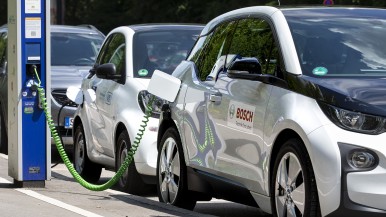
Stress makes cells age faster. Something that geneticists have long since demonstrated for the human body is also true for electric-vehicle battery cells. The older the batteries get, the lower their performance and capacity, and the shorter the range of the vehicle. To help batteries last longer, Bosch is developing new cloud services that supplement the individual vehicles’ battery-management systems. “Bosch is connecting electric-vehicle batteries with the cloud. Its data-based services mean we can substantially improve batteries’ performance and extend their service life,” says Dr. Markus Heyn, member of the board of management of Robert Bosch GmbH. Smart software functions in the cloud continually analyze the battery status and take appropriate action to prevent or slow down cell aging. These measures can reduce the wear and tear on the battery, the most expensive component of an electric vehicle, by as much as 20 percent. Real-time data gathered from the vehicle and its surroundings plays a key role here. The cloud services utilize this data to optimize every single recharging process and to provide drivers with tailored driving tips on how to conserve battery power via the dash display. Bosch calls the new service Battery in the Cloud, and its first customer is DiDi, China’s leading provider of mobility services.Precise real-time analysis According to experts, the average service life of today’s lithium-ion batteries is 810 years or between 500 and 1,000 charge cycles. Battery makers usually guarantee mileage of between 100,000 and 160,000 kilometers. But rapid battery charging, high numbers of charge cycles, an overly sporty driving style, and extremely high or low ambient temperatures are all sources of stress for batteries, which makes them age faster. Bosch’s cloud-based services are designed to recognize – and counter – these stress triggers. All battery-relevant data – e.g. current ambient temperature and charging habits – is first transmitted in real time to the cloud, where machine-learning algorithms evaluate the data. With these services, Bosch is not only offering a window into the battery’s current status at all times, but enabling a reliable forecast of a battery’s remaining service life and performance to be made for the first time. Previously, it was not possible to make any accurate forecast of how quickly an electric-vehicle battery would wear out. “Powerful batteries with long services lives will make electromobility more viable,” said Heyn. Another feature of the smart software functions is their use of the swarm principle: the algorithms used for analysis evaluate data gathered from an entire fleet, not just from individual vehicles. Swarm intelligence is the key to identifying more of the stress factors for vehicle batteries, and to identifying them more quickly. Protecting cells against aging The new insights gained into a battery’s current status enable Bosch to also actively protect it against aging. To give one example: fully-charged batteries age more quickly at particularly high or low ambient temperatures. Bosch’s cloud services thus ensure that batteries are not charged to 100 percent when conditions are too hot or too cold. By reducing the battery charge by only a few percentage points, the battery is protected against inadvertent wear and tear. Data in the cloud will also help improve battery maintenance and repair. As soon as a battery fault or defect is identified, for example, the driver or fleet operator can be notified. This increases the chances that a battery can be repaired before it becomes irrevocably damaged or stops working altogether. Finally, the cloud services also optimize the recharging process itself. The recharging process – which, by the way, is one of the biggest obstacles to creating a mass market for electromobility – harbors the danger that the battery cells permanently lose some of their performance and capacity. Smart software in the cloud can calculate an individual charge curve for each recharging process, regardless of whether it takes place at home or elsewhere. This means the battery is recharged to the optimum level, helping conserve the cells. Whereas existing apps with charge timers merely allow drivers to time the recharging process so that it is carried out when demand for electricity is low, the Bosch solution goes much further, offering a specially developed recharging process as part of the company’s new battery services. They optimize both fast and slow charging and control electricity and voltage levels during the recharging process, thus prolonging battery life. Q&A What is the difference between Bosch cloud services and conventional battery-management systems? The battery-management systems currently integrated in electric vehicles monitor and manage the battery cells, and ensure both reliable operations and uniform recharging of the battery cells. But a battery’s performance and service life depend on numerous factors, such as the frequency with which it is recharged and discharged, the type of recharging process used, the driving style, and external factors such as the ambient temperature. That is why Bosch has developed cloud services that supplement the conventional battery-management systems installed in electric vehicles. Why is Bosch developing its own recharging strategies? Up to now, different recharging processes have been programmed into electric vehicles. Going forward, Bosch will offer automakers innovative recharging strategies that complement the processes available. When, for example, drivers want to recharge their batteries faster, a rapid recharge process automatically shortens the time required without damaging the battery. Another strategy optimizes the more leisurely standard recharging process, which can take several hours. The Bosch process is especially gentle on the battery, enhancing both its capacity and service life.

19.12.2018

Press release

Automated mobility

Bosch presents tomorrow’s mobility today

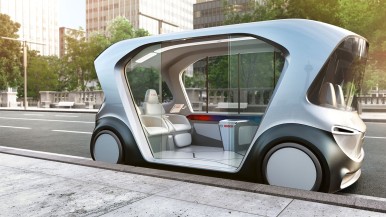
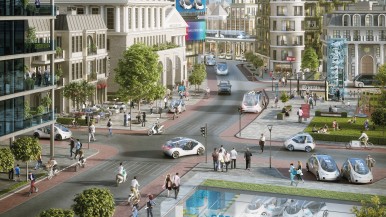
A light, airy, minimalistic design, a futuristic outer shell made of display screens and glass, and a spacious interior – that is how architects might describe a novel structure, but in actuality the description also fits a completely new class of vehicle and a new kind of mobility: driverless electric shuttles that glide almost silently through city centers and are seamlessly connected with their environment. These will soon be a common sight on our city streets – whether they are transporting goods or people. Bosch provides components and systems for automating, connecting, and electrifying the shuttles, but shuttle mobility won’t be possible without mobility services. In the future, the company will offer these services too, bundling them into a smart, seamlessly connected ecosystem. That will include booking, sharing, and networking platforms, parking and charging services, and software solutions for managing and maintaining the vehicles, as well as infotainment during the journey. “Bosch is developing a unique package of hardware, software, and mobility services for shuttle mobility of the future,” says Dr. Markus Heyn, member of the board of management of Robert Bosch GmbH. At CES 2019 in Las Vegas, the world’s biggest electronics show, Bosch will be presenting its solutions for this area of transportation with a concept shuttle, and visitors will be able to experience its full range of services.Bosch services for users and shuttle operators The emergence of the shuttle segment is a result of rising demand for ridesharing services: in Europe, the U.S., and China alone, about one million such on-demand shuttle buses will be on the roads as early as the year 2020, growing to 2.5 million by 2025 (source: Roland Berger). Many of these vehicles, available 24/7, will be fully electric, and they will also be completely autonomous by the middle of the next decade at the latest. That’s why Bosch has packed every square centimeter of its concept shuttle with the appropriate technology – from electric powertrains and 360-degree surround sensors to connectivity management and vehicle computers. Yet these components and systems go only part of the way towards shuttle mobility. To make on- demand vehicles suitable for flexible everyday use, they must be connected to mobility services. “In the future, every vehicle on the road will make use of Bosch digital services,” Heyn says. These services allow users to book the vehicles, share rides with other passengers, and pay for the journey. Charging, repairing, and maintaining the vehicles, plus route planning and administrative activities, also call for services that Bosch will offer shuttle fleet operators in a seamlessly connected ecosystem. Booking and sharing Users can easily book a shuttle via smartphone, regardless of whether they’re relaxing on the sofa or sitting at their desk at work. Working behind the scenes, an algorithm identifies the vehicle closest to the requested location and finds other users who wish to travel a similar route. The more passengers a single shuttle can transport, the cheaper the journey for everyone. This approach also reduces the amount of traffic in cities and mitigates the impact on the environment. Bosch is developing the necessary software platforms to make this a reality. When the shuttle pulls up to the requested pick-up point, users again use their smartphones to identify themselves – thanks to Bosch’s Perfectly Keyless digital access service. It recognizes the owner’s smartphone as unmistakably as a digital fingerprint and opens the vehicle only for them. Every passenger always gets the seat that they reserved. Moving forward: electrified and automated Bosch’s electric axle drive makes the shuttles especially efficient yet affordable as they wend their way through the city. And the company’s Convenience Charging service knows just how long the battery charge will last and where to recharge the vehicle. This service means that even today, drivers no longer need to worry about being stranded with a dead battery. It also links vehicle information, such as the current state of battery charge or how much energy the heating and air-conditioning systems are consuming, with environmental data such as congestion and weather forecasts, so as to predict vehicle range with particular accuracy. Furthermore, Convenience Charging finds the ideal charging station and can reserve it in advance. And thanks to a standardized access and payment system, charging is easier than ever. Driverless e-shuttles provide users with transportation that is not only nearly emissions- free, but also very safe. For automation, Bosch develops and makes its own radar, video, and ultrasonic sensors, braking control systems, and power steering, to name a few examples. Smart digital services are indispensable here, too: Bosch predictive road- condition services let automated vehicles know in advance what environmental conditions to expect. They can thus adapt their driving style as needed so as to ensure maximum safety throughout the journey. The Bosch road signature is a map-based localization service with which automated vehicles can accurately determine their position in the lane down to a few centimeters – another crucial prerequisite for the safety of automated shuttles. Comfortable interior Bosch has designed the interior of its concept vehicle to provide space for four passengers, seating them across from one another to maximize legroom and comfort. Infotainment is provided on screens that can be used either by each passenger individually or in groups; for example, a family can watch a movie together as they travel somewhere for the weekend, or colleagues can work on a presentation on their way to the office. Smartphones use the on-board Wi-Fi and can integrate seamlessly with the infotainment system, thanks to Bosch connectivity technology. Its concierge service turns the shuttle into a personal assistant. With all kinds of information at its disposal, the shuttle can provide passengers with recommendations, advance bookings, weather reports, and travel tips at any time. Once the shuttle has arrived at its destination, the passengers can pay for their journey with Bosch’s e-payment service. Maintenance and administrative activities But Bosch services do not end when a rideshare journey is over: the company’s camera- based system for the vehicle interior checks whether anyone has forgotten their phone or handbag. If a passenger does forget something, the shuttle informs them directly via smartphone. The cameras can also detect gum on the seat or an overturned coffee cup – in other words, whether the shuttle needs cleaning – and can make the necessary arrangements immediately. This is so every passenger can start their journey in a clean shuttle. Bosch’s service for over-the-air updates can determine whether the driverless shuttles have the latest software version. The service detects software updates as soon as they are available and executes them in the vehicle securely and reliably. Thanks to sensors installed in the vehicle, predictive diagnostics can monitor the condition of key components and notify the shuttle before a fault actually occurs, so it has enough time to drive itself to a repair shop. This prevents the car from suddenly breaking down, which is a boon to operators. In the future, Bosch will pool updates from the data cloud and predictive diagnostics into a comprehensive connectivity platform. This will give vehicle manufacturers and shuttle service operators a constant overview of the condition of their fleets, so they can ensure that their shuttles are always ready for action. And finally, the Bosch subsidiary ESCRYPT’s security solutions handle vehicle security – whether for keyless access systems, data connectivity with the outside world, or software updates.

15.03.2018

Press release

Automated mobility

Bosch analysis: driver assistance systems continue their strong advance

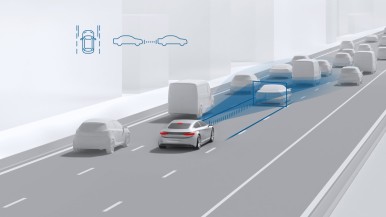
Stuttgart, Germany – People buying new cars today in Germany and Europe are placing more and more value on having electronic assistants on board. “There is a clear trend: it will soon be just as natural to have cars fitted with driver assistance systems as it is with a radio and ESP,” says Bosch board of management member Dr. Dirk Hoheisel, referring to the results of a Bosch analysis carried out on the basis of new registration statistics for 2016. According to these statistics, parking and lane assist systems, as well as emergency braking systems are becoming increasingly popular. For example, 62 percent of new passenger cars registered in Germany in 2016 were equipped with some kind of parking assistance system – ranging from parking beepers to automatic parking assistants. Second place in the popularity scale was taken by automatic emergency braking systems that warn drivers or bring the car to a halt in an emergency. More than one in every three new cars registered in 2016 (38 percent) is able to help drivers to avoid accidents in this way. For more than a quarter of these vehicles, an emergency braking system is even part of the car’s standard fittings. Just behind in third place was driver drowsiness detectionfitted in 37 percent of all new passenger cars in 2016. However, the largest growth was recorded for lane assist systems. Compared with the previous year, there were twice as many of these on board new cars in 2016. Another interesting development was in relation to adaptive cruise control (ACC). Although barely fitted in four percent of newly registered cars in Germany in 2013, in 2016, this function was installed in nearly one in five new cars (19 percent).Driver assistance systems are increasingly fitted as standard equipment Parking assistance systems, emergency braking systems, and lane assist systems are also the most popular driver assistance systems in the U.K., the Netherlands, Belgium, and France – in that exact order. Parking assistance systems are even more widespread in France than they are in Germany: 67 percent of the new passenger cars registered there in 2016 provide their drivers with support while they park. Parking assistance systems are now included in the standard equipment of a vast majority of vehicles: at 63 percent of new cars, France has the highest proportion. In Germany, this figure is 42 percent. In Belgium and the Netherlands, 39 percent of new cars have an automatic emergency braking system – the highest proportion in Europe. Italy and Russia, which, alongside France, were included in the Bosch analysis for the first time, still have room to improve when it comes to driver assistance systems when compared with the other countries that were analyzed. However, 18 percent of new passenger cars registered in Italy in 2016 still had a lane assist system on board – and in Russia, they are getting the ball rolling with an installation rate of 6 percent. This is also true of automatic emergency braking systems, which also achieved a proportion of 6 percent in new passenger cars. Bosch is growing quicker than the market with driver assistance systems Driver assistance systems help drivers in confusing or critical traffic situations, and are an important step on the way to the accident-free and stress-free mobility of the future. If all vehicles in Germany had an automatic emergency braking system on board, for example, up to 72 percent of all rear-end collisions resulting in injury could be prevented. Installation rates for driver assistance systems are constantly increasing. As the largest provider of such systems, Bosch is also benefiting from this. “The market is currently growing by about 20 percent, and Bosch is growing even faster,” says Gerhard Steiger, president of Bosch’s Chassis Systems Control division. In 2019, the provider of technology and services will exceed the two-billion-euro mark with sales of its driver assistance systems. The one-billion mark was already achieved in 2016. At the moment, technical development is increasingly heading toward automated driving. The Bosch analysis shows that, with traffic jam assist, the first partially automated function has now also arrived on the market. In a traffic jam, the car automatically follows the vehicle in front, assuming the tasks of starting and accelerating as well as braking and steering within its own lane. Of the new cars in Germany that are equipped with ACC, almost half of them are also fitted with a traffic jam assist function, which is nine percent of all newly registered passenger cars. Bosch analysis based on 2016 statistics for newly registered cars In 2016, 3.4 million new cars were registered in Germany. Based on new vehicle registration statistics collected by the German Federal Motor Transport Authority (KBA) for the year 2016 as well as data (data status 22.03.2017) supplied by business intelligence firm IHS Markit, Bosch analyzed the passenger segments to see how – whether as standard or optional equipment – and which driver assistance systems are currently on offer. Bosch has been investigating the development of installation rates for driver assistance systems since 2013.

23.02.2018

Press release

Internet of Things

Bosch establishes division for connected mobility services

Berlin and Stuttgart, Germany – Bosch continues to drive forward its transformation into a provider of mobility services. Its new Connected Mobility Solutions division will bring together over 600 associates to develop and sell digital mobility services. These include vehicle sharing, ridesharing, and connectivity-based services for car drivers. “Connectivity will fundamentally change how we get from A to B, and in the process it will help to solve today’s traffic problems. We are using it to realize our vision of emissions-free, stress-free, and accident-free mobility,” said Dr. Volkmar Denner, chairman of the Bosch board of management, at the Bosch ConnectedWorld 2018 IoT conference in Berlin. Connectivity offers tremendous business potential. By 2025, there will be more than 470 million connected vehicles on the world’s roads (source: PwC). Just four years from now, the market for mobility services and associated digital services will be worth 140 billion euros (source: PwC). “Connected driving is a growth area for Bosch. Bosch aims for significant double-digit growth with the solutions it offers,” Denner said. The plan is for the new division to further extend the existing service portfolio. For instance, mobility services from Bosch send alerts about wrong-way drivers and turn smartphones into car keys. The latest of these is the ridesharing service offered by U.S. start-up Splitting Fares Inc. (SPLT). Denner also presented system!e in Berlin. Connected services for electromobility are set to further increase the suitability of electric driving for the mass market.Bosch enters the ridesharing business One growth market in the field of connected mobility is ridesharing, which encompasses online services and apps for carpools as well as for arranging driving services and taxis. By 2022, the number of ridesharing users worldwide is set to rise by 60 percent to 685 million (source: Statista). To date, most such services have been directed at people who happen to be traveling in the same direction or who want to book a trip at the last minute; companies and commuters have been seen as less of a priority. This is precisely where SPLT comes in. Recently acquired by Bosch, this U.S. start-up developed a platform that companies, universities, or municipal authorities can use to arrange ridesharing for their staff. This B2B approach is aimed directly at commuters: the SPLT app brings together people who want to share a ride to the same workplace or place of study. One advantage of this is that rides are shared by colleagues, which means users never have to get in the car with complete strangers. Within seconds, an algorithm locates a suitable rideshare, calculates the fastest route through traffic, and thus assumes what used to be the time-consuming task of coordinating the departure point, departure time, best route, and passengers. Sharing a ride is good for the nerves, for the wallet, and for the environment. Companies can also play a role in reducing traffic volume. “Connectivity is a way for us to rethink not just the car but the whole way we use modes of transport,” Denner said. Digital services for electric vehicles Bosch subsidiary COUP has provided e-scooters for rent in Berlin since 2016. After introducing e-scooter sharing to Paris last year, the service will launch in Madrid this year. This will bring the total number of e-scooters to 3,500. “Digital services will give electric driving a boost,” Denner said. At the IoT conference, the Bosch CEO presented system!e, a comprehensive system of connected electrified powertrain components and new service solutions for electric cars. To this end, Bosch has connected the electric drive to the Bosch Automotive Cloud Suite. The company is developing web-based services that rely on this interaction. In the future, intelligent electric cars will know precisely when their power will run out, but also where they can find their next charge. Eliminating range anxiety: Services that encourage everyday use For many car buyers, the worry that an electric car might leave them stranded is a deal-breaker. It is precisely this problem that system!e is designed to tackle. Because the electric drive is connected to the cloud, the system can produce an “extended range forecast.” An algorithm factors in vehicle data such as current battery charge, energy consumption of heating or air conditioning, and the driver’s driving style, as well as information from the vehicle’s surroundings. This includes the current traffic situation and topographical data for the route ahead. Based on this information, the system can reliably calculate the vehicle’s precise range. For longer journeys in an electric car, the extended range forecast is supplemented by the “charging assistant.” This service knows where all the charge spots are on a given journey, say from Munich to Hamburg, so it can plan ahead for necessary charging stops; it also manages the payment process. Thanks to additional information about for example restaurants, cafés, and shopping options, drivers can make the most of the charging time and relax. A third service manages vehicle charging in smart homes, helping to optimize how they use energy. It integrates the electric car into the smart home’s electricity grid, meaning the car’s battery supplements the stationary storage device for the house’s photovoltaic system. During the day, the car absorbs excess solar power and feeds it back at night as necessary. “For Bosch, mobility goes beyond the car. Our breadth of technology expertise in numerous fields puts us in an unparalleled position to develop and operate cross-application ecosystems,” Denner said. 4,000 participants, 70 exhibitors, and 140 speakers Bosch’s IoT activities are broadly diversified, encompassing solutions for connected mobility, connected manufacturing, as well as for connected energy systems and buildings. At the Bosch ConnectedWorld forum for the IoT industry in Berlin, more than 70 exhibitors will demonstrate what is already possible with the internet of things, and how it will improve people’s everyday lives in the future. On a 10,000 square-meter exhibition space at “Station” in Berlin, some 4,000 delegates will meet from February 21 to 22. In addition to the Bosch CEO Dr. Volkmar Denner, the roughly 140 speakers will include Dr. Dieter Zetsche (CEO Daimler), Dr. Frank Appel (CEO Deutsche Post DHL), and Johann Jungwirth (CDO Volkswagen). At a hackathon, some 700 programmers, start-up associates, and designers will develop new ideas for connected mobility services, automated driving, connected manufacturing and logistics, and connected living. The 2018 Bosch ConnectedWorld will be the fifth event of its kind. It is one of the world’s largest conferences on the internet of things.