Search & find:
media, releases and events to support your reporting about the Bosch Group.

20.10.2020

Press release

Powertrain systems

Bosch polls Europeans about the future of the powertrain: respondents in favor o ...

Stuttgart, Germany – According to a representative survey conducted in June 2020 by the market research institute Innofact on behalf of Bosch, no powertrain types have lost any of their relevance – whether batteries or fuel cells, gasoline or diesel engines. If the 2,500 survey respondents in Germany, France, Italy, and the U.K. had to decide on a new car tomorrow, one in two would opt for a stand-alone combustion engine for their primary car and around one in three for their second car. However, when asked what would be the most prevalently used powertrain in 2030, some 68 percent of those polled see the electrical powertrain in pole position, ahead of hybrids and combustion engines. Survey participants acknowledged the potential of fuel cell-powered cars, with around one in three seeing the fuel cell as the future of mobility. “Electric mobility is on its way – and that’s good news. This year alone, Bosch is investing 500 million euros in this domain. At the same time, we’re also continuously refining the internal combustion engine – because it’s still needed,” says Dr. Stefan Hartung, member of the Robert Bosch GmbH board of management and chairman of the Mobility Solutions business sector.Respondents want incentives for all powertrain types A further question reveals respondents’ open-mindedness toward powertrains of all types: when asked whether they favor incentives for vehicles equipped solely with combustion engines, in addition to the many government subsidies for electric cars and plug-in hybrids, 70 percent of the Europeans polled answered in the affirmative. The number of respondents in favor of government incentives to buy new cars with a conventional powertrain is highest in Italy at 83 percent, and lowest in the United Kingdom at 60 percent. In France, 77 percent are in favor; in Germany, 62 percent. “Incentivizing modern combustion engines can accelerate the vehicle fleet’s renewal, which would also help the environment and the climate,” Hartung says. Just under one-third of Europeans would like to see this subsidy run to at least 9,000 euros. This is the same as the maximum rebate currently offered by the German government for the purchase of an electric car. Two findings are notable: for one, 72 percent of city dwellers in the four surveyed European countries believe the combustion engine merits a subsidy. For the other, the majority (80 percent) of 18-to-29 year-olds also endorse incentives for cars with combustion engines. Even cars with conventional engines can run in a climate-neutral way. The key to this is renewable synthetic fuels (RSF), which are made from renewable hydrogen and CO2 captured from the surrounding air. On average, 57 percent of those taking part in the Bosch survey agreed that RSF should benefit from tax breaks. “There’s just no way around renewable synthetic fuels if we want to achieve our climate targets,” Hartung says. “Only with RSF can the more than one billion vehicles already on the road worldwide help contain global warming.” Can’t live without a car: respondents in Europe are unanimous In Europe, the status of the car and its importance for mobility is unlikely to change any time soon. Around 60 percent of those surveyed in Germany, France, Italy, and the U.K. are unable to imagine living without a car altogether. And a clear majority of the remaining 40 percent are only prepared to leave their car behind some of the time. The car’s approval rating in rural Europe is 77 percent. Incidentally, these findings are roughly similar among 18-to-29 year-olds, around half of whom also come out clearly in favor of a car. While 61 percent of those surveyed in Germany and 47 percent in the U.K. cited greater flexibility as the most important reason for having a car, 41 percent of French respondents indicated they need it mostly for work. In contrast, 55 percent of surveyed Italians prefer the car to other forms of mobility that they feel are less convenient. “For the foreseeable future, the car will remain the number one means of transport – and has excellent prospects of becoming even more climate-friendly,” Hartung says. Bosch’s objective is for people to be able to stay mobile in an affordable and eco-friendly way. The future of the powertrain: Bosch champions electromobility and combustion technology Bosch aims to make transportation as resource-friendly as possible, and is pursuing the vision of CO2-neutral and virtually emissions-free mobility in several ways. In its approach to future powertrain technology, the supplier of technology and services is keeping an open mind. On the one hand, Bosch aims to become the market leader in electromobility with battery and fuel cell-powered vehicles. Electric vehicles are climate-neutral if the charging power and hydrogen are sourced from renewables. On the other hand, Bosch is continuing to refine combustion engines to contain global warming and protect the environment to the greatest extent possible. If they run on RSF, gasoline and diesel engines can also be climate-neutral on the road. Bosch expects around one-third of all newly registered vehicles worldwide to be purely electric by 2030. Two-thirds of all new vehicles will still be powered by a combustion engine, many of them as hybrids.

01.10.2019

Press release

Powertrain systems

Bosch: Renewable synthetic fuels for less CO₂

Stuttgart, Germany – The Paris Agreement calls for global warming to be limited to 2℃ above pre-industrial levels, preferably even 1.5°C. The fossil CO₂ emitted by road vehicles will have to be reduced to nearly zero over the next three decades for that to happen. The big question is how. Electromobility is just now picking up momentum. Electric cars are only as emissions-free as the production of electricity that charges their batteries. Besides, around half the vehicles that will be on the road in 2030 have already been sold, most with gasoline or diesel engines. Legacy vehicles will also have to play their part in cutting CO₂ emissions. One path to achieving this is with renewable synthetic fuels.Seven reasons why renewable synthetic fuels will be part of tomorrow’s mobility mix: 1) Time Renewable synthetic fuels have long since left the basic research phase. Technically speaking, it is already possible to manufacture synthetic fuels. First, they apply electricity generated from renewable sources to obtain hydrogen from water. Then they add carbon. Finally, they combine CO₂ and H₂ to make synthetic gasoline, diesel, gas, or kerosene. The production process is viable, but capacity is lacking. It has to be expanded rapidly to meet demand. Incentives could come from fuel quotas, offsetting CO₂ savings against fleet consumption, and long-term planning certainty. 2) Climate neutrality As their name suggests, renewable synthetic fuels are made exclusively with energy obtained from renewable sources such as the sun or wind. In the best-case scenario, manufacturers capture the CO₂ needed to produce this fuel from the surrounding air, turning a greenhouse gas into a resource. This creates a virtuous cycle where the CO₂ emitted by burning renewable synthetic fuels is reused to produce new fuels. Vehicles on the road, when powered by synthetic fuel, are ultimately climate-neutral. 3) Infrastructure and powertrain technology The Fischer-Tropsch process produces renewable synthetic fuels that can be used with today’s infrastructure and engines. Experts call them “drop-in” synthetic fuels because they can be deployed without first modifying infrastructure and vehicles, and they have an immediate impact and deliver faster results. They may also be added to conventional fuel to help reduce CO₂ emissions from vehicles already on the road today. This way, these fuels could contribute to the cause even before they are ramped up for larger-scale production. The chemical structures and basic properties of gasoline remain intact, so even vintage cars can run on synthetic gas. 4) Costs Producing synthetic fuels is still a costly process. Renewable synthetic fuels will become considerably more affordable when production capacities are expanded and the cost of electricity generated from renewable sources comes down. Present studies suggest that a pure fuel cost of between 1.20 and 1.40 euros a liter can be achieved (excluding any excise duties) by 2030, and as little one euro by 2050. These fuels’ cost disadvantage compared with fossil fuels could be significantly reduced if value was ascribed to the environmental advantage of renewable synthetic fuels. The fact that they are compatible with today’s infrastructure and automotive technology gives them an advantage over other alternative powertrains. 5) Potential applications Even at the point in the future when all cars and trucks are powered by batteries or fuel cells, airplanes, ships, and parts of the heavy-goods transport sector will continue to rely on conventional fuels. Combustion engines powered by carbon-neutral synthetic fuels are therefore a crucial path to explore. 6) Resources Fuel in the tank or food on a plate – this question does not come up with synthetic electricity-based fuels. Innovative biofuels, which are for example produced from waste materials, are useful – however, the supply is limited. When renewable energy is used, synthetic fuels can be produced in unlimited quantities. Sufficient renewable energy can be generated worldwide to produce fuel that can then be stored and transported relatively easily. 7) Storage and transport Synthetic fuels are produced with renewable energy. This process yields a gas or liquid. And that makes renewable synthetic fuels a good medium for storing large amounts of renewable energy and even transporting it across the globe cost-effectively. They can serve as a buffer for fluctuating solar or wind energy or to circumvent regional restrictions on the expansion of renewable energy production. This also affects efficiency ratings. A compact electric car charged in Germany with renewable electricity from Germany converts around 60 to 70 percent of that grid power into road performance. If the electricity comes from further afield and the energy has first to be stored in a chemical medium before being converted back into electricity, efficiency drops to 20–25 percent. This is the same efficiency as a vehicle run on renewable synthetic fuels.

13.12.2018

Press release

Powertrain systems

Bosch trialing fully renewable diesel fuel

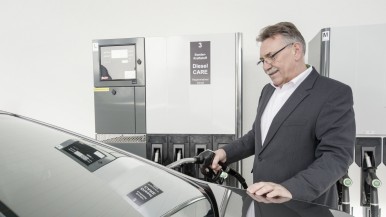
Since early November, the cars chauffeuring the management board members of Robert Bosch GmbH have been running on fully renewable diesel. Known as “C.A.R.E. diesel,” this fuel is synthesized mainly from by-products and waste materials. Its supplier Toolfuel claims that C.A.R.E. diesel reduces the CO2 emissions of these cars by around two-thirds, or 65 percent, from well to wheel. “Renewable and synthetic fuels can contribute greatly to limiting global warming. Their use has a much faster ecological impact than replacing vehicles and infrastructure, as existing filling stations can remain in operation,” says Dr. Volkmar Denner, CEO of Robert Bosch GmbH. For him, the consequences are clear: “Synthetic and renewable fuels should be factored into the CO2 fleet regulation for passenger cars and trucks.” Since C.A.R.E. diesel has yet to be included in the German law on the prevention of airborne pollution, it is not currently available at regular filling stations. In its trials with fully renewable diesel, Bosch wants to show if and how it could be adopted on a broad scale.Bosch is offering partly renewable diesel at certain company filling stations The company is encouraging the use of renewable and synthetic fuels. R33 Blue Diesel, an approved fuel made by Shell, has been available for trial and company car pool vehicles at the filling stations at the Bosch locations in Feuerbach, Schwieberdingen, and Hildesheim for some weeks now. This fuel contains up to 33 percent renewables. The carbon footprint of the more than 1,000 Bosch vehicles that regularly refuel at these three filling stations could thus be reduced by as much as 20 percent from well to wheel. On top of that, Bosch aims to make synthetic and renewable fuels available for company cars and internal delivery vehicles at all its company filling stations across Germany. The supplier of technology and services is also gradually incorporating battery-powered electric vehicles into its fleet. Fewer diesel vehicles mean more CO2 emissions from Europe’s road traffic Since it accounts for 18 percent of global CO2 emissions, road traffic also contributes to the greenhouse effect. On the upside, there has been some progress. In Germany, the CO2 emissions of newly registered vehicles have fallen by one quarter since 2007. On the downside, the CO2 emitted by traffic on European roads is rising again. One reason for this is the shrinking share of newly registered diesel vehicles. They have a great advantage over gasoline models when it comes to CO2 emissions. Compared with its gasoline variant, a diesel model’s carbon footprint is around 15 percent lower on average. “We need diesel and other solutions such as renewable and synthetic fuels in addition to electromobility to further reduce greenhouse gas emissions,” Denner says. If renewable and synthetic fuels were widely used by European passenger cars, this alone could save up to 2.8 gigatons of CO2 by 2050, and that is without electrification factored into the equation. This is three times the amount of carbon dioxide Germany emitted in 2016. Bosch has been exploring renewable and synthetic fuels for some time now. The company’s fuel-carrying components for diesel engines, such as the fuel pump and injection nozzles, have been rigorously tested, and vehicle manufacturers are free to approve them for use with renewable and synthetic fuels. Bosch aims to make transportation as resource-friendly as possible Bosch is approaching future powertrain technology with an open mind. The company is committed to a vision of virtually emissions-free driving. While it will continue to improve the internal-combustion engine, it also aims to become a leader in the market for electromobility. After years of research and development effort, Bosch presented a new diesel technology in April 2018. It is capable of cutting NOx emissions from diesel vehicles to well below the statutory 120 milligram-per-kilometer limit that will come into effect in 2020 – and it can do so in any real traffic conditions. These results were achieved in test vehicles with heavily modified engine and emission settings. The vehicles were also equipped with leading-edge technology and components, just recently introduced to the market. A combination of advanced fuel-injection technology, a newly developed air management system, and intelligent temperature management made such low readings possible. Bosch customers can now tap this system know-how to develop future lines of mass-manufactured vehicles. Q&A about renewable C.A.R.E diesel What is C.A.R.E. diesel? C.A.R.E. diesel is a fully renewable fuel made mainly of by-products and waste materials, recycled cooking oils, and grease. It contains no conventional diesel – that is, fossil fuel. Neste, a Finnish mineral oil company and biofuel manufacturer, makes C.A.R.E. diesel; the company’s partner Toolfuel distributes it in Germany. C.A.R.E., a trademark of Toolfuel, is short for CO2 Reduction, Arctic Grade, Renewable, Emission Reduction. What does Bosch hope to gain by using C.A.R.E. diesel? Bosch is making every effort to optimize internal combustion engines and believes diesel powertrains help reduce CO2 emissions in road traffic. This reduction in CO2 emissions is even greater when vehicles run on renewable paraffinic fuels such as C.A.R.E. diesel, which helps protect the environment and conserve resources. Why only a 65 percent reduction in CO2 emissions? The CO2 advantage here is that only the CO2 emissions resulting from the conversion of waste materials into fuel are taken into account. The waste materials themselves are deemed to be CO2 neutral, as they already exist. What technical upgrades do vehicles need to run on C.A.R.E. diesel? C.A.R.E. diesel is a paraffinic fuel and, as such, has a slightly lower density and higher ignitability than conventional diesel fuel. This is why regulatory authorities have drafted an additional standard, EN 15490, for paraffinic diesel fuels. The EN 590 standard applies to conventional diesel fuel. Manufacturers have to specifically approve vehicles for fuels with the properties set out in EN 15940. This is important, as they must first investigate component compatibility, potential increases in peak pressure during combustion, and other factors. When will C.A.R.E. diesel be available at regular filling stations? Various test fleets are already running on C.A.R.E. diesel. As it stands now, C.A.R.E. diesel is unavailable in quantities sufficient to supply filling stations on a wide scale across Europe. Also, many countries have national laws regulating the fuel sold at public filling stations. In these countries, including Germany, the EN 15940 standard has yet to be adopted. The decision to amend EN 15940 to the 10th German law on the prevention of airborne pollution is still pending. How much does a liter of C.A.R.E. diesel cost at the pump? With approval still pending, C.A.R.E. diesel is currently unavailable at filling stations. A liter of C.A.R.E. diesel is a little more expensive than conventional diesel fuel. This markup is due to manufacturing costs.