Search & find:
media, releases and events to support your reporting about the Bosch Group.

Exercice 2022 : Bosch atteint ses objectifs dans un environnement difficile

30.01.2025

Press release

Bosch Group

Exercice 2022 : Bosch atteint ses objectifs dans un environnement difficile

Stuttgart, Allemagne – Malgré une situation macro-économique difficile, Bosch, fournisseur de technologies et de services, a réussi à augmenter ses ventes et son résultat pour l’exercice 2022. Selon les chiffres provisoires1, le groupe Bosch a réalisé un chiffre d’affaires de 88,4 milliards d’euros. Les ventes ont ainsi augmenté d’environ 12 % par rapport à 2021, 10 % hors effets de change. Le résultat opérationnel (EBIT) atteint 3,7 milliards d’euros. La marge opérationnelle s’élève à environ 4 %. « La difficile année 2022 a montré une fois de plus que Bosch est capable de faire face aux situations de crise tout en maintenant ses fortes capacités d’innovation », a déclaré Stefan Hartung, président du directoire de Robert Bosch GmbH, lors de la présentation des résultats provisoires du Groupe. « Dans un environnement qui reste difficile, nous garantissons nos opportunités de croissance à l’échelle mondiale grâce à des investissements ciblés et nous élargissons notre présence internationale. Nous voulons offrir aux personnes du monde entier « des technologie pour la vie » et apporter ainsi une contribution significative à la société – du chauffage plus respectueux de l’environnement aux économies d’énergie en passant par la mobilité durable. »Parmi les grands projets mis en avant lors de la présentation de ces résultats provisoires : • Bosch a récemment annoncé un investissement de près de 950 millions d’euros sur dix ans dans un centre d’ingénierie et de fabrication à Suzhou, en Chine. Le centre développera des solutions et produits pour la mobilité dans les domaines de l’électrification et de l’automatisation, spécialement conçus pour répondre aux besoins du marché local. • Bosch contribue également à renforcer la position de l’Europe en tant que place de haute technologie : « Un excellent exemple est le développement de nos usines de semi-conducteurs à Dresde et Reutlingen », a déclaré Stefan Hartung. « Jusqu’en 2026, nous envisageons d’investir 3 milliards d’euros supplémentaires dans notre activité de semi-conducteurs – cela contribuera à lutter contre la pénurie de puces dans le secteur de la mobilité. » • Bosch prévoit également de se concentrer davantage sur le développement de ses activités internationales, notamment en Égypte, en Inde, au Mexique, aux États-Unis et au Vietnam. La coopération internationale est essentielle à la prospérité et à l’action pour le climat Pour Bosch, la croissance dans les années à venir sera portée par les évolutions du marché et de l’environnement technologique, avec la connectivité, l’automatisation et l’électrification, ainsi que l’importance croissante de la durabilité. La demande croissante dans les régions émergentes telles que les pays de l’ASEAN offrira une opportunité de croissance supplémentaire. Dans ce contexte, Stefan Hartung estime que l’entreprise est bien positionnée dans la situation économique et énergétique actuelle. Cependant, les pénuries d’énergie à l’origine de l’inflation peuvent avoir un impact négatif sur la consommation et donc sur la stabilité monétaire à long terme. Pour cette raison, il se félicite de l’introduction d’une politique monétaire restrictive par la banque centrale. Dans le même temps, il met en garde contre la formation de blocs économiques mondiaux. Selon lui, « une fragmentation des systèmes économiques menace la force d’innovation et la prospérité de chacun ». « Plus important encore, l’action pour le climat a besoin d’une coopération internationale. » Stefan Hartung considère par ailleurs le développement des énergies renouvelables comme un moyen de résoudre les objectifs contradictoires de durabilité environnementale et économique. « La transformation des systèmes énergétiques doit rester abordable, ne doit pas entraîner de pannes d'électricité pour les entreprises ou les ménages, et doit, dans la mesure du possible, laisser de côté les combustibles fossiles. » Bosch contribue à cette transformation des systèmes énergétiques en accélérant le développement de la technologie des piles à combustible et de l’hydrogène. « En matière d’électromobilité, nous enregistrons un nombre de commandes en croissance constante », a déclaré Stefan Hartung. Bosch prévoit ainsi de réaliser un chiffre d’affaires de 6 milliards d’euros sur ce segment d’ici 2026. En Chine, les activités pour les essieux et les moteurs électriques devraient d’ores-et-déjà générer un bénéfice cette année. Technologies neutres pour le climat : la crise énergétique stimule la demande Malgré tous les défis qu’elle représente, la crise énergétique et climatique augmente la demande mondiale de technologies neutres pour le climat, ouvrant ainsi de nouvelles perspectives pour Bosch, sachant que l’entreprise génère déjà un chiffre d’affaires de plus de 20 milliards d’euros avec ses produits pour la maison. « Notre gamme de produits peut avoir un impact positif sur environ 90 % de la consommation d’énergie dans la maison », a déclaré Christian Fischer, vice-président du directoire de Bosch, qui est également responsable des activités de l’entreprise dans le domaine des technologies de la maison et du bâtiment. « Sur ce pourcentage, 85 % concernent le chauffage et l’eau chaude et 15 % les appareils électroménagers. » En Allemagne, Bosch a déjà augmenté ses ventes de pompes à chaleur de 50 % en 2022. Le marché européen des pompes à chaleur devrait connaître une croissance annuelle de 25 à 35 % d’ici 2025, et de près de 40 % chez Bosch, ce qui lui permettra de gagner des parts de marché. C’est pourquoi le groupe augmente sa capacité de production pour les pompes à chaleur en Europe : depuis le début de l’année, un nouveau site de production se développe à Eibelshausen, en Allemagne. Bosch voit un potentiel de croissance supplémentaire dans la transformation des systèmes énergétiques. « Cependant, cette transformation doit être abordable », a déclaré Christian Fischer. « Dans les bâtiments, il ne faut pas sous-estimer les coûts de rénovation. » C’est la raison pour laquelle Bosch privilégie les systèmes de chauffage hybrides associant pompe à chaleur et chaudière à gaz. Le vice-président du directoire de Bosch analyse ainsi un potentiel supplémentaire dans l’optimisation combinée des flux énergétiques dans les véhicules et dans les bâtiments : « nous électrifions tout, des vélos aux systèmes hydrauliques, et nous savons également comment le faire pour les bâtiments et les véhicules. » La durabilité, un atout pour attirer les nouveaux talents Bosch a également progressé en 2022 dans la mise en oeuvre de ses propres objectifs en matière de durabilité et de protection du climat. Au cours de l’année, la société a porté de 89 à 94 % la part des énergies renouvelables dans sa consommation d’électricité. « En 2022, nous avons atteint près de la moitié de l’objectif d’économie d’énergie de 1,7 térawattheure que nous nous sommes fixés pour 2030 », a déclaré Filiz Albrecht, membre du directoire et directrice des relations industrielles de Bosch, également responsable de la durabilité chez Bosch. « Notre engagement en faveur du développement durable fait de Bosch un employeur plus attractif ». Selon Filiz Albrecht, la stratégie de développement durable de l’entreprise joue un rôle de plus en plus important pour les candidats, particulièrement dans une période de pénurie de main d’oeuvre qualifiée, comme c’est le cas aujourd’hui. Elle a souligné que l’Inde gagne en importance dans la course aux experts en logiciels. Bosch y compte 17 000 Page 4 de 7 collaborateurs dans ce domaine et leur nombre est passé de 38 000 à 44 000 dans le monde, entre 2021 et 2022. Le besoin de développeurs de logiciels reste élevé et l’entreprise prévoit d’en recruter environ 10 000 de plus d’ici le milieu de la décennie. « Bosch va bientôt employer plus de 50 000 collaborateurs en développement de logiciels », a déclaré Filiz Albrecht. Le groupe Bosch développe également les compétences digitales de ses collaborateurs travaillant sur les lignes de production : cette année verra par exemple le lancement de « LernWerk », une initiative dans le secteur des solutions pour la mobilité. Son objectif premier est d’améliorer les compétences requises pour travailler dans « l’Usine du futur », et ce sur tous les sites en Allemagne. Évolution de l’activité en 2022 : le secteur de la mobilité affiche la plus forte croissance des ventes « Malgré la pénurie de semi-conducteurs et une un contexte économique complexe, tous les secteurs d’activité ont augmenté leurs ventes », a déclaré Markus Forschner, membre du directoire et directeur financier de Robert Bosch GmbH. Avec 52,6 milliards d’euros, le secteur des Solutions pour la mobilité, a une fois de plus généré les ventes les plus élevées en 2022. L’augmentation des ventes de 17 % représente une croissance de 12 % après ajustement des effets du taux de change. « La bonne nouvelle est que nos ventes ont augmenté plus rapidement que la production automobile », a déclaré Markus Forschner. Néanmoins, la rentabilité n’est pas encore satisfaisante : les marges ont été grevées par des augmentations de coûts tout au long de la chaîne logistique, ainsi que par des investissements nécessaires pour la transformation de l’entreprise dans le domaine de la mobilité, a-t-il déclaré. Le secteur des Techniques industrielles a enregistré une croissance de son chiffre d’affaires de 14 % pour atteindre 6,9 milliards d’euros. Après correction des effets de change, les ventes ont augmenté de 11 %. Selon Markus Forschner, l’achat d’HydraForce et l’acquisition d’Elmo sont des étapes importantes pour l’activité des Techniques industrielles de Bosch. Le secteur des Biens de consommation est parvenu à augmenter légèrement ses ventes malgré une forte réticence des consommateurs à acheter des appareils électroménagers et de l’outillage électroportatif, a déclaré Markus Forschner. Son chiffre d’affaires a augmenté de 2 % pour atteindre 21,5 milliards d’euros. Après correction des effets de change, ce chiffre passe à 3 %. Dans le secteur des Techniques pour les énergies et les bâtiments, la croissance reflète en revanche la forte demande de technologies performantes énergétiquement pour les maisons et les bâtiments, avec un chiffre d’affaires qui atteint les 7 milliards d’euros. Une augmentation de 15% qui représente 13% après correction des effets de change. Evolution de l’activité en 2022 : forte croissance au second semestre « Il est très encourageant de constater que toutes les régions ont enregistré une augmentation significative de leurs ventes », a déclaré Markus Forschner. « Nous avons connu une croissance particulièrement forte au second semestre 2022. » En Europe, le chiffre d’affaires s’élève à 44,8 milliards d’euros, soit une progression de 8%, 10% hors effets de change. « La croissance en Europe a été plus durement touchée que les autres régions par la guerre en Ukraine et ses conséquences », a déclaré Markus Forschner. En Amérique du Nord, le chiffre d’affaires a augmenté de 25 % pour atteindre 14,3 milliards d’euros. L’augmentation s’élève à 11 % après correction des effets de change, ce qui représente la deuxième plus grande progression du chiffre d’affaires de toutes les régions du groupe Bosch. Markus Forschner a souligné que le développement des activités de Bosch dans les solutions de chauffage et de climatisation était particulièrement prometteur. En Amérique du Sud, le chiffre d’affaires s’élève à 1,8 milliard d’euros. Les ventes y ont ainsi augmenté plus rapidement que dans toutes les autres régions, avec une augmentation de 30 %, ou 21 % hors effets de change. Comme l’a souligné Markus Forschner, « la vigueur de l’économie a été un facteur clé de cette croissance. » Dans la région Asie-Pacifique, le chiffre d’affaires a augmenté de 12 %, ou 8 %, hors effet de change, avec un chiffre d’affaires de 27,5 milliards d’euros. Selon Markus Forschner, la région a bénéficié d’une forte croissance en Inde. En revanche, les changements apportés par la Chine à sa politique sur la crise de Covid-19 ont freiné l’activité dans le pays à la fin de l’année. Evolution des effectifs en 2022 : 18 000 collaborateurs supplémentaires Au 31 décembre 2022, le groupe Bosch comptait dans le monde environ 420 300 collaborateurs. C’est environ 18 400 collaborateurs de plus que l’année précédente, ce qui représente une augmentation d’environ 4 %. 2 600 collaborateurs ont rejoint le groupe Bosch en Allemagne, portant ainsi le nombre total de collaborateurs à 133 400 personnes. « Près de la moitié de cette croissance concerne nos collaborateurs en recherche et développement », a déclaré Markus Forschner, avec près de 84 800 collaborateurs dans ce domaine, dont 44 000 ingénieurs en logiciels. Perspectives 2023 : ralentissement de la reprise économique mondiale Bosch prévoit un ralentissement économique et s'attend à ce que la production économique mondiale augmente de moins de 2 % pour l'année en cours. « Le climat économique mondial reflète déjà des pesanteurs économiques », a déclaré Markus Forschner. « La hausse des taux d'intérêt pèse sur les investissements, notamment sur l'activité de construction et sur la consommation privée. » En Europe, cette situation est aggravée par la hausse marquée des coûts énergétiques, même après les baisses récentes. En Chine, en revanche, après l’abandon de la politique zéro Covid, la reprise est susceptible de débuter une fois les vagues d’infection massives réduites. Selon Markus Forschner, Bosch ressent un ralentissement économique dans des secteurs importants et s’attend à une pression continue sur les coûts dans l’ensemble des chaînes de valeur. Dans le même temps, un investissement important doit être fait pour financer la croissance des technologies futures. « Une entreprise innovante comme Bosch doit faire de gros investissements », a-t-il déclaré. Courant 2023, poursuit-il, Bosch vise ainsi à augmenter ses ventes et à améliorer encore sa rentabilité. « Nous sommes en bonne voie d’atteindre notre objectif de marge à long terme d’au moins 7 % », a déclaré Markus Forschner. « Sur ces mers économiquement agitées, nous maintenons un équilibre entre la protection de notre rentabilité et de notre solidité financière d’une part, et les investissements et les acquisitions possibles d’autre part. »

For safer roads: Bosch teams up with Microsoft to explore new frontiers with gen ...

28.02.2024

Press release

Bosch Group

For safer roads: Bosch teams up with Microsoft to explore new frontiers with gen ...

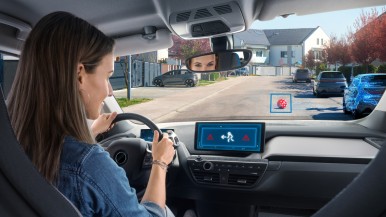
Stuttgart, Germany – It’s a scenario that no driver ever wants to see: a ball rolling out into the road. The chances are it will be followed immediately by a child in hot pursuit, oblivious to any traffic. But while human drivers can assess this situation using their contextual knowledge, today’s assisted and automated driving systems still have to learn how to do it. Bosch is pursuing the use of generative AI in terms to further improve automated driving functions. As part of this, Bosch and Microsoft are exploring opportunities to collaborate and leverage the power of generative AI. “Bosch is working on bringing a new dimension of AI applications into the vehicle,” said Dr. Stefan Hartung, chairman of the Bosch board of management, at this year’s Bosch Connected World (BCW) AIoT industry conference in Berlin. The expectation is that generative AI will enable vehicles to assess situations and react accordingly, and in this way keep road users even safer. Greater safety on the roads is also the wish of 60 percent of respondents to this year’s Bosch Tech Compass, a worldwide representative Bosch survey on the subjects of technology and AI.Generative AI to make road traffic safer The two companies anticipate that a collaboration would take the performance of automated driving functions to the next level. They would like to see generative AI help enhance convenience in the vehicle and to provide greater safety for all road users. To achieve this, Bosch's comprehensive understanding of vehicles and automotive-specific AI expertise will be invaluable, as well as their access to vehicle sensor data to feed the generative AI. “In our unwavering commitment to safer roads, Microsoft is eager to explore collaboration opportunities with Bosch to pioneer the realm of generative AI,” said Uli Homann, Microsoft CVP and Distinguished Architect. Even today, when it comes to training systems for automated driving, AI quickly comes up against its limits. Today’s driver assistance systems can detect people, animals, objects, and vehicles, but in the near future generative AI could help determine whether a situation could potentially lead to an accident. Generative AI utilizes vast amounts of data to train systems for automated driving, enabling them to draw improved conclusions from this data. For example, it could deduce whether an object on the road ahead is a plastic bag or a damaged vehicle part. This information can be used either to communicate directly with the driver – such as by displaying a warning – or to initiate appropriate driving maneuvers, such as braking while switching on the hazard warning lights. Bosch and Microsoft have already partnered to develop a universal software platform for seamlessly connecting cars and the cloud, and are looking forward to work together to identify new opportunities to bring cutting-edge AI technology to their customers and the autonomous vehicle industry. Generative AI as a boost to innovation “Generative AI is a boost to innovation. It can transform industry in much the same way as the invention of the computer,” says Tanja Rueckert, member of the Bosch board of management and chief digital officer. The new 2024 Bosch Tech Compass shows this as well: 64 percent of respondents believe that AI is the technology with the greatest importance for the future. In comparison, only 41 percent of respondents were of the same opinion just one year ago. From manufacturing to everyday office work, generative AI is already being used in many areas at Bosch. In addition to Microsoft, the company is working with several partners, including AWS, Google, and Aleph Alpha. The Bosch Group’s venture capital unit, Bosch Ventures, invested in the AI company Aleph Alpha last year. Bosch also announced it would collaborate with the startup on finding new use cases both for Bosch associates and customers. “Bosch and Aleph Alpha want to learn from each other, benefit from each other’s know-how, and work together on cross-domain use cases,” Rueckert says. This partnership is now bearing its first fruits in North America: in collaboration with Aleph Alpha, Bosch is debuting AI-based speech recognition on behalf of a premium car manufacturer. In this solution, a chatbot understands and answers breakdown service calls with the help of natural language processing, which also recognizes dialects, accents, and moods. The call is taken directly, reducing the driver’s waiting time to a minimum. As many as 40 percent of calls can be processed and resolved automatically; for more complex queries, the bot transmits all relevant information to a service center agent who takes over the case immediately. From the AI search engine to manufacturing AI experts at Bosch are currently working on well over 120 specific applications that these new AI models open up for the company’s associates and customers. Such applications include the generation of software program code or powerful chatbots and voicebots to support technicians or interact with consumers. Another is AskBosch, the in-house AI-assisted search engine launched at the end of 2023. It offers faster natural-language access to a wide variety of data sources – sources scattered over the intranet, say. In addition to externally available data, AskBosch also includes internal data sources, so Bosch associates can research information specific to the company. Generative AI also ensures greater speed in manufacturing: in initial projects in two Bosch plants in Germany, generative AI creates synthetic images in order to develop and scale AI solutions for optical inspection and optimize existing AI models. Bosch expects that this will reduce the time needed for planning, launching, and ramping up AI applications from the current six-to-twelve months to just a few weeks. Following successful piloting, this service for generating synthetic data is to be offered to all Bosch locations.

Flanders pioneers with personalized warnings on wrong-way driving through smartp ...

14.12.2023

Press release

Mobility Solutions

Flanders pioneers with personalized warnings on wrong-way driving through smartp ...

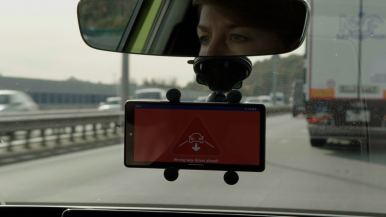
Flanders’ ministers of Mobility and Public Works Lydia Peeters and of Innovation Jo Brouns present a real-time detection system that warns wrong-way drivers as well as drivers in the vicinity, through navigation apps in the car. The system was developed by Bosch and is part of the Mobilidata program of the Flemish government and imec.Tailored warnings The Federal Police counts an average of 350 to 400 wrong-way drivers on highways in Belgium each year. These wrong-way drivers, often involved in head-on collisions with other drivers, can cause severe accidents. To reduce the risk of wrong-way driving accidents, two elements are crucial: better detection of wrong-way drivers, and targeted notification of drivers in the vicinity of a wrong-way driver. Mobilidata, the program of the Flemish government and imec that develops technological traffic solutions, joined forces with the German technology company Bosch to incorporate both elements into several free smartphone applications connected to Mobilidata. Flanders’ ministers Peeters and Brouns are extremely proud to be the first government in the world to integrate digital wrong-way driver detection into its traffic information channels. Innovative communication channel for road users and road authorities The Flanders Traffic Control Center distributes traffic information, including warnings for wrong-way drivers through website updates, radio messages, notifications on the built-in navigation systems of some vehicles. With the new solution, the exact location of a driver is taken into account, and only wrong-way drivers and people in the immediate vicinity receive a warning in their smartphone app. As a consequence, non-affected drivers will not be receive unrelevant messages. Bosch’s solution builds on a large amount of national and international qualitative traffic data, from multiple data sources such as smartphone apps. Car manufacturer Skoda, part of the Volkswagen Group, has already integrated the technology into the infotainment system of their new models. Press folder warnings wrong-way drivers

Bosch at Agritechnica 2023

15.11.2023

Press release

Mobility Solutions

Bosch at Agritechnica 2023

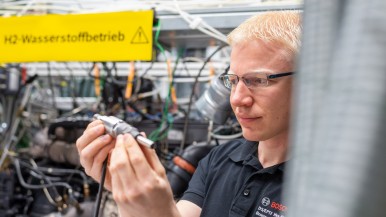
As different as the tasks of agricultural machinery are, all these vehicles have one thing in common: a diesel engine. Yet its use in the agricultural sector alone accounts for some 5 percent of Germany’s diesel consumption. Clearly, agricultural machinery needs to become more climate friendly. Bosch sees hydrogen, which can also be used to power heavy vehicles, as essential for achieving climate neutrality. With its solutions for the hydrogen engine, which can also serve as a suitable drive for specific applications in agriculture, the company wants to move further toward the establishment of a hydrogen economy. At Agritechnica 2023, it will be premiering a technical innovation: an injector for direct hydrogen injection that requires no additional lubrication. “Technologically, the new hydrogen injector for direct injection is a great leap forward,” says Jan-Oliver Röhrl, the executive vice president responsible for commercial vehicle powertrains in the Bosch Powertrain Solutions division.In the course of a vehicle’s service life, the injector opens and closes roughly one billion times. To ensure that this always works reliably, the engineers developing the hydrogen engine had to overcome two challenges: one, the lubrication provided by the fuel in the diesel engine is absent; and two, the hydrogen may react with materials it comes into contact with. The engineers’ solution is a sophisticated design that keeps the media separate inside the injector, and uses various coating technologies. The systems for low-pressure direct and port injection have been developed for engines that can also be operated with heavy loads and in difficult environmental conditions. As a systems supplier, Bosch also offers electronic control units, products for storing and supplying hydrogen, and other powertrain components. Besides fuel-cell applications and battery-electric powertrains, the hydrogen engine is another option in the powertrain mix of the future. Its concept is based on established diesel and natural-gas engines. This means that the fundamental structure of the engine, as well as the fuel, air-supply, and exhaust systems, can be transferred from existing powertrain solutions, along with a large number of other familiar system components. “More than 90 percent of the development and manufacturing technologies needed for the hydrogen engine already exist,” Röhrl says. “This allows us to maintain large parts of our value chain – and applies to the aftermarket as well.” In addition, the hydrogen engine consists primarily of steel and aluminum, which reduces dependencies on critical raw materials and their supply chains. Making conventional systems fit for the future At the same time, Bosch is continuing to improve its conventional diesel-injection and exhaust-gas treatment systems for commercial vehicles and the off-highway sector. “We want our solutions to help automakers worldwide further reduce CO 2 and other emissions,” Röhrl says. For example, the modular CRSN common-rail system for commercial vehicles and off-highway applications exhibited at Agritechnica 2023 ensures efficient fuel supply and injection in diesel engines. It is scalable for pressure levels between 1,800 bar and 2,500 bar, and can be configured for engine sizes of up to eight cylinders. In addition, Bosch diesel technology can already run on renewable synthetic fuels. Such fuels can complement electromobility or hydrogen-based powertrains where these solutions face economic or physical challenges. Digital services improve vehicle availability Bosch also offers innovative digital services that cover the various phases of vehicles’ service lives. These services help identify problems during operation at an early stage, reduce quality costs, and avoid expensive downtime. The cloud-based, connected diagnostic services combine vehicle operating data with Bosch expertise. AI-based algorithms are used to gain additional valuable insights from the combined data. The result is a clear indication of the powertrain’s status when or before a problem occurs, enabling anomalies to be detected.

Climate-neutral building stock: Bosch increases heatpump production in Aveiro, P ...

06.11.2023

Press release

Bosch Group

Climate-neutral building stock: Bosch increases heatpump production in Aveiro, P ...

Aveiro, Portugal / Eibelshausen, Germany / Stuttgart, Germany – Heat pumps are a key component of climate-neutral buildings. For this reason, Bosch is consistently pursuing its long-term strategy and investing in the ramp-up of its development and production capacity for heat pumps. Now, some 100 million euros are going to its Portuguese location in Aveiro, south of Porto, by 2026. The company plans to build new laboratories, two production buildings, and additional heat-pump production lines. This should also create several hundred new jobs there over the medium term. Alongside Eibelshausen in Germany and Tranås in Sweden, Aveiro is an important location in the European development and production network for heat pumps. Bosch will invest a total of more than one billion euros in expanding this network by the end of the decade. “We are pursuing a long-term strategy for our Home Comfort division. We want our sustainable product solutions to help consumers live a comfortable and climate-friendly lifestyle,” he adds.Bosch heat pumps: “made in Europe” The Bosch Home Comfort Group relies on a diversified portfolio to achieve climate targets in the building sector. Heat pumps and heat-pump hybrids are an essential element in decarbonizing the more than 200 million buildings located in Europe alone. “Our engineers, researchers, and developers work hand in hand within our manufacturing network to develop state-of-the-art heat pumps,” he adds. “With the high level of investment and further expansion coming to Aveiro, we’re driving the electrification of buildings and combining home comfort with green technology.” The Bosch Home Comfort Group has been developing and producing technologies for water heating in Aveiro for many years. The location is also home to the development of heat pumps for Southern Europe. In addition, the Aveiro plant will manufacture the outdoor units and wall-mounted indoor units for the next-generation, particularly quiet Compress 5800i AW and Compress 6800i AW heat pumps, which use the eco-friendly refrigerant propane. Experience gained in producing wall-mounted water heaters can feed into this. The Compress 5800i AW and Compress 6800i AW were developed jointly by various teams from Wernau (Germany) and Aveiro and produced in a manufacturing network with Aveiro, Eibelshausen, and Tranås. At the beginning of the year, a production line for the indoor unit of the next-generation heat pumps was started up in Eibelshausen. What sets the new line apart is that the storage tanks are inserted into the heat pump’s indoor unit before it leaves the plant; previously, this was handled by specialist dealers. This significantly reduces the installation time required by the end user, while increasing system robustness and shortening transport routes. The new line benefits from the Eibelshausen plant’s decades of experience in producing hot-water tanks. Tranås, as a long-standing Swedish heat-pump location, manufactures part of the outdoor units, drawing on its many years of experience with the technology. This location has been developing and manufacturing heat pumps for the Bosch Home Comfort Group since 2006. Its development focus is on products for the Northern European market. Heating systems are moving from the basement to the front yard The next-generation Compress 5800i AW and Compress 6800i AW heat pumps were developed in a user-experience approach together with specialists from the heating trade. The development focus was on design, functionality, and sound optimization. “Thanks to their horizontal format, the heat pumps can be placed in various positions, meaning, for example, that they integrate into the visuals of a yard or garden in an appealing way. All these characteristics play a crucial role in a customer’s decision to make a purchase,” adds Tino Hirsch, head of sales at Bosch Home Comfort in Germany. Comprehensive range of services for the heating trade The Bosch Home Comfort Group launched its first heat pump back in the 1970s. After it acquired the Swedish heat-pump manufacturer IVT in 2006, the company has continued to develop not only the products but also the heat-pump ecosystem, with an eye to making the equipment quick and easy for service engineers to install and simple for end users to operate. For example, thanks to their improved design, the next-generation heat pumps take up only 0.36 square meters of space. In addition, the Bosch Home Comfort Group and its brands support heating specialists to make their everyday work more efficient. One way is through the new foundation service, which offers heating professionals the option of ordering a precisely fitted foundation for the outdoor units of air-source heat pumps, thus outsourcing this non-technical activity. In cooperation with Bosch Power Tools, the Bosch Home Comfort brand offers tradespeople OfficeOn software to further increase their efficiency in planning, quoting, and invoicing and to help them with appointment coordination and timesheets. Press kit Bosch Heat pumps

World first: Bosch and Mercedes-Benz’s driverless parking system approved for co ...

01.12.2022

Press release

Mobility Solutions

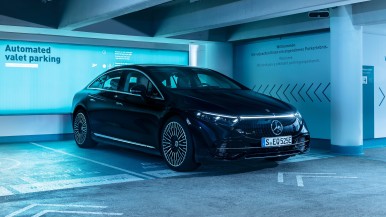
World first: Bosch and Mercedes-Benz’s driverless parking system approved for co ...

Stuttgart, Germany – Bosch and Mercedes-Benz have reached an important milestone on the way to automated driving: Germany’s Federal Motor Transport Authority (KBA) has approved their highly automated parking system for use in the P6 parking garage run by APCOA at Stuttgart Airport. This makes it the world’s first highly automated driverless parking function to SAE Level 4¹ to be officially approved for commercial use. The technological advancement of automated driving plays a key role in the mobility of the future. With the vehicle and infrastructure taking over driving and maneuvering, drivers will be able to turn their attention to other things, instead of time spent looking for a parking space and maneuvering in tight parking garages.“The world’s first approval for customer use of our highly automated and driverless parking function, developed together with our technology partner Bosch, shows that innovation leadership and ‘Made in Germany’ go hand in hand,” says Markus Schäfer, member of the board of management of Mercedes-Benz Group AG, chief technology officer, responsible for development and procurement. “Following the market launch of our DRIVE PILOT Level 3 system, we will soon be offering a Level 4 system for parking with our INTELLIGENT PARK PILOT – all of that this year. We really are showing our customers how technology can make life easier and give back precious time.” “Driverless parking is a key aspect of automated mobility. The highly automated parking system we developed together with our partner Mercedes-Benz shows just how far we’ve already progressed along this development path. It will be with driverless parking that everyday automated driving will start,” says Dr. Markus Heyn, member of the Bosch board of management and chairman of the Mobility Solutions business sector. “From the outset, Bosch has taken the approach of making the infrastructure in parking garages intelligent. Accordingly, we have set standards in this area. In the future, our aim is to equip more and more parking garages with the necessary infrastructure technology – we plan to do several hundred of them worldwide in the next few years.” “We are extremely pleased to have successfully developed a connected system for driverless and contactless parking together with our partners from Bosch, Mercedes-Benz, and Stuttgart Airport. Our digital platform, APCOA FLOW, can be used to book spaces, for contactless access to the parking garage, and for automatic invoicing of the stay in the garage,” says Frank van der Sant, a member of the board of management and chief commercial officer of APCOA PARKING Group. “For our customers, this means a huge gain in convenience: planning certainty, hardly any wasted time, short distances to walk, and a contactless and cashless parking process.” “We are proud that STR has been chosen as the airport for this global premiere,” says Walter Schoefer, management spokesperson for Flughafen Stuttgart GmbH, which runs Stuttgart Airport. “The project shows how innovative our region is. Automated Valet Parking really enhances our flight passengers’ comfort and convenience and saves them time, especially when they’re in a hurry and just want to drop their car off quickly at the airport.” The technology behind driverless parking Drive in to the parking garage, get out, and send the vehicle to a parking space just by tapping in a smartphone app – the Automated Valet Parking service has no need for a driver. Once the driver has left the parking garage – to spend the time just saved on doing something else – the vehicle drives itself to its assigned space and parks. Later, the vehicle returns to the pick-up point in exactly the same way. This process relies on the interplay between the intelligent infrastructure supplied by Bosch and installed in the parking garage and Mercedes-Benz automotive technology. Bosch sensors in the parking garage monitor the driving corridor and its surroundings and provide the information needed to guide the vehicle. The technology in the vehicle converts the information it receives from the infrastructure into driving maneuvers. This way, vehicles can even drive themselves up and down ramps to move between stories in the parking garage. If the infrastructure sensors detect an obstacle, the vehicle brakes and safely comes to a complete stop. Only once the route is clear does it continue on its way. It was in 2019 that Bosch and Mercedes-Benz obtained the world’s first special permit to operate Automated Valet Parking using development vehicles without human oversight in everyday operations of the parking garage of the Mercedes-Benz Museum in Stuttgart. The approval that has now been issued goes beyond this, allowing commercial operation with privately owned vehicles in the P6 parking garage at Stuttgart Airport. The basis for the approval is a law that came into force in Germany in July 2021, which permits driverless driving in accordance with SAE Level 4¹ for motor vehicles ( BMDV – Germany will be the world leader in autonomous driving ). Application of this law to the parking system was implemented in close coordination with the German Federal Ministry for Digital and Transport (BMDV) and the KBA. The AFGBV (autonomous driving directive), passed by the upper chamber of the German parliament on May 20, 2022, clearly specifies the criteria of the German road traffic act that Level 4 vehicles must satisfy. The companies plan to gradually roll out the driverless parking service in the APCOA P6 parking garage at Stuttgart Airport. From the day it is released for operation, the first customers with S-Class and EQS models built since July 2022 whose vehicle variants feature the INTELLIGENT PARK PILOT2 service as part of Mercedes me connect, and who have activated this service, will be able to use the function at the P6 parking garage. Once drivers have used their Mercedes me app to book a parking space in advance, they can leave their vehicle in a predetermined drop-off area. After all the passengers have exited the vehicle, the app starts the parking maneuver. The parking system checks whether the route to the booked parking space is clear, and that all the other technical requirements have been satisfied. If this is the case, drivers receive a notification in the app confirming that the intelligent infrastructure has taken control of the vehicle. They can then leave the parking garage. The vehicle starts automatically and finds its own way to its parking space. When the driver wishes to retrieve their car from the parking garage, they can summon it via smartphone command. Their vehicle then makes its own way to a predetermined pick-up area. [1] SAE J3016 defines six levels of automation for road vehicle driving operations (Level 0 to Level 5). Level 4 states: The vehicle can autonomously handle all traffic situations under certain conditions (e.g. in a parking garage). No driver is required. [2] The INTELLIGENT PARK PILOT service from Mercedes me connect will initially be available in Germany for the Mercedes-Benz S-Class Saloon, Saloon Long and Mercedes EQS, starting with those built 07.2022 and later. This excludes Mercedes-Maybach and AMG models. The Mercedes-Benz S-Class Saloon and Saloon Long built as of 12.2020, excluding Mercedes-Maybach and AMG models, will follow shortly thereafter. Mercedes EQS models, excluding AMG, built as of 04.2021 will also follow shortly. As soon as INTELLIGENT PARK PILOT is available for a particular vehicle, the service will appear in the services menu of the Mercedes me app, ready for activation. In order to use the Mercedes me connect services, users require a personal Mercedes me ID and must agree to the conditions of use for Mercedes me connect services. Furthermore, the vehicle in question must be registered with the user account. Upon expiration of the initial period, users can extend services free-of-charge as long as those services remain available for that particular vehicle. First activation of services is possible within 1 year of initial vehicle registration or use by the customer, whichever is first.

CES 2022: For better quality of life and more climate action – connected and sma ...

27.01.2022

Press release

Connected Devices and Solutions

CES 2022: For better quality of life and more climate action – connected and sma ...

Las Vegas – At home, on the road, at work, in the hospital, or even in orbit: Bosch is improving the everyday lives of people from all walks of life with smart and connected solutions. At the same time, the company is tapping into new areas of business through software, services, and licenses. “We are systematically digitalizing our core business to increase the benefits for our customers. Going forward, we aim turn the sale of every digital product into services-based revenue as well,” says Tanja Rückert, the Bosch Group’s chief digital officer, at CES in Las Vegas. To achieve this goal, Bosch is focusing on the connection of IoT with AI – in other words, it is linking the internet of things (IoT) with artificial intelligence (AI).This creates a virtuous circle in which connected products deliver information that, in turn, is processed by means of AI and incorporated into software updates for these products. At the core of this approach is the benefit for customers, since it allows users to be an integral part of the development process and enables solutions to be tailored precisely to their needs. Furthermore, neither development nor value creation ends with the sale of the products. “We see the combination of AI and IoT as holding the key to leveraging the most user benefit from both of these technologies,” Rückert says. “Besides enabling us to develop new business models, this approach helps us offer better products and solutions that deliver real added value for individuals and society as a whole.” Expanding software expertise: Bosch is already shaping the future today Bosch laid the foundation for this long ago. As of the new year, all electronics product classes will be connectable. Sales of connected power tools, household appliances, and heating systems alone have grown by 50 percent within one year – from four million units in 2020 to more than six million in 2021. With the Bosch Center for Artificial Intelligence (BCAI), the company has established a strong unit in the field of AI that has already contributed some 300 million euros to result. In addition, the company invests a total of more than four billion euros every year in its software expertise, around three billion of which goes to the mobility business. To shape the software-defined future of mobility, Bosch will also be pooling development activities for application-independent software in one unit as of mid-2022. In the future, under the umbrella of its subsidiary ETAS GmbH, the company will develop and sell basic vehicle software, middleware, cloud services, and development tools for universal application. Bosch is also rapidly advancing connected and automated driving. Over the past five years, Bosch has generated some nine billion euros in sales just with driver assistance systems and the associated sensors. Bosch Tech Compass: a survey conducted in five countries around the world The Bosch Tech Compass – a representative survey conducted in five countries and presented for the first time at CES – shows what people across the globe expect from new technologies. According to the survey, the majority of respondents (72 percent) are convinced that technological progress is making the world a better place, for instance as a key to fighting climate change (76 percent). At the same time, four out of five people think technology should be more focused on tackling the great challenges of our time rather than serving individual needs. “We at Bosch also believe that technology offers a broad range of benefits,” Rückert says. “When we talk about high-tech, we’re not talking only about pushing the envelope on what’s possible. We use technology as a means to improve people’s lives wherever they are.” From space to pediatric medicine: the Bosch SoundSee sensor system One example of the benefit of AI and connectivity is the SoundSee sensor system. Since late 2019, it has been traveling through space to identify unusual sounds on the ISS, using AI algorithms to analyze and indicate when maintenance is required. Now, in collaboration with the non-profit healthcare company Highmark in Pittsburgh (USA), Bosch is pursuing a completely down-to-earth application of this technology: investigating how audio AI can be used as a diagnostic tool in pediatric medicine. Specifically, Bosch and Highmark are working to adapt the sensors in a way that will enable them to detect pulmonary conditions such as asthma at an early stage just by listening to children’s breathing patterns. “Using innovative technology to improve children’s health – that’s exactly what we mean with high tech,” says Mike Mansuetti, president of Bosch in North America. SoundSee’s use in medicine also illustrates Bosch’s understanding of its “Invented for life” strategic imperative. Bosch’s new gas sensor – the first on the market to contain AI – serves to protect both humans and nature. Part of Dryad’s Silvanet Wildfire Sensor, it is essentially a digital nose that helps detect forest fires early on. Dryad’s sensors are attached to trees, where they continuously monitor the local microclimate to detect incipient fires – and to wirelessly notify the local authorities, long before camera- or satellite-based systems can. Not only can this protect against devastation by fire, it can also reduce global carbon emissions from forest fires. “These sensors are going to help save lives, homes, and tons of CO2 from entering the atmosphere – all thanks to AI and connectivity,” Mansuetti says. High-tech #LikeABosch: new campaign for smart solutions A new, lighthearted Bosch campaign shows the solutions the company has developed to improve the little things in people’s everyday lives. Called “High tech #LikeABosch – with many connected, intelligent, and sustainable solutions,” its protagonist takes viewers on a tour through her daily routine and uses several Bosch solutions, from smart glasses to a connected e-bike to a digital access pass for work. This makes her teenage son, who at the start of the clip said his mom was “old school,” look pretty out of touch.

Bosch Tech Compass: 72 percent believe that technology makes the world a better place

04.01.2022

Press release

Energy and Building Technology

Bosch Tech Compass: 72 percent believe that technology makes the world a better place

Stuttgart, Germany / Las Vegas, USA – The vast majority of people surveyed worldwide believe that technological progress is making the world a better place (72 percent). This is a finding of the Bosch Tech Compass , a representative survey of the general public in China, India, Germany, the United Kingdom, and the United States. The survey is having its global debut at CES 2022. In view of the rapid and profound changes technology is driving in many spheres of life, the Bosch Tech Compass aims to encourage people to take a closer look at the positive impact of technological progress on a globalized world.Technological progress as key to combating climate change Although technology has the potential to make almost anything possible, such as creating a pizza with a 3D printer, global respondents strongly agree that technology should be more focused on tackling the major challenges of our time rather than serving individual needs (83 percent). For example, the survey shows that more than three out of four respondents worldwide see technological progress as the key to combating climate change. “The Bosch Tech Compass shows that people want technology that addresses the problems of our time,” says Bosch CEO Stefan Hartung. “Technology should support us, make life easier overall, and make the world a better place. This is why we at Bosch are committed to technology that is ‘Invented for life’ and serves people.” Despite global confidence in technological progress, there are regional differences in the perception of how technology is currently being used. While most Chinese (83 percent) and Indian respondents (77 percent) are more confident that technology is currently being used sufficiently to tackle the major problems of our time, only a minority of people in the U.S. (47 percent), the U.K. (37 percent), and Germany (29 percent) believe this. Western countries have high hopes for green tech, Asia for AI In the assessment of individual technologies and their impact, there are significant regional differences. While Germany, the U.K., and the U.S. see green technologies like climate engineering, biotechnology, and hydrogen as having a particularly positive impact on society, China and India have high hopes for intelligent and connected technologies like AI and 5G. Around a third of all respondents in the U.S. and Europe, however, say they see AI as the biggest technological threat. “Easing such concerns is yet another reason why building trust in digital technology will be crucial, and it will have a direct impact on consumer behavior as well,” Hartung says. Four out of five people worldwide believe that a company’s success will depend on building digital trust with its customers in the future. Trust is also becoming increasingly important: for 43 percent of global respondents, trust plays a greater role in the digital world than in the analog world, as opposed to only 20 percent who see it the other way around. “This is also why Bosch has introduced its AI code of ethics , which is contributing to the important public debate around AI and trust in AI,” Hartung adds. Driving or beaming? When asked how they would prefer to move around in the future – regardless of technical feasibility – German respondents displayed fewer reservations. Nearly four in ten (39 percent) would choose beaming as their preferred mode of transportation, which makes them more adventurous than the Chinese with 34 percent. Teleportation also has a few fans in the U.K. (27 percent), the U.S. (20 percent), and India (10 percent). Despite respondents being given free rein to daydream, teleportation was not at the top of anyone’s wish list. In first place with 56 percent was the considerably more mundane human-controlled car, followed by planes (40 percent) and trains (32 percent). About the survey: For this study, people aged 18 and over were surveyed online in five countries (China, Germany, India, the U.K., and the U.S.) in August 2021 by Gesellschaft für Innovative Marktforschung mbH (GIM) on behalf of Robert Bosch GmbH. In Germany and the United Kingdom, 1,000 people were surveyed, in China, India, and the United States, 2,000 people were surveyed. The samples are representative for the respective country in terms of region, gender, and age (DE, UK, USA: 18–69 years / CN, IN: 18–59 years). Additional information: www.bosch.com/techcompass

Bosch at CES 2022: smart technology to make everyday life safe, convenient, and  ...

20.12.2021

Press release

Bosch Group

Bosch at CES 2022: smart technology to make everyday life safe, convenient, and ...

Stuttgart, Germany, and Las Vegas, NV – Technology for all walks of life: at CES in Las Vegas, Bosch will be presenting connected, smart, and sustainable products and services for a better life – at home and on the road. From January 4 through 8, 2022, you will find Bosch at CES in the Central Hall, Booth #16103. CES Innovation Awards: Honoree for smart connected biking solution For its smart connected biking solution, Bosch eBike Systems has been named a CES® 2022 Innovation Award honoree in the “Vehicle Intelligence & Transportation” category. The CES® Innovation Awards are given by the Consumer Technology Association (CTA).Smart connected biking solution – e-bike riding enjoyment 2.0: The new systems generation from Bosch eBike Systems merges the physical experience of riding an e-bike with the digital experience provided by connectivity and an app. This smart system comprises the new eBike Flow app, an LED user interface, color display, rechargeable battery, and drive unit. Over-the-air updates mean it can be continuously enhanced. The eBike Flow app opens up a range of new digital features for e-bikes, such as automatic activity tracking and personalized riding modes. Whether on the daily commute or a leisurely ride, the result is more enjoyment over longer distances. A Bosch must-see Bosch show car: The future of mobility is automated, connected, electrified, and personalized. In the future, more and more vehicles will be electrically powered. They will increasingly be connected with other road users and their surroundings, and provide personalized, cloud-based services for their occupants such as wrong-way driver alerts or road condition updates. The show car will demonstrate Bosch systems expertise and extensive know-how in software and hardware. For example, Bosch is developing central computers for the electronics architecture of the future. These vehicle computers will be used for assisted and automated driving, controlling vehicle motion, as well as for cockpit functions and body electronics. Over-the-air updates will keep cars’ functions constantly up to date. Virtual visor – the transparent digital sun visor: Conventional sun visors shield car drivers from dazzling light. But folding them down often also blocks significant areas of a driver’s field of vision. Bosch has solved this problem with a new, transparent LCD solution that replaces opaque visors. The virtual visor is connected to the interior monitoring camera, which detects the position of the driver’s eyes. Using AI-based intelligent algorithms, the virtual visor analyzes this information and darkens only the portion of the windshield through which the sun or other light sources would dazzle the driver. The rest remains transparent, leaving the driver’s view of the road unobstructed. SoundSee – intelligent ears for the ISS: Although barely bigger than a lunch box, Bosch’s SoundSee is brimming with start-of-the-art artificial intelligence (AI). SoundSee can be found on the ISS (international space station). Installed on board Astrobee, NASA’s autonomous free-flying robot, SoundSee’s integrated microphones pick up ambient noise in space. Using AI, the Bosch technology then analyzes the audio data in order to detect potential anomalies and to flag areas requiring maintenance work. SoundSee was developed together with Astrobotic as part of a NASA research partnership. Software-based solutions for the mobility of today and tomorrow Solutions for the software-defined vehicle: Software is playing an increasingly central role in automotive engineering. After all, future connectivity, automation, and personalization functions will more than ever be brought about by software. Even now, Bosch annually puts more than 200 million control units running its proprietary software into vehicles worldwide. To achieve this, the company can draw on profound software, electronics, and systems expertise, and use this to develop application-specific vehicle software and the hardware to match for automotive applications of all kinds, from driver assistance and infotainment to the powertrain. Bosch plans to pool the development of application-independent basic software and middleware, as well as cloud-based software modules for over-the-air software updates, at its wholly owned subsidiary ETAS. Advanced driving module – pre-integrated components for electric cars: To make the development of electric cars less complex, and thus improve efficiency for automakers, Bosch offers pre-integrated modules such as its ADM advanced driving module. The ADM combines powertrain, brakes, and steering to form an integrated unit that automakers can incorporate faster and more cost-effectively into their vehicles. In addition, simplified interfaces and a standard software architecture ensure the best possible communication between the components, and provide the basis for new features. TPA technician process assistant – a digital handyman: The TPA technician process assistant is part of a connected after-sales ecosystem in which humans and machines exchange data as needed to efficiently repair and maintain vehicles. The system, which is continuously learning and evolving, is a hands-free, platform-agnostic solution that works with tablet, PC, and wearables. With the help of AI, moreover, a knowledge base has been created on the basis of information taken from traditional servicing operations. If more expertise is needed, a connection can be set up between an expert and the “eyes and ears” of the technician working on the vehicle. This helps improve accuracy and efficiency when servicing and repairing today’s ever more complex vehicles. Nevonex – connecting agriculture: Agriculture currently faces the challenge of securing food production in a changing climate. Here, Nevonex can help farmers by providing the necessary expert knowledge in the form of digitalized services. Nevonex allows these third-party services to be used in all makes of agricultural machinery – for example, to automate machine settings or optimize crop-planting processes. Bosch’s research here focuses on harnessing data from these processes to optimize subsequent process steps. The aim is to use edge computing to make robust, AI-based services available for farmers. A breath of fresh air – Bosch solution for better urban air quality: To improve air quality in cities, at airports and train stations, and in business parks, Bosch offers innovative solutions that precisely record and simulate emissions. Bosch air-quality monitors provide precise readings for nitrogen oxides, particulates, humidity, and temperature – in other words, important information for gauging local air quality. The data is then uploaded to the cloud and evaluated. Knowing precisely what pollutants are in the air, where they are, and where they are spreading to allows countermeasures to be taken quickly, for better air at all times. Smart solutions that improve convenience and security in the home Bosch heating and cooling solutions for a perfect climate in the home: Thanks to state-of-the-art inverter technology, the highly efficient Climate 5000 3.0 ductless mini-split air-source heat-pump system offers ample heating and cooling capacity. This heat pump is suitable for most residential buildings due to its ability to heat efficiently, even in frigid outdoor temperatures. The Climate 5000 3.0 features improved energy efficiency and humidity control, creating a comfortable indoor climate. In addition, its built-in air filtration system purifies the air and reduces volatile organic compounds (VOCs) and other harmful gases and odors. Bosch is also launching the Inverter Ducted Split (IDS) Premium Connected heat-pump system on the market. This solution offers high efficiency and particularly innovative connected features. Using a wireless internet connection and an IoT platform means that installers and homeowners can register it in the app. It also makes installation and troubleshooting easy. With the EasyAir app, installers and homeowners can access data remotely, allowing them to monitor energy consumption and appliance status. Connected thermostats – smart and simple heating control: With its BCC50 and BCC100 connected thermostats, Bosch offers a simple and smart all-in-one control for heating, air-conditioning, and ventilation systems. Users can program their own heating and cooling schedules, for example. The controls are set directly on the thermostat, by using the Bosch Connected Control app, or by voice command. Intelligent oven – cooking with a voice assistant: What temperature? Direct heat or steam? Finding the right setting can be tricky. But whether it’s a quick supper or fine dining, an intelligent Bosch oven will do the trick. The voice assistant Alexa is standing by with advice, and will not only recommend the best oven setting, but also switch the oven on if required – all you have to do is ask. Recipes inspired by a digital look inside the fridge: No idea what to eat? Fridge always full of leftovers? That’s now a thing of the past. Now food can be entered into a digital fridge inventory – manually, by synchronizing with the Home Connect shopping list, or via a camera in the fridge. The Home Connect app will then know exactly what’s in the fridge and provide recipe ideas based on the provisions available. A surefire recipe for new ways to treat your taste buds, as well as for less food waste. Bosch Cookit – all-around culinary talent: Cookit offers a whole new dimension of flexibility in the kitchen. Whether guided cooking, automatic programs, or manual cooking, the multifunctional food processor with cooking function has the right level of support for everyone. And now it has become even more flexible: the new “My Recipe” function allows Cookit to save personal recipes. The recipe, with all ingredients, quantities, temperatures, and special tips, is entered in the Home Connect app, which then relays it to the Cookit. The food processor with cooking function will then guide the user through the preparation steps as often as required. Spexor – protecting what you love: This mobile security assistant is an intelligent all-in-one appliance that provides constant, ubiquitous protection. It detects break-ins and hazardous gases, measures room-air quality, and sounds the alarm if it gets too hot or too cold. If spexor’s integrated sensors detect anomalies in the monitored environment, it sends a notification straight to the user’s smartphone. The multisensor appliance is wireless and can be used wherever there is at least a cellular connection. Bosch sensors – unshakeable, untiring, and incredibly flexible BME688 – monitors air quality and protects forests: Whether at home, in the office, or outdoors – to satisfy the need for clean air, Bosch Sensortec has developed the BME688. This innovative MEMS sensor is the world’s most compact four-in-one air-quality sensor featuring artificial intelligence, and is capable of measuring gas, humidity, temperature, and atmospheric pressure simultaneously. It is suitable for a range of applications, such as sending a warning when foodstuffs expire or the early detection of forest fires. In collaboration with Dryad Networks, BME688 sensors have been combined with an IoT network to detect forest fires early. Fewer forest fires mean significantly lower CO2 emissions. In this way, Bosch is helping to mitigate global warming. BHI260AP – revolutionizing fitness tracking : Squats, sit-ups, kettlebell training: the list of fitness exercises is nearly endless. However, many fitness trackers and smart watches can track only a limited number of activities, and the variety of apparatus types as well as users’ different movement styles, physiques, and fitness levels mean that they cannot always reliably recognize the exercises being done. To solve this problem, Bosch Sensortec has developed the BHI260AP – a novel, self-learning motion sensor that gives wearables and hearables artificial intelligence. The sensor recognizes and responds automatically to many different movements and can learn any new fitness activity based on regularly repeated routines. BMP384 – resistant to water, chemicals, and dust: Wearables, home appliances, and industrial applications often have to cope with tough conditions. Up to now, however, many barometric pressure sensors have not been very robust or resistant to fluids, and therefore could not always be installed in watertight products. With Bosch Sensortec’s BMP384, it’s a different story. This barometric pressure sensor is as compact as it is robust. At CES, Bosch Sensortec is also debuting a new ultra-precise pressure sensor that can also be used for indoor navigation and location. Bosch IoT solutions for the connected city and for more data security From a single source – application store for video analytic apps: The world’s first open application store for video analytics apps allows surveillance cameras to be flexibly equipped with new AI-assisted functions. In just a few minutes, applications for detecting things such as face masks, smoke, fire, and flooding or for evaluating flows of traffic and visitors can be installed on compatible cameras. Developed by the Bosch subsidiary Azena, more than 100 apps are already available for more than 40 use cases – with new ones joining them every month. Smart video cameras for greater road safety: Thanks to a new deep-learning video analytic software, the new Inteox cameras with object classification can be used in areas such as traffic monitoring. Even in heavy traffic, they can recognize precise details of vehicles faster. AI helps to detect unforeseen, undesired, or future situations more quickly, more intuitively, and more reliably. Using artificial intelligence to ward off hackers: The Bosch AI shield is a security product featuring artificial intelligence. It protects against external attacks by AI-assisted systems. One way it provides this protection is through a vulnerability analysis. The solution comprises an SaaS (software as a service) tool and user interface, and has been designed so that developers can use and scale it for a variety of applications. The AI model in the appliances or the cloud protects IP, brands, and investments, and in this way creates trust in digitalization. Bosch at CES 2022: • PRESS CONFERENCE: Tuesday, January 4, 2022 , from 8:00 to 8:45 a.m. local time (17:00–17:45 CET) with Dr. Tanja Rückert, Bosch CDO, and Mike Mansuetti, president of Bosch in North America, in Ballroom H, Mandalay Bay Hotel, Las Vegas South Convention Center, Level 2 , as well as livestreamed on the Bosch Media Service . • BOOTH: January 5–8, 2022 , in the Central Hall, booth #16103 • ELECTRIC BIKE TEST TRACK: January 5–8, 2022 , at the eMobility Experience, LVCC, West Hall, West Plaza • FOLLOW the Bosch CES 2022 highlights on Twitter: #BoschCES • PANELS WITH BOSCH EXPERTS: Friday, January 7, 2022, 10:00 a.m. , Venetian Hotel (local time) Building a Resilient Smart Home session with Dr. Carla Kriwet, CEO at BSH Hausgeräte GmbH

Longer range as standard: Bosch gives go-ahead for volume production of silicon  ...

07.12.2021

Press release

Mobility Solutions

Longer range as standard: Bosch gives go-ahead for volume production of silicon ...

Reutlingen, Germany – They are small, powerful, and extremely efficient: semiconductors made of silicon carbide (SiC). After several years of development, Bosch is now starting volume production of power semiconductors made of this innovative material, supplying automotive manufacturers worldwide. In the future, more and more production vehicles will feature these chips. “The future for silicon carbide semiconductors is bright. We want to become a global leader in the production of SiC chips for electromobility,” says Harald Kroeger, member of the board of management of Robert Bosch GmbH. Two years ago, the supplier of technology and services had announced that it would push ahead with the development of SiC chips and enter production. For this, Bosch has developed its own highly complex manufacturing processes, which it has been using to produce the special semiconductors since the beginning of 2021 – initially as samples for customer validation. “Our order books are full, thanks to the boom in electromobility,” Kroeger says. In the future, Bosch intends to expand its production capacity for SiC power semiconductors to a unit volume running into the hundreds of millions. With this in mind, the company has already started expanding the clean-room space at its Reutlingen plant. In parallel, work is also being done on the second generation of SiC chips, which will be even more efficient and should be ready for volume production as of 2022. Bosch is receiving support for the development of these innovative manufacturing processes for SiC semiconductors from the German Federal Ministry for Economic Affairs and Energy (BMWi) as part of the “Important Project of Common European Interest (IPCEI) Microelectronics” program. “For several years now, we have been providing support to help establish semiconductor production in Germany. Bosch’s highly innovative semiconductor production strengthens the microelectronics ecosystem in Europe and is a further step toward greater independence in this key field of digitalization,” says Peter Altmaier, Germany’s Federal Minister for Economic Affairs.The stuff range dreams are made of Around the world, demand for silicon carbide power semiconductors is rising. A forecast by the market research and consulting company Yole indicates that, between now and 2025, the SiC market as a whole will grow on average by 30 percent a year to over 2.5 billion dollars. At around 1.5 billion dollars, the SiC car market is expected to account for the lion’s share. “Silicon carbide power semiconductors make particularly efficient use of energy. This material’s advantages really come to the fore in energy-intensive applications such as electromobility,” Kroeger says. In the power electronics of electric vehicles, silicon carbide chips ensure that drivers can drive significantly further on one battery charge – on average around 6 percent further than with their pure silicon counterparts. In order to meet steadily increasing demand for these semiconductors, an extra 1,000 square meters were already added to the clean-room space at the Bosch wafer fab in Reutlingen in 2021. Another 3,000 square meters will be added by the end of 2023. The new space will house state-of-the-art production facilities for manufacturing silicon carbide semiconductors using processes developed in-house. To achieve this, Bosch’s semiconductor experts are building on their decades of expertise in chip manufacturing. In the future, the company – incidentally the only automotive supplier to produce its own silicon carbide chips – plans to manufacture the semiconductors on 200-millimeter wafers. Compared with today’s 150-millimeter wafers, this will deliver sizeable economies of scale. After all, it takes several months for a single wafer to pass through several hundred process steps in countless machines. “By producing on larger wafers, we can manufacture significantly more chips in one production run and thus supply more customers,” Kroeger says. Small atom, big impact The secret behind SiC chips’ impressive performance lies in a tiny carbon atom. Introducing it into the crystalline structure of the ultra-pure silicon generally used to manufacture semiconductors gives the raw material special physical properties: for example, silicon carbide semiconductors support higher switching frequencies than pure silicon chips. What’s more, they lose only half as much energy in the form of heat, thereby increasing the range of electric vehicles. The chips are also important for 800-volt systems, where they enable faster recharging and better performance. Since the SiC chips also emit significantly less heat, the power electronics require less in the way of costly cooling. In addition to weight, this is another way to reduce the cost of electric vehicles. In the future, Bosch will supply silicon carbide power semiconductors to customers around the world – both as individual chips and installed in power electronics or complete solutions such as the e-axle. This combination of electric motor, gearbox, and power electronics achieves an efficiency of up to 96 percent thanks to the more efficient design of the overall system. This leaves more energy for the powertrain, which increases the range.