#Energy and Building Solutions

Bosch to supply fuel-cell components to cellcentric

30.07.2021

Press release

Energy and Building Solutions

Bosch to supply fuel-cell components to cellcentric

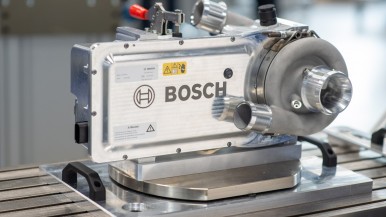
Stuttgart, Germany – Fuel cells are finding their way onto the roads around the world. For Bosch, the next milestone in this development is a major order for electric air compressors with integrated power electronics. These compressors govern the fuel-cell system’s oxygen supply. Bosch has signed a long-term agreement with cellcentric to supply this high-tech component. A 50:50 joint venture between Daimler Truck AG and Volvo Group AB, cellcentric is responsible for all activities along the entire value chain. Like Bosch, the joint venture aims to become a leading global manufacturer of fuel-cell systems and thus to help make transportation climate neutral and sustainable by 2050. The air compressor will be part of the cellcentric fuel-cell system that will feature in heavy trucks and stationary applications in the future. Large-scale production is set to begin from around the middle of the decade.Fuel cells make commercial vehicles climate neutral In fuel cells, hydrogen reacts with atmospheric oxygen to produce electrical energy as well as water and heat. Running a fuel-cell powertrain on hydrogen that is green – in other words, produced using renewable energy – makes the vehicle climate neutral. As the electric air compressor supplies the required amount of filtered air, it is one of the core components of a fuel-cell system. “Bosch is devoting a huge effort to developing this component. For example, we have 15 cross-divisional teams working to commercialize the electric air compressor,” says Dr. Uwe Gackstatter, president of the Bosch Powertrain Solutions division. Bosch offers the air compressor in two power classes – 20 and 30 kilowatts. The 30-kilowatt class is rated for voltages from 450 to 850 volts, while the 20-kilowatt class is rated for either 250–450 volts or 450–850 volts. The compressor wheel reaches speeds of more than 100,000 rpm. “The combination of a high-speed electric motor with integrated power electronics enables easy system integration at competitive manufacturing costs,” Gackstatter says. In addition, the silicon carbide semiconductors used in Bosch power electronics make this powerful component particularly efficient. It is features such as these that cellcentric was looking for. High-tech product secures jobs With the air compressor, the greatest technical challenge lies in scaling up the production of the high-speed electric motors with their air bearings and power electronics from customized to large-scale manufacturing. Since the overall technical complexity is comparable with that of a diesel injection system for commercial vehicles, the effect of these systems on employment is a positive one. “This promising component secures jobs at our Homburg plant,” Gackstatter says. Bosch is working on mobile and stationary fuel cells Bosch believes that hydrogen has a bright future as an energy carrier, and is making considerable upfront investments in this area. From 2021 to 2024, the company plans to invest around 600 million euros in mobile fuel-cell applications and a further 400 million euros in stationary ones for the generation of electricity and heat. The portfolio for vehicles ranges from individual sensors to core components such as the electric air compressor and the stack to the complete fuel-cell module.
Bosch grows with connected energy and building solutions

07.12.2018

Press release

Business/economy

Bosch grows with connected energy and building solutions

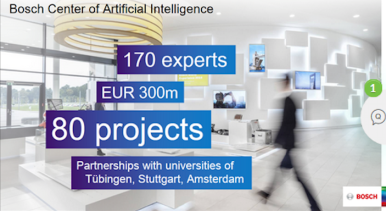
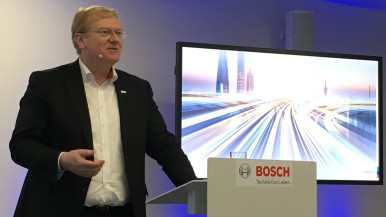
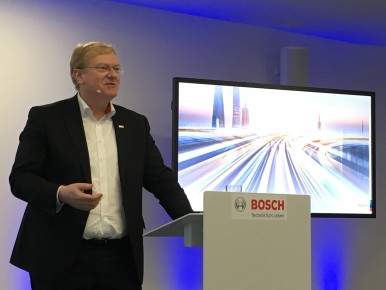
Bosch is growing with connected energy and building solutions. Last year, the Energy and Building Technology business sector sold some 13 million web-enabled devices – everything from connected heating, cooling, and ventilation systems in office buildings, to smart home applications. “The internet of things is and will remain the key driver for our business,” said Dr. Stefan Hartung, the member of Bosch’s board of management responsible for energy and building technology, at a press conference. The company expects the sector’s sales to grow to 5.5 billion euros in 2018. That amounts to an increase of 2 percent, or 6 percent when adjusted for exchange-rate effects. He added that artificial intelligence (AI) will be the key to further advances on the internet of things as well as future growth: “With the help of AI, web-enabled products will become intelligent assistants.”Smart and connected: greater safety, efficiency, and convenience Where energy and building technology are concerned, connectivity and AI have the potential to boost security, efficiency, and convenience. To give one example: The Building Technologies division offers cameras that use smart image analysis to pinpoint fires. With a direct line of sight on potentially dangerous situations, these cameras spot flames and smoke in seconds – which is even faster than conventional smoke detectors. Smoke does not first need to reach the ceiling before the alarm is raised – and those few extra seconds can help limit the damage and perhaps even save lives. “Everyone is talking about AI. Bosch is putting it to use,” Hartung said. “In ten years, every electronic Bosch product will either utilize AI itself or will have been developed and manufactured with its help.” The company plans to invest accordingly, with around 300 million euros alone going to expand the Bosch Center for Artificial Intelligence (BCAI) by 2021. The BCAI currently employs 170 experts globally, and looking ahead, this is expected to rise to 400. They are currently working on some 80 development projects – from automated driving to applications in medicine and manufacturing. Many of these are being carried out in collaboration with academic partners, including the universities of Tübingen, Stuttgart, and Amsterdam. Championing open platforms, partnerships, and interoperability Bosch is also focusing on platforms and partnerships in its energy and building technology activities. “There are many devices and services from different manufacturers out there in the connected world,” explained Hartung. “We have to get these devices and services to interface. They have to understand one another and be interoperable in order to benefit people.” For this reason, the company set up Security and Safety Things GmbH (SAST) as a wholly owned Bosch subsidiary a few weeks ago. This startup is working on the world's first open IoT platform for security camera apps. SAST wants to deliver something unprecedented – an operating system that programs and controls apps for different types of security cameras. Updating cameras made by different manufacturers will require just one version rather than countless software variants. “SAST is striving to create nothing less than a global marketplace for security camera applications with this open, standardized operating system,” Hartung said. Change in management After five years as head of the Energy and Building Technology business sector, Hartung will hand over the reins to Dr. Christian Fischer on January 1, 2019. Before joining the Bosch board of management on October 1, 2018, Fischer was a senior partner at the management consultancy Roland Berger. He holds a doctorate in economics. “Bosch began exploring the opportunities offered by the internet of things ten years ago, which has given it a technological head start,” said Fischer at the press conference. “Bosch is extremely well positioned to take on the challenges of digital transformation. I’m looking forward to being a part of that.”