Search & find:
media, releases and events to support your reporting about the Bosch Group.

Bosch presents tomorrow’s mobility today

17.12.2018

Press release

Automated mobility

Bosch presents tomorrow’s mobility today

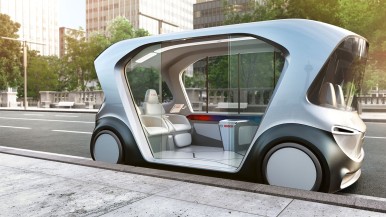
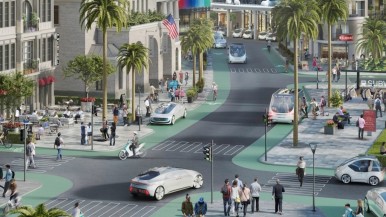
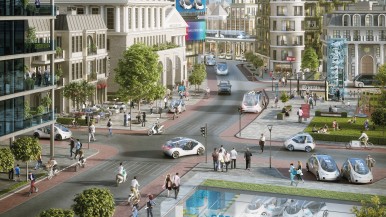
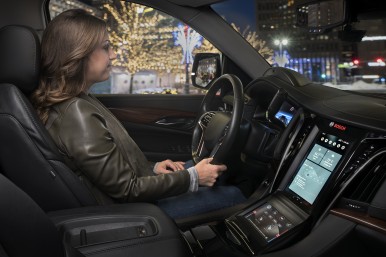
A light, airy, minimalistic design, a futuristic outer shell made of display screens and glass, and a spacious interior – that is how architects might describe a novel structure, but in actuality the description also fits a completely new class of vehicle and a new kind of mobility: driverless electric shuttles that glide almost silently through city centers and are seamlessly connected with their environment. These will soon be a common sight on our city streets – whether they are transporting goods or people. Bosch provides components and systems for automating, connecting, and electrifying the shuttles, but shuttle mobility won’t be possible without mobility services. In the future, the company will offer these services too, bundling them into a smart, seamlessly connected ecosystem. That will include booking, sharing, and networking platforms, parking and charging services, and software solutions for managing and maintaining the vehicles, as well as infotainment during the journey. “Bosch is developing a unique package of hardware, software, and mobility services for shuttle mobility of the future,” says Dr. Markus Heyn, member of the board of management of Robert Bosch GmbH. At CES 2019 in Las Vegas, the world’s biggest electronics show, Bosch will be presenting its solutions for this area of transportation with a concept shuttle, and visitors will be able to experience its full range of services.Bosch services for users and shuttle operators The emergence of the shuttle segment is a result of rising demand for ridesharing services: in Europe, the U.S., and China alone, about one million such on-demand shuttle buses will be on the roads as early as the year 2020, growing to 2.5 million by 2025 (source: Roland Berger). Many of these vehicles, available 24/7, will be fully electric, and they will also be completely autonomous by the middle of the next decade at the latest. That’s why Bosch has packed every square centimeter of its concept shuttle with the appropriate technology – from electric powertrains and 360-degree surround sensors to connectivity management and vehicle computers. Yet these components and systems go only part of the way towards shuttle mobility. To make on- demand vehicles suitable for flexible everyday use, they must be connected to mobility services. “In the future, every vehicle on the road will make use of Bosch digital services,” Heyn says. These services allow users to book the vehicles, share rides with other passengers, and pay for the journey. Charging, repairing, and maintaining the vehicles, plus route planning and administrative activities, also call for services that Bosch will offer shuttle fleet operators in a seamlessly connected ecosystem. Booking and sharing Users can easily book a shuttle via smartphone, regardless of whether they’re relaxing on the sofa or sitting at their desk at work. Working behind the scenes, an algorithm identifies the vehicle closest to the requested location and finds other users who wish to travel a similar route. The more passengers a single shuttle can transport, the cheaper the journey for everyone. This approach also reduces the amount of traffic in cities and mitigates the impact on the environment. Bosch is developing the necessary software platforms to make this a reality. When the shuttle pulls up to the requested pick-up point, users again use their smartphones to identify themselves – thanks to Bosch’s Perfectly Keyless digital access service. It recognizes the owner’s smartphone as unmistakably as a digital fingerprint and opens the vehicle only for them. Every passenger always gets the seat that they reserved. Moving forward: electrified and automated Bosch’s electric axle drive makes the shuttles especially efficient yet affordable as they wend their way through the city. And the company’s Convenience Charging service knows just how long the battery charge will last and where to recharge the vehicle. This service means that even today, drivers no longer need to worry about being stranded with a dead battery. It also links vehicle information, such as the current state of battery charge or how much energy the heating and air-conditioning systems are consuming, with environmental data such as congestion and weather forecasts, so as to predict vehicle range with particular accuracy. Furthermore, Convenience Charging finds the ideal charging station and can reserve it in advance. And thanks to a standardized access and payment system, charging is easier than ever. Driverless e-shuttles provide users with transportation that is not only nearly emissions-free, but also very safe. For automation, Bosch develops and makes its own radar, video, and ultrasonic sensors, braking control systems, and power steering, to name a few examples. Smart digital services are indispensable here, too: Bosch predictive road condition services let automated vehicles know in advance what environmental conditions to expect. They can thus adapt their driving style as needed so as to ensure maximum safety throughout the journey. The Bosch road signature is a map-based localization service with which automated vehicles can accurately determine their position in the lane down to a few centimeters – another crucial prerequisite for the safety of automated shuttles. Comfortable interior Bosch has designed the interior of its concept vehicle to provide space for four passengers, seating them across from one another to maximize legroom and comfort. Infotainment is provided on screens that can be used either by each passenger individually or in groups; for example, a family can watch a movie together as they travel somewhere for the weekend, or colleagues can work on a presentation on their way to the office. Smartphones use the on-board Wi-Fi and can integrate seamlessly with the infotainment system, thanks to Bosch connectivity technology. Its concierge service turns the shuttle into a personal assistant. With all kinds of information at its disposal, the shuttle can provide passengers with recommendations, advance bookings, weather reports, and travel tips at any time. Once the shuttle has arrived at its destination, the passengers can pay for their journey with Bosch’s e-payment service. Maintenance and administrative activities But Bosch services do not end when a rideshare journey is over: the company’s camera- based system for the vehicle interior checks whether anyone has forgotten their phone or handbag. If a passenger does forget something, the shuttle informs them directly via smartphone. The cameras can also detect gum on the seat or an overturned coffee cup – in other words, whether the shuttle needs cleaning – and can make the necessary arrangements immediately. This is so every passenger can start their journey in a clean shuttle. Bosch’s service for over-the-air updates can determine whether the driverless shuttles have the latest software version. The service detects software updates as soon as they are available and executes them in the vehicle securely and reliably. Thanks to sensors installed in the vehicle, predictive diagnostics can monitor the condition of key components and notify the shuttle before a fault actually occurs, so it has enough time to drive itself to a repair shop. This prevents the car from suddenly breaking down, which is a boon to operators. In the future, Bosch will pool updates from the data cloud and predictive diagnostics into a comprehensive connectivity platform. This will give vehicle manufacturers and shuttle service operators a constant overview of the condition of their fleets, so they can ensure that their shuttles are always ready for action. And finally, the Bosch subsidiary ESCRYPT’s security solutions handle vehicle security – whether for keyless access systems, data connectivity with the outside world, or software updates.

Bosch and Daimler: San José targeted to become pilot city for an automated on-d ...

21.11.2018

Press release

Automated mobility

Bosch and Daimler: San José targeted to become pilot city for an automated on-d ...

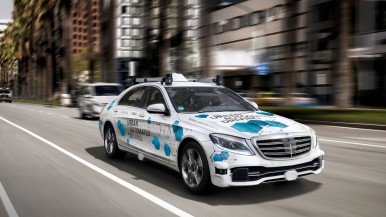
Located on the southern shore of San Francisco Bay in Silicon Valley, and with more than one million inhabitants, San José is the third biggest city in California. It is planned to be the pilot city for trials, targeted to begin during the second half of 2019, of the highly and fully automated driving (SAE Level 4/5) on-demand ride-hailing service recently announced by Bosch and Daimler. The three parties have signed a memorandum of understanding to pursue and finalize this activity. Using automated Mercedes-Benz S-Class vehicles, Bosch and Daimler propose to offer the service to a selected user community in the San Carlos/Stevens Creek corridor between downtown and west San José. With its population expected to grow 40 percent in the next two decades, the metropolitan area faces growing transportation challenges. Moreover, San José wants to prepare itself for a future in which autonomous cars hit the streets.“The pilot project is an opportunity to explore how autonomous vehicles can help us better meet future transportation needs,” says Sam Liccardo, mayor of San José. “Since many years we consequently push autonomous driving. With this pilot we will generate valuable insights to connect fully automated vehicles in the best way with users of future mobility services,” says Dr. Michael Hafner, Vice President Drive Technologies and Automated Driving at Daimler AG. “We have to rethink urban transportation. Automated driving will help us complete the picture of future urban traffic,” says Dr. Stephan Hönle, senior vice president of the Automated Driving business unit at Robert Bosch GmbH. The on-demand ride-hailing service app operated by Daimler Mobility Services will demonstrate how mobility services such as car sharing (car2go), ride-hailing (mytaxi), and multi-modal platforms (moovel) can be intelligently connected. The test operation will provide information about how highly and fully automated vehicles can be integrated into a multi-modal transportation network. The intent is to provide a seamless digital experience, in which a selected user community will have the opportunity to hail a self-driving car, monitored by a safety driver, from a designated pick-up location and drive automatically to their destination. Automated vehicles make urban mobility more attractive With their joint development work on highly and fully automated driving (SAE level 4/5) in urban environments, Bosch and Daimler aim to improve the flow of traffic in cities, enhance road safety, and provide an important building block for the way traffic will work in the future. Among other things, the technology will boost the attraction of car sharing. Without compromising driving safety, it will allow people to make the best possible use of the time they spend in their vehicles, and open up new mobility opportunities for people without a driver’s license. Bosch and Daimler associates share the same office space Bosch and Daimler associates involved in the development project work together in teams in two regions: in the greater Stuttgart area in Germany and, in the United States, around Sunnyvale in Silicon Valley between San José and San Francisco. Since they share the same office space, rapid communication across working disciplines is ensured, and decision-making paths are short. At the same time, they can draw on the combined know-how of their colleagues in the parent companies. The two companies’ associates are jointly developing the concepts and algorithms for the highly and fully automated drive system. Daimler’s task is to bring the drive system into the car. The company is providing the necessary development vehicles, test facilities, and vehicles for the test fleet. Bosch is responsible for the components specified during the development work, such as sensors, actuators, and control units. For test purposes, Bosch and Daimler use their laboratories and test rigs, plus their respective test sites in Germany. Since obtaining its Autonomous Vehicle Testing Permit from the California Department of Motor Vehicles in 2014, Mercedes-Benz has been testing automated vehicles in the Sunnyvale/California region. And since 2016, it has had similar approval for the greater Stuttgart area in Germany. In early 2013, Bosch was the world’s first automotive supplier to test automated driving (SAE level 3) on public roads in Germany and the United States.

Bosch and Daimler: Metropolis in California to become a pilot city for automated ...

19.07.2018

Press release

Automated mobility

Bosch and Daimler: Metropolis in California to become a pilot city for automated ...

Stuttgart – Bosch and Daimler are speeding up the development of fully- automated and driverless driving (SAE Level 4/5) in the city and are decisively setting the course. The partners have chosen California as the pilot location for the first test fleet. In the second half of 2019, Bosch and Daimler will offer customers a shuttle service with automated vehicles on selected routes in a Californian metropolis. Daimler Mobility Services is envisaged as the operator of this test fleet and the app-based mobility service. The pilot project will demonstrate how mobility services such as carsharing (car2go), ride-hailing (mytaxi) and multi-modal platforms (moovel) can be intelligently connected to shape the future of mobility. In addition, the partners have decided on the US technology company Nvidia as the supplier of the artificial intelligence platform as part of their control unit network.For the joint development of a driving system for fully-automated and driverless vehicles, Bosch and Daimler rely on their automotive expertise accumulated over many decades to bring mature and safe innovations to market. Both companies are guided by a shared philosophy: “The decisive factor is to introduce a safe, dependable and mature system,” says Dr. Michael Hafner, Head of Automated Driving at Daimler AG. “Safety has the highest priority, and is the constant theme of all aspects and development stages on our way to the start of series production. If in doubt, thoroughness comes before speed.” “Developing automated driving to a level ready for series production is like a decathlon”, according to Dr. Stephan Hönle, Senior Vice President Business Unit Automated Driving at Robert Bosch GmbH. “It’s not enough to be good in one or two areas. Like us, you have to master all disciplines. Only then will we succeed in bringing automated driving to the roads and the city safely.” Evaluation of sensor data within milliseconds A decisive factor for fully-automated and driverless driving in an urban environment is the reliable recognition of the vehicle’s surroundings with the aid of various sensors. Analyzing and interpreting the variety of incoming data and translating them into driving commands within a very short time requires enormous computing power – the fully-automated, driverless vehicle will be a mobile super-computer. At the same time, fully-automated, driverless driving in the city requires a versatile, redundant systems architecture and the highest level of functional safety. To achieve this level of safety, the necessary computing operations are performed in parallel in different circuits. This means that the system has instant recourse to these parallel computing results when necessary. For their driving system, Bosch and Daimler thus rely on a control unit network made up of several individual control units. The US technology company Nvidia supplies the platform required for this, which can run the Artificial Intelligence (AI) algorithms generated by Bosch and Daimler for the vehicle’s movement. The network of control units collates the data from all sensors with radar, video, lidar and ultrasound technology (sensor data fusion), evaluates them within milliseconds and plans the movements of the vehicle. All in all, the control unit network has a computing capacity of hundreds of trillion operations per second. That’s as much as several S-Class vehicles together could reach just a few years ago. Metropolis in California will be a pilot city for automated test fleet The control unit network will also be used in the fleet vehicles which Daimler and Bosch will put on the roads of California in the second half of 2019. Not only that: Both partners will offer customers an automated shuttle service on select routes in a city located in the San Francisco Bay in Silicon Valley. The test operation will provide information about how fully-automated and driverless vehicles can be integrated into a multi-modal transport network. Many cities face numerous challenges that are increasingly burdening the existing transport system. The test is to show how this new technology might be a solution to these challenges. Driverless driving makes urban mobility more attractive With their development cooperation on fully-automated and driverless driving in urban environments which began in April 2017, Bosch and Daimler aim to improve the flow of traffic in cities, enhance safety on the road and provide an important building block for the way traffic will work in the future. The technology will, among other things, boost the attraction of car sharing. In addition, it will allow people to make the best possible use of their time in the vehicle, and open up new mobility opportunities for people without a driver’s licence, for example. The vehicle comes to the driver, not the driver to the vehicle. Within a defined city area, users can conveniently order a car-sharing car or a vehicle that drives by without a driver. The project especially combines the overall vehicle and mobility expertise of one of the world’s leading premium manufacturer with the systems and hardware expertise of one of the world’s largest suppliers. The ensuing synergies’ purpose is to introduce the new technology early and fully validated. Bosch and Daimler employees share the same office space Bosch and Daimler employees work together in teams in two regions: In the greater Stuttgart area in Germany and around Sunnyvale in Silicon Valley to the south of San Francisco in the USA. Employees from both companies share the same office space. This ensures rapid communication across working disciplines and short decision-making paths. At the same time they have access to the entire know-how of the colleagues in the mother companies. The partners are equally financing the development work. The personnel in this cooperation are jointly developing the concepts and algorithms for the fully-automated, driverless drive system. Daimler's task is to bring the drive system into the car. To this end, the company is providing the necessary development vehicles, test facilities and later the vehicles for the test fleet. Bosch is responsible for the components (sensors, actuators and control units) specified during the development work. For test purposes the partners use their laboratories and test rigs, plus their respective test sites in Immendingen and Boxberg. Furthermore, since 2014 Mercedes-Benz has approval to test automated vehicles in the Sunnyvale/California region. The company also has comparable approval for the Sindelfingen/Böblingen region since 2016. Bosch was the world’s first automotive supplier to test automated driving on public roads in Germany and in the US in early 2013.

Bosch analysis: driver assistance systems continue their strong advance

14.03.2018

Press release

Automated mobility

Bosch analysis: driver assistance systems continue their strong advance

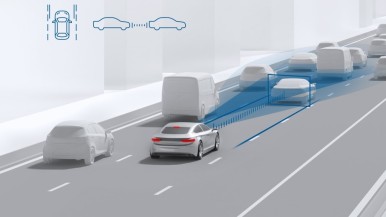
Stuttgart, Germany – People buying new cars today in Germany and Europe are placing more and more value on having electronic assistants on board. “There is a clear trend: it will soon be just as natural to have cars fitted with driver assistance systems as it is with a radio and ESP,” says Bosch board of management member Dr. Dirk Hoheisel, referring to the results of a Bosch analysis carried out on the basis of new registration statistics for 2016. According to these statistics, parking and lane assist systems, as well as emergency braking systems are becoming increasingly popular. For example, 62 percent of new passenger cars registered in Germany in 2016 were equipped with some kind of parking assistance system – ranging from parking beepers to automatic parking assistants. Second place in the popularity scale was taken by automatic emergency braking systems that warn drivers or bring the car to a halt in an emergency. More than one in every three new cars registered in 2016 (38 percent) is able to help drivers to avoid accidents in this way. For more than a quarter of these vehicles, an emergency braking system is even part of the car’s standard fittings. Just behind in third place was driver drowsiness detection – fitted in 37 percent of all new passenger cars in 2016. However, the largest growth was recorded for lane assist systems. Compared with the previous year, there were twice as many of these on board new cars in 2016. Another interesting development was in relation to adaptive cruise control (ACC). Although barely fitted in four percent of newly registered cars in Germany in 2013, in 2016, this function was installed in nearly one in five new cars (19 percent).Driver assistance systems are increasingly fitted as standard equipment Parking assistance systems, emergency braking systems, and lane assist systems are also the most popular driver assistance systems in the U.K., the Netherlands, Belgium, and France – in that exact order. Parking assistance systems are even more widespread in France than they are in Germany: 67 percent of the new passenger cars registered there in 2016 provide their drivers with support while they park. Parking assistance systems are now included in the standard equipment of a vast majority of vehicles: at 63 percent of new cars, France has the highest proportion. In Germany, this figure is 42 percent. In Belgium and the Netherlands, 39 percent of new cars have an automatic emergency braking system – the highest proportion in Europe. Italy and Russia, which, alongside France, were included in the Bosch analysis for the first time, still have room to improve when it comes to driver assistance systems when compared with the other countries that were analyzed. However, 18 percent of new passenger cars registered in Italy in 2016 still had a lane assist system on board – and in Russia, they are getting the ball rolling with an installation rate of 6 percent. This is also true of automatic emergency braking systems, which also achieved a proportion of 6 percent in new passenger cars. Bosch is growing quicker than the market with driver assistance systems Driver assistance systems help drivers in confusing or critical traffic situations, and are an important step on the way to the accident-free and stress-free mobility of the future. If all vehicles in Germany had an automatic emergency braking system on board, for example, up to 72 percent of all rear-end collisions resulting in injury could be prevented. Installation rates for driver assistance systems are constantly increasing. As the largest provider of such systems, Bosch is also benefiting from this. “The market is currently growing by about 20 percent, and Bosch is growing even faster,” says Gerhard Steiger, president of Bosch’s Chassis Systems Control division. In 2019, the provider of technology and services will exceed the two-billion-euro mark with sales of its driver assistance systems. The one-billion mark was already achieved in 2016. At the moment, technical development is increasingly heading toward automated driving. The Bosch analysis shows that, with traffic jam assist, the first partially automated function has now also arrived on the market. In a traffic jam, the car automatically follows the vehicle in front, assuming the tasks of starting and accelerating as well as braking and steering within its own lane. Of the new cars in Germany that are equipped with ACC, almost half of them are also fitted with a traffic jam assist function, which is nine percent of all newly registered passenger cars. Bosch analysis based on 2016 statistics for newly registered cars In 2016, 3.4 million new cars were registered in Germany. Based on new vehicle registration statistics collected by the German Federal Motor Transport Authority (KBA) for the year 2016 as well as data (data status 22.03.2017) supplied by business intelligence firm IHS Markit, Bosch analyzed the passenger segments to see how – whether as standard or optional equipment – and which driver assistance systems are currently on offer. Bosch has been investigating the development of installation rates for driver assistance systems since 2013.

Bosch establishes division for connected mobility services

23.02.2018

Press release

Internet of Things

Bosch establishes division for connected mobility services

Berlin and Stuttgart, Germany – Bosch continues to drive forward its transformation into a provider of mobility services. Its new Connected Mobility Solutions division will bring together over 600 associates to develop and sell digital mobility services. These include vehicle sharing, ridesharing, and connectivity-based services for car drivers. “Connectivity will fundamentally change how we get from A to B, and in the process it will help to solve today’s traffic problems. We are using it to realize our vision of emissions-free, stress-free, and accident-free mobility,” said Dr. Volkmar Denner, chairman of the Bosch board of management, at the Bosch ConnectedWorld 2018 IoT conference in Berlin. Connectivity offers tremendous business potential. By 2025, there will be more than 470 million connected vehicles on the world’s roads (source: PwC). Just four years from now, the market for mobility services and associated digital services will be worth 140 billion euros (source: PwC). “Connected driving is a growth area for Bosch. Bosch aims for significant double-digit growth with the solutions it offers,” Denner said. The plan is for the new division to further extend the existing service portfolio. For instance, mobility services from Bosch send alerts about wrong-way drivers and turn smartphones into car keys. The latest of these is the ridesharing service offered by U.S. start-up Splitting Fares Inc. (SPLT). Denner also presented system!e in Berlin. Connected services for electromobility are set to further increase the suitability of electric driving for the mass market.Bosch enters the ridesharing business One growth market in the field of connected mobility is ridesharing, which encompasses online services and apps for carpools as well as for arranging driving services and taxis. By 2022, the number of ridesharing users worldwide is set to rise by 60 percent to 685 million (source: Statista). To date, most such services have been directed at people who happen to be traveling in the same direction or who want to book a trip at the last minute; companies and commuters have been seen as less of a priority. This is precisely where SPLT comes in. Recently acquired by Bosch, this U.S. start-up developed a platform that companies, universities, or municipal authorities can use to arrange ridesharing for their staff. This B2B approach is aimed directly at commuters: the SPLT app brings together people who want to share a ride to the same workplace or place of study. One advantage of this is that rides are shared by colleagues, which means users never have to get in the car with complete strangers. Within seconds, an algorithm locates a suitable rideshare, calculates the fastest route through traffic, and thus assumes what used to be the time-consuming task of coordinating the departure point, departure time, best route, and passengers. Sharing a ride is good for the nerves, for the wallet, and for the environment. Companies can also play a role in reducing traffic volume. “Connectivity is a way for us to rethink not just the car but the whole way we use modes of transport,” Denner said. Digital services for electric vehicles Bosch subsidiary COUP has provided e-scooters for rent in Berlin since 2016. After introducing e-scooter sharing to Paris last year, the service will launch in Madrid this year. This will bring the total number of e-scooters to 3,500. “Digital services will give electric driving a boost,” Denner said. At the IoT conference, the Bosch CEO presented system!e, a comprehensive system of connected electrified powertrain components and new service solutions for electric cars. To this end, Bosch has connected the electric drive to the Bosch Automotive Cloud Suite. The company is developing web-based services that rely on this interaction. In the future, intelligent electric cars will know precisely when their power will run out, but also where they can find their next charge. Eliminating range anxiety: Services that encourage everyday use For many car buyers, the worry that an electric car might leave them stranded is a deal-breaker. It is precisely this problem that system!e is designed to tackle. Because the electric drive is connected to the cloud, the system can produce an “extended range forecast.” An algorithm factors in vehicle data such as current battery charge, energy consumption of heating or air conditioning, and the driver’s driving style, as well as information from the vehicle’s surroundings. This includes the current traffic situation and topographical data for the route ahead. Based on this information, the system can reliably calculate the vehicle’s precise range. For longer journeys in an electric car, the extended range forecast is supplemented by the “charging assistant.” This service knows where all the charge spots are on a given journey, say from Munich to Hamburg, so it can plan ahead for necessary charging stops; it also manages the payment process. Thanks to additional information about for example restaurants, cafés, and shopping options, drivers can make the most of the charging time and relax. A third service manages vehicle charging in smart homes, helping to optimize how they use energy. It integrates the electric car into the smart home’s electricity grid, meaning the car’s battery supplements the stationary storage device for the house’s photovoltaic system. During the day, the car absorbs excess solar power and feeds it back at night as necessary. “For Bosch, mobility goes beyond the car. Our breadth of technology expertise in numerous fields puts us in an unparalleled position to develop and operate cross-application ecosystems,” Denner said. 4,000 participants, 70 exhibitors, and 140 speakers Bosch’s IoT activities are broadly diversified, encompassing solutions for connected mobility, connected manufacturing, as well as for connected energy systems and buildings. At the Bosch ConnectedWorld forum for the IoT industry in Berlin, more than 70 exhibitors will demonstrate what is already possible with the internet of things, and how it will improve people’s everyday lives in the future. On a 10,000 square-meter exhibition space at “Station” in Berlin, some 4,000 delegates will meet from February 21 to 22. In addition to the Bosch CEO Dr. Volkmar Denner, the roughly 140 speakers will include Dr. Dieter Zetsche (CEO Daimler), Dr. Frank Appel (CEO Deutsche Post DHL), and Johann Jungwirth (CDO Volkswagen). At a hackathon, some 700 programmers, start-up associates, and designers will develop new ideas for connected mobility services, automated driving, connected manufacturing and logistics, and connected living. The 2018 Bosch ConnectedWorld will be the fifth event of its kind. It is one of the world’s largest conferences on the internet of things.