09.01.2018
Press release
Internet of Things
CES 2018: Bosch sees future in smart-city business
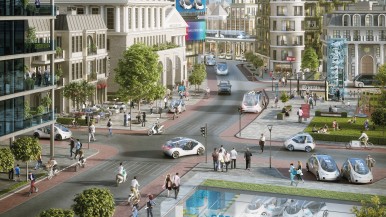
Las Vegas, NV – Urban populations are growing: according to the United Nations, roughly two-thirds of the global population will live in conurbations by 2050. In 2014, this figure was just one-half. Urbanization is increasing, and with it the challenges cities have to solve. Even today, therefore, there is a considerable need for smart solutions. Speaking at CES in Las Vegas, the Bosch management board member Stefan Hartung said: “We need a new conception of the city. One key factor here is technologies that make cities smart and worth living in. In the long run, cities without intelligence will not survive, but succumb to gridlock.” Bosch is working to equip cities and neighborhoods for the future, offering smart mobility, better air quality, more convenience, greater security, and many new services. In short, the aim is significantly better quality of life in cities and neighborhoods. “When it comes to smart cities, few other companies can match Bosch’s comprehensive portfolio, cross-domain knowledge, and outstanding expertise in sensors, software, and services – and all this from a single source,” Hartung said. From January 9 to 12, the supplier of technology and services will be presenting many new solutions that make cities smart at CES 2018, the world’s largest electronics show. These range from a new compact unit that measures and analyzes air quality in real time, to a system that digitally monitors river water levels and gives early warning of flood risks, to a completely automatic parking space service that makes drivers’ lives easier. For more business: the smart-city market is booming Some of the world’s major metropolises are already synonymous with the term “smart,” among them Barcelona, Seoul, and London. Across the globe, cities large and small are investing in smart-city technologies. According to a study on behalf of Bosch, the smart-city market will grow 19 percent each year between now and 2020, reaching a volume of 800 billion dollars (680 billion euros). Bosch believes this is a great business opportunity: “For a long time, the smart city was a vision. We’re helping make it reality. Bosch is in an excellent position to make the connected city a technological and commercial success,” Hartung said. The company is currently involved in 14 extensive smart-city projects in places such as San Francisco, Singapore, Tianjin, Berlin, and Stuttgart. Others are planned to follow. Within the past two years, the company has doubled its sales from cross-domain projects to nearly one billion euros, and this figure is set to rise further. In the Bay Area city of San Leandro, for example, the company has equipped roughly 5,000 streetlights with LEDs and supplied a system for remote management of the city’s street lighting. In this way, the lights are only switched on when they are actually needed. With this solution, San Leandro will be able to save roughly 8 million dollars over the next 15 years. At the Bosch CES press conference, Mike Mansuetti, the president of Bosch North America, said: “Whether cities are big or small, our smart solutions will help them save energy, and money too.” In the case of San Leandro and its 100,000 inhabitants, sensors can be used to measure and analyze air quality, and cameras can automatically re-route traffic in the event of congestion. For more connectivity: IoT and artificial intelligence The internet of things (IoT) has laid one of the main foundations for the connected city. The IoT is finding its way into all walks of life: a Gartner study predicts that some 230 million homes worldwide – roughly 15 percent of all homes – will be intelligently connected by 2020. Here as well, the potential is huge, with market volume estimated to reach 250 billion dollars annually by 2020. By the same year, more than 20 billion devices worldwide will be connected with each other – smoke detectors, burglar alarms, electricity meters, home appliances, and many more. “Bosch recognized this potential early on,” Hartung said. “Even now, more than half our electronic product classes are web-enabled – and the aim is for this to be 100 percent by 2020. Not only that: for each of our products, we want to offer accompanying services.” Another driver of the rapid development of smart cities is artificial intelligence (AI). Bosch intends to further expand its research in this field. Last year, the company opened a research center for artificial intelligence, which now employs some 100 associates in Renningen, Germany, Palo Alto, CA, and Bengaluru, India. By 2021, Bosch will invest some 300 million euros in expanding the center. The company anticipates that, ten years from now, scarcely any product will be conceivable without AI. For better air quality: Climo creates basis for targeted action Air quality is one of the greatest challenges cities face. Thanks to smart technologies, cities can take faster and more targeted action to improve it. However, this depends on accurate measurements. At CES 2018, Bosch is presenting a new solution that it developed together with Intel – the Climo microclimate monitoring system. Climo measures and analyzes 12 parameters that are important for air quality, including carbon dioxide, nitrogen oxide, temperature, and relative humidity. The appliance is one-hundredth the size of conventional systems – and one-tenth the cost. Climo won a CES Honoree Innovation Award in the “smart cities” category. For early warning: digital monitoring of rivers In many regions, climate change is resulting in unpredictable weather. Researchers expect that heavier rainfall will result in more frequent flash flooding. Up to now, mechanical devices have been used to measure river water levels. Hours may pass before these measurements become available for others. However, the flood monitoring system changes all this. In real time, it monitors the water level in rivers and other bodies of water close to cities, and warns of an impending flood. In a pilot project, Bosch is testing the new system on the Neckar river near Ludwigsburg, Germany. Ultrasonic sensor probes and cameras track changes in water level, speed, and throughput. The data is sent to the Bosch IoT Cloud for processing. Should critical thresholds be exceeded, the affected municipalities, residents, and business owners are alerted well in advance by text message. This gives them enough time to take precautions against flooding and flood-related damage. Among those interested in the solution are a number of Indian and South American municipalities that frequently have to combat flooding. For more time: connected parking Urban traffic will increase by roughly one-third by 2050. Bosch is working to make tomorrow’s mobility free of accidents, stress, and emissions. At CES 2018, the company is presenting many solutions that lead toward this goal. Urban traffic plays a role in roughly half the smart-city projects Bosch is involved in. Parking is a particular focal point. U.S. drivers now spend more than 40 hours a year stuck in congestion, wasting some 160 billion dollars in the process. Of this time, roughly one-third is wasted on the search for parking alone. This is where Bosch can help: with its community-based parking, the company simplifies the search for a suitable space. As they drive by, cars automatically recognize and measure the size of the gaps between parked cars, transmitting the data in real time to a digital map. In this way, drivers can have themselves guided directly to free parking spaces. Bosch is already testing this service in German cities, including Stuttgart. This year, as many as 20 U.S. cities will follow, including Los Angeles, Miami, and Boston. In early 2018, moreover, Bosch and Daimler will be launching a new automated valet parking service. Cars in the Mercedes-Benz Museum parking garage in Stuttgart will look for a parking space and park themselves, without a driver. This cuts out stress, and makes more efficient use of parking lots – the same amount of space can accommodate up to 20 percent more vehicles. One factor making fully automated parking a reality is smart parking-garage infrastructure, which connects with the vehicle’s on-board software. Bosch recently won a Frost & Sullivan’s 2017 Technology Innovation Award for this driverless parking solution. For energy and cost savings: Bosch DC microgrids According to the International Panel on Climate Change (IPCC), cities account for roughly 75 percent of total global energy consumption. Forty percent of this is attributable to buildings alone. And the BP Energy Outlook 2035 estimates that global energy consumption will rise 30 percent by 2035. Bosch has many smart energy management solutions that can reduce power consumption. One of these is the Bosch DC (direct current) microgrid, which can be used to supply power to large buildings or building complexes. Since microgrids are generally fed by renewable sources, they are especially eco-friendly. DC microgrids consume up to 10 percent less energy than conventional power plants. Another major advantage is their self-sufficiency, which makes them a reliable source of power when a weather- or security-related outage affects the broader grid. Bosch at CES 2018: PRESS CONFERENCE: In Ballrooms B, C, and D, Mandalay Bay Hotel, Las Vegas South Convention Center, Level 2 , from 8:00 to 8:45 a.m. local time on Monday, Jan 8. BOOTH: Tuesday to Friday, Jan 9–12 , in the Central Hall, booth #14028 FOLLOW the Bosch CES 2018 highlights on Twitter: #BoschCES PANELS WITH BOSCH EXPERTS: PANELS WITH BOSCH EXPERTS: Tuesday, January 9, 1:30 – 3:15 p.m. (local time) “Connect2Car: Next-Gen Automobility” session with Kay Stepper, Vice President of Bosch in North America, head of driver assistance and automated driving, Las Vegas, Convention Center, North Hall, N256 Wednesday, Jan 10, 1:45–2:30 p.m. (local time) “Connected Vehicles in Connected Ecosystems” session with Mike Mansuetti, President Bosch North America, Smart Cities Conference, Westgate. Thursday, Jan 11, 11:30 a.m to 12:30 p.m. (local time) “The Future of Robots at Work and Home” session with Phil Roan, Senior Engineer Robotics, BSH Hausgeräte GmbH, Las Vegas Convention Center, North Hall, N258