Suche

Press release #Business/economy
Share pressrelease

Q&A: Bosch Rapid Catalyst Heating (RCH) with Mohammad Fatouraie, director of Engineering

Megan Bonelli

Megan Bonelli

X

Q: What is Bosch Rapid Catalyst Heating (RCH)?

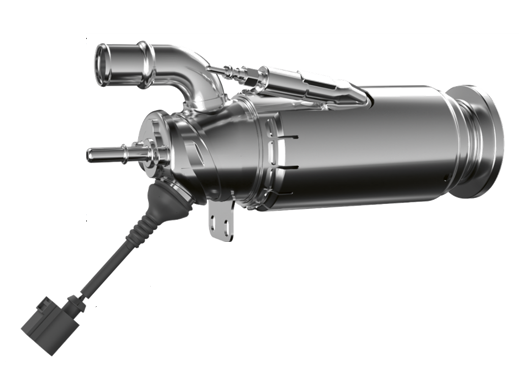
A: RCH is a new Bosch system designed to reduce cold-start emissions in gasoline-powered vehicles. It accelerates catalyst activation, known as catalyst "light-off," during the first seconds of engine operation, when tailpipe emissions are typically at their highest.

Q: Why is cold-start emissions reduction important?

A: Cold-start emissions, which occur before the catalyst reaches its operating temperature, commonly account for the majority of a vehicle's total emissions footprint. While the problem is more pronounced in colder weather, catalyst heating is necessary across all environmental conditions.

Q: How does the RCH system work?

A: RCH uses an integrated, fuel-based auxiliary burner that delivers additional thermal energy directly into the exhaust stream, rapidly raising catalyst temperature during cold start and early drive-off.

The system provides 25+ kilowatts of thermal power, operates independently from the engine, and runs on a standard 12-volt electrical system with a low-pressure gasoline fuel supply.

Q: How does RCH differ from existing catalyst heating approaches?

A: RCH system does not compromise engine efficiency to generate elevated exhaust temperatures. By decoupling catalyst heating from engine operation, RCH reduces calibration complexity and efficiency trade-offs.

Unlike electrically heated catalysts, RCH does not require a high-voltage architecture.

Q: What emissions reductions can RCH deliver?

A: Vehicle testing shows RCH can reduce emissions by up to 70 percent during cold start and early drive-away conditions. These results hold across passenger vehicles and larger platforms, including pickup trucks, under both standard and quick drive-away cycles.

Q: Does RCH require significant changes to vehicle architecture?

A: RCH is compatible with existing vehicle architectures and supports both closely coupled and underfloor catalyst configurations, making it practical for automakers to deploy at scale without major redesigns.

Q: Is RCH relevant for hybrid vehicles?

A: Yes, RCH is relevant for hybrids. Exhaust thermal management is particularly important in hybridized powertrains, where catalyst temperatures can drop below light-off thresholds during all-electric operation. RCH helps ensure consistent emissions conversion even in these scenarios.

Q: Are there any cost benefits associated with RCH?

A: Faster catalyst activation may reduce the required density of precious metal loading and lower calibration complexity, which can help offset system costs while supporting compliance with reduced emissions standards.

Q: What is the current status of RCH development?

A: Bosch is continuing validation with OEM partners, with emphasis on durability, packaging flexibility, and readiness for series production.
Contact:

Megan Bonelli
Megan.bonelli@us.bosch.com
947-281-7062

About Bosch

Having established a presence in North America in 1906, today the Bosch Group employs around 38,000 associates in more than 100 locations in the North American region (as of Dec. 31, 2024). According to preliminary figures, Bosch generated consolidated sales of $18.7 billion in the U.S., Mexico and Canada in 2025. For more information visit www.bosch.us, www.bosch.mx and www.bosch.ca.

The Bosch Group is a leading global supplier of technology and services. It employs roughly 412,000 associates worldwide (as of December 31, 2025). According to preliminary figures, the company generated sales of 91 billion euros in 2025. Its operations are divided into four business sectors: Mobility, Industrial Technology, Consumer Goods, and Energy and Building Technology. With its business activities, the company aims to use technology to help shape universal trends such as automation, electrification, digitalization, connectivity, and an orientation to sustainability. In this context, Bosch’s broad diversification across regions and industries strengthens its innovativeness and robustness. Bosch uses its proven expertise in sensor technology, software, and services to offer customers cross-domain solutions from a single source. It also applies its expertise in connectivity and artificial intelligence in order to develop and manufacture user-friendly, sustainable products. With technology that is “Invented for life,” Bosch wants to help improve quality of life and conserve natural resources. The Bosch Group comprises Robert Bosch GmbH and its roughly 490 subsidiary and regional companies in over 60 countries. Including sales and service partners, Bosch’s global manufacturing, engineering, and sales network covers nearly every country in the world. Bosch’s innovative strength is key to the company’s further development. At 136 locations across the globe, Bosch employs some 82,000 associates in research and development.

The company was set up in Stuttgart in 1886 by Robert Bosch (1861-1942) as “Workshop for Precision Mechanics and Electrical Engineering.” The special ownership structure of Robert Bosch GmbH guarantees the entrepreneurial freedom of the Bosch Group, making it possible for the company to plan over the long term and to undertake significant upfront investments in the safeguarding of its future. Ninety-four percent of the share capital of Robert Bosch GmbH is held by Robert Bosch Stiftung GmbH, a limited liability company with a charitable purpose. The remaining shares are held by Robert Bosch GmbH and by a company owned by the Bosch family. The majority of voting rights are held by Robert Bosch Industrietreuhand KG.
It is entrusted with the task of safeguarding the company’s long-term existence and in particular its financial independence – in line with the mission handed down in the will of the company’s founder, Robert Bosch.

Additional information is available online at www.bosch-press.com, www.bosch.com.

Exchange rate: 1 EUR = 1.1297

Download pressrelease