

Las Vegas, USA – In a world that is becoming increasingly digital, software is the invisible engine of progress. It shapes the way we communicate, work, use devices in everyday life and produce goods. But only when it merges seamlessly with the physical world of hardware does it unfold its full potential. At CES® 2026, Bosch is showcasing how software and hardware can work together to pave the way to a smarter future. “Our many years of expertise in hardware and software enable us to bridge the gap between the physical and the digital,” says Tanja Rueckert, member of the board of management of Robert Bosch GmbH, at the electronics trade fair in Las Vegas. “By integrating hardware and software, we can create intelligent products and solutions that are people centric – in other words, ‘invented for life’,” she continues. “Bosch is equally at home in both worlds – and we’ve built up the necessary expertise for this ourselves. That’s what our success is built on,” adds Paul Thomas, president of Bosch in North America.
By the beginning of the next decade, Bosch expects to generate sales of more than 6 billion euros with software and services, much of which will already be based on artificial intelligence (AI). Around two-thirds of this revenue is expected to come from the Mobility business sector. The company expects its sales of software, sensor technology, high-performance computers and network components to double by the mid-2030s to well over 10 billion euros. Bosch continues to set the pace in the application and development of AI, too: by the end of 2027, the technology company will invest more than 2.5 billion euros in this field.
AI innovations for the cockpit
When it comes to the vehicles of the future, AI plays a crucial role. Bosch is already using AI to enhance safety and convenience behind the wheel. At CES® 2026 in Las Vegas, Bosch will be demonstrating its new AI-based cockpit. This is an all-in-one system that allows the car environment to be highly personalized. The cockpit is equipped with an AI large language model that enables communication as if with a real person. It also has a visual language model that can interpret what is happening both inside and outside the vehicle. Based on this, the system can, for example, automatically search for a parking space on arrival at the destination or create meeting minutes for online meetings.
At the same time, Bosch is establishing itself as a leading provider of by-wire systems, another key technology for automated and software-defined driving. These systems replace mechanical connections for brakes and steering with electrical signal lines, which opens up completely new freedoms in terms of design, safety and software control. With brake-by-wire and steer-by-wire, Bosch expects to achieve cumulative sales revenue of more than 7 billion euros by 2032. The market dynamics of this key technology will continue to accelerate in the 2030s.
Reduce motion sickness – thanks to smart Bosch software
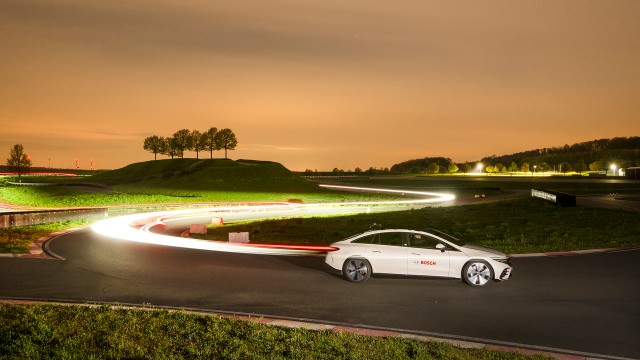
Bosch’s Vehicle Motion Management software makes it possible to control the vehicle movement in all six degrees of freedom by centrally controlling the brakes, steering, powertrain and chassis. This means the individual actuators can be better coordinated and used more efficiently. In the future, they even will be adjusted to the driver’s needs. Vehicle Motion Management can greatly reduce vehicle rolling movements in bends or pitching movements in stop-and-go traffic, which aim to prevent motion sickness – an important step on the way to autonomous driving.
On that topic, Bosch presents groundbreaking technology in the combination of sensor technology and AI with its new Radar Gen 7 Premium, which is celebrating its world premiere at CES in Las Vegas. The radar sensor improves driving assistance functions such as the freeway pilot. Thanks to its special antenna configuration, it enables maximum angular precision and a very long range. For example, the sensor detects very small objects such as pallets and car tires at a distance of over 200 meters. This enables it to precisely detect lost loads or other road users even in complex traffic situations and thus trigger a suitable driving maneuver.
E-bikes are also becoming safer than ever thanks to Bosch’s expertise in hardware and software: the eBike Flow app now has a new function that allows users to mark their e-bike or battery as stolen. This makes it more difficult for thieves to resell the e-bike or battery, because as soon as second-hand buyers, specialist dealers, or authorities attempt to connect to the e-bike via the eBike Flow app, they will receive a warning.
Unsung heroes of digitalization: MEMS sensors
No matter whether it’s a question of high-tech devices in cars, in industry, or at home: innovations rely on tiny sensors. At CES, Bosch is presenting its newest BMI5 AI MEMS sensor platform. All sensors developed on this basis are characterized by a high degree of precision, robustness and energy efficiency. They also have integrated AI functions that can recognize movements, positions and even contexts. One area in which these new motion sensors are used is in virtual and augmented reality applications. By tracking head movements precisely and with virtually no delay, they allow users to interact naturally in 3D environments. They also help robots recognize their surroundings and movements with high accuracy – for example, they show humanoid robots how to find the right path even when there is an object obscuring the camera lens.
Bosch cooperates with Microsoft on “Manufacturing Co-Intelligence®”
At CES® 2026 in Las Vegas, Bosch has now announced that it would be continuing its collaboration with Microsoft. Together with Microsoft, Bosch will expand its “Manufacturing Co-Intelligence®” offer, exploring advancements that have the potential to revolutionize production through the use of agentic artificial intelligence. The two companies will be signing a Memorandum of Understanding (MoU) in Las Vegas.
Agentic AI can interpret very large amounts of data, make largely autonomous decisions and execute tasks in order to optimize production, maintenance and supply chains. “It makes factory processes more intelligent,” says Tanja Rückert. This collaboration seeks to combine the deep industrial knowledge of Bosch in the production and industrial software sector with the leading IT infrastructure and software expertise of Microsoft. The two companies aim to make existing production processes scalable with AI-supported solutions so that factories are not only more efficient, but organizations can also relieve the burden on associates. For example, by detecting deviations in the production process at an early stage, downtimes can be minimized and production costs reduced. One of the first Bosch customers for “Manufacturing Co-Intelligence®” is Sick AG, a leading global manufacturer of sensors and sensor solutions for industrial applications.
Revolutionary pocket-sized protection against counterfeiting
Another CES highlight is Bosch’s innovative approach in the fight against counterfeit products. With Origify, Bosch presents a smart solution that gives products a digital DNA. This is a software ecosystem with a core technology for surface pattern recognition that verifies the authenticity of physical goods. Instead of relying on additional labels, chips, or codes, Origify analyzes the unique, non-replicable physical characteristics of a product’s surface and assigns it a tamperproof digital identity. Once registered in the system, the associated Detector app can enable fast and reliable verification: a live video stream of the object can be used to determine within seconds whether it is an original – or a fake.
Bosch in the U.S.: growth, investment and strong partnerships
The U.S. remains an important and strategic growth market for Bosch. “Our collaboration with Microsoft is a strong example of how we’re continuing to drive growth, investment and collaborations here in the U.S. – and it’s just one example among many,” Thomas says. In addition to its work with Microsoft, Bosch is driving forward numerous other initiatives in the U.S. market. That includes an agreement with Kodiak AI, a pioneer in the field of autonomous driving for trucks. Bosch and Kodiak AI are collaborating on vehicle-independent, redundant platforms for driverless trucks. Such a platform is a comprehensive system of specialized hardware and software that is integrated into standard trucks to give them autonomous driving capabilities. Bosch is supplying a variety of hardware components – including sensors and vehicle actuation components such as steering technologies – for these platforms. Bosch is also currently modernizing its silicon carbide wafer fab in Roseville, California. The aim is to strengthen the production of this essential technology for electromobility.
Bosch Tech Compass: AI is a driving force for the future
The Bosch Tech Compass, a survey of more than 11,000 people in seven countries worldwide, shows that the majority of people see AI as the most influential and most positive technology in the years ahead. A key finding is that enthusiasm for AI is growing worldwide, with 70 percent of respondents seeing it as crucial for the future. This positive attitude is accompanied by a simultaneous increase in progress fatigue. According to the Bosch survey, despite the high hopes placed in AI, there are also concerns about its negative social impact – no other technology is seen as such a potential threat to society. Overall, 57 percent would like to see a “pause button” to better understand the implications of technological development.